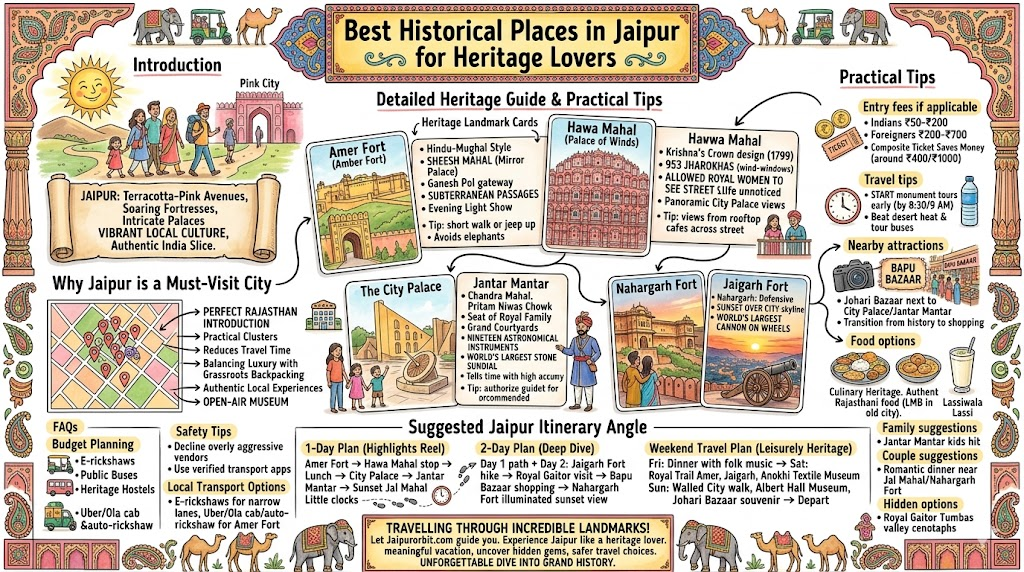
Introduction
Few cities in the world capture the imagination quite like Jaipur. Known globally as the Pink City, the capital of Rajasthan is a living, breathing testament to royal Indian history. For centuries, its striking terracotta-pink avenues, soaring fortresses, and intricate palaces have drawn curious souls from every corner of the earth.
But if you think Jaipur is a one-dimensional destination, think again. A complete Jaipur travel guide reveals a city that effortlessly satisfies every kind of traveler. Beyond the breathtaking architecture, it offers a vibrant mix of colorful local culture, peaceful landscapes, legendary culinary scenes, and unexpected outdoor adventures. Whether you are a solo backpacker looking for affordable stories, a couple seeking royal romance, or a family wanting an educational yet exciting holiday, Jaipur serves it all. It is a place where deep peace coexists with bustling bazaars, making it the ultimate destination for anyone seeking an authentic slice of India’s past.
Why Jaipur is a Must-Visit City
Jaipur is the perfect introduction to Rajasthan, specially designed on a geometric grid system that was centuries ahead of its time. It is highly practical for travelers because the major Jaipur tourist places are clustered beautifully, reducing unnecessary travel time.
The city effortlessly balances high-end luxury with grassroots backpacking. You can spend your afternoon exploring a rugged fort that has survived dozens of battles, your evening shopping for handcrafted block-print textiles, and your night dining on a rooftop overlooking a lit-up palace. It offers an incredible depth of local experiences without requiring you to trek to remote, inaccessible regions. For heritage lovers, it is nothing short of an open-air museum.
Detailed Heritage Guide & Practical Tips
Best places to visit
To truly appreciate Jaipur’s heritage, focus your energy on the core royal structures: Amer Fort, Hawa Mahal, City Palace, Jantar Mantar, Nahargarh Fort, and Jaigarh Fort.
Things to do
- Walk through the massive courtyards of the royals and hire a local certified guide to hear the hidden stories.
- Watch a sunset over the city skyline from the high ramparts of Nahargarh.
- Photograph the intricate wind-windows of Hawa Mahal from a street-side cafe.
Entry fees if applicable
Most major monuments charge between ₹50 to ₹200 for Indian nationals and ₹200 to ₹700 for international tourists.
Pro Tip: If you plan on visiting multiple spots over two days, buy the Composite Entry Ticket at your first stop. It costs around ₹400 for Indians and ₹1000 for foreigners, saving you significant money and queue time.
Travel tips
Always start your monument tours early in the morning (by 8:30 AM or 9:00 AM). This helps you beat both the intense desert heat and the heavy tour buses that arrive closer to midday.
Nearby attractions
Most historical monuments sit near bustling traditional markets. For example, City Palace and Jantar Mantar are right next to Johari Bazaar and Bapu Bazaar, making it easy to transition from history to shopping.
Food options
Do not skip the culinary heritage! Try authentic Rajasthani Dal Baati Churma at heritage restaurants like LMB (Laxmi Misthan Bhandar) in the old city, or grab a quick, refreshing Lassi at the famous Lassiwala on MI Road.
Budget planning
Jaipur is incredibly flexible. Budget backpackers can comfortably explore using public buses, e-rickshaws, and staying in heritage hostels for under ₹1,500 a day. Mid-range to luxury travelers can opt for private cabs and magnificent heritage hotel stays.
Safety tips
Jaipur is generally very safe for solo travelers and families. However, be cautious of overly aggressive street vendors or unofficial “guides” near monument entries. Politely but firmly decline their services if you are not interested.
Local transport options
E-rickshaws are the best way to navigate the narrow lanes of the walled city. For longer distances, like traveling out to Amer Fort, booking an app-based cab (Uber or Ola) or hiring an auto-rickshaw for the day is highly convenient.
Family-friendly suggestions
Jantar Mantar is an absolute hit with kids. The giant stone astronomical instruments look like a futuristic playground and offer a fantastic, interactive way to learn about science and history.
Couple-friendly suggestions
Plan an evening dinner near Jal Mahal or up at Nahargarh Fort. The glittering lights reflecting on the water and the sweeping views of the illuminated city create an incredibly romantic setting.
Hidden or less-crowded options
If you want to escape the crowds, head to the Royal Gaitor Tumbas. It is a beautifully peaceful valley containing the intricately carved stone cenotaphs of Jaipur’s past rulers, often completely bypassed by mass tourism.
Best Places or Experiences Related to the Walled City Heritage
1. Amer Fort (Amber Fort)
- Location: Amer Town, roughly 11 kilometers north of Jaipur’s main city center.
- Why it is worth visiting: This majestic fort combines Hindu and Mughal architectural styles, constructed from yellow and pink sandstone and white marble. The highlight is the Sheesh Mahal (Mirror Palace), where the ceilings and walls are entirely inlaid with glittering mirrors imported from Belgium centuries ago.
- Best things to do: Walk through the stunning Ganesh Pol gateway, explore the subterranean passages, and stay back for the evening Light and Sound Show that narrates the fort’s history.
- Best time to visit: Between October and March, early morning around 9:00 AM to avoid the heat.
- Ideal for whom: History buffs, architecture lovers, photography enthusiasts, and families.
- Travel tip: Avoid taking the elephant rides up to the fort due to animal welfare concerns; instead, enjoy the beautiful, short walk up the stone ramp or take a local jeep.
2. Hawa Mahal (The Palace of Winds)
- Location: Right in the heart of the walled Old City, Chayan Rasta.
- Why it is worth visiting: Built in 1799, this unique five-story structure resembles the crown of Lord Krishna. It features 953 small windows called jharokhas, decorated with incredible latticework. This design allowed royal women to witness everyday street life without being seen themselves.
- Best things to do: Climb to the top floor for a panoramic view of the City Palace and Jantar Mantar, and check out the small museum inside.
- Best time to visit: Early morning when the golden sunlight hits the front facade, making it glow.
- Ideal for whom: Photographers, solo travelers, and short-term weekend visitors.
- Travel tip: The best view of Hawa Mahal isn’t from its base, but from the rooftop cafes located directly across the street. Grab a coffee there for the ultimate photo angle.
3. The City Palace
- Location: Located centrally within the walled city, close to Hawa Mahal.
- Why it is worth visiting: This remains the seat of the royal family of Jaipur. It is a sweeping complex of grand courtyards, pavilions, and museums. The Pritam Niwas Chowk inside features four spectacular inner doorways, each representing a different season and dedicated to Hindu gods.
- Best things to do: Admire the world’s largest sterling silver vessels (Gangajalis), explore the royal clothing museum, and marvel at the architecture of the Chandra Mahal.
- Best time to visit: Late afternoon, around 3:30 PM, when the sun softens and the courtyards cast beautiful shadows.
- Ideal for whom: Couples, luxury travelers, and textile lovers.
- Travel tip: If you want an exclusive experience, you can buy a premium ticket that unlocks the private inner rooms of the palace, accompanied by a dedicated royal guide.
4. Jantar Mantar
- Location: Directly opposite the entry gates of the City Palace.
- Why it is worth visiting: A UNESCO World Heritage Site, this is a collection of nineteen architectural astronomical instruments built by King Sawai Jai Singh II. It houses the world’s largest stone sundial, which tells local time with an accuracy of just a few seconds.
- Best things to do: Track how shadows move to tell time, explore the geometric stone shapes, and understand ancient Indian astrology and astronomy.
- Best time to visit: Midday is actually excellent here, as the sun is directly overhead, allowing you to see exactly how the shadow instruments function.
- Ideal for whom: Backpackers, families with kids, and science geeks.
- Travel tip: The instruments look like abstract art unless you know how they work. Hiring an authorized guide here is highly recommended to make sense of the structures.
Travel Planning Tips for Jaipur
Book stays early during peak season
Jaipur’s winter months (November to February) draw massive crowds for festivals and heritage tourism. Secure your heritage hotels or boutique homestays at least two to three months in advance.
Rent scooters only with proper documents
Exploring the outskirts of Jaipur on a scooter is highly fun, but ensure you rent from licensed agencies and carry a valid driving license and helmet at all times.
Respect monument safety rules
Do not climb onto fragile, ancient railings or sit on high, unprotected fortress walls for photos. The drop-offs at places like Nahargarh Fort can be dangerous.
Avoid isolated heritage tracks late at night
While Jaipur’s main streets are bright and busy, avoid hiking down unlit trails around the old forts or hills after sunset.
Carry cash for local markets
While digital payments (like UPI) are common across India, small street vendors, rickshaw drivers, and traditional artisans in the old bazaars still strongly prefer cash transactions.
Check weather before outdoor activities
If you are planning an early morning hot air balloon ride or an open-top jeep safari through the historical plains, double-check weather forecasts for winter fog or summer storms.
Respect local culture and environment
Dress modestly when visiting active places of worship like the Birla Mandir or Galta Ji (Monkey Temple). Cover your shoulders and knees out of respect for local traditions.
Keep historical sites clean
Carry a reusable water bottle and avoid leaving any plastic waste behind inside monument complexes. Preserving these historic spots is a shared responsibility.
Common Mistakes to Avoid
- Trying to rush the city in a single day: Jaipur has too much depth for a quick stopover. Rushing results in monument fatigue and missing the true soul of the city.
- Visiting only the crowded spots: Tourists often cluster around the main courtyards of Amer Fort while missing peaceful gems like the Royal Gaitor or the Anokhi Museum of Hand Printing.
- Ignoring the outer geographic regions: Travelers often focus entirely on the walled central city (North Jaipur) and forget to explore the quieter craft villages and modern cultural spaces in the southern sectors.
- Not checking transport rates beforehand: Avoid getting into unmetered auto-rickshaws without agreeing on a fixed price first. Using ride-hailing apps provides a safe baseline price reference.
- Overpaying for souvenir rentals or items: Shops right outside monument exits charge premium prices. Walk a few blocks into the local markets for authentic goods at honest rates.
- Skipping the local street food heritage: Sticking exclusively to continental hotel buffets means missing out on legendary local treats like Pyaaz Kachori and sweet Ghewar.
Suggested Jaipur Itinerary Angle
Integrating these rich historical spaces into your Jaipur itinerary depends on how much time you have. Here is how you can structure your trip plan seamlessly:
1-Day Plan (The Highlights Reel)
- Morning: Arrive early at Amer Fort by 8:30 AM to beat the crowds.
- Midday: Head back into the old city for a photo stop outside Hawa Mahal, followed by a lunch of traditional thali.
- Afternoon: Explore the City Palace and the adjacent Jantar Mantar.
- Evening: Catch the sunset outside Jal Mahal (Water Palace).
2-Day Plan (The Deep Dive)
- Day 1: Follow the 1-day plan above to cover the core city icons.
- Day 2: Spend your morning hiking up to Jaigarh Fort to see the world’s largest cannon on wheels. Afternoon visit to the peaceful Royal Gaitor and shopping for local crafts in Bapu Bazaar. Spend your evening watching the city light up from the edge of Nahargarh Fort.
Weekend Travel Plan (The Leisurely Heritage Weekend)
- Friday Evening: Arrive and enjoy a traditional Rajasthani dinner with folk music at a heritage property.
- Saturday: Dedicated completely to the grand royal trail: Amer Fort, Jaigarh Fort, and a late afternoon visit to the Anokhi Textile Museum.
- Sunday: Explore the inner walled city on foot early in the morning, visit theAlbert Hall Museum, grab souvenirs from Johari Bazaar, and depart by evening.
FAQs
1. What is the best time to plan a trip to Jaipur?
The absolute best time for Jaipur trip planning is from October to March. The weather is pleasant and cool, making it ideal for walking around massive stone forts.
2. How many days are enough to see the historical places in Jaipur?
A 2 to 3-day itinerary is perfect. It gives you ample time to see the main forts, palaces, and markets without feeling exhausted.
3. Is Jaipur safe for solo female travelers?
Yes, Jaipur is a very popular tourist destination and generally safe. Stick to well-traveled areas, avoid isolated paths after dark, and use verified transport apps for peace of mind.
4. Can we enter inside the Jal Mahal?
No, entry inside the actual water palace is restricted to the public to preserve the structure. However, you can stroll along the scenic lakeside promenade to take photographs.
5. What should I buy while shopping in Jaipur’s heritage markets?
Look for authentic blue pottery, traditional block-printed textiles, silver jewelry, hand-woven carpets, and classic Rajasthani leather shoes (juttis).
6. Is Jaipur a good holiday choice for families with small kids?
Yes! Children love the giant instruments at Jantar Mantar, the expansive fort courtyards, and the opportunity to see traditional puppet shows.
7. What is the difference between Amer Fort, Jaigarh Fort, and Nahargarh Fort?
Amer was the luxurious residential palace of the royals. Jaigarh was the rugged military fort built to protect Amer. Nahargarh served as a strategic defense outpost offering sweeping views over the entire city.
8. Do I need to hire a guide at every monument?
It isn’t mandatory, but hiring government-authorized guides or using official audio guides at complex spots like Jantar Mantar and City Palace adds incredible context to your visit.
9. What is the local dress code for visiting Jaipur’s heritage sites?
There is no official dress code for forts, but modest clothing that covers shoulders and knees is highly recommended, especially if you cross path with smaller shrines inside the complexes.
10. How far is Amer Fort from the main city center?
It is about 11 kilometers away. It takes roughly 25 to 30 minutes to reach by car or auto-rickshaw from the old walled city.
Conclusion
Jaipur is far more than a simple pin on a tourist map; it is an unforgettable dive into India’s grand history. By slowing down, planning your routes smart, and looking past the generic tourist traps, you can experience the city like a true heritage lover.
Let Jaipurorbit.com be your trusted companion as you plan your next journey. Use our detailed guides to uncover hidden local treasures, make safer travel choices, and craft a meaningful vacation that stays with you long after the desert dust settles.
