Introduction
Jaipur, the magnificent capital of Rajasthan, is a city that captures your heart the moment you enter its historic gates. Often called the Pink City, it serves as a stunning showcase of India’s royal past, artistic brilliance, and timeless traditions. While first-time visitors frequently associate India’s top holiday destinations with beaches or nightlife, Jaipur proves that a truly soulful vacation is built on deep culture, grand architecture, street food adventures, and local heritage experiences.
At the literal and cultural heart of this city stands the iconic Hawa Mahal, or the “Palace of Winds.” Its breathtaking, beehive-like pink facade with 953 intricate windows is world-famous. But what happens after you have taken your perfect photograph of this architectural wonder?
Many travelers mistake the Hawa Mahal as a quick photo-stop, not realizing that the surrounding walled city area is packed with incredible palaces, ancient markets, hidden alleys, and rooftop views. This guide is crafted to help you discover the absolute best things to do near Hawa Mahal. Whether you are traveling as a family, a couple looking for romantic viewpoints, a solo backpacker, or a weekend explorer, this guide ensures you maximize every minute spent in Jaipur’s historic core.
Why Jaipur is a Must-Visit City
Jaipur is a masterclass in ancient urban planning mixed with living heritage. Founded in 1727 by Maharaja Sawai Jai Singh II, it stands out as a destination that perfectly balances royal grandeur with practical traveler accessibility.
- Architectural Marvels: From the scientific genius of Jantar Mantar to the sprawling courtyards of the City Palace, the city offers an incredible look into the luxurious lifestyles of the Rajput rulers.
- A Paradise for Shoppers: The historic bazaars surrounding the main monuments are globally renowned for traditional block-print textiles, blue pottery, and precious gemstones.
- Culinary Journeys: Jaipur’s food scene ranges from rich royal thalis to sizzling street-side kachoris that have tasted exactly the same for generations.
- Accessible Exploration: Unlike sprawling mega-cities, Jaipur’s primary historical zone is highly concentrated. This means you can experience world-class heritage sites, local markets, and traditional cafes all within walking distance of one another.
Best Places or Experiences
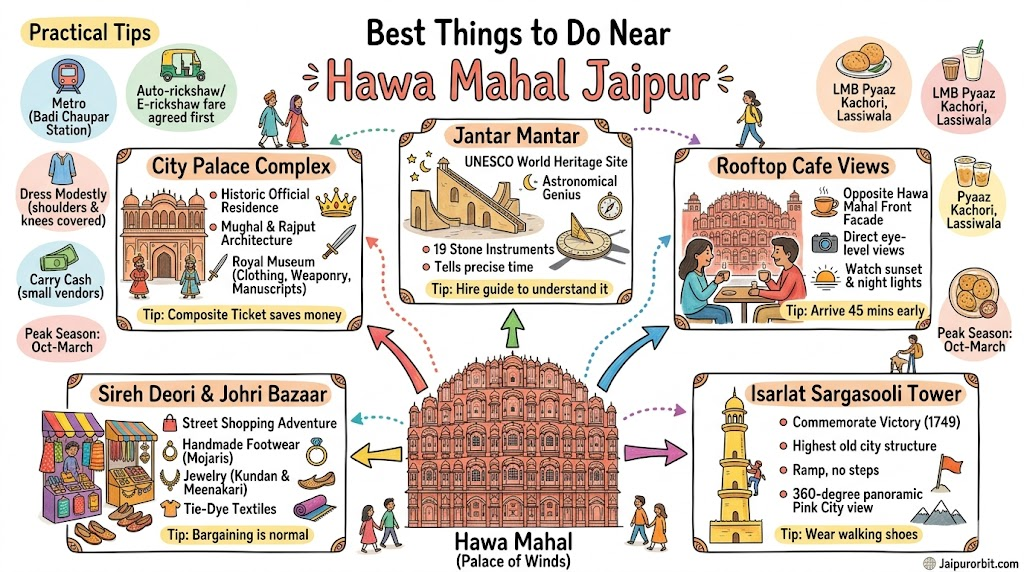
1. Explore the Historic City Palace Complex
Location
Located at Jalebi Chowk, exactly behind the Hawa Mahal (less than a 5-minute walk).
- Why it is worth visiting: The City Palace is a stunning blend of Mughal and Rajput architecture. It remains the official residence of Jaipur’s royal family, with a portion open to the public as a world-class museum showcasing royal clothing, weaponry, and rare manuscripts.
- Best things to do: Walk through the dazzling Pritam Niwas Chowk to admire the four intricately decorated gates representing the four seasons, visit the silver urns (the largest sterling silver vessels in the world) at the Diwan-i-Khas, and upgrade your ticket to tour the exclusive Chandra Mahal if you want a deeper look at royal luxury.
- Best time to visit: 9:30 AM right when it opens to avoid the heavy afternoon crowds.
- Ideal for whom: Families, history lovers, photography enthusiasts, and couples.
- Travel tip: Buy a Composite Ticket at the counter if you plan to visit multiple monuments over two days. It saves you a significant amount of money and helps you bypass individual ticket lines.
2. Witness Astronomical Genius at Jantar Mantar
Location
Situated right next to the entry gate of the City Palace, an easy 4-minute walk from Hawa Mahal.
- Why it is worth visiting: A UNESCO World Heritage Site, Jantar Mantar is a collection of 19 architectural astronomical instruments built in the early 18th century. It features the world’s largest stone sundial and is a living testament to ancient India’s scientific and mathematical intelligence.
- Best things to do: Watch how the shadow moves across the massive Vrihat Samrat Yantra to tell time with an accuracy of just two seconds. Explore the different geometric instruments designed to track stars and predict eclipses.
- Best time to visit: Late morning (11:00 AM to 1:00 PM) when the sun is directly overhead, making the shadows cast by the instruments sharp and easy to read.
- Ideal for whom: Curious kids, families, solo travelers, and architecture students.
- Travel tip: Hire an authorized, licensed guide at the entrance or use the official audio guide. Without an explanation of how these stone structures work, they will just look like abstract concrete sculptures.
3. Catch the Sunset from a Rooftop Cafe Opposite Hawa Mahal
Location
Directly across the street from the front facade of Hawa Mahal (e.g., Wind View Cafe or Tattoo Cafe).
- Why it is worth visiting: The front facade of Hawa Mahal faces a bustling street. To truly appreciate its scale and beauty without dodge-rolling through active traffic, you need to head upstairs. These rooftop spots offer a direct, unobstructed eye-level view of the palace.
- Best things to do: Order a cup of hot masala chai or a cold coffee, sit by the terrace edge, and watch the sunset light up the pink sandstone facade. It is also an incredible spot to watch the chaotic, vibrant street life of the Old City down below.
- Best time to visit: 4:30 PM to 6:00 PM to catch the golden hour and stay until they turn on the beautiful night lights illuminating the monument.
- Ideal for whom: Couples looking for a romantic view, solo backpackers, and Instagram photographers.
- Travel tip: These cafes get incredibly packed around sunset. Arrive at least 45 minutes early to secure a seat right along the edge of the terrace for the best view.
4. Go Street Shopping in Johri Bazaar and Sireh Deori Bazaar
Location
The historic market lanes stretching out directly from the foot of Hawa Mahal.
- Why it is worth visiting: This is the beating heart of Jaipur’s traditional trade. Sireh Deori Bazaar sits directly outside Hawa Mahal, while Johri Bazaar is world-famous for traditional jewelry, textiles, and handmade footwear.
- Best things to do: Shop for handmade Mojaris (leather shoes), explore rows of glittering Kundan and Meenakari jewelry, and purchase authentic tie-dye (Bandhani) sarees or block-printed linens.
- Best time to visit: Late afternoon (around 4:00 PM) when all the shops are fully open and the evening market energy begins to pick up.
- Ideal for whom: Backpackers, solo travelers, families, and avid shoppers.
- Travel tip: Bargaining is a normal part of the experience here. Start by politely offering about half of the initially quoted price and work your way up to a fair middle ground.
5. Climb the Isarlat Sargasooli Tower
Location
Aatish Market, Gangori Bazaar area, roughly a 7-to-8-minute walk from Hawa Mahal.
- Why it is worth visiting: Built in 1749 by Maharaja Ishwari Singh to commemorate a grand military victory, this historic 7-story yellow minaret is the highest historical structure in the old walled city.
- Best things to do: Walk up the circular, step-free ramp inside the tower to reach the top balcony. From there, you get an unparalleled 360-degree view of the entire Pink City, including clear sights of City Palace and the distant Nahargarh Fort.
- Best time to visit: Early morning or late afternoon when the desert sun is mild.
- Ideal for whom: Adventure lovers, solo travelers, and travelers looking for a less-crowded view.
- Travel tip: The climb involves an incline ramp rather than traditional steps, which can feel steep. Wear shoes with good grip and carry a bottle of water with you.
Detailed Travel & Experience Guidance
To make your exploration around the Pink City as smooth as possible, keep these practical points in mind:
- Entry Fees & Timings: Hawa Mahal is open daily from 9:00 AM to 5:00 PM. Individual entry tickets cost ₹50 for Indian nationals and ₹200 for foreign tourists. If you plan to visit Jantar Mantar, City Palace, and Nahargarh Fort, save money by purchasing a Composite Ticket at the counter.
- Food Options Near the Monument: For a legendary local breakfast, head to LMB (Laxmi Misthan Bhandar) in Johri Bazaar for their famous Pyaaz Kachori and massive Raj Kachori. If you want a quick, clean western bite with great views, stick to the rooftop cafes directly facing Hawa Mahal.
- Local Transport Options: The easiest way to reach the old city is via the Jaipur Metro (Pink Line), getting off at the Badi Chaupar Station, which exits right next to Hawa Mahal. For moving between closer lanes, hop onto an e-rickshaw or a traditional auto-rickshaw. Always agree on the fare before sitting down.
- Budget Planning: Exploring the monuments themselves is very affordable. Allocate around ₹500–₹1,500 per day for monument entry fees, local transport, and classic street food. Keep a separate, flexible budget for high-quality textiles or jewelry.
- Safety & Crowds: The area around Hawa Mahal is highly crowded and chaotic. Keep a close eye on your personal belongings in busy market lanes. If you are looking for a hidden, less-crowded option nearby, walk over to the serene Gatore Ki Chhatriyan royal cenotaphs, which sit peacefully just 2 kilometers away at the foothills of Nahargarh.
Travel Planning Tips for Jaipur
Book Stays Early During Peak Season
The prime time to visit Jaipur is between October and March when the weather is pleasant. Heritage hotels, boutique guesthouses, and popular hostels fill up months in advance, so lock in your bookings early.
Rent Scooters Only with Proper Documents
Two-wheelers are a fun way to navigate Jaipur’s outer roads, but always ensure you carry a valid driving license. Wear a helmet at all times—local traffic police are strict, and the Old City traffic can be incredibly overwhelming for an inexperienced rider.
Respect Local Heritage Sites
Do not touch, scratch, or write on ancient stone walls inside monuments. These historic structures are centuries old, and keeping them clean ensures they stay preserved for generations to come.
Carry Cash for Local Markets
While digital payments (like UPI) are common across India, small street vendors, rickshaw drivers, and traditional market stalls around Hawa Mahal still heavily prefer physical cash. Always keep small bills (₹20, ₹50, and ₹100 notes) handy.
Dress Appropriately for the Culture
Jaipur is a traditional heritage city. When exploring the historic streets, local markets, and temples near Hawa Mahal, it is highly recommended to wear clothing that covers your shoulders and knees out of respect for local customs.
Common Mistakes to Avoid
- Rushing the Walled City in an Hour: Many tourists simply jump out of a cab, take a 5-minute photo of the front of Hawa Mahal, and leave. You miss out on the incredible history, the inner museum courtyard, and the historic markets by rushing.
- Overpaying for Rickshaws and Guides: Always look for government-approved tourist guides with official ID cards. For auto-rickshaws, ask your hotel staff beforehand what a fair rate to the Old City should be so you don’t pay double.
- Skipping the Real Street Food: Don’t eat all your meals inside closed hotel dining rooms. Jaipur’s culinary soul lives in its street food lanes. Trying fresh lassi out of a clay cup (kulhad) at Lassiwala or hot kachoris near the bazaar is an essential part of the journey.
- Forgetting Comfort on Sightseeing Days: The pathways around Jantar Mantar and the ramps inside Hawa Mahal require a lot of walking on old stone floors. Do not wear heels or uncomfortable formal shoes; stick to high-quality walking shoes or sneakers.
Suggested Jaipur Itinerary Angle
Here is how you can seamlessly weave the experiences around Hawa Mahal into your overall Jaipur travel guide itinerary.
1-Day Plan (The Highlights Express)
- Morning (9:00 AM): Arrive early at Hawa Mahal to tour the interior rooms and museum before the crowds hit.
- Late Morning (10:30 AM): Walk over to the City Palace and explore the royal courtyards.
- Lunch (1:00 PM): Grab a traditional Rajasthani lunch at LMB in Johri Bazaar.
- Afternoon (2:30 PM): Explore the astronomical instruments at Jantar Mantar.
- Evening (5:00 PM): Relax at a rooftop cafe directly across from Hawa Mahal to watch the monument light up at dusk.
2-Day Plan (Deep Heritage & Forts)
- Day 1: Follow the 1-day plan above to fully cover the historic walled city core.
- Day 2: Head out of the city center to explore the massive Amer Fort, look at the beautiful Jal Mahal (Water Palace) on the way back, and catch a panoramic sunset over the entire city from the ramparts of Nahargarh Fort.
Weekend Travel Plan (The Complete Experience)
- Friday Evening: Arrive in Jaipur, check into a beautiful heritage property, and head to Chokhi Dhani for an immersive cultural village dinner.
- Saturday: Spend your entire day exploring the monuments and shopping bazaars centered around Hawa Mahal, finishing with a sunset climb up Isarlat tower.
- Sunday: Visit the Albert Hall Museum in the morning, do some last-minute handicraft shopping at Bapu Bazaar, and catch your evening flight or train back home.
FAQs
1. What is the best time to photograph Hawa Mahal?
The best time is early morning between 8:00 AM and 9:30 AM. The building faces east, so the morning sunlight hits the pink and red sandstone facade directly, making it glow beautifully.
2. Can you go inside the Hawa Mahal?
Yes! While most people only look at the famous front facade from the street, there is a regular entrance located at the back of the building that lets you explore the interior courtyards, narrow passages, and the museum.
3. Are City Palace and Jantar Mantar within walking distance of Hawa Mahal?
Absolutely. Both attractions are situated right next to each other and are less than a 5-minute walk from the rear exit of Hawa Mahal.
4. How much time do I need to explore the things near Hawa Mahal?
To comfortably visit Hawa Mahal, City Palace, Jantar Mantar, and do a little bit of market shopping, you should dedicate at least one full day (around 6 to 7 hours).
5. What is a Composite Ticket in Jaipur?
It is a single entry ticket sold by the Rajasthan Tourism department that grants you access to multiple major monuments—including Hawa Mahal, Amber Fort, Jantar Mantar, and Nahargarh Fort—over a 2-day period at a heavily discounted rate.
6. Where can I find the best view of Hawa Mahal?
The rooftop cafes located directly across the main road (such as Wind View Cafe and Tattoo Cafe) offer the best elevated, eye-level views of the palace facade.
7. Is the area around Hawa Mahal family-friendly?
Yes, it is very family-friendly. Children love looking at the massive sundials at Jantar Mantar and exploring the weapons rooms inside the City Palace museum. Just hold small hands tightly in the crowded bazaar areas.
8. Is parking easily available near Hawa Mahal?
No. The Old City lanes are narrow, highly congested, and parking space for private cars is extremely limited. It is much smarter to take the metro to Badi Chaupar or use an auto-rickshaw.
9. What should I buy from the markets near Hawa Mahal?
Look for traditional leather slippers (mojaris), block-printed cotton bedsheets, Jaipuri quilts, lac bangles, and silver ethnic jewelry.
10. Is it safe for solo female travelers to explore the Old City at night?
Yes, the main monument areas and major bazaars are well-lit and remain highly active with locals and tourists until around 9:00 PM. As with any busy destination, stay aware of your surroundings and use registered cabs or metros for late-night transit.
Conclusion
Hawa Mahal is undeniably the visual anchor of Jaipur, but the true magic of the Pink City unfolds when you step beyond its historic shadow. By taking the time to explore the grand palaces, scientific wonders, historic towers, and vibrant street markets sitting right at its doorstep, you transform a simple photo-stop into an unforgettable travel experience.
When planning your next big adventure to Rajasthan, use Jaipurorbit.com as your trusted local travel guide. We are dedicated to uncovering local hidden spots, providing real-world safety tips, and offering practical planning advice to help you make smarter travel decisions. Explore Jaipur with curiosity, dive into its local flavors, and let the historic lanes tell you their stories.
