Introduction
Most modern travelers chasing winter getaways find themselves funneled into synthetic, manufactured resort enclaves or overcrowded coastal hubs where globalized sameness has replaced local identity. Escaping that cycle demands a destination anchored in unapologetic architectural majesty, deep-seated ancestral traditions, and an atmospheric rhythm that slows your pulse.
When cold mists roll across the rugged Aravalli ridges, Jaipur discards its blistering desert glare and awakens with crisp, crystalline air, sun-warmed courtyards, and the faint fragrance of woodsmoke and crushed cardamom. Winter transforms Rajasthan’s historic capital into a sensory masterclass, where centuries of royal Rajput governance, Persian aesthetic mastery, and kinetic bazaar commerce greet travelers seeking genuine substance over algorithmic tourism.
Why Jaipur is a must-visit city
Jaipur is not merely an urban stopover; it is an epochal design manifesto. Established in 1727 by the visionary astronomer-king Maharaja Sawai Jai Singh II, it stands as India’s first planned grid-pattern city, built according to the classical cosmic principles of Vastu Shastra. The city’s geographical placement nestled against the ancient, weathered folds of the Aravalli Hills provided tactical military defense, which in turn fostered undisturbed artisanal guilds, royal patronage systems, and sprawling palace-fort complexes that remain intact today.
Strategically linked to New Delhi and Agra via the historic Golden Triangle, Jaipur offers world-class accessibility for every traveler archetype. High-speed expressways (NE4), an international airport (JAI) operating daily direct domestic and foreign flights, and heritage rail services like the Shatabdi Express seamlessly connect the metropolis to broader regional corridors. Whether you are an independent solo wanderer traversing by foot, a couple seeking heritage luxury, or a family exploring generational craftsmanship, Jaipur delivers a complete infrastructure of boutique havelis, luxury heritage resorts, and navigable urban lanes.
The regional travel circuit flows naturally from the fortified northern hill passes down into the walled, terracotta-pink core, extending outward into vibrant suburban craft communities. In the cooler months, this entire circuit thrives outdoors, making full-day walking expeditions not just tolerable, but profoundly invigorating.
| Fact / Metric | Specification |
| State & Zone | Rajasthan, Northern India (Golden Triangle Circuit) |
| Winter Temperatures | 8°C (Night) to 24°C (Day) |
| Primary Transit Hubs | Jaipur International Airport (Sanganer), Jaipur Junction (JP) |
| Urban Planning Principle | Nine-square grid derived from Vedic Vastu Shastra |
| UNESCO World Heritage Status | The Walled Pink City Core (2019) & Jantar Mantar (2010) |
| Peak Cultural Events | Jaipur Literature Festival, Kite Festival (Makar Sankranti) |
Best Places or Experiences
Amer Fort and Palace
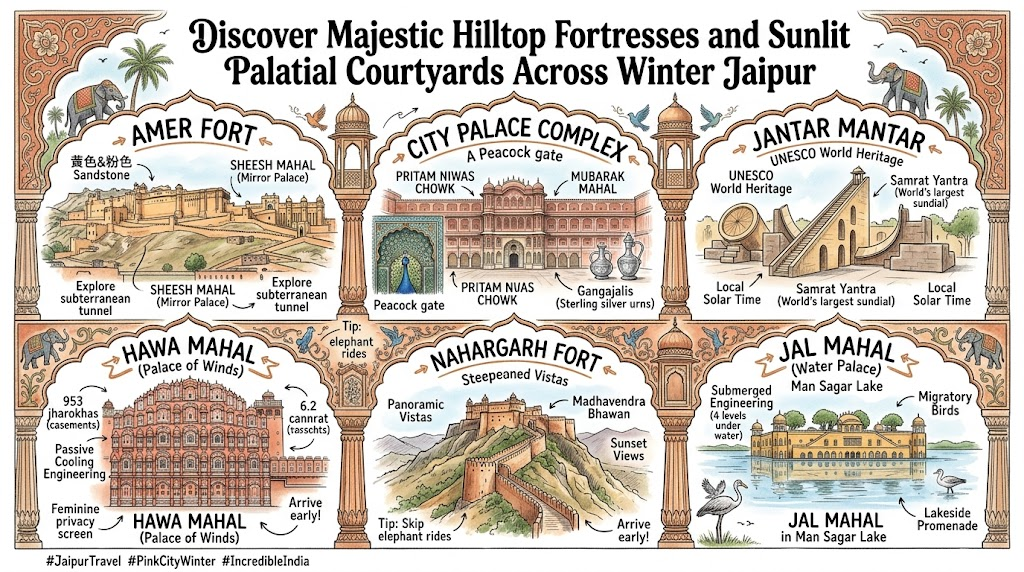
Rising dramatically above the dark waters of Maota Lake, Amer Fort is a spellbinding convergence of Hindu Rajput chivalry and Mughal opulence. Constructed primarily from rich yellow and pink sandstone by Raja Man Singh I in the late 16th century, its defensive battlements snake up precipitous hillsides, enclosing a succession of terraced palaces, open parade courtyards, and private royal sanctums. In the cool winter months, walking up the ramparts offers expansive vistas of ancient water channels and surrounding watchtowers draped in morning fog.
The interior palace houses the legendary Sheesh Mahal (Mirror Palace), where ceilings and walls are embellished with hand-cut Belgian concave mirrors set into floral plasterwork. Royal legends recount how a solitary candle flickered into thousands of stars across the ceiling to keep the queen warm on frosty desert evenings. Moving deeper reveals the Zenana (women’s quarters), designed with singular acoustic mastery to allow private, compartmentalized movement across inner rooms.
- Location: Devising the Amer Sector, 11 km north of the Jaipur city center.
- Why it is worth visiting: Unrivaled scale of Rajput military architecture combined with the breathtaking artistry of the Sheesh Mahal.
- Best things to do: Explore the subterranean underground tunnel linking Amer to Jaigarh Fort; inspect the marble relief carvings at Jas Mandir; witness the evocative evening Sound and Light Show in the central Kesar Kyari garden.
- Best time to visit: Arrive at 08:00 AM sharp to capture soft, golden-hour morning light and beat the tour bus arrivals.
- Ideal for whom: History enthusiasts, architectural purists, and passionate cultural photographers.
- Travel tip: Skip the contentious elephant rides; ascend via the stone pedestrian pathway or take an authorized electric jeep to the upper Suraj Pol gate.
City Palace Complex
Situated at the direct geographical nucleus of the walled city, the City Palace remains the living, breathing ceremonial home of Jaipur’s royal lineage. Founded concurrently with the city in 1727, this monumental complex bridges classic Mughal and Rajput structural philosophies through a series of pillared arcades, carved marble gates, and expansive paved courtyards. The pale pink, ochre, and deep crimson color palettes glow brilliantly under the soft winter sun.
Inside, the Mubarak Mahal—a fusion of Islamic, Rajput, and European architectural vocabularies—stands as a striking multi-tiered welcome pavilion carved from delicate cream marble. Within the central courtyard (Pritam Niwas Chowk), four ornate doorways represent the four seasons and Hindu deities, including the iconic, masterfully enameled Peacock Gate that symbolizes the vibrant energy of autumn.
- Location: J.D.A. Market, Pink City, central urban core.
- Why it is worth visiting: It offers an intimate, unfiltered look into continuous royal heritage, housing living descendants, sacred armories, and personal royal archives.
- Best things to do: Stand before the massive Gangajalis (guinness-record sterling silver urns used to carry sacred Ganges water across oceans); examine ceremonial flintlock rifles in the Sileh Khana armor gallery; book a private museum ticket to access the legendary blue-walled Sukh Niwas.
- Best time to visit: Mid-afternoon between 02:00 PM and 04:30 PM, when the sun illuminates the enameled peacock gateways.
- Ideal for whom: Cultural heritage seekers, luxury tourists, and design aficionados.
- Travel tip: Purchase a combined composite ticket at the entry counter to save significantly across royal palace galleries and adjacent monuments.
Jantar Mantar
Directly adjacent to the City Palace stands Jantar Mantar, the world’s most monumental stone astronomical observatory. Built by Maharaja Sawai Jai Singh II between 1728 and 1734, this UNESCO World Heritage marvel features nineteen colossal stone, marble, and brass instruments designed to observe astronomical positions with the naked eye. Far from being archaic artifacts, these geometric sculptures represent the pinnacle of medieval scientific observation.
The centerpiece is the Vrihat Samrat Yantra, the world’s largest stone sundial, rising over 27 meters into the sky. Its sweeping triangular gnomon casts a massive shadow that shifts visibly across marble calibrations at the rate of one millimeter per second, measuring local solar time to an accuracy of approximately two seconds. Walking through this forest of modernist-looking curves and angles provides a profound intellectual encounter with pre-modern celestial mathematics.
- Location: Gangori Bazar, Pink City, mere walking distance from City Palace.
- Why it is worth visiting: The world’s largest collection of stone astronomical instruments, where medieval architecture meets precise orbital physics.
- Best things to do: Track real-time solar movement on the face of the Samrat Yantra; decipher your celestial constellation at the circular Rashivalaya yantras; climb the viewing balconies to grasp the mathematical layout of the grounds.
- Best time to visit: High noon (11:30 AM to 01:30 PM), when the overhead winter sun casts distinct, sharp shadows across the astronomical scales.
- Ideal for whom: Scientific minds, astronomy enthusiasts, and structural photographers.
- Travel tip: Hiring a government-certified astronomical guide at the main gate is essential to comprehend how the instruments function.
Hawa Mahal (The Palace of Winds)
Hawa Mahal is Jaipur’s most instantly recognizable architectural signature, yet its interior remains thoroughly misunderstood by passersby. Commissioned in 1799 by Maharaja Sawai Pratap Singh and designed by Lal Chand Ustad, this five-story pyramidal facade was built from blushing red and pink sandstone to mimic the crown of Lord Krishna. Its honeycombed face is pierced with 953 meticulously carved jharokhas (casements) that channel natural breezes through cooling Venturi drafts.
The monument was not built as a residential palace, but rather as an elevated, private screen for the royal women of the court. Hidden behind delicately pierced stone latticework, queens and handmaidens could observe religious street processions, everyday bazaar exchanges, and public festivals below without violating strict purdah (seclusion) customs. Inside, narrow, stairless ramps ascend to miniature stained-glass chambers that wash the upper floors in kaleidoscopic hues.
- Location: Badi Chaupar, Hawa Mahal Road, Walled City.
- Why it is worth visiting: A masterstroke of passive cooling engineering and feminine architectural privacy that anchors the urban streetscape.
- Best things to do: Climb through the interior ramps to reach the highest observation balcony overlooking Jantar Mantar; observe sunlight filtering through vintage Belgian colored glass; view the facade from an open street-level cafe terrace across the road.
- Best time to visit: Sunrise (06:45 AM to 08:00 AM) when morning rays ignite the east-facing pink sandstone in brilliant coral light.
- Ideal for whom: Solo backpackers, photographers, and lovers of vernacular design.
- Travel tip: Most travelers only view the outer street facade; pay the modest entrance fee at the rear gate to walk through the peaceful interior courtyards.
Nahargarh Fort
Perched menacingly along the sheer edge of the Aravalli Hills, Nahargarh (meaning “Abode of Tigers”) was constructed in 1734 by Sawai Jai Singh II as a strategic defensive retreat. While Amer was opulent and celebratory, Nahargarh was designed to project absolute artillery dominion over the plains below. The fort’s long, winding stone curtain walls cling to craggy ridges, framing an awe-inspiring, unobstructed panoramic view of the entire Jaipur city basin.
The architectural centerpiece inside is the Madhavendra Bhawan, built by Sawai Madho Singh. This two-story pleasure pavilion features nine identical suites created for the king’s nine queens, linked by open corridors and painted with delicate floral murals. Ingeniously, the king’s private master suite connected to all nine apartments via secluded inner passages, allowing him to visit any queen without the knowledge of the others.
- Location: Krishna Nagar, Brahampuri, atop the northern Aravalli Ridge.
- Why it is worth visiting: The definitive vantage point for sweeping vistas of the urban landscape and dramatic desert sunsets.
- Best things to do: Walk the wide parapets that overlook the pink grid of the old city; tour the historic stepwells (baoris) carved into the solid rock inside the fort; visit the royal wax museum housed within the palace walls.
- Best time to visit: Late afternoon (04:00 PM to 06:30 PM) to watch the city lights flicker on as the sun dips beneath the horizon.
- Ideal for whom: Sunset chasers, panoramic photographers, and road-trip enthusiasts.
- Travel tip: The steep, winding ghat road up the mountain is hazardous after dusk; book a reliable round-trip vehicle rather than attempting to catch a return cab from the summit.
Jal Mahal (Water Palace)
Floating serenely in the middle of Man Sagar Lake, Jal Mahal is an astonishing example of submerged structural engineering. Built in the mid-18th century as a royal duck-hunting lodge and summer retreat, the palace was constructed out of dense pink sandstone. Though only a single grand story with ornate chhatris is visible above the surface, four full levels of the palace remain completely submerged beneath the lake’s waters, held secure by water-tight lime mortar that has resisted hydrostatic pressure for centuries.
While public entry into the interior palace is restricted to protect the fragile structural masonry, winter brings cool breezes, flocks of migratory Eurasian waterbirds, and tranquil pathways along the restored lakeside promenade. The palace illuminated against the dark water beneath an evening sky is one of Jaipur’s most striking tableaus.
- Location: Amer Road, roughly 4 km north of the city center.
- Why it is worth visiting: A unique water-borne pleasure pavilion framed against a backdrop of barren mountain slopes.
- Best things to do: Stroll along the paved lakeside promenade during twilight; spot migratory flamingos, pintails, and pelicans through binoculars; sample authentic street snacks from regulated lakeside food carts.
- Best time to visit: Twilight between 05:30 PM and 07:00 PM, when dynamic floodlights illuminate the palace facade against the lake.
- Ideal for whom: Couples, casual strollers, and bird-watching enthusiasts.
- Travel tip: Never pay unauthorized local boatmen claiming they can secretly ferry you to the island; private boat approaches to the structure are strictly prohibited.
Offbeat Exploration: Hidden Gems Tourists Miss
Gaitore Ki Chhatriyan
Tucked away in a quiet, secluded valley beneath the ramparts of Nahargarh Fort lies the royal crematorium of the Kachwaha Rajput rulers. Gaitore is a breathtaking complex of open marble and sandstone chhatris (cenotaphs), each meticulously carved with historical war campaigns, elephant processions, and mythological pantheons.
Unlike the crowded corridors of City Palace, Gaitore receives only a trickle of discerning travelers, allowing you to walk through white marble cupolas in profound silence, accompanied only by the calls of wild peacocks.
Panna Meena Ka Kund
Hidden just behind the shadow of Amer Fort lies this exceptional 16th-century stepwell. Constructed as both a communal gathering space and a critical rainwater harvesting system, Panna Meena Ka Kund is an optical masterpiece of crisscrossing, symmetrical geometric steps that descend down to a recessed reservoir.
The play of morning shadows against the ochre-washed plaster steps provides an extraordinary visual rhythm that outshines commercial tourist sites.
Galta Ji (The Sun Temple and Monkey Valley)
Nestled deep within a narrow mountain gorge on the eastern outskirts of the city, Galta Ji is an ancient Hindu pilgrimage site centered around natural mountain springs that fill seven sacred stone tanks (kunds).
Fringed by rugged cliffs and populated by large troops of rhesus macaques, the complex features pavilion walls painted with vintage religious frescoes. Hiking up the rocky switchback trail to the dramatic Surya Mandir at the crest rewards you with expansive vistas across the eastern plains.
Detailed Practical Guidance for Travelers
| Destination | Standard Entry Fee | General Timings | Best Local Food Options Nearby | Recommended Nearby Attractions |
| Amer Fort | ₹100 (Indians), ₹550 (Foreigners) | 08:00 AM – 05:30 PM, 06:30 PM – 09:15 PM | 1135 AD (Royal Dining inside fort), Jagat Shiromani temple stalls | Jaigarh Fort, Panna Meena Ka Kund, Anokhi Museum |
| City Palace | ₹300 (Indians), ₹1000 (Foreigners) | 09:30 AM – 05:00 PM, 07:00 PM – 10:00 PM | Laxmi Mishthan Bhandar (LMB) for traditional Ghewar | Jantar Mantar, Hawa Mahal, Johari Bazaar |
| Jantar Mantar | ₹50 (Indians), ₹200 (Foreigners) | 09:00 AM – 05:00 PM | The Tattoo Cafe (Rooftop coffee overlooking bazaars) | City Palace, Govind Dev Ji Temple |
| Hawa Mahal | ₹50 (Indians), ₹200 (Foreigners) | 09:00 AM – 05:00 PM | Wind View Cafe (Street-level snacks and chai) | Bapu Bazaar, Tripolia Bazaar, Sireh Deori |
| Nahargarh Fort | ₹50 (Indians), ₹200 (Foreigners) | 10:00 AM – 05:30 PM | Padao Open Air Restaurant (Sunset beverages inside fort) | Jaigarh Fort, Charan Mandir, Royal Gaitore |
| Jal Mahal | Free (Exterior viewing only) | Open 24 Hours (Promenade accessible all day) | Local roasted corn (bhutta) and masala tea along promenade | Kanak Vrindavan Gardens, Amer Road craft hubs |
Logistics & On-Ground Navigation
Local Transport Options
- Metro Rail: The Jaipur Metro currently operates an elevated and underground east-west line connecting the suburban Mansarovar residential hub directly to Badi Chaupar inside the walled city, making it an exceptional way to bypass traffic jams.
- Auto-Rickshaws & E-Rickshaws: Green e-rickshaws dominate the interior lanes of the walled city, offering inexpensive, eco-friendly transit through narrow shopping alleys. Always confirm pricing before stepping in.
- App-Based Taxis: Uber and Ola operate extensively throughout the wider city, providing reliable, fixed-rate transport for trips to Amer, Nahargarh, and Sanganer.
- Car Rentals with Chauffeur: For comprehensive day trips covering the outlying forts, hiring an air-conditioned car and driver for an 8-hour, 80-kilometer block is the most seamless and comfortable strategy.
Budget Planning
- Budget / Backpacking Tier: Expect to spend ₹1,800 to ₹3,000 per day. This covers a bed in a top-rated traveler hostel (e.g., Zostel, Moustache), street-food dining (kachoris, thalis), public transit via the metro and e-rickshaws, and entry fees with an official student ID.
- Mid-Range / Comfort Tier: Expect to spend ₹6,500 to ₹12,000 per day. This provides an authentic room in a restored heritage haveli (e.g., Alsisar Haveli, Mandawa Haveli), comfortable private taxis for daily transit, sit-down dinners at specialty Rajasthani restaurants, and professional monument guide services.
Safety and Inclusivity Tips
- For Families: Stick to well-paved palace courtyards, keep small children close along the steep, unbarricaded edges of Nahargarh Fort, and rely on private taxis to avoid the chaotic traffic of the older bazaars.
- For Couples: Jaipur is welcoming and safe for traveling couples. Historic rooftop cafes around the Pink City and evening light walks along Amber’s Maota Lake offer comfortable, relaxed spaces.
- General Safety: Beware of gem and textile scams. Touts and aggressive auto drivers may insist on guiding you to “government-approved emporiums” where prices are wildly inflated. Politely decline and book your own transportation.
Strategic Travel Planning Guardrails
Travel Planning Tips for Jaipur
- Secure Peak Winter Bookings Months in Advance: Winter is high season; boutique havelis and heritage properties book out months ahead, particularly around Christmas, New Year, and the annual January Jaipur Literature Festival.
- Carry a Hybrid Payment Mix: While UPI and credit cards are widely accepted at established monuments and upscale cafes, small cash notes (₹50, ₹100) are indispensable for temple offerings, street vendors, and e-rickshaws.
- Pack Adaptable Clothing Layers: Desert winters bring sharp temperature swings. You will need a warm woolen fleece or light down jacket for brisk 8°C mornings, transitioning to breathable cottons as the sun hits 24°C in the afternoon.
- Invest in the Composite Entry Pass: The Rajasthan Tourism Department sells a composite ticket valid for two consecutive days covering Amer Fort, Hawa Mahal, Jantar Mantar, Nahargarh Fort, and Albert Hall, saving substantial time spent waiting in ticket queues.
- Respect Sacred Site Etiquette: When visiting active sites like Govind Dev Ji Temple or Galta Ji, dress conservatively (covering shoulders and knees), remove leather belts and shoes at the gate, and always ask permission before taking portraits of devotees.
Common Mistakes to Avoid
- Do Not Pack an Exclusively Summer Wardrobe: Many visitors wrongly assume Rajasthan is blisteringly hot year-round and end up freezing during evening desert winds and unheated historic haveli nights.
- Avoid Hurrying Through Too Many Monuments in One Day: Packing Amer, City Palace, Nahargarh, and three bazaars into a single 8-hour window leads to historical fatigue and exhaustion.
- Do Not Hire Unofficial Street Guides: Use only guides carrying official identification issued by the Department of Tourism, available directly at monument ticket kiosks.
- Never Ignore Road Safety on Fort Hills: The winding roads up to Nahargarh and Jaigarh have sharp drop-offs and tight hairpin turns; avoid driving rented two-wheelers up after dark.
- Do Not Dismiss Local Street Snacks: Refusing street-level vendors out of health anxiety often means missing out on the culinary heartbeat of the city; prioritize busy stalls with high customer turnover and freshly cooked food.
Suggested Itinerary Blueprints
Day Quick Dash (Express Heritage Circuit)
- Target Audience: Business travelers, short weekenders, or Golden Triangle sprint travelers.
- Morning: Begin early at 07:30 AM at Hawa Mahal to capture the morning light, followed immediately by a self-guided exploration of City Palace and Jantar Mantar.
- Afternoon: Head north to Amer Fort by 01:30 PM; spend three hours walking its palatial courtyards and Sheesh Mahal.
- Evening: Return past Jal Mahal for twilight photos, finishing the night with a lavish Rajasthani thali dinner on MI Road.
Day Deep-Dive (Palaces, Forts & Living Culture)
- Day 1 (The Walled City Core): Dedicate the morning to Hawa Mahal, Jantar Mantar, and City Palace. In the afternoon, explore the artisan lanes of Bapu Bazaar and Johari Bazaar, stopping for hot pyaaz kachoris. Complete the evening with the Aarti ceremony at Govind Dev Ji Temple.
- Day 2 (The Northern Fortresses): Spend the morning immersed in Amer Fort and descend into Panna Meena Ka Kund. In the afternoon, ascend the hills to explore the cannon foundries of Jaigarh Fort, heading to Nahargarh Fort by 04:30 PM for sunset drinks overlooking the glowing city below.
Complete Weekend Travel Plan (The Grand Pink City Immersion)
- Friday Evening: Arrive, check into an atmospheric heritage haveli, and enjoy a warm pot of masala chai on an open terrace, followed by an evening walk through illuminated markets.
- Saturday (Fortress Majesty & Scenic Heights): Begin at 08:00 AM exploring the depths of Amer Fort. Walk through the secluded valley of Gaitore Ki Chhatriyan at midday. In the late afternoon, drive up the Aravallis for an unforgettable sunset at Nahargarh Fort, followed by an open-air dinner.
- Sunday (Science, Palaces, and Craft Guilds): Devote the morning to the astronomical wonders of Jantar Mantar and the interior chambers of City Palace. After lunch, spend a peaceful afternoon visiting the hidden Anokhi Museum of Hand Printing near Amer, picking up authentic block-printed textiles and blue pottery before your departure.
Common Tourist Mistakes to Avoid
Geographic Blunders
A frequent logistical failure is attempting to visit Amer Fort in the morning, driving south to central Albert Hall Museum for lunch, and then attempting to return north to Nahargarh Fort for sunset. Group your itinerary geographically: explore the northern fort cluster (Amer, Jaigarh, Panna Meena, Jal Mahal) on one day, and keep the walled city core (City Palace, Hawa Mahal, Jantar Mantar, inner bazaars) for a separate day to avoid spending hours trapped in heavy regional traffic.
Commercial Traps
Many visitors spend their limited shopping hours wandering through modern, air-conditioned commercial shopping malls along Tonk Road that look identical to malls anywhere in the world. Real cultural commerce lives in the specialized, historic alleyways of the Pink City: Kishanpole Bazaar for wooden furniture, Johari Bazaar for certified precious gemstones and Kundan jewelry, and Maniharon Ka Rasta for traditional lac bangles hand-shaped over charcoal braziers.
Neglecting Modern/Alternative Zones
While the walled city holds historic majesty, visiting only the old core misses the vibrant contemporary renaissance flourishing across Jaipur’s modern neighborhoods. Districts like C-Scheme and Civil Lines feature tranquil residential avenues filled with world-class indie coffee roasters, design studios, contemporary art galleries, and modern fusion restaurants that reimagine Rajasthani ingredients for the modern palate.
Transport Overpayment
Unsuspecting travelers walking out of railway stations or tourist sites frequently fall victim to auto-rickshaw drivers demanding four times the fair rate. Always politely insist on using the meter, or use ride-hailing apps like Uber or Ola to establish a realistic baseline fare before bargaining with local drivers on the street.
Luxury Dining Bias
Confining your meals solely to high-end, continental hotel dining rooms deprives you of Jaipur’s culinary soul. The true flavors of the desert thrive in street-level, high-turnover institutions: tearing into a steaming, crisp Pyaaz Kachori at Rawat Mishthan Bhandar, drinking thick, creamy lassi poured into disposable terracotta kulhads at Lassiwala on MI Road, or enjoying authentic Dal Baati Churma cooked over dried cow-dung cakes at simple local dhabas.
Frequently Asked Questions
1. Is Jaipur genuinely cold during the winter months?
Yes, Jaipur experiences surprisingly sharp drops in temperature between late November and early February. While sunny afternoons are warm and pleasant, hovering around 22°C to 25°C, early mornings and late nights frequently drop down to 7°C to 10°C. Historic heritage hotels and havelis often feature stone floors and high ceilings without central heating, so packing warm layers is essential.
2. How many days are ideal to explore Jaipur in winter?
A minimum of three full days is recommended to comfortably experience Jaipur’s primary heritage sites without rushing. This timeframe allows you to spend one dedicated day in the northern fortress corridor, one full day exploring the walled city core, and a third day discovering hidden stepwells, artisan workshops, and local markets.
3. What is the most reliable way to purchase authentic blue pottery?
Avoid purchasing cheap pottery from roadside souvenir stalls, which are often factory-made ceramic knockoffs. Instead, purchase directly from established legacy workshops such as Kripal Kumbh in Bani Park, founded by the late craft revivalist Kripal Singh Shekhawat, or registered artisan cooperatives in the nearby craft village of Kot Jeweller.
4. Are the monuments in Jaipur accessible for travelers with mobility issues?
Accessibility varies across historic sites. City Palace and Jantar Mantar feature relatively flat, paved stone courtyards that accommodate wheelchairs with minor ramp assistance. Conversely, Amer Fort, Nahargarh, and Hawa Mahal involve steep gradients, cobblestones, and narrow, stairless ramps that present real physical challenges for travelers with limited mobility.
5. Can I photograph the inside of the royal chambers at City Palace?
Standard entry tickets allow photography throughout the public courtyards and museum galleries of City Palace. However, if you book a premium guided ticket to access the private palace quarters (such as the Chandra Mahal and the blue-walled Sukh Niwas), photography is strictly regulated or prohibited in select private royal rooms to protect the heritage furnishings.
6. What are the signature Rajasthani winter dishes to try?
Winter is the absolute best time for authentic Rajasthani gastronomy. Look out for Bajra Roti (pearl millet flatbread) served with fresh churned white butter and garlic chutney, Ker Sangri (desert bean and berry curry), piping-hot Pyaaz Kachori, and winter-special sweets like authentic sesame-jaggery Til Patti and freshly fried Gond ke Laddu.
7. Is an International Driving Permit required to rent a scooter in Jaipur?
Yes, if you are a foreign national planning to rent a self-drive scooter or motorcycle, local law requires you to present an International Driving Permit alongside your domestic driver’s license. However, navigating Jaipur’s dense, erratic traffic on two wheels is challenging; hiring an auto-rickshaw or app-based cab is safer.
8. Why is the historic center of Jaipur painted pink?
In 1876, Maharaja Sawai Ram Singh ordered the entire walled city painted an earthy terracotta-pink to welcome Queen Victoria’s son, Albert Edward, Prince of Wales. Pink historically symbolizes warm hospitality in Rajput culture. The Maharaja subsequently passed legislation mandating that all buildings within the city walls maintain this exact terracotta hue.
9. How do I avoid buying fake gemstones in Johari Bazaar?
Never make purchases based on the recommendations of unsolicited street touts or auto-rickshaw drivers. If you plan to invest in gemstones, visit established, certified jewelers who supply verifiable authenticity certificates from recognized gemological laboratories, and avoid treating jewelry purchases as speculative financial investments.
10. When does the annual Jaipur Literature Festival take place?
The Jaipur Literature Festival usually takes place during late January at the historic Clarks Amer hotel grounds. It attracts hundreds of thousands of international authors, thinkers, and visitors. If your trip coincides with the festival dates, ensure you secure hotel rooms and train tickets at least three to four months in advance.
11. Is street food safe to consume for sensitive stomachs?
Street food in Jaipur is generally safe and delicious if you follow a few basic rules. Choose busy stalls crowded with local families, ensuring high food turnover where ingredients are freshly cooked at high heat in front of you. Avoid cold, pre-cut raw salads, and always consume bottled or filtered water.
12. What is the unique protocol for visiting Govind Dev Ji Temple?
Govind Dev Ji, situated within the City Palace complex, is an active place of worship with seven distinct daily prayer windows (Aartis). The temple can become packed with thousands of singing devotees, particularly during morning and evening Aartis. Arrive thirty minutes early, dress respectfully, watch your personal belongings, and remove your footwear outside.
Conclusion
Choosing Jaipur in the winter is an invitation to engage with a living, resilient cultural landscape rather than an ordinary vacation itinerary. As amber afternoon light warms the rugged stone battlements of the Aravallis and temple bells echo through pink sandstone arcades, the city rewards travelers who take the time to look deeper. Walking through quiet artisan courtyards, watching the morning mist rise over medieval stepwells, and sharing hot, spiced chai along busy bazaar lanes offers an enduring journey—one that lingers in your memory long after the winter chill has faded.
