Introduction
While the standard tourist trail in Rajasthan often traps travelers in crowded souvenir markets and hurried palace photo-ops, Nahargarh Fort offers something radically authentic. Perched dramatically along the jagged ridge of the ancient Aravalli Hills, this fortress looks down upon the geometric grid of the Pink City with timeless detachment.
Instead of hurried commercialism, visiting this bastion allows you to connect with authentic Rajput defensive genius, forgotten folklore, and cinematic sunsets that bathe the arid plains in liquid gold. Stepping across its weathered stone thresholds reveals an untouched sanctuary where raw historical roots replace manicured tourist spectacles.
Why Jaipur is a must-visit city
Jaipur anchors Rajasthan’s cultural narrative, functioning as a vital historical nexus that balances centuries of monarchical planning with lively artistic traditions. The city forms the southern pillar of India’s famed Golden Triangle travel circuit, drawing travelers across the globe into its planned 18th-century grid of terracotta-hued avenues and fortified mountain ramparts. Modern infrastructure makes the region exceptionally accessible, featuring the fully operational Jaipur International Airport, express highway corridors from Delhi, and comprehensive rail terminals linking every Indian metropolis.
The travel circuit seamlessly transitions from high-energy urban bazars to peaceful hill defenses. A journey here balances architectural masterworks like the City Palace and Hawa Mahal with rugged mountain forts like Jaigarh, Amer, and Nahargarh, providing a holistic immersion into regal history.
| Key Fact | Details |
| Fort Designation | Nahargarh Fort (Originally Sudarshangarh) |
| Founding Ruler & Year | Maharaja Sawai Jai Singh II, 1734 |
| Geographic Ridge | Aravalli Mountain Range (Cheel ka Teela ridge) |
| Altitude / Elevation | ~599 meters (1,965 feet) above sea level |
| Best Travel Season | October to March (Crisp, cool desert air) |
Best Places or Experiences
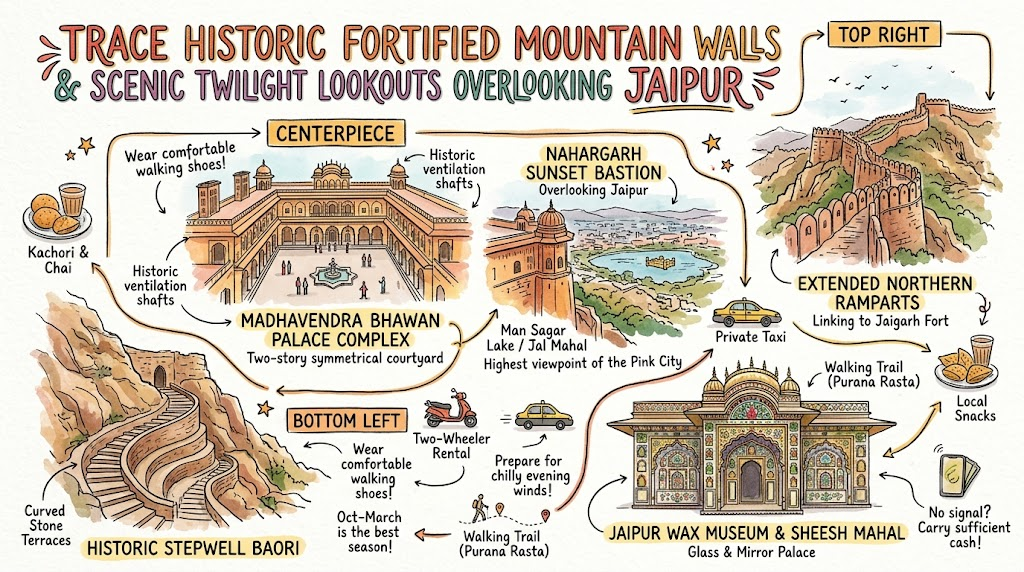
Madhavendra Bhawan Palace Complex
Built by Maharaja Sawai Madho Singh in the late 19th century, Madhavendra Bhawan represents an ingenious architectural marriage of royal privacy and symmetry. The complex features a two-story central royal suite for the Maharaja connected to nine identical palatial suites created specifically for his nine queens.
Each queen’s apartment is designed with separate courtyards, private bedchambers, and intricate frescoes of floral and mythical themes. The architectural brilliance lies in its clever corridors, allowing the king to visit any queen without the knowledge of the other eight chambers.
- Location: Inside Nahargarh Fort premises, 16 km north of Jaipur city center.
- Why it is worth visiting: Extraordinary Rajput-Mughal symmetrical architecture boasting untouched wall frescoes and historic ventilation shafts.
- Best things to do: Walk through the narrow interconnecting secret passageways, admire delicate ceiling plasterwork, and study the passive natural cooling ducts.
- Best time to visit: Early morning between 10:00 AM and 11:30 AM before midday crowds fill the courtyards.
- Ideal for whom: History buffs, architecture lovers, and heritage photographers.
- Travel tip: Wear comfortable walking shoes without slippery soles; the historic polished lime-plaster corridors are smooth and steep.
The Historic Stepwell Baori
Tucked beside the central approach to the fort lies one of the most striking undulating stone stepwells in Rajasthan, made famous by cinematic appearances in Bollywood films. Unlike symmetrical square stepwells, this ancient rainwater catchment follows the natural curved contours of the rocky mountain slope.
Cut directly into the granite ridge, its sweeping stair patterns directed precious monsoon water down into deep subterranean collection shafts. Standing beside its curved stone terraces offers a profound appreciation for medieval desert hydrology and ecological engineering.
- Location: Northern quadrant of the main fortress gate entry.
- Why it is worth visiting: An unconventional, organic stepped design that harmonizes natural granite hills with hydraulic utility.
- Best things to do: Photograph the rhythmic patterns of the curved stairs, observe the water harvesting channels, and enjoy the cool stone breeze.
- Best time to visit: Late afternoon around 3:30 PM for striking diagonal shadows on the stone steps.
- Ideal for whom: Photographers, design researchers, and solo travelers.
- Travel tip: Observe the stepwell strictly from behind designated safety railings, as the historic stair ledges have no side barriers.
Nahargarh Sunset Bastion
Extending out along the southwestern edge of the perimeter wall, the Sunset Bastion offers an unrivaled vantage point over the entirety of Jaipur. As the sun dips toward the horizon, the city’s historic avenues, lakes, and pastel facades are drenched in deep crimson and amber light.
The evening breeze howling across the steep rocky drop creates an unforgettable sensory atmosphere. Once the sun disappears, the vast urban sprawl below ignites into a carpet of shimmering city lights beneath the desert sky.
- Location: Southwest fortification edge near Padao Open-Air Restaurant.
- Why it is worth visiting: The highest and most unobstructed panoramic sunset viewpoint over the walled city of Jaipur.
- Best things to do: Watch the sunset over the plains, view Man Sagar Lake from above, and listen to the faint evening temple bells from the valley below.
- Best time to visit: 5:00 PM to 6:30 PM (arrive an hour before twilight to secure a spot).
- Ideal for whom: Couples, landscape photographers, and sunset chasers.
- Travel tip: Carry a light windbreaker jacket during winter months, as mountain temperatures drop rapidly once twilight settles.
Jaipur Wax Museum and Sheesh Mahal
Housed within the restored historic arms barracks and royal rest houses near the fort entrance, this complex houses life-sized wax statues celebrating Indian icons. Adjacent to it stands an exquisitely recreated modern Sheesh Mahal (Palace of Mirrors), echoing classical Amber craftsmanship.
The mirror hall is handcrafted using two point five million pieces of hand-cut convex glass tiles, polished mirrors, and gold-leaf inlays. It glows with royal opulence, giving travelers a firsthand glimpse into the artistic traditions of Rajasthani glass inlay work.
- Location: Left terrace immediately past the main entry gate of Nahargarh Fort.
- Why it is worth visiting: A dazzling modern continuation of traditional Thikri mirror inlay craft that mirrors historical royal chambers.
- Best things to do: Walk through the reflective optical illusions of the mirror palace, view historical royal statues, and admire traditional glass craftsmanship.
- Best time to visit: Midday between 1:00 PM and 2:30 PM as an indoor escape from bright desert sunshine.
- Ideal for whom: Families traveling with children, art lovers, and pop-culture enthusiasts.
- Travel tip: Separate entry tickets are required for the Wax Museum and Sheesh Mahal; purchase combo tickets at the gate to save time.
The Extended Northern Rampart Trail
Stretching beyond the palace quarters, the fortified stone battlements wind along the crest of the Aravalli hills for multiple kilometers, physically linking the defensive systems of Nahargarh to Jaigarh Fort. Walking these high stone ramparts gives a raw understanding of how the Kachwaha Rajputs fortified their capital against Maratha invaders.
The trail runs alongside ancient gun bastions, arched observation slits, and deserted stone guard posts. Far from the chatter of the primary courtyards, this walk offers absolute quiet broken only by desert winds and passing eagles.
- Location: Extended northern outer walls leading toward Jaigarh.
- Why it is worth visiting: A rugged, authentic historical hike away from commercial kiosks with sweeping views of the desert ranges.
- Best things to do: Trace the ancient archer parapets, observe the natural defensive geology, and spot wild peacocks along the scrub slopes.
- Best time to visit: Early morning between 8:00 AM and 10:00 AM for pleasant hiking weather.
- Ideal for whom: Adventure travelers, hikers, and military history enthusiasts.
- Travel tip: Carry plenty of drinking water in a reusable canteen, as there are no food or water vendors on the remote outer ramparts.
Offbeat Exploration: Hidden Gems Tourists Miss
The Nahar Singh Bhomia Shrine
Located near the main entrance gates, this modest shrine honors the Rathore prince Nahar Singh, whose restless spirit allegedly hindered initial construction until a dedicated memorial was built and the fort renamed in his honor. Local caretakers still perform daily morning prayers here with fresh marigolds and incense, offering a glimpse into folk beliefs.
Charans Mandir Viewpoint
Situated roughly halfway up the winding mountain ascent to the fort, this quiet temple viewpoint features stone footprints honoring Lord Krishna. It offers an exceptional panoramic perspective of Jal Mahal floating serenely on the Man Sagar Lake below, completely missed by travelers rushing past in taxis.
The Forest Scrub Birding Trail
The forested valleys flanking the Nahargarh Biological Park and lower fort walls host an indigenous dry deciduous ecosystem. Early morning walks along the lower service trails frequently reward quiet travelers with sightings of Indian peafowl, grey francolins, paradise flycatchers, and desert monitors scurrying across dry granite rocks.
Detailed Practical Guidance for Travelers
| Destination | Standard Entry Fee | General Timings | Best Local Food Options Nearby | Recommended Nearby Attractions |
| Madhavendra Bhawan | ₹50 (Indians) / ₹200 (Foreigners) | 10:00 AM – 5:30 PM | Fort Canteen (Kachori & Chai) | Jaigarh Fort, Amer Fort |
| Historic Stepwell Baori | Included in General Fort Ticket | 10:00 AM – 5:30 PM | Durg Cafe (Local Snacks) | Royal Cenotaphs at Gaitore |
| Nahargarh Sunset Bastion | Included in General Fort Ticket | 10:00 AM – 5:30 PM | Padao Restaurant (Drinks & Snacks) | Nahargarh Biological Park |
| Wax Museum & Sheesh Mahal | ₹500 (Combo entry approx.) | 10:00 AM – 6:00 PM | Heritage Restro Cafe | Kanak Vrindavan Gardens |
| Extended Rampart Trail | Included in General Fort Ticket | 10:00 AM – 5:30 PM | Local tea stalls near outer gate | Jaigarh Cannon Foundry |
Logistics & On-Ground Navigation
Local Transport Options
- Private Taxi Hire: The most comfortable option for the steep winding mountain road. Book a round-trip taxi with a three-hour waiting buffer, as securing return rides atop the hill is challenging.
- Auto-Rickshaws: Feasible, but ensure you negotiate the waiting charges beforehand. Drivers will charge premium return rates due to the steep, desolate hill climb.
- Two-Wheeler Rental: Highly popular with adventurous solo travelers. Scooters and motorbikes handle the curving mountain switchbacks easily and offer scenic pullover stops.
- The Footpath Hike (Purana Rasta): A steep pedestrian stone trail leads from the foot of Nahargarh road in the old city directly up to the fort gates, taking roughly 45 to 60 minutes of strenuous uphill climbing.
Budget Planning
- Backpacker Tier (₹1,200 – ₹2,200/day): Navigate using shared city buses or the walking trail, stay in Old City backpacker hostels, eat kachoris and thalis at local sweet shops, and purchase standard composite monument entry tickets.
- Comfort/Mid-Range Tier (₹4,500 – ₹8,000/day): Book a dedicated air-conditioned rental car for the hill circuit, dine at hilltop heritage cafes like Padao, stay in a boutique haveli in Bani Park, and purchase all special attraction add-ons.
Safety and Inclusivity Tips
- Families: Watch young children closely around the historic palace terraces and stepwells, as historical parapets often lack modern safety fencing.
- Couples: Stick to populated viewing bastions and designated restaurant areas, particularly after dark, and avoid wandering into remote, unlit forest paths alone.
- General Safety: Beware of playful rhesus macaque monkeys along the outer stone walls. Keep food items and plastic bags concealed inside your backpack.
Strategic Travel Planning Guardrails
Travel Planning Tips for Nahargarh Fort
- Purchase the Composite Monument Ticket: Buy the Rajasthan Tourism composite ticket covering Nahargarh, Amer, Hawa Mahal, and Jantar Mantar to avoid standing in long ticket lines.
- Carry Sufficient Cash: Network connectivity on top of the Aravalli ridge can be unstable, frequently causing digital UPI and card payment terminals to fail at ticket counters.
- Dress in Layered Clothing: The open hill ridges can be surprisingly hot and sunny at midday yet bitterly breezy and chilly immediately after sunset in winter.
- Hydrate Constantly: The arid desert breeze evaporates perspiration rapidly; always keep a water bottle inside your day pack.
- Plan Downhill Travel Before Dark: If riding two-wheelers, descend before complete nightfall, as the winding mountain roads lack bright street lighting.
Common Mistakes to Avoid
- Booking One-Way Cabs: Never book a one-way app taxi up to Nahargarh Fort; mobile network dead zones make booking a return ride nearly impossible.
- Ignoring Footwear Grip: Avoid wearing smooth formal footwear, heels, or flip-flops; the steep polished stone pathways inside the palace demand solid traction.
- Feeding Wild Macaques: Avoid offering snacks to monkeys around the stepwell; it encourages aggressive snatching behavior toward travelers.
- Skipping Water Catchment Exploration: Do not rush through just the bedroom chambers while skipping the engineering marvels of the rainwater canals and stepwells outside.
- Arriving at Twilight Only: Visiting solely for the sunset means missing the museum, the fresco suites, and the remarkable Madhavendra palace rooms that close strictly at 5:30 PM.
Suggested Itinerary Blueprints
Day Quick Dash (Express Hill Fortress Route)
- Target Audience: Busy travelers on a short layover seeking top scenic viewpoints.
- 1:30 PM: Depart central Jaipur via private car and climb the scenic mountain road, pausing briefly for photos at Charans Mandir.
- 2:15 PM – 4:00 PM: Explore Madhavendra Bhawan palace suites and step inside the historic curved stepwell.
- 4:30 PM – 6:00 PM: Settle into the western ramparts to watch the sunset over Jaipur before descending to the city.
Day Deep-Dive (Heritage, Palaces & Mountain Battlements)
- Day 1: Explore walled city treasures including the City Palace, Jantar Mantar, and Hawa Mahal, followed by traditional shopping along Bapu Bazar.
- Day 2: Devote the day to the mountain ridge. Spend the morning touring Amer Fort and Jaigarh’s ancient foundry, transfer in the afternoon to Nahargarh, and end the evening enjoying sunset drinks above the city.
Complete Weekend Travel Plan (The Ultimate Jaipur Loop)
- Friday Evening: Check into a heritage hotel, stroll through the vibrant illuminated Old City markets, and eat traditional pyaaz kachoris.
- Saturday: Full-day architectural immersion starting with early morning Amber Fort exploration, Panna Meena Stepwell, and afternoon walking tours of Nahargarh Fort and its stepwells.
- Sunday: Morning visit to Gaitore royal cenotaphs, a leisurely craft tour of Kripal Kumbh blue pottery studios, and evening shopping along MI Road before departure.
Common Tourist Mistakes to Avoid
- Geographic Blunders: Attempting to combine southern attractions like Chokhi Dhani with northern mountain bastions like Nahargarh on the same afternoon wastes precious hours in city traffic.
- Commercial Traps: Spending hours in overpriced roadside souvenir showrooms instead of supporting genuine craft guilds or enjoying the monuments.
- Neglecting Modern Zones: Skipping charming residential pockets like C-Scheme or Civil Lines, which feature peaceful garden cafes and local design stores.
- Transport Overpayment: Agreeing to arbitrary roadside taxi fares without establishing return waiting terms or checking baseline fare estimates.
- Luxury Dining Bias: Restricting your meals solely to hotel buffets, thereby missing out on iconic regional street specialties like Rawat’s kachoris and Pandit’s pav bhaji.
Frequently Asked Questions
1. What is the historical story behind the naming of Nahargarh Fort?
Nahargarh Fort was initially named Sudarshangarh when commissioned by Maharaja Sawai Jai Singh II in 1734. Construction was allegedly disturbed by the restless spirit of a Rathore prince named Nahar Singh Bhomia. To pacify the spirit, a dedicated shrine was built on the premises, and the entire fortification was rechristened Nahargarh, translating to the “Abode of Tigers.”
2. How far is Nahargarh Fort from the main city of Jaipur?
The fortress is located approximately sixteen kilometers from central Jaipur and the main railway station via the winding vehicular mountain road. Although it sits directly above the old walled city on the Aravalli cliff, navigating the mountain ridge requires driving around the northern slopes near Kanak Vrindavan, taking roughly forty to fifty minutes by car.
3. Can I walk or hike up to Nahargarh Fort instead of taking a vehicle?
Yes, an ancient cobbled stone footpath known as Purana Rasta leads directly from the foot of the hill in the Purani Basti neighborhood up to the fort. This hike takes forty-five to sixty minutes of continuous uphill walking. It is physically demanding but offers rewarding aerial views, though it is best tackled during cool early mornings.
4. What are the official visiting hours and ticket prices for the fort?
Nahargarh Fort opens daily from 10:00 AM to 5:30 PM. The standard entrance fee is ₹50 for Indian nationals and ₹200 for international visitors, with discounts available for students with valid identification. Separate admission fees apply for the Wax Museum and Sheesh Mahal, and composite state tourism tickets are widely accepted at the main gate.
5. Is it safe to stay at Nahargarh Fort after sunset?
The palace museum sections close strictly by 5:30 PM, but visitors can remain at the hilltop restaurant facilities until late evening. The winding mountain road has sharp curves and minimal street lighting, so returning down the mountain before 8:00 PM in a pre-arranged vehicle is strongly recommended for safety and convenience.
6. Are food and drinking water available inside the fort complex?
Yes, basic refreshment stalls, packaged drinking water kiosks, and tea shops are stationed around the main entrance and inner courtyards. In addition, Durg Cafe and the Padao open-air restaurant provide sit-down dining spaces, simple North Indian snacks, and drinks accompanied by panoramic cliffside vistas of the city skyline below.
7. Why was the Madhavendra Bhawan built with nine identical suites?
Maharaja Sawai Madho Singh commissioned Madhavendra Bhawan to house his nine queens in equal comfort and style. The nine identical two-story suites share the exact same spatial layout, courtyard orientation, and decorative wall motifs. The design allowed the king to visit any queen in complete privacy through secluded connecting corridors without alerting the others.
8. Can you easily visit Amber Fort, Jaigarh Fort, and Nahargarh on the same day?
Yes, visiting all three forts in one day is entirely possible because they sit along the same northern mountain ridge. To do this efficiently, start early in the morning at Amber Fort, explore Jaigarh Fort around midday, and finish the late afternoon at Nahargarh to enjoy the palace courtyards and sunset views.
9. Is photography allowed, and do you need a special camera permit?
Standard still photography and mobile phone photography are permitted throughout the fort courtyards and ramparts without expensive special permits. However, commercial shoots, tripods, fashion photography, and video equipment may require explicit prior authorization from the Department of Archaeology and Museums of Rajasthan, and drone operations are strictly prohibited across the perimeter.
10. What is the best month of the year to visit Nahargarh Fort?
The ideal window runs from October through March, when daytime temperatures hover pleasantly between fifteen and twenty-five degrees Celsius. In contrast, the summer months between April and June bring blistering desert heat above forty degrees Celsius, making walking along the exposed stone ramparts and unshaded courtyards extremely exhausting during midday hours.
11. How do you ensure reliable return transportation from the hilltop?
The most reliable approach is hiring an auto-rickshaw or taxi on a round-trip basis from the city, paying a pre-negotiated waiting fee for three hours. Rideshare apps often fail atop the hill because mobile signals are spotty and drivers are reluctant to drive up the mountain empty-handed just for an unreserved pickup.
12. Is Nahargarh Fort accessible for wheelchair users and strollers?
The terrain of Nahargarh Fort presents challenges for wheelchairs and strollers due to historic cobblestone paths, steep inclines, and stepped palace thresholds. While the main central courtyards and approach roads are relatively wide and paved, navigating the multi-story suites and high rampart bastions requires climbing multiple flights of narrow, uneven stone stairs.
Conclusion
Standing along the wind-swept battlements of Nahargarh Fort as twilight blankets the Pink City in deep violet and gold provides an enduring cultural awakening. Stepping beyond standard itineraries to explore this highland redoubt rewards travelers with deep historical reverence, quiet architectural genius, and an intimate connection to Rajasthan’s royal soul that ordinary tourist trails simply cannot match.
