Introduction
While standard tour buses deposit hurried crowds before sun-scorched palace gates, an entirely different medieval metropolis breathes in the shadows of the terracotta alleyways. Most travelers merely skim the surface of Jaipur through bus windows, completely missing the aromatic lanes where fifth-generation silversmiths hammer raw metal and morning temple bells reverberate through vaulted archways.
Exploring Jaipur on foot bridges the divide between generic tourist gazing and profound cultural discovery. Tracing the historic walled city on foot reveals how Maharaja Sawai Jai Singh II and architect Vidyadhar Bhattacharya embedded Vedic spatial planning, astronomical curiosity, and neighborhood craft guilds into a living, breathing urban sanctuary.
Why Jaipur is a must-visit city
Jaipur anchors the golden triangle of northern India not merely as a scenic pitstop, but as the quintessential capital of planned Rajput urbanism. Established in 1727, the city broke away from hilltop militarism to celebrate open trade, classical geometry, and specialized artisan colonies arranged into nine distinct sectors (chokris).
Superb infrastructure connects the capital through high-speed national expressways, a direct international airport, and trans-continental rail routes. Whether arriving as an independent budget backpacker, a couple seeking atmospheric heritage havelis, or a curious multi-generational family, Jaipur’s layered history delivers an unforgettable walking journey.
| Key Fact | Details |
| State & Region | Rajasthan, Western India |
| Foundation Date | 1727 AD by Maharaja Sawai Jai Singh II |
| Urban Blueprint | Shilpa Shastra & Vastu Shastra grid layout |
| UNESCO Designation | World Heritage City (Inscribed 2019) |
| Best Walking Season | October to March (Mild, crisp temperatures) |
Best Places or Experiences
Badi Chaupar to Sireh Deori Bazaar Heritage Trail
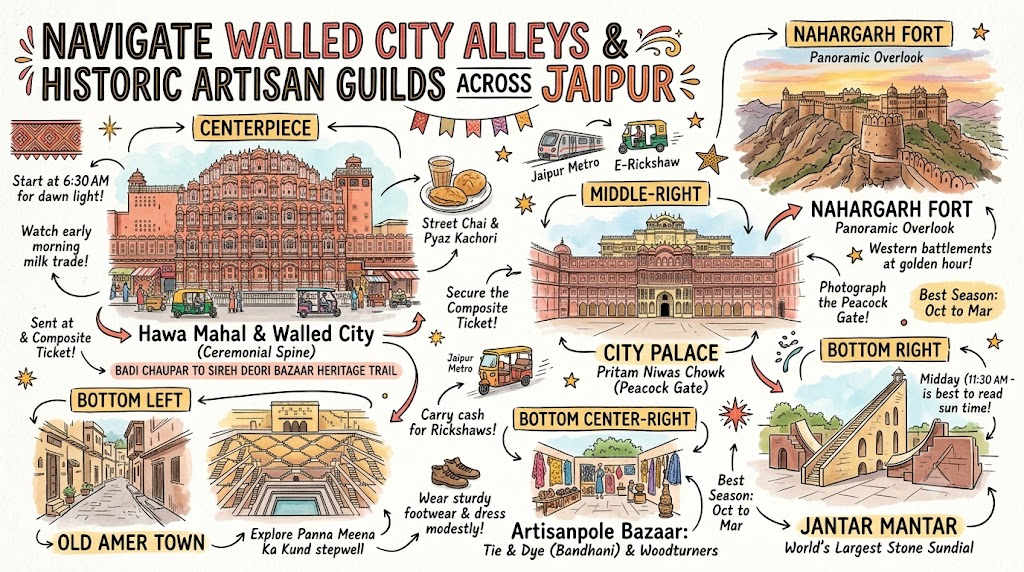
Tracing the ceremonial spine of Jaipur, the walk beginning at Badi Chaupar and winding down Sireh Deori Bazaar reveals the vibrant heartbeat of the royal city. Early dawn bathes the iconic 953-casement lattice facade of Hawa Mahal in deep crimson, free of midday tourist coaches and vendors.
This path cuts straight through historic havelis, spice warehouses, and morning milk trading hubs. Walking past the tiered colonnades, you witness priests carrying fresh marigolds into subterranean shrines and shop owners offering incense to painted lintels before lifting their timber shutters.
- Location: Old Walled City, approximately 4.5 km from Jaipur Junction Railway Station.
- Why it is worth visiting: The quintessential urban heritage axis combining royal architectural mastery with traditional market commerce.
- Best things to do: Stand across Hawa Mahal at 6:30 AM for undisturbed light, watch early morning street chai makers boil buffalo milk, and examine ornate wood-carved haveli doors.
- Best time to visit: 6:00 AM to 8:30 AM for cool weather and empty footpaths.
- Ideal for whom: Street photographers, architecture scholars, and first-time visitors.
- Travel tip: Wear slip-on shoes since multiple micro-temples along the colonnade invite quick interior visits.
City Palace Royal Courtyards Walk
The royal residence complex reflects the synthesis of Rajput chivalric grace, Mughal symmetry, and European grandeur. Stepping past the towering Virendra Pol, the walk unfurls across expansive open courtyards where royal durbars once met and private guards still stand watch in heirloom uniforms.
Pritam Niwas Chowk showcases four dazzling, hand-painted inner gateways dedicated to the seasons and Hindu deities. From the massive sterling silver urns in the Diwan-i-Khas to the soaring nine-story Chandra Mahal rising in the background, this heritage precinct preserves aristocratic Rajput statecraft.
- Location: Jalebi Chowk, central walled city, 5 km from the city railway hub.
- Why it is worth visiting: The unbroken royal residence showcasing authentic court costume collections, weapons, and palatial design.
- Best things to do: Photograph the Peacock Gate at Pritam Niwas Chowk, inspect the Gangajali silver urns, and view the royal artillery collection in the armory.
- Best time to visit: 9:30 AM right at opening, or 3:30 PM for softer courtyard shadows.
- Ideal for whom: History buffs, royal craft admirers, and visiting families.
- Travel tip: Upgrade to the composite inner tour if you wish to see the private blue-walled Sukh Niwas drawing room.
Jantar Mantar Astronomical Observatory Walk
Built by the astronomer-king Sawai Jai Singh II, Jantar Mantar offers a surreal architectural stroll through nineteen massive stone and marble astronomical instruments. This UNESCO World Heritage complex appears almost like a modernist sculpture garden of giant geometric stairs, dials, and curved ramps.
Walking among these instruments reveals how medieval Indian scientists predicted eclipses, tracked planetary orbits, and calculated local solar time down to two seconds. The Vrihat Samrat Yantra, standing 27 meters tall, projects a crisp shadow across fine marble scales as the earth rotates.
- Location: Adjoining the City Palace entrance, walled city sector.
- Why it is worth visiting: The world’s largest stone sundial and an architectural triumph of 18th-century observational astronomy.
- Best things to do: Read the local sun time directly on the giant Samrat Yantra, study the zodiac stone pavilions, and hire an approved observatory guide.
- Best time to visit: Midday between 11:30 AM and 1:30 PM when the sun hits the instrument centers for accurate time tracking.
- Ideal for whom: Science buffs, geometric photographers, and curious thinkers.
- Travel tip: Carry an umbrella or broad-brimmed hat, as the open stone courtyard offers minimal shade during midday sun.
Nahargarh Fort Rampart Edge Trail
Perched on the rugged ridge of the Aravalli Hills, Nahargarh Fort provided defensive fortification and hunting respite for Jaipur’s royal court. The walk along its stone battlements provides a panoramic overview of the geometric city plan stretching across the desert basin far below.
Inside the complex, the Madhavendra Bhawan holds twelve identical, interconnected suites built for royal queens, decorated with delicate floral frescoes and hidden rooftop staircases. Walking the ramparts in late afternoon as the desert wind picks up reveals why this fortress was named the “Abode of Tigers.”
- Location: Aravalli Ridge, approximately 15 km northwest of Jaipur city center.
- Why it is worth visiting: Unmatched vantage point over the pink city grid coupled with unique identical royal suite architecture.
- Best things to do: Walk the western parapet at golden hour, wander the interconnected corridors of Madhavendra Bhawan, and view the stepped water reservoirs.
- Best time to visit: 4:00 PM to 6:30 PM for cooler temperatures and sunset views.
- Ideal for whom: Hikers, sunset lovers, and panoramic landscape photographers.
- Travel tip: Book your return taxi ahead of time; app cabs rarely pick up from the top of the hill after sunset.
Old Amer Town Heritage & Baori Walk
Most visitors take an elephant or jeep straight up to Amer Fort, completely bypassing the medieval settlement nestled beneath its ramparts. Walking the quiet cobblestone alleys of Old Amer reveals dozens of 16th-century temples, ruined mansions, and stepped public stepwells.
The path meanders past the famous Jagat Shiromani Temple, featuring intricate black stone carvings of Vishnu and Meera Bai. Continuing toward Panna Meena Ka Kund, you discover an eight-tiered geometric stepwell where medieval villagers gathered to collect hillside runoff and escape the midday heat.
- Location: Amer settlement, 11 km north of Jaipur via the Delhi highway.
- Why it is worth visiting: Bypasses commercial crowds to highlight pre-Jaipur medieval settlement history and stepwell engineering.
- Best things to do: Admire the Torana entrance gate at Jagat Shiromani Temple, photograph the symmetric stairways of Panna Meena Ka Kund, and explore atmospheric street havelis.
- Best time to visit: 7:00 AM to 9:30 AM before tourist convoys reach the fort base.
- Ideal for whom: Heritage preservationists, spiritual seekers, and quiet explorers.
- Travel tip: Walking on the stepwell stairs themselves is restricted for heritage preservation, but the rim provides striking overhead views.
Offbeat Exploration: Hidden Gems Tourists Miss
Gaitore Ki Chhatriyan (Royal Cenotaphs)
Tucked into a quiet valley at the foot of Nahargarh, Gaitore houses the marble and sandstone funerary cenotaphs (chhatris) of the Kachwaha rulers. Open carved cupolas, soaring stone domes, and battle relief sculptures sit in peaceful, manicured gardens, creating an open-air sculpture sanctuary that tour groups rarely visit.
Ghat Ki Ghuni Terraced Mughal Gardens
Located along the historic eastern mountain pass leading to Agra, this hidden valley features a sequence of 18th-century tiered gardens, including Sisodia Rani Ka Bagh and Vidyadhar Bagh. Walking past bubbling water fountains, muraled royal pavilions, and terraced desert gardens reveals how royal planners harnessed natural spring waters.
Kishanpole Bazaar Artisan Pols
Venture away from main commercial roads into Kishanpole’s narrow residential pols (courtyards) to see master tie-and-dye (bandhani) dyers stretch silk fabrics across courtyard lines. Here you can watch woodturners carve bespoke printing blocks and metal casters pour molten brass into intricate idol molds using lost-wax techniques.
Detailed Practical Guidance for Travelers
| Destination | Standard Entry Fee | General Timings | Best Local Food Options Nearby | Recommended Nearby Attractions |
| Badi Chaupar Walk | Free public access | Open 24 Hours (Best 6 AM – 9 AM) | Samrat Restaurant (Pyaz Kachori, Jalebi) | Hawa Mahal, Johari Bazaar |
| City Palace Complex | ₹300 Indian, ₹700 Foreigner | 9:30 AM – 5:00 PM | Baradari Fine Dining (Inside Palace) | Jantar Mantar, Govind Dev Ji Temple |
| Jantar Mantar | ₹50 Indian, ₹200 Foreigner | 9:00 AM – 5:00 PM | LMB Sweets (Ghewar & Royal Thali) | City Palace, Tripolia Gate |
| Nahargarh Fort | ₹50 Indian, ₹200 Foreigner | 10:00 AM – 5:30 PM | Padao Restaurant (Sunset beverages) | Jaigarh Fort, Charan Mandir |
| Old Amer Town Trail | Free (Temples free, small camera fee) | 6:00 AM – 6:00 PM | 1135 AD (Luxury dining in Amer Fort) | Amber Palace, Panna Meena Ka Kund |
Logistics & On-Ground Navigation
Local Transport Options
- Jaipur Metro: Air-conditioned, swift transit connecting railway terminals to Badi Chaupar inside the walled city; perfect for avoiding traffic jams.
- Auto-Rickshaws & E-Rickshaws: Nimble transport for navigating narrow alleys; always negotiate fare or ensure digital meter verification before stepping in.
- Chauffeured Day Cabs: Recommended for exploring outlying hill paths like Nahargarh Fort, Amer, and Ghat Ki Ghuni.
- Walking & Foot Trails: The single best method inside the walled city sectors, where footpaths run under sheltered heritage colonnades.
Budget Planning
- Backpacker Tier (₹1,500 – ₹2,200 per day): Budget dorm stay in Bani Park or C-Scheme, street breakfasts of kachoris and tea, travel via Metro and foot, and composite government monument ticket access.
- Mid-Range / Comfort Tier (₹4,500 – ₹8,500 per day): Boutique heritage hotel room, private air-conditioned cab for fort transfers, guided heritage walking tours, sit-down courtyard lunches, and specialized entry tickets.
Safety and Inclusivity Tips
- Families: Keep children close around high fort battlements and unrailed stepwells; morning walks avoid overwhelming midday market traffic.
- Couples: Early mornings along Amer’s backstreets provide tranquil, respectful sightseeing away from aggressive marketplace touts.
- General Safety: Watch out for uneven stone pavements, keep wallets tucked away in crowded bazaars, and decline unsolicited guides outside palace ticket gates.
Strategic Travel Planning Guardrails
Travel Planning Tips for Jaipur
- Secure the Composite Monument Ticket: Buy the government composite ticket covering Hawa Mahal, Jantar Mantar, Amer Fort, and Nahargarh to skip ticket lines.
- Prepare for Hybrid Payments: While digital UPI payments are widespread, always carry ₹1,000 in small cash denominations for street snacks, temple shoe attendants, and rickshaws.
- Dress Modestly: When walking through working residential lanes and active neighborhood temples, keep shoulders and knees covered out of cultural respect.
- Start Before the City Wakes: Jaipur’s streets change completely between 7:00 AM and 10:00 AM; morning walkers enjoy empty vistas and cooler air.
- Pack Sturdy Footwear: Ancient cobblestones, stepwell stairs, and dusty fort trails demand supportive walking sneakers with good grip.
Common Mistakes to Avoid
- Overloading Single-Day Plans: Jamming three distant hill forts and the walled city into one afternoon causes exhaustion and superficial sightseeing.
- Assuming Afternoon Walking is Comfortable: The afternoon sun warms exposed stone walls even in winter; schedule cultural walks early in the morning.
- Falling for “Special Factory” Gem Touts: Never follow rickshaw drivers promising secret wholesale jewelry or textile warehouses.
- Skipping Street Food Institutions: Avoiding storied street stalls like Laxmi Mishthan Bhandar or Samrat deprives you of Jaipur’s true culinary roots.
- Ignoring Neighborhood Pols: Walking only on wide commercial roads misses the fascinating craft courtyards tucked behind main streets.
Suggested Itinerary Blueprints
Day Quick Dash (Old City Heritage Pulse)
- Target Audience: Travelers on a tight 24-hour layover looking for essential heritage depth.
- Morning (7:00 AM – 11:30 AM): Sunrise photo walk outside Hawa Mahal, breakfast kachori at Samrat, followed by walking through Jantar Mantar and City Palace courtyards.
- Afternoon (1:00 PM – 4:00 PM): Browse jewelry stalls along Johari Bazaar and stone cutters in Khazane Walon Ka Rasta.
- Sunset: Drive up to Nahargarh Fort ramparts for golden hour across the pink cityscape.
Day Deep-Dive (Walled City & Fortified Ridges)
- Day 1 (Walled City Foundations): Sunrise walking loop starting at Badi Chaupar, full cultural tour of City Palace and Jantar Mantar, afternoon exploration of Kishanpole artisan guilds, and evening Aarti at Govind Dev Ji temple.
- Day 2 (Fortress Trails & Historic Amer): Morning walking discovery of Old Amer village, Jagat Shiromani Temple, and Panna Meena Ka Kund, followed by an afternoon ridge hike across Nahargarh and Jaigarh fortifications.
Complete Weekend Travel Plan (The Grand Cultural Immersion)
- Friday Evening: Arrive, settle into a restored haveli in Bani Park, and enjoy a traditional Rajasthani thali dinner.
- Saturday: Complete morning heritage walk through Badi Chaupar and Sireh Deori, mid-day observatory tour at Jantar Mantar, and late afternoon rampart walk at Nahargarh Fort.
- Sunday: Early excursion to Old Amer stepwells and temples, midday shopping for authentic block-print textiles and blue pottery, and a sunset farewell walk through the terraced gardens of Ghat Ki Ghuni.
Common Tourist Mistakes to Avoid
- Geographic Blunders: Grouping Amer Fort and Nahargarh Fort with southern districts like Sanganer on the same morning wastes precious hours sitting in traffic jams.
- Commercial Traps: Spending afternoon hours in modern souvenir malls instead of wandering authentic guild lanes where artisans craft genuine wares.
- Neglecting Modern/Alternative Zones: Overlooking leafy modern sectors like C-Scheme, home to specialty coffee roasters, art galleries, and quiet leafy avenues.
- Transport Overpayment: Agreeing to arbitrary roadside auto-rickshaw fares without checking app estimates or insisting on prepaid booth rates.
- Luxury Dining Bias: Sticking exclusively to five-star hotel buffets, which misses authentic flavors like charcoal-cooked dal baati churma and piping-hot street jalebis.
Frequently Asked Questions
1. Is it safe to take self-guided heritage walks through Jaipur’s Old City?
Yes, walking through the walled city is very safe during daylight and early evening hours. The historic streets remain lively with local families and neighborhood merchants. Simply keep your valuables secure in crowded market bottlenecks and stick to well-lit main corridors after dusk.
2. What is the best starting time for a heritage walk in Jaipur?
The best time to start is 6:30 AM to 7:00 AM, especially between October and March. Morning hours let you experience the city as shopkeepers unlock their doors and temple bells ring, while avoiding harsh midday sun and congested scooter traffic along the narrow footpaths.
3. Do I need to book an authorized tour guide for heritage walks?
While independent walkers can navigate the open streets, hiring an official government-licensed guide brings great value to complex sites like Jantar Mantar and the City Palace. Certified guides reveal hidden architectural symbols, mathematical calculations, and royal legends that self-guided strolls often overlook.
4. What should culture lovers wear during walking tours of Jaipur?
Wear lightweight, breathable cotton clothing that covers shoulders and knees to show respect when visiting active neighborhood shrines. Choose broken-in walking sneakers with good rubber grip, as century-old flagstones, marble steps, and fort inclines can be slick and uneven underfoot.
5. How much walking distance is typically covered on a Jaipur heritage walk?
A typical heritage walking route across the walled city covers between 3 and 5 kilometers over two to three hours. The route includes frequent stops inside temple courtyards, artisan workshops, and street tea stalls, keeping the overall physical exertion manageable for moderate fitness levels.
6. Can I visit active temples during a heritage walking tour?
Yes, historic neighborhood temples such as Govind Dev Ji and small roadside shrines warmly welcome respectful visitors. Always remove leather belts and shoes at the entrance, dress modestly, ask before taking photographs, and step quietly during morning and evening prayer services.
7. Where can I watch authentic artisans at work inside the Pink City?
Walk down Kishanpole Bazaar for traditional tie-and-dye fabric workshops, Maniharon Ka Rasta for skilled lac bangle makers, and Khazane Walon Ka Rasta for marble stone sculptors. Artisans often work in open-front shops and welcome respectful observers who watch without disrupting their focus.
8. Are public restroom facilities available along the historic walking routes?
Public restrooms in the historic city center are limited and variable in cleanliness. Plan your comfort breaks inside managed heritage landmarks like the City Palace and Jantar Mantar, or stop for refreshments at established heritage cafes and sweet shops along the route.
9. Is photography permitted everywhere inside the heritage quarters?
Street photography is widely accepted throughout the public bazaars, but always ask permission before taking close portraits of artisans or worshipers. Certain private palace galleries, active temple inner sanctums, and defensive fort areas charge small camera fees or restrict photography completely.
10. What local morning street breakfast shouldn’t be missed on a heritage walk?
Make sure to try a crisp pyaz kachori served with tangy tamarind chutney, followed by freshly fried saffron jalebis and a clay cup of cardamom masala tea. Storied spots like Samrat Restaurant near Badi Chaupar have perfected this classic breakfast for generations.
11. What is the most scenic viewpoint overlooking Jaipur on foot?
The western battlements of Nahargarh Fort offer the most breathtaking panoramic viewpoint over the city. Looking down in late afternoon reveals the pink terracotta color of the urban grid below, the surrounding Aravalli mountain peaks, and the waters of Man Sagar Lake.
12. How accessible are Jaipur’s historic walking routes for travelers with limited mobility?
The historic center presents challenges like broken stone curbstones, busy scooter traffic, and steep temple staircases. Travelers with limited mobility should stick to paved, flat palace courtyards like the City Palace, or rent a private e-rickshaw for easier access between monuments.
Conclusion
Walking through Jaipur’s historic districts connects you directly to the living pulse of a royal Rajasthani civilization. Leaving crowded tour buses behind to wander quiet courtyard pols and listen to temple bells rewards you with an authentic travel experience that stays with you long after you leave the Pink City.
