Introduction
Most travelers retreat into predictable, packed hill stations the moment summer arrives, trading urban congestion for overcrowded mountain bottlenecks. Yet, experienced explorers understand that desert-fringe heritage cities harbor profound secrets when the mercury climbs. In Jaipur, summer strips away the tourist throngs, laying bare the city’s authentic, unvarnished rhythm.
When the midday sun blazes, the Pink City does not shut down; it shifts into spaces designed by master medieval planners to stay naturally cool. Massive sandstone bastions channel dry cross-breezes, indoor royal galleries reveal intricate artwork in solitude, and tranquil stepped reservoirs create refreshing microclimates. Visiting now connects you directly with local life—unhurried chai sessions, empty palace courtyards, and sunset breezes atop high ridgelines..
Hawa Mahal in the quiet morning light
Why Jaipur is a must-visit city
Jaipur stands as India’s first planned city, founded in 1727 by Maharaja Sawai Jai Singh II under precise Vastu Shastra and Shilpa Shastra principles. Its wide grid layout, nine-square urban division, and thick perimeter walls represent an architectural marvel built specifically for arid Rajasthan. Beyond its historical status as the anchor of the legendary Golden Triangle circuit, Jaipur serves as the beating cultural heart of craft traditions spanning gems, textiles, and stone masonry.
The city offers exceptional logistical access across every traveler profile. Delhi is connected via the high-speed Delhi-Mumbai Expressway and smooth Vande Bharat rail links, while Jaipur International Airport connects major national metros directly. Whether you seek palatial luxury resorts with shaded courtyards or budget backpacker hostels near the railway junction, hospitality here remains warm, hospitable, and deeply rooted in royal heritage.
The broader travel circuit links the walled Old City seamlessly with the rugged Aravalli hill ranges to the north and east. Travelers can loop effortlessly from downtown bazaars to ancient fort complexes without arduous detours, making intra-city transitions efficient during warm-weather months.
| Travel Factor | Macro Details |
|---|---|
| Geographic Zone | Eastern Rajasthan, Aravalli Hill Range Foothills |
| City Architecture | Classical Vastu Shastra Grid, Terracotta-Pink Lime Wash |
| Summer Climate Range | 28°C to 42°C (Dry heat with cool post-sunset breezes) |
| Primary Transit Hubs | Jaipur International Airport (JAI), Jaipur Junction (JP) |
| Ideal Summer Window | Early mornings (6:00 AM – 10:30 AM) & Evenings (5:30 PM – 9:00 PM) |
Best Places or Experiences
Hawa Mahal
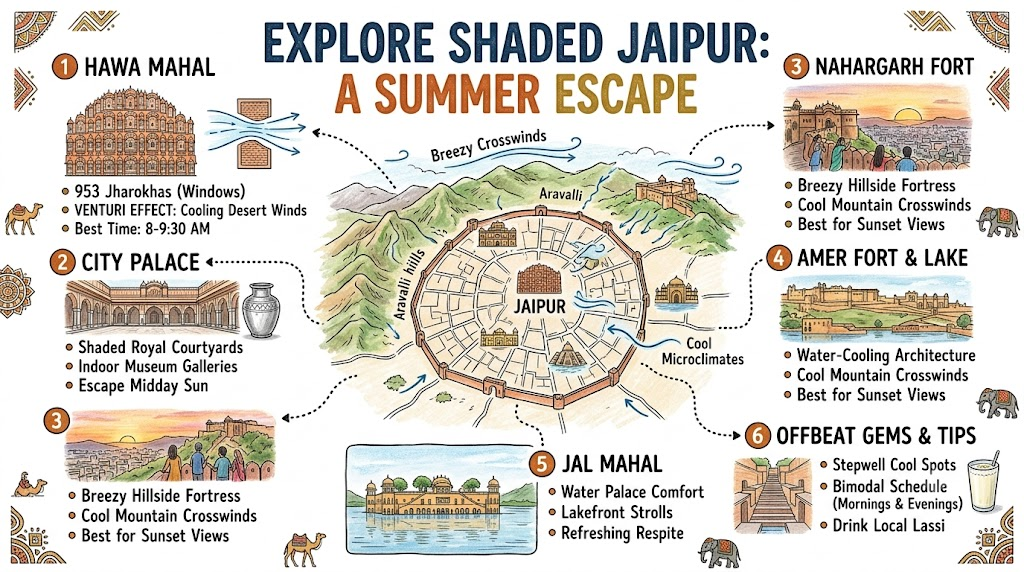
Rising five stories above the bustling street of Badi Chaupar, Hawa Mahal—or the Palace of Winds—was constructed in 1799 by Maharaja Sawai Pratap Singh. Designed by architect Lal Chand Ustad, its iconic exterior mimics the crown of Lord Krishna while functioning as an ingenious natural air-conditioning system. Its honeycomb façade contains 953 meticulously carved jharokhas (casements) that manipulate the Venturi effect, pulling hot desert winds through tight stone apertures to cool the interior chambers.
Step past the façade into the inner courtyards, where quiet fountains and colored glass windows cast vibrant shadows across cool stone floors. Visiting during summer reveals why this building was an engineering triumph for royal women who observed daily street life without suffering the scorching heat.
- Location: Badi Chaupar, Walled Old City, roughly 5 km from Jaipur Junction.
- Why it is worth visiting: Unmatched architectural ventilation system featuring 953 carved sandstone windows that remain cool throughout early summer mornings.
- Best things to do: Stand behind the colored glass casements on the top floor, photograph the inner courtyard fountains, and admire the miniature museum.
- Best time to visit: 8:00 AM to 9:30 AM when early sunlight illuminates the pink façade and the stone passages remain cool.
- Ideal for whom: Architecture enthusiasts, culture lovers, and solo photographers.
- Travel tip: Skip the street-facing crowds; buy your ticket to enter the rear interior courtyard to explore the breezy upper ramparts in near isolation.
City Palace Complex
Occupying one-seventh of the walled city’s perimeter, the City Palace represents a seamless synthesis of Rajput, Mughal, and European architecture. Established alongside the city’s founding, this sprawling complex has housed generations of Jaipur royalty and continues to serve as the residence of the titular Maharaja. Its vast stone courtyards, subterranean armories, and sheltered colonnades were conceived to provide shade, breeze, and quiet retreat from harsh desert daylight.
Within the palace grounds lies the Mubarak Mahal, a grand reception pavilion carved from delicate white marble and chiseled sandstone, alongside the Diwan-i-Khas housing the world’s largest sterling silver vessels. Walking these shaded pavilions allows you to immerse yourself in royal history while escaping direct exposure to the sun.
Pritam Niwas Chowk inside the City Palace.
- Location: J.D.A. Market, Kanwar Nagar, Central Jaipur, 4.5 km from the main railway station.
- Why it is worth visiting: An active royal residence featuring shaded courtyards, preserved medieval galleries, and priceless textile exhibits.
- Best things to do: Marvel at the four season-themed doorways of Pritam Niwas Chowk, inspect the silver Gangajali urns, and view antique weaponry in the armory.
- Best time to visit: 9:30 AM opening time or late afternoon after 4:00 PM when courtyard shadows lengthen.
- Ideal for whom: History buffs, multi-generational families, and textile connoisseurs.
- Travel tip: Book the composite ticket that covers the shaded indoor museums to spend peak midday heat indoors without direct sun exposure.
Nahargarh Fort
Perched along the rugged precipice of the Aravalli hills, Nahargarh Fort—meaning ‘Abode of Tigers’—was built in 1734 by Maharaja Sawai Jai Singh II as a defensive perimeter. The citadel’s crowning architectural jewel is the Madhavendra Bhawan, a series of twelve identical double-storied suites built for royal queens, interconnected by airy corridors and deep covered loggias. The design ensures perpetual natural ventilation across the highest hill ridges above the Jaipur basin.
In the height of summer, as twilight descends over the valley, Nahargarh becomes Jaipur’s premier open-air vantage point. Crisp, cooling downdrafts sweep over the stone ramparts while the sprawling metropolis lights up like an ember field below.
Ramparts of Nahargarh Fort at sunset.
- Location: Krishna Nagar, Brahampuri, approximately 15 km driving distance from the city center via the winding hill road.
- Why it is worth visiting: Dramatic cliffside panoramic views coupled with cool mountain crosswinds and remarkably preserved summer royal suites.
- Best things to do: Explore the breezy rooftop corridors of Madhavendra Bhawan, watch the sunset over the city grid, and view the massive stepwells.
- Best time to visit: 5:00 PM to 7:30 PM for sunset golden hour and cooling twilight winds.
- Ideal for whom: Couples, landscape photographers, and sunset chasers.
- Travel tip: Hire a round-trip cab beforehand; finding return transport down the winding hill road after 7:30 PM is notoriously difficult.
Amer Fort and Maota Lake
Constructed from yellow and pink sandstone by Raja Man Singh I in 1592, Amer Fort stands as a fortified palace complex perched above Maota Lake. Its defensive walls sprawl across miles of rugged Aravalli ridgelines, protecting four tiered courtyards containing palatial halls, sunken Mughal gardens, and private royal apartments. The fort incorporates sophisticated subterranean water channels and covered aqueducts that transported cool lake water through palace walls to combat summer heat.
The crowning highlight is the Sheesh Mahal (Mirror Palace), constructed using thousands of convex Belgian glass mirrors set into white marble plaster. A single lantern reflects across the ceiling like an expanse of stars, while its shaded interior remains cool even when outdoor temperatures rise.
Amer Fort above the waters of Maota Lake.
- Location: Devisinghpura, Amer, roughly 11 km north of Jaipur’s walled city.
- Why it is worth visiting: World Heritage monument featuring ingenious water-cooling architecture, massive defensive gates, and the glittering Sheesh Mahal.
- Best things to do: Walk through the shaded colonnades of the Diwan-i-Aam, admire the mirrored ceiling of the Sheesh Mahal, and view the Kesar Kyari garden.
- Best time to visit: 7:30 AM to 10:00 AM before radiant heat warms the open courtyards.
- Ideal for whom: World heritage explorers, history enthusiasts, and architectural scholars.
- Travel tip: Skip the elephant rides up the stone ramps; enter on foot via the Suraj Pol in the quiet early morning to beat all tourist buses.
Albert Hall Museum
Situated in the historic Ram Niwas Garden outside the city gates, Albert Hall Museum is Rajasthan’s oldest museum, designed by Sir Samuel Swinton Jacob in 1876. Exemplifying the Indo-Saracenic design movement, its stone corridors feature intricate floral motifs, high vaulted ceilings, and perforated stone jaali screens. These stone screens temper intense summer light into soft, filtered rays while maintaining steady indoor air circulation.
The interior showcases an eclectic collection including Persian carpets, ancient coins, traditional costumes, and an authentic Egyptian mummy. It offers a cool, peaceful sanctuary during the hottest hours of the day.
- Location: Ram Niwas Garden, Kailash Puri, 3 km south of the Old City.
- Why it is worth visiting: An Indo-Saracenic architectural masterpiece offering cool, high-ceilinged museum galleries filled with historic artifacts.
- Best things to do: View the 2,300-year-old Egyptian mummy of Tutu, inspect the 17th-century Persian garden carpet, and study miniature paintings.
- Best time to visit: 12:00 PM to 3:00 PM (to stay indoors during peak heat) or 7:00 PM to 9:00 PM for night-viewing under floodlights.
- Ideal for whom: Art lovers, solo travelers, and travelers seeking midday indoor air-conditioned respite.
- Travel tip: Take advantage of the night ticketing option; the building’s exterior is illuminated with colorful LED lights, surrounded by cool park lawns.
Jal Mahal
Resting in the center of Man Sagar Lake against the backdrop of the Nahargarh hills, Jal Mahal (Water Palace) was constructed in the mid-18th century by Maharaja Madho Singh I as a summer pleasure pavilion. Out of its five stone storeys, four remain submerged beneath the lake’s waters, leaving only the top terrace level exposed. This design kept the lower structure cool while lake breezes chilled the upper pavilions during intense summer months.
While the interior chambers remain closed to regular walk-in tourists, the expansive lakeside promenade along Amer Road provides a scenic retreat. In the early mornings and late evenings, mountain winds skim across the water, providing a refreshing respite.
- Location: Amer Road, approximately 6 km north of the city center.
- Why it is worth visiting: Unique semi-submerged palace offering pleasant lakefront breezes and scenic mountain vistas.
- Best things to do: Stroll along the paved lakeside promenade, photograph the palace reflections during twilight, and sample spiced roasted corn.
- Best time to visit: 6:30 AM to 8:00 AM or 6:30 PM to 8:00 PM when cool water winds blow across the paved promenade.
- Ideal for whom: Romantic strolls, casual walkers, and sunset photographers.
- Travel tip: Visit at dusk when street lamps flicker on along the promenade and the water palace lights reflect across the dark lake.
Offbeat Exploration: Hidden Gems Tourists Miss
Panna Meena Ka Kund
Tucked into the ancient lanes behind Amer Fort, this 16th-century stepwell is an engineering marvel designed for communal water harvesting and cool community gatherings. Its interlocking criss-cross stone stairs descend eight stories into a deep subterranean pool. The subterranean architecture creates a localized microclimate up to five degrees cooler than street level.
Gaitore Ki Chhatriyan
Nestled in a quiet valley beneath the slopes of Nahargarh Fort, Gaitore serves as the royal cremation grounds of the Kachwaha Maharajas. The site is filled with marble and sandstone cenotaphs featuring domes carved with battle scenes, peacocks, and musicians. The sheltered valley location keeps the site quiet and shaded from direct city winds, surrounded by tranquil woodland.
Kishan Bagh Sand Dunes
Located at the base of the Nahargarh hills in Vidyadhar Nagar, Kishan Bagh is a restored desert park curated by naturalist Pradip Krishen. This rewilded arid habitat celebrates the native vegetation of the Thar Desert, such as Rohida trees and scrub vegetation. Morning walks across the boardwalks reveal the quiet resilience of desert plants while morning temperatures remain gentle.
Detailed Practical Guidance for Travelers
| Destination | Standard Entry Fee | General Timings | Best Local Food Options Nearby | Recommended Nearby Attractions |
|---|---|---|---|---|
| Hawa Mahal | ₹50 (Indians), ₹200 (Foreigners) | 9:00 AM – 5:00 PM | Tattoo Cafe & Wind View Cafe (Directly opposite) | Jantar Mantar, Sireh Deori Market |
| City Palace | ₹300 (Indians), ₹700 (Foreigners) | 9:30 AM – 5:00 PM | Baradari Restaurant (On-site), LMB Sweets (Johari Bazar) | Govind Dev Ji Temple, Jantar Mantar |
| Nahargarh Fort | ₹50 (Indians), ₹200 (Foreigners) | 10:00 AM – 5:30 PM | Padao Open Air Restaurant (Inside fort perimeter) | Jaigarh Fort, Charan Mandir |
| Amer Fort | ₹100 (Indians), ₹500 (Foreigners) | 8:00 AM – 5:30 PM | 1135 AD (Inside fort), Jagat Shiromani Sweet Stalls | Panna Meena Ka Kund, Anokhi Museum |
| Albert Hall Museum | ₹40 (Indians), ₹300 (Foreigners) | 9:00 AM – 5:00 PM, 7:00 PM – 10:00 PM | Masala Chowk (Directly behind in Ram Niwas Garden) | Ram Niwas Garden, Zoo |
| Jal Mahal | Free (Promenade viewing only) | Open 24 Hours (Promenade) | Street vendors along promenade, Jal Mahal Restaurant | Kanak Vrindavan Valley, Amer Road |
Logistics & On-Ground Navigation
Local Transport Options
- Jaipur Metro: Air-conditioned, swift, and budget-friendly. Runs from Mansarovar to Badi Chaupar, dropping you right at the gates of Hawa Mahal and the Old City bazaars.
- Auto-Rickshaws & E-Rickshaws: Abundant throughout the central districts. E-rickshaws are particularly quiet and suited for narrow alleys in the walled city. Always negotiate beforehand or use fixed pre-paid stands.
- App-Based Taxis (Uber & Ola): The most comfortable, air-conditioned way to navigate between city sights, especially during the warm midday window.
- Private Chauffeured Cars: Best hired for full-day excursions that include the outer hill forts (Amer, Jaigarh, and Nahargarh).
Budget Planning
- Backpacker Tier (₹1,500 – ₹2,500 per day): Dorm bed in a heritage backpacker hostel (₹600–₹1,000), meals at local dhabas and kachori stalls (₹500), metro and e-rickshaw travel (₹200), and state monument composite entry pass (₹400 amortized).
- Comfort/Mid-Range Tier (₹5,500 – ₹10,000 per day): Private room in a boutique heritage haveli (₹3,500–₹6,500), dining in air-conditioned courtyard restaurants (₹1,500–₹2,500), private AC cab hire for 8 hours (₹1,800), and full access monument entries.
Safety and Inclusivity Tips
- For Families: The sun can tire young children quickly; limit daytime walks between 11:30 AM and 3:30 PM. Opt for the Albert Hall Museum or shaded City Palace galleries during those hours.
- For Couples: Nahargarh Fort and Padao restaurant offer scenic, respectful settings at dusk, but avoid isolated dirt trails along the fort ridges after dark.
- General Safety & Hydration: Desert dry heat leads to rapid moisture loss. Carry an insulated water bottle with electrolyte tablets, wear UV-protective sunglasses, and cover your head with a breathable cotton scarf.
Strategic Travel Planning Guardrails
Travel Planning Tips for Jaipur
- Leverage the Composite Ticket: Purchase the Rajasthan Tourism composite ticket at your first monument to save up to 40% on entry fees and bypass ticket queues.
- Embrace the Bimodal Schedule: Start sightseeing by 7:30 AM, retreat indoors between 12:00 PM and 4:00 PM, and resume explorations from 5:00 PM to 10:00 PM.
- Rely on Digital UPI Payments: Digital payment via QR codes is universal across Jaipur, even at street-side kachori stalls, reducing the need to carry large cash reserves.
- Wear Natural Breathable Fabrics: Linen, mulmul, and light cottons are essential to stay cool under dry, sunny conditions.
- Sample Cool Regional Specialties: Try refreshing local drinks like sweet mawa lassi served in earthen kulhads, bel sharbat, or spiced buttermilk (chaas).
Common Mistakes to Avoid
- Underestimating Midday Distances: Walking between monuments in the walled city during afternoon hours will quickly drain your energy.
- Ignoring Hotel Shoulder-Season Deals: Jaipur’s luxury heritage palaces offer heavy summer discounts; don’t settle for basic accommodation when heritage suites are deeply discounted.
- Skipping Water Safety: Avoid tap water and unpackaged ice at informal stalls; choose sealed mineral water or RO-filtered water provided by reputable cafes.
- Forgetting Sun Protection: Neglecting a wide-brim hat, sunscreen (SPF 50+), and UV sunglasses will make outdoor fort explorations challenging.
- Bargaining Overly Aggressively in Bazaars: Fair bargaining is expected in open markets, but maintain a polite, friendly demeanor with local artisans.
Suggested Itinerary Blueprints
1. Day Quick Dash (The Royal Breezes Circuit)
- Target Audience: Business travelers, short-stay explorers, or rail stopover guests.
- 07:30 AM – 09:30 AM: Start at Hawa Mahal for morning light, then walk over to Jantar Mantar before the stone observatory heats up.
- 10:00 AM – 12:30 PM: Explore the shaded interior courtyards and textile museum of the City Palace.
- 01:00 PM – 03:30 PM: Enjoy a traditional Rajasthani thali in an air-conditioned restaurant on MI Road, followed by a chilled lassi.
- 04:30 PM – 07:30 PM: Drive up to Nahargarh Fort to catch panoramic sunset views over the illuminated city.
2. Day Deep-Dive (Heritage & Hidden Gems Route)
- Day 1 (The Walled City Core):
- Morning: 07:30 AM walk through Hawa Mahal and Jantar Mantar.
- Midday: Shaded museum tour at City Palace; leisurely lunch at LMB in Johari Bazar.
- Late Afternoon: Discover the hidden cenotaphs at Gaitore Ki Chhatriyan.
- Evening: Catch dusk along the Jal Mahal promenade with chilled street refreshments.
- Day 2 (Fortresses & Royal Stepwells):
- Morning: 08:00 AM exploration of Amer Fort and the stepwell at Panna Meena Ka Kund.
- Midday: Indulge in an indoor lunch at 1135 AD inside Amer, then explore the Indo-Saracenic galleries of Albert Hall Museum.
- Late Afternoon: Ascend the hills to Jaigarh Fort and Nahargarh Fort for sunset breezes.
3. Complete Weekend Travel Plan (The Ultimate Jaipur Loop)
- Friday:
- Late Afternoon: Check into your heritage haveli; stroll around the illuminated Albert Hall Museum.
- Night: Dine at Masala Chowk, sampling dishes from dozens of Jaipur’s premier food vendors in one open garden.
- Saturday:
- Early Morning: 07:30 AM photography at Hawa Mahal, followed by morning darshan at Govind Dev Ji Temple.
- Midday: Comprehensive tour of City Palace; rest and refresh at your hotel during peak afternoon heat.
- Evening: Drive up to Nahargarh Fort for sunset drinks at Padao overlooking the urban expanse.
- Sunday:
- Morning: Early visit to Amer Fort and Panna Meena Ka Kund; stop by Anokhi Museum of Hand Printing.
- Afternoon: Blue pottery shopping in C-Scheme, paired with artisanal cold coffee at an independent cafe.
- Evening: Pick up authentic ghewar and sweet souvenirs from LMB or Rawat Mishthan Bhandar before heading to the station or airport.
Common Tourist Mistakes to Avoid
Geographic Blunders
Attempting to visit Amer Fort in the north, head down south to Chokhi Dhani for lunch, and then return north to Nahargarh for sunset wastes hours in congested traffic. Group your visits by zone: northern forts (Amer, Jaigarh, Nahargarh, Jal Mahal) on one day, and central walled-city landmarks (Hawa Mahal, City Palace, Albert Hall) on another.
Commercial Traps
Spending limited vacation time inside modern, generic air-conditioned shopping malls on Tonk Road or Malviya Nagar deprives you of Jaipur’s rich living culture. Instead, browse historic bazaars like Johari Bazar for fine jewelry, Bapu Bazar for textiles, or Kishpole Bazar for wooden handicrafts during the cooler morning and evening hours.
Neglecting Modern/Alternative Zones
Many visitors focus solely on the historic Old City, overlooking the vibrant contemporary quarters of C-Scheme and Civil Lines. These tree-lined residential neighborhoods feature modern art galleries, boutique lifestyle stores, and third-wave cafes with leafy garden seating.
Transport Overpayment
Hailing an unmetered auto-rickshaw right outside monument gates often results in heavily inflated quotes. Check prevailing rates on Uber or Ola before negotiating with street drivers, or use the air-conditioned Jaipur Metro to cross between the central railway station and the walled city for under ₹20.
Luxury Dining Bias
Confining your meals entirely to five-star hotel buffets means missing out on the genuine, time-tested flavors of Jaipur’s street culinary heritage. Street vendors and heritage sweet shops serve iconic specialties like crisp pyaaz kachoris at Rawat, creamy lassi in clay kulhads at Lassiwala on MI Road, and freshly prepared dal baati churma.
Frequently Asked Questions
1. Is Jaipur worth visiting during the summer season?
Jaipur is well worth visiting during the summer if you adjust your daily itinerary. You will experience major landmarks like Amer Fort and City Palace without winter crowds, take advantage of discounted rates at five-star heritage hotels, and enjoy cool breezes atop hillside forts in the evenings.
2. What are the best hours of the day to explore monuments in summer?
The best sightseeing hours are early mornings from 7:30 AM to 10:30 AM and late afternoons from 4:30 PM to 7:30 PM. The midday hours from 11:30 AM to 3:30 PM should be reserved for indoor air-conditioned museums, relaxed haveli dining, or resting at your hotel.
3. What should I wear while sightseeing in Jaipur during summer?
Wear loose, breathable clothing made of natural fabrics like cotton or linen. Opt for long-sleeve shirts and light trousers to protect your skin from direct sun exposure, and bring a cotton scarf to wrap around your head or neck during open fort explorations.
4. How can I stay properly hydrated while touring the city?
Drink water consistently throughout the day, and complement it with electrolyte solutions, fresh coconut water, or local cooling drinks like salted chaas and sweet lime juice. Carry an insulated water bottle to keep your drinks cool while traveling between monuments.
5. Which Jaipur monuments provide the most shade from the sun?
The City Palace, Albert Hall Museum, and the interior palace chambers of Amer Fort provide extensive shade. These destinations feature covered colonnades, indoor museum rooms, and deep verandas designed historically to keep royalty cool in summer heat.
6. Are auto-rickshaws and taxis readily available across the city?
Yes, auto-rickshaws, e-rickshaws, and app-based taxis like Uber and Ola operate extensively across Jaipur. Taxis are recommended for longer trips to hill forts like Nahargarh, while e-rickshaws are ideal for navigating the narrow alleys of the historic walled city.
7. Is the Jaipur composite ticket valid during the summer months?
Yes, the Rajasthan Tourism Department composite ticket remains available throughout the year. It covers entry to multiple premier sites, including Hawa Mahal, Amer Fort, Jantar Mantar, Nahargarh Fort, and Albert Hall Museum, offering significant cost savings and faster entry.
8. Can I visit Nahargarh Fort after sunset in summer?
Yes, Nahargarh Fort remains accessible in the evening and is one of the most popular sunset and night-viewing spots in the city. The open-air restaurant Padao provides sweeping night vistas over Jaipur’s illuminated urban landscape beneath cool mountain winds.
9. Are summer hotel rates in Jaipur significantly cheaper than winter?
Yes, summer is Jaipur’s shoulder season, meaning luxury heritage hotels, havelis, and boutique resorts offer price drops between 30% and 60% compared to winter rates. This makes it an ideal time for budget-conscious travelers seeking luxury stays.
10. What local summer food specialties should I try in Jaipur?
Sample cooling drinks like the thick mawa lassi at Lassiwala on MI Road, fresh rose sharbat, and chilled kulfi falooda on Link Road. For savory meals, enjoy ker sangri, light bajra rotis, and dal baati churma prepared with cooling desi ghee.
11. Is it safe for solo female travelers to explore Jaipur in summer?
Jaipur is generally welcoming and safe for solo female travelers. Standard travel precautions apply: dress modestly when visiting old city bazaars and temples, use app-based cabs for late-night transit, and avoid isolated hillside roads after dark.
12. Does the Jaipur Metro connect directly to the major tourist sights?
The Jaipur Metro Pink Line connects directly to Badi Chaupar station, located just a two-minute walk from Hawa Mahal, Jantar Mantar, and the City Palace entrance. It offers a cool, air-conditioned escape from traffic in the summer heat.
Conclusion
Traveling to Jaipur during the summer offers a deeply rewarding journey for those who appreciate seeing a historic city at its own natural pace. As the winter tour groups clear, the city’s ancient pink sandstone walls, breeze-cooled mountain ramparts, and shaded courtyards welcome you with unhurried grace. By pacing your days with the rising and setting sun, you will discover the authentic spirit, warmth, and enduring royalty of Rajasthan.
