Introduction
Modern applications require steady foundations so millions of people can stream movies, buy clothes, and communicate without service interruptions. Site Reliability Engineering keeps these critical systems operating smoothly around the clock. Today, unexpected traffic surges quickly push computers past their physical limits. Engineers address these issues by combining custom software scripting with traditional systems administration. Instead of fixing computer troubles manually each time, engineers build automated scripts that resolve operational bugs instantly. In this guide, you will explore core reliability concepts, daily operations tasks, essential monitoring utilities, and clear learning roadmaps. Dedicated training platforms like SRESchool.in provide structured lessons that make these advanced cloud concepts very simple to grasp.
What Is Site Reliability Engineering?
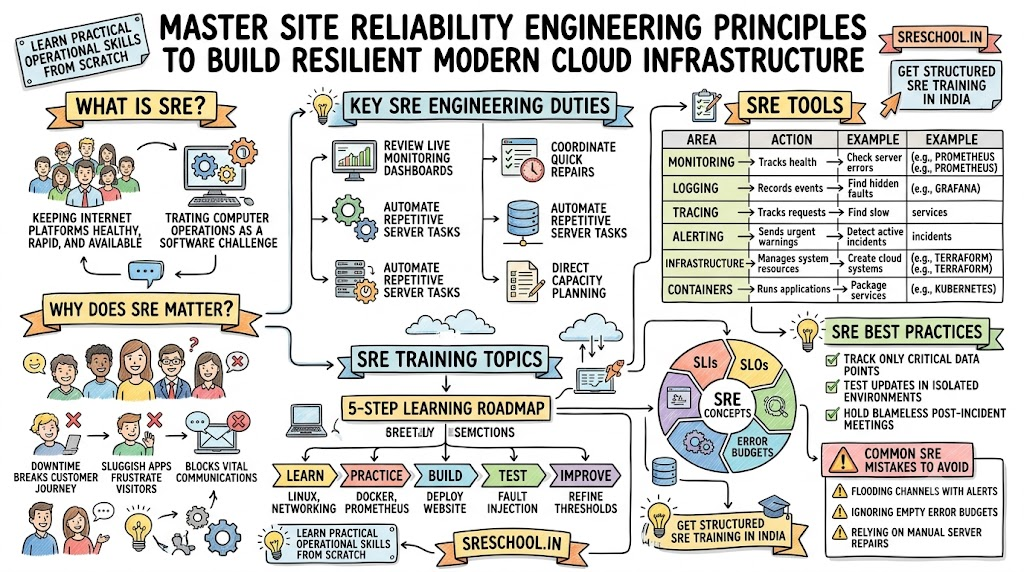
Site Reliability Engineering treats computer operations as a software challenge. Its primary goal is keeping websites accessible, fast, and healthy for visitors. Reliability means an application does its job correctly every single time someone opens it. Users expect web pages to load instantly when they click a link. Engineers call this state of operational health system uptime. Uptime means servers run properly and deliver requested content. Downtime occurs when machines stop functioning and visitors encounter broken pages. Strong engineering maintains high uptime so people stay happy with the service. It also delivers rock-solid stability during sudden traffic surges. Fast page loads matter just as much as steady connections. Automation frees engineers from dull, repetitive manual work. Automation uses code scripts so computers finish mundane chores without human hands. Continuous monitoring watches cloud machines every minute of the day. Monitoring acts like an alert guard dog that catches unusual errors before they hurt users.
Why Does SRE Matter?
People quickly abandon apps that stall or fail during checkout. Computer hardware breaks unexpectedly across data centers every single day. Fiber optic cables snap, power grids fail, and software updates carry hidden errors. Unplanned downtime drives users away and shrinks corporate income within minutes. Customers lose faith in services that crash during critical transactions. SRE protects businesses by identifying small defects before they trigger catastrophic outages. Sophisticated telemetry alerts on-call staff within seconds of a performance drop. The engineering team quickly cures the issue and restores normal speed. Afterward, the team studies the root cause so the same error never returns. Engineers build protective barriers around every core service. This continuous care preserves user trust and safeguards business revenue.
What Does an SRE Engineer Do?
An SRE Engineer guards digital platforms against unexpected failures. They function like airplane mechanics who tune engines mid-flight. First, they inspect live dashboards that display server memory and network latency. When a computer runs hot, a loud alarm sounds. The on-call specialist answers the page and isolates the failing component. Engineers label this swift recovery work incident management. An incident simply means an unexpected failure that hurts end users. The engineer applies a fast repair to revive normal service. Next, they code an automated script that handles that issue automatically in the future. Engineers also forecast capacity needs before massive online holiday sales. They run controlled failure experiments in cloud environments to uncover hidden weak points. They also partner with application developers to design resilient code. Following every major disruption, they analyze the breakdown with an open mind and repair the root flaw.
What Is SRE Training?
Comprehensive SRE Training teaches professionals how to operate massive web platforms without panic. Learners begin by mastering Linux command line operations. Linux runs the vast majority of enterprise cloud servers across the globe. Next, students study observability to inspect the inner health of running software. Courses clarify three essential industry terms: SLI, SLO, and SLA. A Service Level Indicator measures real-time operational performance, like response latency. A Service Level Objective is the internal target that an engineering team strives to achieve. A Service Level Agreement is a formal business contract that promises specific reliability levels to paying customers. Beating the target generates an error budget. An error budget gives development teams room to launch new features safely. Students also practice structured incident response and automated cloud provisioning. Finally, they package software into portable containers using tools like Kubernetes.
Why Consider SRE Certification?
An SRE Certification validates your grasp of core platform engineering fundamentals. Earning a credential helps you organize study hours around an established syllabus. It provides beginners with a structured roadmap of critical concepts to review. However, an exam certificate cannot replace genuine keyboard time. Technology companies hire individuals who can debug broken production systems under pressure. Therefore, you must complete real-world projects alongside your formal exam preparation. Configure an old computer as a home lab server or host an open-source web application. Write small scripts that purposefully interrupt and heal cloud resources. Combining exam preparation with practical lab work helps you master concepts much faster. The certificate proves your conceptual vocabulary, while your labs prove your practical competence. Both assets together strengthen your career portfolio.
What Should an SRE Course Include?
A structured SRE Course presents a clear educational path from beginner concepts to production mastery.
| Stage Number | Stage Title | Key Skills Acquired |
| Stage 1 | Core Fundamentals | Master uptime metrics, system availability, and core reliability goals |
| Stage 2 | Operating Systems | Execute Linux commands, navigate shells, and manage user permissions |
| Stage 3 | Telemetry & Alerts | Build monitoring dashboards and configure alarms for critical events |
| Stage 4 | Reliability Targets | Define service indicators, track error budgets, and measure drift |
| Stage 5 | Incident Workflows | Direct incident bridges, triage damage, and write blameless reviews |
| Stage 6 | Cloud & Containers | Package services with Docker and manage clusters using Kubernetes |
| Stage 7 | Task Automation | Write clean Python or Go scripts to replace manual server chores |
| Stage 8 | Infrastructure as Code | Provision cloud networks programmatically using tools like Terraform |
| Stage 9 | Resilience Testing | Create automated failover systems and conduct disaster recovery drills |
| Stage 10 | Production Operations | Run production-scale traffic, inject faults, and evaluate recovery times |
SRE Training in India
Technology hubs across India now manage critical cloud platforms for global enterprises. Software businesses, financial institutions, and consumer startups are moving workloads to the cloud rapidly. Consequently, engineering managers actively seek professionals who understand systems, scripting, and site stability. Many local teams support mission-critical platforms that operate across multiple international time zones. These engineers must ensure that consumer services stay responsive every second. Simple textbook reading will not keep high-traffic cloud systems running. Engineers want hands-on labs that feature real production tools. SRESchool.in addresses these learning needs by providing structured, practical reliability lessons. These modules prepare engineers to step into modern cloud operations with strong technical confidence.
SRE Tools
Engineers use specialized SRE Tools to audit, provision, and repair web ecosystems. Selecting the right utility helps you find and resolve software defects before users notice them.
| Tool Group | What It Does | Example Use |
| Monitoring | Tracks internal computer metrics | Watch memory consumption and request drop rates |
| Logging | Records system activity | Search log files to isolate an application error |
| Tracing | Maps user request journeys | Find the database call that slows down checkout |
| Alerting | Sends urgent warnings | Page an on-call technician when a server crashes |
| Infrastructure | Provisions cloud assets | Run Terraform scripts to build twenty virtual servers |
| Containers | Isolates software packages | Use Kubernetes to run, scale, and restart apps |
SRE Best Practices
Modern operations thrive when engineers adopt practical SRE Best Practices every single day. Establish clear performance goals so developers know their targets. Monitor clear, actionable signals and ignore meaningless operational noise. Configure precise alert rules so engineers only wake up for genuine emergencies. Reducing alert fatigue keeps responders sharp during real crises. Automate every repetitive task to save time and eliminate human mistakes. Test every configuration change in an isolated sandbox before production release. Prepare for unexpected crashes by drafting clear, step-by-step runbooks. Run blameless post-mortem meetings after every outage to learn from mistakes. Fix fragile software bugs instead of scolding human operators. Plan machine capacity well before peak shopping events to prevent system crashes. Finally, pay down tech debt so your code remains clean, secure, and maintainable.
Real-Life Scenarios / Experiences
- Flash Sale Traffic Surge: A shopping website welcomes fifty thousand bargain hunters in five minutes. Server memory fills up, and product pages slow down. Telemetry systems flag the traffic wave immediately. The orchestration layer adds thirty new virtual nodes to absorb the surge. Shoppers buy their items with zero payment failures.
- Flawed Code Rollout: An engineer ships an update containing a hidden database query error. The login button stops working for mobile users. Tracing tools notice an instant jump in failed logins. The automated deployment pipeline cancels the rollout and reverts back to the old build. The service heals itself in ninety seconds without human intervention.
- Storage Limit Crash: An unmonitored server log consumes the entire hard disk overnight. The API server freezes because it cannot record new transactions. An automatic disk-cleaner script triggers, frees twenty gigabytes of space, and revives the service. The next morning, the on-call engineer adjusts the log-rotation policy to eliminate the root cause permanently.
Common SRE Mistakes to Avoid
- Triggering Alarms for Low-Priority Events: Waking engineers for tiny blips causes burnout. Solution: Route pages only when user-facing services break down completely.
- Assigning Personal Blame for Outages: Blaming individuals forces engineers to conceal critical errors. Solution: Run neutral post-mortems that identify flaws in tool design.
- Tolerating Tedious Manual Chores: Performing manual updates steals valuable engineering time. Solution: Dedicate fifty percent of your calendar to building automation scripts.
- Demanding Flawless 100 Percent Uptime: Chasing absolute perfection stalls all product progress. Solution: Adopt a sensible 99.9 percent target and use the rest as an error budget.
- Neglecting Disaster Drills: Assuming backup drives work without testing leads to data loss. Solution: Restore databases in an isolated test environment every month.
- Shipping Straight to Live Environments: Skipping pre-flight checks causes frequent service outages. Solution: Run automated integration tests in a staging sandbox first.
- Operating Without Emergency Playbooks: Guessing repair steps during a crisis sparks bigger mistakes. Solution: Write explicit runbooks that outline exact commands for common failures.
- Brushing Aside Micro-Errors: Tiny intermittent glitches usually signal larger structural weaknesses. Solution: Review daily error distributions and fix unstable parts early.
How SRESchool.in Can Support SRE Learning
Aspiring engineers find a dependable partner in SRESchool.in for comprehensive Site Reliability Engineering Training. The platform deconstructs modern operations into intuitive, bite-sized lessons for complete beginners. Candidates studying for an official Site Reliability Engineering Certification get clear roadmaps that cover essential operational practices. Reading through a structured SRE Tutorial helps you grasp how operating systems, networking, and cloud components link together. You will also learn to deploy essential SRE Tools to discover and fix system bottlenecks quickly. Absorbing practical SRE Best Practices helps novices build safe operational habits early. Whether you need a starter SRE Course or advanced cloud exercises, the lessons focus on solving realistic engineering headaches. For tech professionals exploring SRE Training in India, this hub delivers practical guidance to build strong production skills. These structured resources give every rising SRE Engineer the confidence to keep enterprise applications fast, reliable, and secure.
SRE Learning Roadmap
- Learn: Master operating system fundamentals, Linux terminal commands, basic networking rules, and clean Python scripting.
- Practice: Spin up small virtual machines inside free cloud tiers to explore system settings.
- Build: Write a simple web app, bundle it inside a Docker container, and host it online.
- Test: Break the app intentionally by overloading memory or dropping network packets to see how it acts.
- Improve: Install telemetry agents, design live monitoring dashboards, and script bots that restart fallen services without human input.
Frequently Asked Questions
1. What tasks fill an SRE’s regular workday?
These professionals safeguard online services so they never crash. They track live graphs to catch anomalies before clients notice any trouble. When an outage occurs, they triage the incident and bring systems back online fast. Afterward, they write code to automate repetitive operations. They also collaborate with product developers to ensure upcoming releases run stably.
2. Can someone switch to SRE without prior background?
Anyone with curiosity and patience can break into this field. You do not need deep expertise on day one. Begin by learning core Linux terminal navigation and writing simple scripts in Python. Study how internet browsers talk to cloud servers. Once you understand the basics, practice configuring simple monitoring dashboards and container tools.
3. What separates SRE from standard DevOps practices?
DevOps serves as a collaborative culture that encourages teams to build and release software fast. SRE provides concrete operational guidelines to achieve that dream using software techniques. SRE defines specific rules for managing outages, measuring system health, and sharing operational workloads. DevOps outlines the philosophy, whereas SRE provides the actual handbook to run it.
4. How do SLIs, SLOs, and SLAs differ from each other?
An SLI measures actual operational performance, such as how many milliseconds a request takes. An SLO is the internal goal your team fights to hit for that metric. An SLA is a formal business contract that promises specific performance levels to clients. Missing SLA thresholds often forces businesses to pay monetary refunds to customers.
5. Why do engineering teams reject 100 percent uptime targets?
Hunting for absolute perfection burns massive budgets and stops innovation entirely. Every new software release brings a tiny chance of failure. Forbidding all downtime prevents developers from shipping exciting new features to customers. SRE uses an error budget instead, giving teams room to launch updates safely while guarding overall stability.
6. Which programming languages should an SRE learn first?
Most engineers choose Python or Go for everyday engineering chores. Python features a readable syntax, making it ideal for creating quick automation scripts. Go delivers high execution speed and powers major cloud frameworks like Docker and Kubernetes. Many engineers also use Bash to execute administrative shell commands directly on remote servers.
7. How does an error budget actually function?
An error budget represents the tiny amount of downtime an application can experience safely. When a team targets 99.9 percent uptime, they reserve 0.1 percent for system risk. Teams use this cushion to launch experimental features. If unpredicted errors burn this entire allowance, the team halts new releases and fixes broken parts immediately.
8. What happens during a blameless post-mortem?
A blameless post-mortem gathers the team after an incident to unpack what went wrong. Engineers reconstruct the failure timeline, identify root causes, and discuss the final fix. Nobody faces punishment or criticism during these debriefs. Instead, engineers upgrade their runbooks and add automated guardrails so that specific bug never recurs.
9. Must I work as a full-stack coder before entering SRE?
Prior experience as a software developer is not mandatory. Many people transition into reliability work from technical support, operations, or systems administration backgrounds. However, you must learn fundamental programming along your path. Writing automation routines represents a core duty of the role, and solid coding skills will simplify your daily work.
10. How does observability differ from basic monitoring?
Monitoring alerts you when an individual server stops responding to network traffic. Observability allows you to look inside complex systems to discover why a service failed. It relies on three primary data streams: metrics, log records, and request traces. These signals help engineers locate mysterious bugs across distributed systems quickly.
11. Why does a blameless culture matter in operations?
A blameless culture treats accidents as system defects rather than personal shortcomings. Humans make mistakes when tools lack proper safety checks. If someone accidentally erases a database, the core fault lies with the tool that allowed that command. Updating the tool protects every team member from making that same mistake again.
12. In what ways does SRE protect business revenue?
SRE keeps customer-facing websites running, ensuring users can buy goods and access services without interruptions. Automated recovery scripts reduce labor overhead by performing routine tasks without human involvement. In addition, thoughtful capacity planning ensures companies pay only for the cloud hardware they genuinely need, lowering recurring hosting invoices.
CONCLUSION
Dependable cloud platforms sustain digital commerce, entertainment, and everyday communications across the planet. Site Reliability Engineering provides a structured approach that tackles tough operational hurdles using software engineering practices. Writing programs to handle mechanical infrastructure chores saves time and maintains service quality. Building an SRE career starts with simple curiosity, hands-on Linux practice, and basic scripting skills. You can expand your expertise by creating small cloud labs, testing failure points, and recording system reactions. Guided learning portals like SRESchool.in offer structured modules that help you develop these operational skills step by step. Adopting these proactive habits will help you design resilient systems that stay fast, dependable, and always available.
