Introduction
Mainstream vacation hubs often exhaust travelers with congested commercial strips, relentless traffic horns, and formulaic resort packages. True rest demands stepping off the beaten circuit and retreating to ancient landscapes where crisp breezes sweep over stone ridges and pine-dusted ridgelines.
Surrounding the Pink City, the ancient Aravalli Range and neighboring highlands reveal a serene network of elevated getaways. These tranquil hill retreats blend royal history with dramatic valleys, offering a deep cultural connection and restorative solitude far removed from urban chaos.
Aravalli hill bastions near Jaipur.
Why Jaipur is a must-visit city
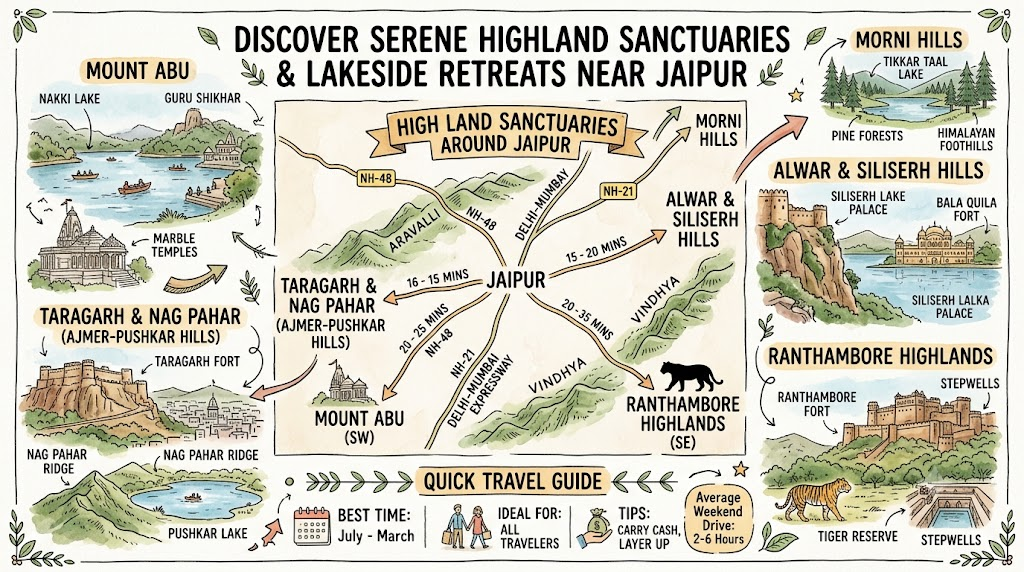
Jaipur stands as the strategic epicenter for exploring north-western India’s oldest fold mountains. Its central placement offers seamless multi-modal connectivity via international air links, the Western Dedicated Freight and Vande Bharat rail corridors, and smooth expressways connecting travelers smoothly into the highlands.
Rather than remaining confined to the plains, discerning travelers use the city as a gateway to explore elevated bastions, lakeside plateaus, and forested crags. This diverse circuit bridges desert kingdoms and elevated green sanctuaries, creating an unmatched blend of regal pampering and alpine calm.
| Travel Dimension | Overview & Regional Specifics |
|---|---|
| Base Elevation / Terrain | 431 m (Jaipur base) rising to 1,220 m (Mount Abu plateau) |
| Peak Relaxation Window | July to March (Monsoon mists and crisp, sunny winters) |
| Primary Highway Arteries | Delhi-Mumbai Expressway (NE-4), NH-48, and NH-21 |
| Core Rail Transit Hubs | Jaipur Junction (JP), Gandhinagar Jaipur (GADJ) |
| Average Weekend Drive | 2 to 6 hours across key highland routes |
Best Places or Experiences
Mount Abu
Perched at the southern tip of the Aravalli Range, Mount Abu is Rajasthan’s only designated hill station, rising above the sun-drenched plains like a floating emerald oasis. Its history dates back to ancient Vedic hermitages, later serving as an aristocratic summer haven for Rajput kings and British colonial administrators seeking relief from summer heat.
The landscape features granite rock outcrops, lush subtropical forests, and the sparkling freshwater expanse of Nakki Lake. Beyond its refreshing mountain breezes, the town showcases stunning white marble architecture at the Dilwara Temples, where intricate stone lace ceilings challenge human craftsmanship
.
Serene waters of Nakki Lake.
- Location: Sirohi District, approximately 495 km south-west of Jaipur via NH-48.
- Why it is worth visiting: The highest peak between the Himalayas and the Nilgiris (Guru Shikhar), featuring rare mountain fauna and ancient Jain shrines.
- Best things to do: Sail across Nakki Lake at golden hour, hike up to Toad Rock for panoramic valley views, and admire the stone carvings inside Dilwara Temple.
- Best time to visit: October to March for crisp mountain chills, or August to September to experience cascading waterfalls during the monsoon.
- Ideal for whom: Couples seeking romantic retreats, nature photographers, and spiritual architecture enthusiasts.
- Travel tip: Book private cars or taxis early for Guru Shikhar, as mountain road checkpoints experience morning queues on long weekends.
Alwar & Siliserh Hills
Nestled within the jagged arms of the north-eastern Aravallis, Alwar pairs formidable fortresses with serene highland lakes. The town sits beneath the dramatic ramparts of Bala Quila, an ancient citadel hugging a 300-meter-high cliff edge that provides breathtaking views across the valley floor.
Just outside town lies Siliserh Lake, created in 1845 by Maharaja Vinay Singh as a scenic royal water retreat. A former royal hunting lodge, now transformed into a heritage hotel, overlooks the tranquil waters where migratory birds glide beneath rugged mountain ridgelines.
- Location: Alwar District, roughly 150 km north-east of Jaipur via NH-21 and the Delhi-Mumbai Expressway.
- Why it is worth visiting: A peaceful blend of dramatic cliffside forts, royal palace architecture, and quiet lakeside boat rides.
- Best things to do: Sip tea on the terrace of Siliserh Lake Palace, drive up the steep switchbacks to Bala Quila, and wander through Moosi Maharani ki Chhatri.
- Best time to visit: November through February, when morning mists drape the tranquil lake waters.
- Ideal for whom: Solo weekenders, birdwatchers, and families looking for easy road trips.
- Travel tip: Drive up to Bala Quila before 4:00 PM; forest department barriers close the hill route promptly before dusk.
Taragarh & Nag Pahar (Ajmer-Pushkar Hills)
The Nag Pahar (Serpent Mountain) forms a natural highland barrier separating holy Pushkar Lake from the historical city of Ajmer. Perched atop this rugged ridge stands Taragarh Fort, one of India’s oldest hill citadels, constructed during the 11th century by King Ajaypal Chauhan.
The drive up Nag Pahar offers winding mountain curves with dramatic valley drop-offs on both sides. Travelers can leave crowded temple shrines behind to enjoy panoramic vistas, where sacred incense smoke mingles with refreshing mountain winds
.
Taragarh Fort’s hilltop ramparts.
- Location: Ajmer District, approximately 135 km west of Jaipur along the six-lane NH-48 highway.
- Why it is worth visiting: Commanding 360-degree viewpoints over Pushkar’s sacred dunes to the west and historic Ana Sagar Lake to the east.
- Best things to do: Trek the rocky footpaths of Nag Pahar, photograph the sunset from Taragarh’s battlements, and relax by the marble pavilions at Ana Sagar.
- Best time to visit: October to March, particularly during early morning hours for cooler, peaceful ascents.
- Ideal for whom: History lovers, spiritual seekers, and panoramic landscape photographers.
- Travel tip: Avoid driving oversized luxury SUVs up the steep, narrow alleys leading to Taragarh; use local auto-rickshaws or agile hatchbacks instead.
Ranthambore Highlands
While famous for royal Bengal tigers, the elevated plateau of Ranthambore encompasses a breathtaking junction where the ancient Aravalli and Vindhya ranges meet. Deep inside the sanctuary, Ranthambore Fort rises atop a sheer 700-foot escarpment surrounded by dense deciduous jungle.
This UNESCO World Heritage hill fort contains ancient stepwells, ruined stone palaces, and solitary Jain temples. Standing along its southern ramparts, travelers can gaze over the wild forest canopy and sparkling lakes while langurs jump across moss-covered stone carvings.
Ranthambore Fort atop the wild ridge.
- Location: Sawai Madhopur District, about 160 km south-east of Jaipur via the Delhi-Mumbai Expressway.
- Why it is worth visiting: An incredible combination of a high-altitude fortress complex set inside a world-class wildlife reserve.
- Best things to do: Explore the massive gates of Ranthambore Fort, spot soaring serpent eagles from the high ramparts, and visit the historic Trinetra Ganesha Temple.
- Best time to visit: October to April, when dry deciduous forests offer clear, expansive visibility.
- Ideal for whom: Wildlife photographers, adventure travelers, and heritage enthusiasts.
- Travel tip: Fort visitors do not need standard jungle safari permits, but walking shoes are essential for the uneven stone stairs.
Morni Hills
For travelers willing to take an overnight express journey northward, Morni Hills provides a lush, pine-scented Himalayan foothills experience. Situated in the Shivalik range, this peaceful retreat offers a complete change of scenery from central Rajasthan’s arid plains.
Morni features rolling green hills, dense sal and pine forests, and two interconnected sacred lakes known as Tikkar Taal. Hidden trekking paths weave through gentle orchards, making it a peaceful sanctuary for writers, wellness travelers, and mountain lovers.
- Location: Panchkula District (Haryana), accessible via overnight direct train from Jaipur to Chandigarh (around 450 km north).
- Why it is worth visiting: The closest true Himalayan foothill environment accessible via direct overnight express links from Jaipur.
- Best things to do: Kayak on Tikkar Taal, hike to the ruins of Morni Fort, and stroll beneath aromatic pine groves.
- Best time to visit: September to April for cool mountain air, and July to August for lush green monsoon hillsides.
- Ideal for whom: Wellness travelers, hikers, and families seeking true mountain vegetation.
- Travel tip: Mobile networks can be intermittent along the lakeside; download offline driving maps before climbing the hill road.
Offbeat Exploration: Hidden Gems Tourists Miss
Garh Ganesh Hill Path
Tucked behind Jaipur’s northern urban edge, this steep, ancient stone staircase leads up to the 18th-century Garh Ganesh Temple. Free from tour buses, this rewarding 500-step climb offers sunrise views across the historic city ramparts as wild peacocks call from surrounding acacia trees.
Hathni Kund Ridge Walk
Located near the forested gorge between Amber and Nahargarh, the Hathni Kund trail winds through seasonal streams and rugged quartzite outcrops. During the monsoon, natural springs pool inside carved stone basins, creating a serene, moss-covered escape just minutes from town.
Bhangarh Valley Viewpoint
While tourists focus on ghost legends inside the ruined market, few venture up the winding hillside pass behind Bhangarh Fort. The elevated forest overlook reveals undisturbed natural amphitheaters framed by dramatic Aravalli ridges.
Detailed Practical Guidance for Travelers
| Destination | Standard Entry Fee | General Timings | Best Local Food Options Nearby | Recommended Nearby Attractions |
|---|---|---|---|---|
| Mount Abu | Free entry (Temple free; lake boating ₹100–₹250) | Open 24/7 (Temples: 12:00 PM – 5:00 PM) | Arbuda Restaurant (Gujarati Thali, Dal Baati) | Dilwara Temples, Toad Rock, Guru Shikhar |
| Alwar & Siliserh | Fort free; Siliserh Lake terrace ₹100 | Fort: 9:00 AM – 5:00 PM; Lake: 8:00 AM – 6:30 PM | Prem Pavitra Bhojnalaya (Kalakand, Gatte ki Sabzi) | Moosi Maharani ki Chhatri, Sariska Tiger Reserve |
| Taragarh (Ajmer) | Free entry | 6:00 AM – 7:30 PM | Ambrosia Pushkar (Falafel, wood-fired pizzas) | Pushkar Ghats, Ana Sagar Lake Baradari |
| Ranthambore Fort | Free entry (Tiger safari fee separate) | Sunrise to Sunset (6:00 AM – 6:00 PM) | The Dining Room at Sawai Madhopur (Ker Sangri) | Trinetra Ganesha Temple, Padam Talao |
| Morni Hills | Free entry (Adventure park activities extra) | Daylight hours (8:00 AM – 6:00 PM) | Highway dhabas near Tikkar Taal (Makki Roti, Sarson Saag) | Tikkar Taal, Morni Fort ruins |
Logistics & On-Ground Navigation
Local Transport Options
- Railways: Jaipur Junction operates frequent daily express trains, including the Ajmer Shatabdi, Vande Bharat, and Mount Abu Express, providing fast, stress-free connections to nearby highland bases.
- Chauffeur-Driven Cars: Hiring an SUV or sedan through trusted regional rental desks gives you flexible pacing along winding mountain switchbacks.
- Self-Drive Vehicles: Available via car-rental apps in Jaipur; ideal for reaching Alwar, Pushkar, and Sawai Madhopur via well-paved national expressways.
- Auto-Rickshaws & E-Rickshaws: Best suited for climbing the steep, narrow lanes of historic towns like Pushkar and Ajmer where big cars struggle.
Budget Planning
- Backpacker Tier (₹1,800 – ₹2,800/day): Travel via public Rajasthan State Road Transport (RSRTC) express buses, stay in heritage hostel dorms or family guesthouses, dine at local dhabas, and explore hill trails on foot.
- Comfort / Mid-Range Tier (₹6,000 – ₹11,000/day): Travel in private air-conditioned sedans, stay in heritage haveli resorts or lakeside properties, dine at traditional thali restaurants, and book guided cultural tours.
Safety and Inclusivity Tips
- Families: Keep children close around unfenced lake promenades and steep fortress bastions lacking perimeter railings.
- Couples: Head to sunset viewpoints early to secure quiet spots away from noisy group tour areas.
- General Safety: Watch out for wild macaque troops near mountain temples; secure loose food, water bottles, and sunglasses inside zipped bags.
Strategic Travel Planning Guardrails
Travel Planning Tips for Jaipur
- Book Winter Stays Early: Highland resorts around Mount Abu and Pushkar fill up weeks in advance during winter and the annual Pushkar Fair.
- Carry Cash for Hill Tolls: While UPI and digital cards work across most shops, small rural tolls, forest checkpoints, and hill dhabas often need cash.
- Layer Your Clothing: Temperature drops rapidly in the hills after sunset; pack a lightweight windcheater and thermal layers between November and February.
- Respect Sacred Mountain Customs: Remove leather footwear, belts, and caps before entering sacred hill temples like Dilwara or Trinetra Ganesha.
- Start Road Trips at Dawn: Leaving Jaipur before 7:00 AM helps you avoid industrial commuter traffic along the bypasses.
Common Mistakes to Avoid
- Overestimating Driving Speeds: Winding mountain roads take twice as long to navigate as multi-lane expressways; build buffer time into your schedule.
- Assuming Hills Stay Warm: Highland plateaus can drop below 5°C in December; traveling with only light cotton clothes leads to uncomfortable evenings.
- Ignoring Local Wildlife Signs: Driving fast through forested park corridors risks dangerous collisions with wild animals.
- Skipping Mountain Sweets: Passing by fresh regional treats like Alwar’s Milk Cake (Kalakand) or Mount Abu’s Rabdi means missing authentic regional flavours.
- Booking Mountain Stays Far Out: Choosing remote, off-grid resorts without confirming access road conditions can leave you stranded on unpaved village trails.
Suggested Itinerary Blueprints
Day Quick Dash (Alwar & Siliserh Lake Loop)
- Target Audience: Travelers short on time wanting scenic hill landscapes without long overnight drives.
- 07:00 AM: Depart Jaipur via the Delhi-Mumbai Expressway toward Alwar.
- 10:00 AM: Drive the mountain switchbacks up to Bala Quila for panoramic Aravalli valley views.
- 01:00 PM: Lunch at Prem Pavitra Bhojnalaya in Alwar for authentic regional thali.
- 03:00 PM: Relax along the shaded terrace at Siliserh Lake Palace.
- 05:30 PM: Enjoy a golden-hour drive back to Jaipur for a late dinner.
Day Deep-Dive (Ajmer, Taragarh & Pushkar Pass)
- Day 1: Depart Jaipur on the morning Shatabdi or private car to Ajmer. Explore the marble pavilions along Ana Sagar Lake, ascend Taragarh Fort for panoramic views, and cross Nag Pahar into Pushkar for a relaxed evening around the illuminated lake ghats.
- Day 2: Rise early for a morning hike up Savitri Temple hill for sunrise views across the sand dunes. Browse Pushkar’s vibrant craft lanes, enjoy lunch at a garden cafe, and return smoothly to Jaipur by late afternoon.
Complete Weekend Travel Plan (Mount Abu Highland Sanctuary)
- Friday: Take an early morning train (Vande Bharat Express) from Jaipur to Abu Road Station. Take a pre-paid taxi up the hill, check into your hotel, and relax with an evening stroll around serene Nakki Lake.
- Saturday: Dedicate your morning to the breathtaking white marble carvings of Dilwara Temples. Have lunch in town, then drive up to Guru Shikhar, the highest peak in Rajasthan, catching dramatic sunset hues from Toad Rock on your descent.
- Sunday: Enjoy an early morning birdwatching walk through Trevor’s Tank sanctuary. Pick up local sweets, descend to Abu Road Station, and catch your return train back to Jaipur.
Common Tourist Mistakes to Avoid
- Geographic Blunders: Trying to visit both Ranthambore’s southern forests and Alwar’s northern ridges on the same day wastes hours stuck on rural connector roads.
- Commercial Traps: Spending afternoons in crowded bazaars when you could be relaxing in peaceful hill groves and quiet temples.
- Neglecting Modern Zones: Missing out on modern, tree-lined cafes in C-Scheme or Vaishali Nagar that make ideal rest stops after long highway drives.
- Transport Overpayment: Taking unmetered hill taxis without checking standard regional board rates. Always negotiate or confirm rates at pre-paid stands.
- Luxury Dining Bias: Sticking only to resort dining halls means missing out on legendary highway roadside dhabas serving piping hot, fresh dal baati churma.
Frequently Asked Questions
1. What is the closest scenic hill station to Jaipur for a quick weekend getaway?
Alwar and the surrounding Siliserh Hills represent the closest scenic highland destination to Jaipur, located roughly 150 km away. Connected by modern expressways, travelers can complete the journey within three hours to enjoy elevated lakeside retreats and ancient hill forts.
2. Is Mount Abu comfortable to visit during the summer months?
Mount Abu offers a noticeably cooler climate than the surrounding desert plains, with summer daytime temperatures rarely exceeding 33°C. The hill station remains a pleasant summer getaway thanks to refreshing breezes around Nakki Lake and thick forest canopies across higher elevations.
3. Do I need an advance permit to visit Ranthambore Fort?
No separate wildlife safari permit is required simply to explore Ranthambore Fort. Visitors can enter during standard daytime hours, though vehicles must register at the park entrance gate and visitors must descend before sunset for wildlife safety reasons.
4. Can I drive a small hatchback car up to Taragarh Fort in Ajmer?
Small hatchbacks can navigate the winding road up to Taragarh Fort, but the final approach narrows significantly through crowded village alleys. Many travelers prefer parking lower down and hiring nimble local three-wheelers to comfortably reach the upper battlements.
5. Which hill destination near Jaipur is best for viewing monsoon greenery?
Alwar, Sariska, and the Pushkar-Ajmer hills turn vibrant green during the monsoon months between July and September. Rain fills seasonal streams, covers ancient dry valleys in lush foliage, and wraps historic stone forts in dramatic mist.
6. Are food choices suitable for strict vegetarians across these hill towns?
Vegetarian dining is abundant throughout Rajasthan’s hill destinations. High concentrations of traditional Marwari and Gujarati pilgrims mean almost every dhaba and restaurant serves pure vegetarian food, including fresh lentils, unleavened breads, and local vegetable curries.
7. How far in advance should I book train tickets to Mount Abu?
Direct train tickets from Jaipur to Abu Road Station should be booked at least three to four weeks ahead, especially during winter months, long holiday weekends, and festival seasons like Diwali when passenger demand surges.
8. Is trekking safe on the Nag Pahar ridge between Ajmer and Pushkar?
Trekking Nag Pahar is generally safe, provided you hike along established paths during clear daylight hours. Always hike in pairs, carry sufficient drinking water, and return before sunset to avoid steep footing and poor visibility.
9. Are automated teller machines and digital UPI payments widely accepted in the hills?
Digital UPI payments via mobile apps work across most boutique hotels, sit-down restaurants, and shopping stores. However, carrying some paper cash is wise for remote toll gates, small tea stalls, and village temple offerings.
10. What clothes should I pack for a winter trip to Mount Abu?
Winter visits between November and February require warm clothing layers. Night-time temperatures frequently drop below 5°C, making warm woollen sweaters, windproof coats, thermal innerwear, and warm socks essential for early morning and evening strolls.
11. Is boating safe for children on Siliserh Lake near Alwar?
Boating on Siliserh Lake is managed under government safety standards, and all passengers must wear life jackets before boarding. Keep children seated calmly, as the lake is deep and occasionally inhabited by freshwater marsh crocodiles.
12. Can elderly family members comfortably visit Dilwara Temples in Mount Abu?
The Dilwara Temple complex is mostly flat with smooth marble corridors, making it manageable for senior travelers once inside. However, leather shoes and belts must be removed outside, so wearing thick cotton socks helps protect feet on cool stone floors.
Conclusion
Escaping to the elevated hill sanctuaries surrounding Jaipur offers more than just scenic photos; it provides a rejuvenating pause for the soul. Sitting atop ancient granite cliffs, watching the sun dip behind misty valleys, and feeling cool mountain winds carry away urban stress reminds you of the quiet magic hidden just beyond the city limits.
