Introduction
Most travelers imagine Jaipur as a sea of terracotta pink walls, packed city palace courtyards, and relentless traffic honking around historic gates. Yet, just minutes past the bustling heritage bazaars lies a dramatically different landscape of dry deciduous forests, craggy granite hills, and wild scrubland.
Here, ancient Aravalli ridge lines provide haven to apex predators, thriving deer herds, and hundreds of resident and migratory bird species. Stepping away from manicured monument corridors and onto the dust-kicked jungle trails brings you face-to-face with Rajasthan’s untamed soul, where regal history and rugged biodiversity co-exist in raw harmony.
Leopard safari tracks in Jaipur.
Why Jaipur is a must-visit city
Jaipur is celebrated globally as a cultural jewel, but its geographical perch at the foothills of the ancient Aravalli Range makes it a premier launchpad for ecotourism. From urban leopard habitats surviving in the center of modern districts to world-renowned tiger corridors a few hours away, the city offers unprecedented accessibility for wildlife lovers.
Modern expressways, double-track rail links, and an international airport make jumping between royal havelis and wild jungle camps seamless for backpackers, family vacationers, and wildlife photographers alike. Whether you have two hours for an evening safari or a full weekend to track apex predators, Jaipur is the undisputed gateway to north-western India’s natural reserves.
| Key Fact | Details |
|---|---|
| Primary Region | Aravalli Foothills & Dhonk Forest Belt |
| Key Apex Predators | Royal Bengal Tiger, Indian Leopard, Striped Hyena |
| Best Travel Season | October to March (Mild weather) / April to June (High predator sightings) |
| Transit Hub | Jaipur International Airport (JAI) & Jaipur Junction (JP) |
| Conservation Focus | Project Tiger, Project Leopard, Wetland Preservation |
Best Places or Experiences
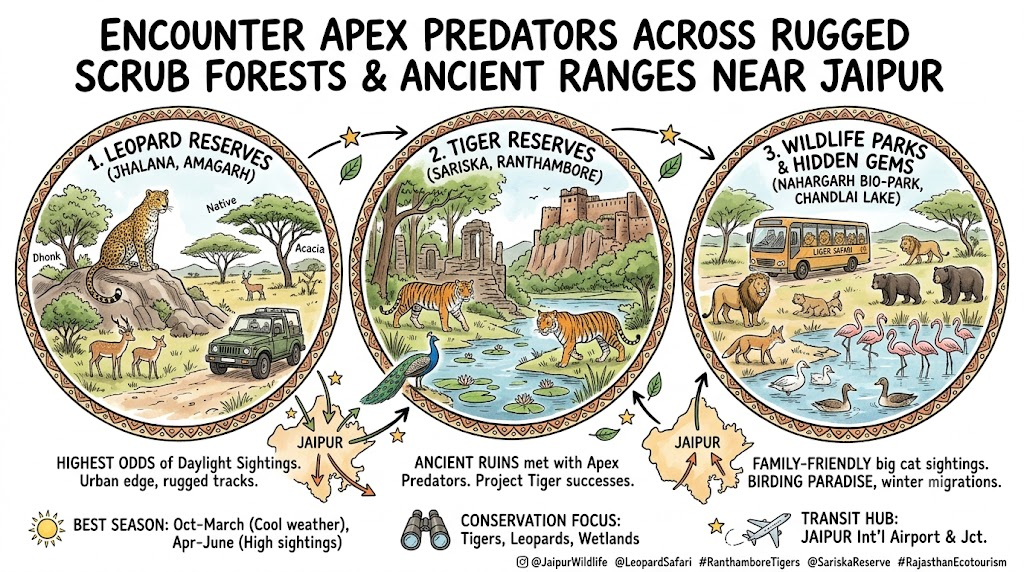
Jhalana Leopard Reserve
Spanning roughly 20 square kilometers right inside Jaipur’s municipal bounds, Jhalana is an unprecedented conservation success story. Once a royal hunting reserve for the Jaipur Maharajas, it was officially designated as India’s first dedicated leopard reserve in 2017.
The forest consists primarily of dry deciduous scrub and Dhonk trees growing over rolling quartzite rocks. Despite flanking modern industrial areas and apartment complexes, Jhalana maintains one of the world’s highest densities of leopards, offering wildlife lovers unmatched odds of daylight big cat encounters.
- Location: Malviya Nagar / Jhalana Dungri, approximately 10 km south-east of Jaipur city center.
- Why it is worth visiting: It provides the highest statistical probability in India of spotting wild leopards roaming freely during daylight.
- Best things to do: Take an open-top 4×4 Gypsy safari, photograph Indian pitta and desert foxes, and visit the historic Shikar Audi (royal hunting lodge).
- Best time to visit: October to April for comfortable weather; early morning or late afternoon safari shifts for optimal predator tracking.
- Ideal for whom: Wildlife photographers, time-pressed urban travelers, and couples seeking quick adventure.
- Travel tip: Book your safari permit online weeks ahead through the Rajasthan Forest Department portal, as vehicle slots per shift are strictly capped.
Sariska Tiger Reserve
Nestled in the craggy Alwar hills, Sariska spans over 800 square kilometers of deep valleys, dry teak forests, and ancient ruins. The park gained international attention when it successfully reintroduced Royal Bengal Tigers following local extinction in the mid-2000s, turning the sanctuary into a resilient haven.
The forest landscape is dotted with historical relics, including the 10th-century Kankwari Fort, medieval Shiva temples, and the ruins of royal pavilions. As your open canter or gypsy climbs through dramatic limestone passes, the mix of dense greenery, screeching peacocks, and tiger alarm calls creates an unforgettable safari atmosphere.
Rugged valleys of Sariska Reserve.
- Location: Alwar District, about 110 km north-east of Jaipur via the Delhi-Jaipur Expressway.
- Why it is worth visiting: A scenic, less-commercialized tiger reserve that merges apex predator safaris with medieval historical ruins.
- Best things to do: Search for tigers across core Zones 1 through 3, climb the cliff-top Kankwari Fort, and explore the ancient Pandupol Hanuman temple.
- Best time to visit: November to March for cool safari drives; early morning slots offer the best light through the forest canopy.
- Ideal for whom: History buffs, road-trippers, wilderness purists, and family groups.
- Travel tip: Private vehicles are allowed up to Pandupol on Tuesdays and Saturdays, causing heavy civilian traffic; book dedicated forest department gypsies on weekdays instead.
Nahargarh Biological Park
Located along the Jaipur-Delhi highway at the base of the Aravalli hills, Nahargarh Biological Park is an expansive eco-tourism facility spread over 720 hectares. Carved out of the Nahargarh wildlife sanctuary perimeter, it was conceptualized to conserve regional flora and fauna while rehabilitating injured wildlife.
The park is home to a dedicated lion and tiger safari enclosure, alongside open naturalistic habitats for Asiatic lions, Bengal tigers, panthers, Himalayan black bears, and sloth bears. Surrounded by native Dhonk and Acacia groves, the sanctuary offers birders fantastic viewing trails around the seasonal Ram Sagar lake.
Nahargarh Biological Park wilderness gateway.
- Location: Kukas, NH-48, around 20 km north of central Jaipur.
- Why it is worth visiting: Reliable, family-friendly big cat sightings and lion safari drives within a quick cab ride of the city center.
- Best things to do: Board the caged open safari bus, walk the interpretive birdwatching trails, and explore the nocturnal animal house.
- Best time to visit: October to February, specifically between 9:00 AM and 12:00 PM when animals bask in the morning sun.
- Ideal for whom: Families with young children, casual nature enthusiasts, and school educational tours.
- Travel tip: The park remains closed on Tuesdays; make sure to rent electric golf carts at the main entrance if visiting with elderly companions.
Ranthambore National Park
World-renowned as the definitive territory of the Royal Bengal Tiger, Ranthambore is located around the historic junction of the Aravalli and Vindhya hill systems. Once the private hunting grounds of the Maharajas of Jaipur, this 1,334-square-kilometer reserve is dominated by the imposing 10th-century Ranthambore Fort perched on high cliffs above the forest canopy.
The park’s unique charm lies in its cinematic scenery, where wild tigers patrol past ancient pavilions, crumbling archways, and lakes blanketed with water lilies. Watching a tigress hunt amidst the ruins of Rajbagh or lounge by the banks of Padam Talao is widely considered one of the pinnacle wildlife experiences on earth.
Wild Royal Bengal Tiger at Ranthambore.
- Location: Sawai Madhopur District, approximately 160 km south-east of Jaipur.
- Why it is worth visiting: The world’s most famous wilderness for photographing wild tigers against historic royal architecture.
- Best things to do: Explore premium lake zones (Zones 2 to 5), climb inside the UNESCO-listed Ranthambore Fort, and photograph marsh crocodiles at Malik Talao.
- Best time to visit: October to April for mild weather; May and June for guaranteed tiger sightings around drying water holes.
- Ideal for whom: Professional photographers, international travelers, and adventurous couples.
- Travel tip: Book permits 90 to 120 days in advance; morning gypsies in Zones 1 through 5 offer the highest sighting probabilities.
Amagarh Leopard Reserve
Opened as Jaipur’s second dedicated big cat sanctuary, Amagarh covers around 15 square kilometers of craggy forest terrain in the eastern hills. It connects to the larger Jhalana forest corridor, creating an expanded sanctuary for leopards, hyenas, and desert cats.
The rugged hilly tracks climb toward the historic Amagarh Fort, offering dramatic panoramic views over the Jaipur skyline. Because vehicle quotas are kept low, exploring Amagarh feels far more raw, secluded, and intimate than busier urban parks.
- Location: Transport Nagar / Ghat Ki Guni, roughly 8 km east of Jaipur Old City.
- Why it is worth visiting: Pristine ridge-line tracks, lower vehicle traffic, and sweeping views of Jaipur’s historical valley.
- Best things to do: Track leopards along rocky cliff ledges, photograph striped hyenas in the twilight, and birdwatch near Galta valley.
- Best time to visit: Late afternoon safari shift for sunset lighting over the surrounding hilltops.
- Ideal for whom: Offbeat adventurers, return visitors to Jaipur, and birdwatchers.
- Travel tip: Combine your safari booking with a morning hike to nearby Galta Ji (the Monkey Temple) for a full day of eco-cultural touring.
Offbeat Exploration: Hidden Gems Tourists Miss
Chandlai Toll Lake Birding Sanctuary
Located roughly 30 km south of Jaipur along the Kota highway, Chandlai Lake is a quiet inland body of water that remains entirely off the commercial tourist radar. During winter, thousands of migratory birds—including bar-headed geese, flamingos, black-winged stilts, and pintails—make this lake their feeding grounds. It is an unfenced, peaceful paradise where photographers can sit along the bund without tourist crowds.
Jawa Ramgarh Forest Enclave
Situated 35 km north-east of the Pink City, the former royal hunting reserve surrounding the dry Ramgarh Lake basin is a pristine expanse of Dhonk and Khair woodlands. While the lake bed itself is mostly seasonal, the surrounding buffer hills host wild nilgai, golden jackals, chinkara gazelles, and rare raptors. It is an exceptional drive for travelers who want wilderness walks away from safari jeeps.
Sambhar Salt Lake Wetland Rim
India’s largest inland saltwater lake sits just 80 km west of Jaipur and transforms into an otherworldly visual spectacle every winter. Millions of greater and lesser flamingos feed in the shallow hypersaline waters, tinting the shimmering salt horizon pink. Driving the dirt bunds between old salt train tracks offers a desert wetland experience found nowhere else in northern India.
Detailed Practical Guidance for Travelers
| Destination | Standard Entry Fee | General Timings | Best Local Food Options Nearby | Recommended Nearby Attractions |
|---|---|---|---|---|
| Jhalana Leopard Reserve | ₹1,200 – ₹1,500 (Indian) / ₹2,800 – ₹3,500 (Foreigner) per seat in Gypsy | Morning: 6:00 AM – 9:30 AM / Evening: 3:30 PM – 6:30 PM | Sethi Tikka Kabab (Raja Park), Indian Coffee House (Jawahar Kala Kendra) | World Trade Park, Patrika Gate, Albert Hall Museum |
| Sariska Tiger Reserve | ₹1,200 – ₹1,400 (Canter) / ₹1,800 – ₹2,200 (Gypsy) | Morning: 6:30 AM – 10:00 AM / Evening: 2:30 PM – 6:00 PM | Dadhikar Fort Dining, Highway King (Pratapsinghpura) | Bhangarh Fort, Siliserh Lake Palace, Kankwari Fort |
| Nahargarh Biological Park | ₹50 (Indian) / ₹200 (Foreigner) + Safari charges | 8:30 AM – 5:30 PM (Closed every Tuesday) | The Forresta Kitchen, Royal Dhaba (Kukas highway) | Amer Fort, Jaigarh Fort, Panna Meena Ka Kund |
| Ranthambore National Park | ₹1,500 – ₹1,900 (Canter) / ₹2,200 – ₹2,800 (Gypsy) | Morning: 6:30 AM – 10:00 AM / Evening: 2:30 PM – 6:00 PM | The Oberoi Vanyavilas Dining, Sky Lounge Sawai Madhopur | Ranthambore Fort, Trinetra Ganesha Temple, Surwal Lake |
| Amagarh Leopard Reserve | ₹1,100 – ₹1,400 (Indian) / ₹2,700 – ₹3,200 (Foreigner) per seat | Morning: 6:00 AM – 9:15 AM / Evening: 3:45 PM – 6:30 PM | Rawat Mishthan Bhandar (Sindhi Camp), Talk of the Town (MI Road) | Sisodia Rani Garden, Galta Ji Temple, Vidyadhar Garden |
Logistics & On-Ground Navigation
Local Transport Options
- Self-Drive / Car Rentals: The best option for long-range trips to Sariska, Sambhar Lake, or Ranthambore; the Delhi-Mumbai Expressway and NH-21 offer smooth multi-lane tarmac.
- App-Based Cabs (Uber / Ola): Reliable and convenient for reaching city-edge parks like Jhalana, Amagarh, and Nahargarh Biological Park without haggling.
- Indian Railways: Fast daily express trains (such as the Jan Shatabdi and Vande Bharat) link Jaipur Junction to Sawai Madhopur (Ranthambore) in under two hours.
- Auto-Rickshaws: Great for short hops to Jhalana or Amagarh gates from central hotels, but agree on return waiting charges in advance since return rides are hard to find outside park gates.
Budget Planning
- Backpacker Tier (₹2,000 – ₹3,500 per day): Stay in boutique hostels in C-Scheme or Bani Park, take the Jaipur Metro and shared autos, opt for canter safaris over private gypsies, and eat hearty dal-baati at local dhabas.
- Comfort / Mid-Range Tier (₹7,000 – ₹14,000 per day): Stay in heritage havelis or jungle lodges, hire private air-conditioned sedans for sanctuary excursions, book private 6-seater safari gypsies, and dine at royal palace restaurants.
Safety and Inclusivity Tips
- Families: Nahargarh Biological Park and Jhalana are easiest for kids due to paved tracks, short drive times, and reliable facilities.
- Couples: Private gypsies in Sariska or luxury wilderness tent camps in Sawai Madhopur offer quiet romance away from city bustle.
- General Safari Safety: Always keep arms and cameras inside the vehicle, wear muted earth-toned clothing (khaki, olive, beige), and never yell or stand up when predators approach your vehicle.
Strategic Travel Planning Guardrails
Travel Planning Tips for Jaipur Wildlife
- Reserve Government Permits Early: All wildlife zones in Rajasthan route through the official state forest booking system; holiday and winter weekend permits sell out months in advance.
- Pack Layers for Winter Safaris: Open-air gypsies in December and January feel freezing during early 6:00 AM departures; bring windbreakers, beanies, and fleece jackets.
- Carry Original Photo ID: Forest checkpoints match your permit name letter-for-letter against your physical passport or Aadhaar card before letting vehicles through the barrier.
- Carry Cash for Local Tips: While park tickets are paid online, safari drivers, forest trackers, and rural dhabas rely primarily on direct cash or local UPI.
- Respect No-Plastic Mandates: All Rajasthan sanctuaries strictly prohibit single-use plastic bottles and polythene snack wraps inside core zones.
Common Mistakes to Avoid
- Assuming You Can Buy Tiger Permits at the Gate: Last-minute window queues at Ranthambore or Sariska are notoriously overcrowded and often sold out; never travel without confirmed permits.
- Wearing Neon Clothing: Bright pinks, yellows, and whites agitate wildlife and cause animals to retreat into dense bush before you can view them.
- Skipping Afternoon Shifts: Many travelers mistakenly book only morning drives; afternoon safaris often produce superior lighting for predator photography near watering holes.
- Forgetting Camera Dust Protection: Sandy dirt trails kick up fine mineral dust; keep lens hoods attached and camera bodies inside zip pouches between sightings.
- Relying Solely on Card Payments: Cell phone towers near remote forest gates are spotty, regularly crashing digital payment card machines.
Suggested Itinerary Blueprints
Day Quick Dash (The Urban Predator Express)
- Target Audience: Business travelers, short-stay visitors, and city sightseers.
- Morning (6:30 AM – 9:30 AM): Board a morning open Gypsy at Jhalana Leopard Reserve to track leopards and striped hyenas.
- Midday (11:00 AM – 2:30 PM): Enjoy an authentic Rajasthani lunch in C-Scheme, followed by a visit to the Albert Hall Museum.
- Afternoon (3:30 PM – 6:30 PM): Head to Amagarh Leopard Reserve for a scenic sunset ridge safari overlooking the eastern valley.
Day Deep-Dive (Palaces, Scarp Ridges & Big Cats)
- Day 1 (Amer Fort & Nahargarh Wilderness): Spend the morning touring Amer Fort and Panna Meena stepwell. After lunch, visit Nahargarh Biological Park for the lion and tiger enclosure safari, followed by sunset drinks at Nahargarh Fort.
- Day 2 (Jhalana & Chandlai Wetland): Start with a dawn safari inside Jhalana Zone 1. Spend the afternoon on a scenic 45-minute drive south to Chandlai Lake to photograph wintering migratory birds.
Complete Weekend Travel Plan (The Wild Royal Triangle)
- Friday: Arrive in Jaipur, explore Old City markets, and take an evening leopard safari at Jhalana. Stay at a heritage hotel in Jaipur. www.jaipurmetroroutes.com
- Saturday: Early morning drive (2.5 hours) down the highway to Sariska Tiger Reserve. Check into a jungle eco-lodge, take an afternoon safari through Sariska Zone 2, and dine around an outdoor bonfire.
- Sunday: Take a dawn safari to the ruins of Kankwari Fort inside Sariska. Check out by midday, stop by the haunted stepwells of Bhangarh on your return leg, and arrive back in Jaipur by evening.
Common Tourist Mistakes to Avoid
- Geographic Blunders: Attempting to combine Nahargarh Biological Park (north) and Jhalana Leopard Reserve (south) in a single afternoon rush causes you to spend your prime wildlife hours stuck in city traffic.
- Commercial Traps: Booking so-called “private elephant or wildlife parks” along the Amer highway; these are often expensive captive tourist compounds rather than protected, authentic forest reserves.
- Neglecting Modern/Alternative Zones: Confining your entire trip within the historic walled city gates and skipping the leafy cafes, galleries, and quiet green enclaves of Malviya Nagar and Jawahar Kala Kendra.
- Transport Overpayment: Paying arbitrary rates demanded by roadside auto-rickshaws outside transit stations; always cross-reference baseline prices with Uber or Ola.
- Luxury Dining Bias: Eating only inside international hotel buffets; missing out on street-corner Pyaaz Kachoris at Rawat or rich clay-cup lassi on MI Road deprives you of Jaipur’s true culinary soul.
Frequently Asked Questions
1. Which wildlife sanctuary is closest to Jaipur city center?
Jhalana Leopard Reserve is the closest wildlife reserve, located merely 10 kilometers from Jaipur’s city center in Malviya Nagar. It takes only 20 to 30 minutes by taxi to reach the entry gates, making it exceptionally convenient for travelers who want wild big cat sightings without embarking on long, exhausting highway journeys.
2. What are my chances of actually seeing a leopard at Jhalana?
Sightings at Jhalana Leopard Reserve are remarkably high, often exceeding 70% to 80% across multiple safari drives. Because the forest tract is relatively compact and bounded by rocky ridges, resident leopards are well-documented and frequently spotted basking on granite boulders, patrolling dirt tracks, or resting around active waterholes during broad daylight.
3. How far is Ranthambore from Jaipur, and can it be done as a day trip?
Ranthambore National Park is roughly 160 kilometers from Jaipur, taking about 3.5 hours by road or less than 2 hours via express train to Sawai Madhopur. While an ambitious day trip is technically feasible by taking a pre-dawn train, booking an overnight stay is strongly recommended to comfortably enjoy both evening and morning safaris.
4. Are safari permits available on the spot at Rajasthan national parks?
While small last-minute “current booking” windows operate at park gates, permits are strictly limited and sell out rapidly to waiting crowds. Booking your safari well in advance through the official Rajasthan Forest Department online portal is essential, especially if you want a six-seater Gypsy or specific core zones during winter weekends.
5. What is the difference between a Gypsy and a Canter safari?
A Gypsy is an open-top, four-wheel-drive six-seater vehicle capable of navigating steep, narrow forest tracks quietly and maneuvering swiftly for wildlife photography. A Canter is an open-air twenty-seater bus; while it offers a more budget-friendly option, it is noisier, restricted to wider main tracks, and less agile during fast-moving sightings.
6. Do wildlife sanctuaries near Jaipur remain open during the monsoon season?
Core zones in major tiger reserves like Sariska and Ranthambore typically close from July 1st to September 30th for the animal breeding season and track maintenance. However, select buffer zones, as well as urban reserves like Jhalana and Amagarh, remain open throughout the year, offering lush, verdant landscapes for off-season adventurers.
7. Is a safari in Jaipur safe for solo female travelers and families with small children?
Yes, Rajasthan forest safaris are highly regulated, professional, and secure for families, solo travelers, and children. Every commercial safari vehicle is accompanied by a registered forest department driver and a licensed nature guide who strictly enforce park safety protocols, keep safe distances from animals, and monitor vehicle movements along designated routes.
8. What camera gear is recommended for wildlife photography in these reserves?
A telephoto zoom lens covering at least 100-400mm or 150-600mm is ideal for capturing wild leopards, tigers, and distant birds from safari vehicles. Bring protective dust sleeves, extra memory cards, and a backup battery, as dusty open-track driving and dry winter winds quickly deplete standard camera equipment over several hours.
9. Can I take my personal private car inside Sariska or Jhalana for a self-drive safari?
Private personal vehicles are strictly barred from entering Jhalana and Amagarh reserves. At Sariska, private vehicles are permitted solely along a fixed asphalt road leading to the Pandupol temple on Tuesdays and Saturdays; all genuine wildlife exploration must be conducted via authorized forest department safari gypsies and canters.
10. What clothes should I pack for a wildlife safari near Jaipur?
Pack neutral, earth-toned clothing like khaki, beige, olive green, and brown to blend into the dry deciduous landscape. If traveling between November and February, dress in warm layers including thermal innerwear, gloves, and a windbreaker, because pre-dawn open-top safari drives through the forest are surprisingly frigid before the sun rises.
11. Are food and snacks permitted inside the wildlife sanctuaries?
Carrying packed food, snacks, and single-use plastic bottles into core wildlife zones is strictly prohibited to prevent littering and animal habituation. Travelers may carry reusable metal water flasks; it is recommended to eat a substantial breakfast before entering the gates or enjoy meals at authorized forest rest stops after exiting.
12. How does Amagarh Leopard Reserve differ from Jhalana Leopard Reserve?
While both sanctuaries share a contiguous eco-belt and protect thriving leopard populations, Amagarh features steeper, hillier terrain centered around ancient ramparts and defensive outposts. Jhalana has flatter scrubland and historically more habituated leopards, whereas Amagarh offers more raw, elevated vistas and lighter vehicle volume on any given safari shift.
Conclusion
Choosing to explore the wildlife reserves around Jaipur transforms an ordinary heritage holiday into a profound encounter with India’s enduring wild heritage. Leaving behind the marble corridors to witness a wild leopard gracefully scale a sunlit granite ridge or a Royal Bengal Tiger stroll through medieval palace ruins connects you to a timeless Rajasthan that few vacationers ever see.
