Jaipur, the capital of Rajasthan, is a city where history isn’t tucked away in textbooks—it lives on in the towering fortresses, buzzing bazaars, and vibrant local life. If you are planning a trip to Jaipur, you might already know it as the “Pink City.” But to experience it fully, you must look past the postcards. Jaipur is an architectural wonderland that effortlessly blends deep culture, local culinary adventures, peaceful sunset spots, and high-energy heritage exploration.
Whether you are traveling as a family, on a romantic couple’s getaway, charting your own path as a solo backpacker, or trying to pack the ultimate experience into a quick weekend trip, this comprehensive Jaipur travel guide will ensure your visit is seamless and unforgettable. At the absolute heart of the city’s royal heritage stands a majestic golden fortress on the hill: Amber Fort (locally spelled as Amer Fort). This ultimate guide covers everything you need to know to explore it like a pro.
Why Jaipur is a Must-Visit City
Jaipur is the cornerstone of India’s famous Golden Triangle tourist circuit, and for good reason. It offers a perfect gateway for travelers looking for a mix of royal grandeur, bustling craft markets, and breathtaking landscapes.
- A World Heritage Site: The historic walled city center is a UNESCO World Heritage site, recognized for its exceptional urban planning and pink-hued architecture.
- Beyond the Forts: While it boasts some of the most impressive military architecture in India, it also offers incredible street food (from spicy Pyaz Kachoris to rich Lassi), thriving local textile and jewelry markets, and serene spots like the Sagar Lake hidden behind the hills.
- Accessible Adventure: It serves as an accessible base for all types of travelers. Budget backpackers can navigate easily using public e-rickshaws, while families and couples can enjoy luxurious heritage stays that make them feel like royalty.
Complete Guide to Amber Fort Jaipur
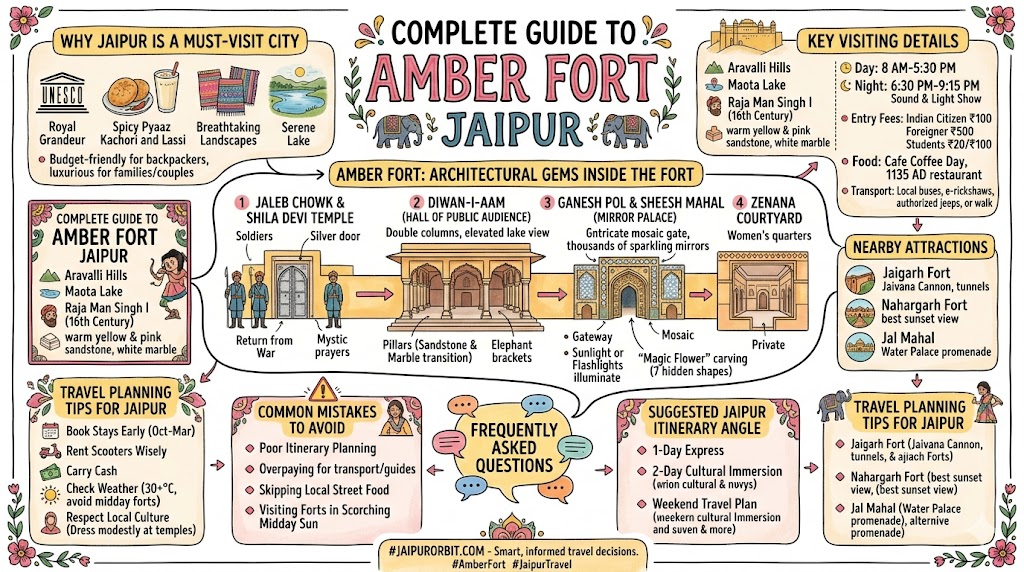
Perched on the rugged Aravalli hills overlooking the glassy waters of Maota Lake, Amber Fort is a 16th-century masterpiece built by Raja Man Singh I. It stands as a stunning testament to the artistic fusion of Rajput (Hindu) and Mughal (Islamic) architecture, crafted out of warm yellow and pink sandstone mixed with pure white marble.
                  [ SUN GATE / SURAJ POL ]
                             │
                             ▼
                    [ JALEB CHOWK ] ───► ( Shila Devi Temple )
                             │
                             ▼
                    [ DIWAN-I-AAM ] (Public Audience Hall)
                             │
                             ▼
                     [ GANESH POL ]  (Intricate Fresco Gate)
                             │
                             ▼
             ┌───────────────┴───────────────┐
             ▼                               ▼
      [ SHEESH MAHAL ]                [ SUKH NIWAS ]
     (Mirror Palace)                 (Pleasure Hall)
             │                               │
             └───────────────┬───────────────┘
                             ▼
                    [ ZENANA COURTYARD ] (Women's Quarters)
Best Places and Architectural Gems Inside the Fort
1. Jaleb Chowk and the Shila Devi Temple
- Location: The primary open courtyard directly inside the main entrance gates.
- Why it is worth visiting: This massive courtyard is where returning armies would display their spoils of war. Tucked into its right corner is the Shila Devi Temple, famous for its grand, embossed silver doors and mystical atmosphere.
- Best things to do: Stand in the center of the courtyard to capture the sheer scale of the fortress walls. Step inside the temple (ensure your head is covered) to witness the intricate silver craftsmanship.
- Best time to visit: 8:00 AM to 9:30 AM to catch the morning temple prayers (Aarti) before the midday heat.
- Ideal for whom: History lovers, cultural explorers, and families.
- Travel tip: You must remove your shoes and leather items (like belts and wallets) before stepping into the Shila Devi Temple complex.
2. Diwan-i-Aam (Hall of Public Audience)
- Location: The second level courtyard, accessible via a grand flight of stone stairs from Jaleb Chowk.
- Why it is worth visiting: It is a magnificent open pavilion featuring a double row of columns. The outer pillars are made of red sandstone, while the inner ones are finished in creamy marble, topped with beautifully carved elephant head brackets.
- Best things to do: Walk through the rows of pillars and observe the transition from sandstone to marble. Look outward to get an elevated, sweeping view of Maota Lake below.
- Best time to visit: Early morning or late afternoon when the low sun casts long, dramatic shadows through the pillars—perfect for photography.
- Ideal for whom: Photography enthusiasts, architecture buffs, and solo travelers.
- Travel tip: Look closely at the top of the columns to spot the tiny carvings of elephants supporting the roof structures.
3. Ganesh Pol and the Sheesh Mahal (Mirror Palace)
- Location: The entrance to the inner, private royal apartments of the Maharaja.
- Why it is worth visiting: Ganesh Pol is a breathtaking gateway covered in fine, colorful frescoes and mosaic work. Beyond it lies the world-renowned Sheesh Mahal, where the walls and ceilings are entirely inlaid with thousands of tiny, convex mirror fragments imported from Belgium centuries ago.
- Best things to do: Admire the symmetry of Ganesh Pol. Step into the Sheesh Mahal and watch how a tiny ray of sunlight or a flashlight illuminates the entire room like a star-filled sky.
- Best time to visit: 11:00 AM to 1:00 PM when the bright overhead sun makes the mirror mosaics glitter at their maximum intensity.
- Ideal for whom: Couples looking for a romantic backdrop, Instagram creators, and first-time visitors.
- Travel tip: Stand under the central arch of the Sheesh Mahal and ask your local guide to show you the “magic flower” carved into the base of one of the marble pillars—it reveals seven different hidden shapes (like a fish tail, a cobra, and an elephant trunk) depending on how you cover it with your hands.
Key Visiting Details
- Timings: 8:00 AM to 5:30 PM (Daytime exploration). The fort reopens from 6:30 PM to 9:15 PM for its beautiful night viewing and the evening Sound and Light Show.
- Entry Fees:
- Indian Citizens: ₹100 per person (₹20 for Indian students with valid IDs).
- Foreign Tourists: ₹500 per person (₹100 for foreign students).
- Night Entry: ₹100 for all categories.
- Sound & Light Show: ₹100 per person for the Hindi show, ₹200 per person for the English show.
- Food Options: Inside the fort complex, you’ll find a small Cafe Coffee Day outlet for quick refreshments. For a luxurious, sit-down royal dining experience, visit the 1135 AD restaurant located right inside the fort walls, which serves authentic, upscale Rajasthani cuisine.
- Local Transport Options: Amber Fort is located roughly 11 km outside the main city center. You can easily book an air-conditioned cab, hire an auto-rickshaw for a round-trip, or catch the budget-friendly local public bus that runs frequently from Hawa Mahal directly to the foot of Amber hill. To go up the fort’s steep ramparts, you can hire a local government-authorized jeep (approx. ₹400 for a round-trip up to 5 people) or enjoy the walk up the stone path.
Nearby Attractions
To make the most of your excursion out to Amer, combine your fort visit with these incredible attractions located just minutes away:
- Jaigarh Fort: Located right above Amber Fort on the cliffside, it is connected via a network of fortified subterranean tunnels. It houses the Jaivana Cannon, which was once the world’s largest cannon on wheels.
- Nahargarh Fort: Perched further down the same ridge, this fort offers the absolute best panoramic sunset views overlooking the entire pink city grid.
- Jal Mahal (Water Palace): Located directly on the road back to Jaipur city center, this low-slung, five-story palace floats elegantly in the middle of Man Sagar Lake. While you cannot enter the palace itself, the lakeside promenade is perfect for a breezy evening stroll and street photography.
Travel Planning Tips for Jaipur
To ensure a smooth, safe, and fully enjoyable heritage holiday, keep these practical tips in mind:
- Book Stays Early During Peak Season: The prime time to visit Jaipur is between October and March when the weather is cool and pleasant. Heritage properties and boutique hotels fill up months in advance, so lock in your bookings early.
- Rent Scooters Wisely: Two-wheelers are a highly cost-effective way for solo travelers and backpackers to explore the city at their own pace. Rent only from licensed agencies and always check that they provide a proper registration card and two helmets.
- Carry Cash for Local Markets: While digital payments (like UPI and cards) are widely accepted in major restaurants and ticket counters, tiny street food stalls and local handicraft vendors in Johari Bazar or Bapu Bazar prefer cash.
- Check the Weather: If you are visiting during the shoulder months (September or April), temperatures can cross 40°C by midday. Plan to see outdoor forts like Amber at 8:00 AM sharp and head to indoor AC museums by noon.
- Respect the Local Culture: Jaipur is a historic city with deep traditions. Dress modestly when visiting religious sites like the Shila Devi Temple or Galtaji (The Monkey Temple)—keep your shoulders and knees covered.
Common Mistakes to Avoid
- Poor Itinerary Planning: Many travelers try to cram Amber Fort, Jaigarh, City Palace, and shopping into a single afternoon. Amber Fort alone requires at least 2.5 to 3 hours to explore properly without rushing.
- Overpaying for Transport and Guides: Always verify guide credentials. Look for the official ID cards issued by the Ministry of Tourism. For auto-rickshaws, negotiate and fix the price firmly before sitting inside, or stick to app-based rides for clear pricing.
- Skipping the Local Street Food: Don’t limit yourself exclusively to your hotel buffet. Missing out on the legendary Pyaaz Kachori at Rawat Misthan Bhandar or the creamy clay-pot Lassi at Lassiwala on MI Road means missing out on the true soul of Jaipur.
- Visiting Forts in the Scorching Midday Sun: Walking up the stone paths of a desert fortress at 1:00 PM will drain your energy rapidly. Always tackle heavy climbing or outdoor exploration in the early morning slots.
Suggested Jaipur Itinerary Angle
Here is how you can seamlessly fit an Amber Fort exploration into various lengths of travel plans:
1-Day Express Plan
- Morning (8:00 AM – 11:30 AM): Beat the rush and head straight to Amber Fort. Explore the beautiful courtyards and Sheesh Mahal.
- Midday (12:00 PM – 2:30 PM): Stop for a quick photo at Jal Mahal on the way back, then head to the walled city for a traditional Rajasthani Thali lunch.
- Afternoon (3:00 PM – 5:00 PM): Visit the iconic Hawa Mahal (Palace of Winds) and step across the street to explore the grand City Palace.
2-Day Cultural Immersion Plan
- Day 1: Dedicate your morning to Amber Fort and the ancient stepwell Panna Meena ka Kund nearby. In the afternoon, explore the astronomical marvels of Jantar Mantar and enjoy an evening sunset view from Nahargarh Fort.
- Day 2: Spend your morning discovering the massive weapons collection at Jaigarh Fort. Dedicate your afternoon to a deep-dive shopping and street food crawl through Bapu Bazar and Johari Bazar.
Weekend Travel Plan
- Friday Evening: Arrive, check into a beautiful heritage haveli hotel, and enjoy a traditional folk dance performance over dinner.
- Saturday: Follow the 1-Day Express Plan but slow it down. End your night by attending the magical evening Sound and Light Show at Amber Fort.
- Sunday: Visit the lesser-known, stunning royal cenotaphs at Gaitor Ki Chhatryan for a peaceful, crowd-free morning before catching your afternoon flight or train back home.
Frequently Asked Questions
1. What is the best time of day to visit Amber Fort?
The ideal window is right when it opens at 8:00 AM. You will experience pleasant morning temperatures, softer lighting for travel photography, and far fewer crowds before the tour buses arrive.
2. How much time do I need to fully explore Amber Fort?
You will need at least 2 to 3 hours to comfortably walk through the four main courtyards, the temples, the mirror palace, and the underlying pathways.
3. Is Amber Fort accessible for elderly visitors or young families?
Yes. If you want to avoid the steep walking ramp, you can hire an authorized jeep at the base of the hill. It will drive your family directly through the back gate (Chand Pol) right into the main Jaleb Chowk courtyard.
4. Can we walk from Amber Fort to Jaigarh Fort?
Yes, there is an ancient fortified uphill path and a tunnel network connecting the two forts. However, it is a moderately steep trek that takes around 20 to 30 minutes. If you are tired, a quick 5-minute auto or cab ride via the mountain road is much easier.
5. Is it safe to travel solo as a backpacker in Jaipur?
Jaipur is highly safe and very welcoming to solo travelers. Just use standard travel awareness: stick to busy, well-lit market areas at night, use authorized transport apps, and politely decline pushy street vendors.
6. What should I wear when visiting the fort?
Wear light, breathable cotton clothing and high-quality walking shoes or sneakers, as you will be walking over stone pavements and climbing stairs. Carry a scarf to cover your head if you plan to enter the Shila Devi Temple.
7. Can I buy a combined ticket for multiple monuments in Jaipur?
Yes! The Rajasthan Tourism Department sells a highly economical Composite Ticket (valid for two days). It covers entry to Amber Fort, Jantar Mantar, Hawa Mahal, Albert Hall Museum, and Nahargarh Fort, saving you significant time and money.
8. Is photography allowed inside the Sheesh Mahal?
You can take photos of the Sheesh Mahal from the open courtyard barrier. To protect the centuries-old, delicate mirror work from heat damage, stepping deep inside the closed glass rooms with heavy professional flash gear is restricted.
9. What is the Amber Fort night tourism experience?
Visiting after 6:30 PM is a completely different experience. The entire fort is illuminated by warm floodlights. While the deep inner rooms are closed off, walking through the glowing main courtyards under the night sky is incredibly romantic and peaceful.
10. Where can I find authentic souvenirs near the fort?
While there are shops right outside the fort, prices can be heavily marked up for tourists. For authentic block-printed textiles, blue pottery, and silver jewelry at local prices, head into the old city markets like Johari Bazar.
Conclusion
Amber Fort is far more than just old stone walls; it is a gateway into the opulent lifestyle, military strategy, and artistic heights of royal Rajasthan. By planning your trip smartly—arriving early, mapping out your paths, and avoiding common tourist traps—you can unlock a genuinely magical travel experience.
When planning your next big adventure to the Pink City, let Jaipurorbit.com be your trusted digital travel companion. We help you skip the guesswork and discover the most authentic local food joints, navigate transportation easily, and uncover hidden, crowd-free cultural corners. Pack your bags, respect the rich heritage, and get ready to create memories that will last a lifetime!
