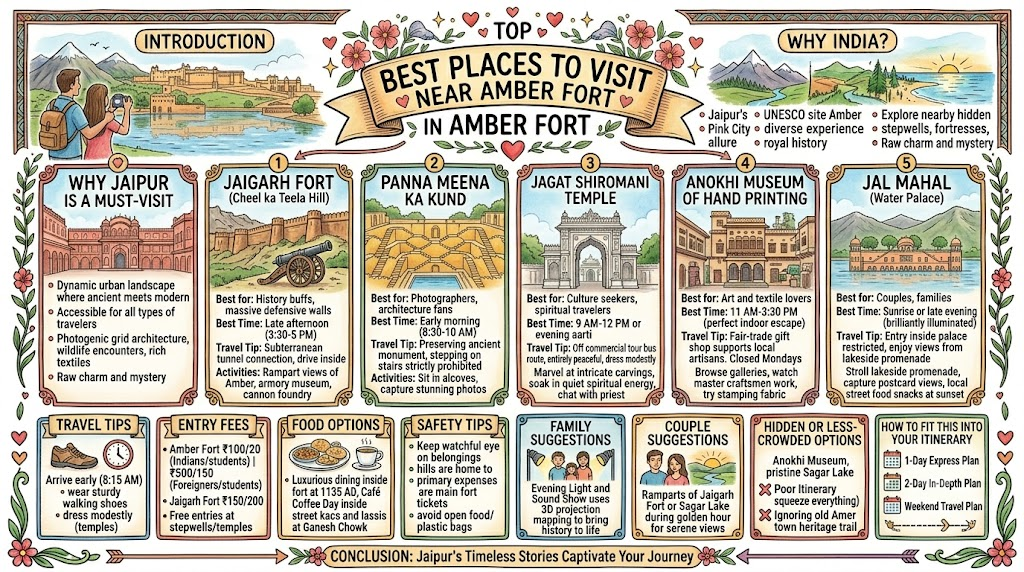
Introduction
Jaipur, the iconic Pink City of Rajasthan, is a destination that captures the imagination of every traveler. While many associate great travel experiences with coastal beaches and late-night party hubs, Jaipur proves that a truly enriching vacation is built on a foundation of heritage, timeless culture, and profound local experiences. The city serves up a masterful blend of stunning mountain backdrops, dramatic fortresses, incredible street food, vibrant local crafts, and a deeply peaceful royal history.
At the absolute center of this royal allure is the majestic Amber Fort (Amer Fort). Perched proudly on the Aravalli hills, this UNESCO World Heritage Site draws millions of visitors each year. However, if you only visit the main palace and head straight back to your hotel, you are missing out on an incredible cluster of nearby wonders. The area surrounding Amber Fort is brimming with hidden stepwells, military fortresses, unique museums, and serene lakeside view points. This practical Jaipur travel guide explores the absolute best places to visit near Amber Fort to help you design a well-rounded, memorable itinerary.
Why Jaipur is a Must-Visit City
Jaipur is far more than just an open-air museum; it is a dynamic urban landscape where the ancient world walks hand-in-hand with modern daily life. It is an accessible destination that caters perfectly to all types of travelers—whether you are a solo backpacker looking for affordable hostels, a couple seeking a romantic heritage retreat, or a family introducing kids to India’s rich history.
The city’s unique grid-like architecture, painted entirely in a warm terracotta pink, makes it incredibly photogenic. Beyond the major Jaipur tourist places, the city offers rich wildlife encounters, world-class textiles, and a legendary culinary scene dominated by rich daal baati churma, spicy pyaaz kachoris, and artisanal sweets. It provides a structured, safe, and welcoming environment for first-time international visitors while retaining enough raw charm and mystery to keep seasoned domestic travelers coming back for more.
Exploring the Areas Surrounding Amber Fort
To maximize your day at Amber Fort, it helps to understand what the immediate area offers. Rather than rushing back to the walled city center, spending an entire morning and afternoon in the historical town of Amer unveils a treasure trove of cultural assets.
Best Places to Visit
The immediate vicinity of the fort is packed with architectural marvels. Right across the road and up the ridge sits its protector fortress, Jaigarh Fort. Down in the valley lies the old historic Amer town, home to the symmetrical Panna Meena ka Kund stepwell and the intricately carved Jagat Shiromani Temple.
Things to Do
- Take a self-guided walking trail through the quiet lanes of old Amer town.
- Photograph the stunning reflection of Amber Fort in the still waters of Maota Lake.
- Watch a live demonstration of hand-block printing at the Anokhi Museum.
Entry Fees
Entry fees vary significantly depending on your nationality and student status:
- Amber Fort: ₹100 for Indians, ₹20 for Indian students, ₹500 for Foreigners, ₹150 for Foreign students.
- Jaigarh Fort: ₹150 for Indians, ₹200 for Foreigners.
- Panna Meena ka Kund & Jagat Shiromani Temple: Free entry.
Travel Tips
Always arrive early! The gates to Amber Fort open at 8:00 AM. Being there by 8:15 AM guarantees cooler morning temperatures, fewer tourist crowds, and perfect lighting for photography. Wear sturdy walking shoes with a solid grip, as you will be navigating steep stone ramps and polished marble staircases.
Nearby Attractions
If you head back toward the center of Jaipur from Amer, you will cross the stunning Jal Mahal (Water Palace) sitting gracefully in the middle of Man Sagar Lake. The base of the Nahargarh hills is also easily accessible from this northern corridor.
Food Options
For a luxurious royal dining experience, you can eat inside the fort at 1135 AD, a restaurant serving authentic Mughlai and Rajasthani cuisine in an opulent hall. For quick bites and a morning caffeine fix, there is a Café Coffee Day operating right within the fort courtyard. If you want a local taste, head down to Ganesh Chowk in Amer town for fresh, steaming kachoris and sweet lassis.
Budget Planning
Exploring the sites near Amber Fort is highly budget-friendly. Because three of the major nearby attractions (Panna Meena ka Kund, Sagar Lake, and Jagat Shiromani) charge no admission fee, your primary expenses will be the main fort tickets and local transportation.
Safety Tips
Keep a watchful eye on your belongings. The hills surrounding Amber Fort are home to large populations of wild rhesus macaque monkeys. Avoid carrying open food items, plastic bags, or flashy hanging accessories that might entice them to snatch your items.
Local Transport Options
The most convenient way to travel the 11 kilometers from central Jaipur to Amer is via app-based cabs (Ola or Uber) or by renting a private auto-rickshaw for the day. Once you arrive at the base of the fort, you can choose to walk up the ramp, hire a government-authorized jeep shuttle for roughly ₹450 return, or take an auto-rickshaw through the back entrance via Chand Pol.
Family-Friendly Suggestions
Families will thoroughly love the evening Amber Fort Light and Sound Show. It uses dramatic 3D projection mapping and a booming voiceover to bring centuries of war, royalty, and romance to life across the fort walls.
Couple-Friendly Suggestions
Couples seeking romance should head to the ramparts of Jaigarh Fort or the banks of Sagar Lake during late afternoon. The golden hour views over the Aravalli hills provide a serene, intimate escape from the bustling city crowds.
Hidden or Less-Crowded Options
While Amber Fort gets packed with tourist buses by midday, the nearby Anokhi Museum of Hand Printing and the pristine Sagar Lake remain wonderfully quiet, offering a peaceful sanctuary for deep exploration.
Best Places or Experiences Near Amber Fort
1. Jaigarh Fort
Perched high on the Cheel ka Teela (Hill of Eagles), Jaigarh Fort was built by Maharaja Sawai Jai Singh II to protect Amber Fort and the royal treasury. Unlike the delicate, artistic design of Amber Palace, Jaigarh is a rugged, imposing military fortress featuring massive defensive walls, an ancient cannon foundry, and breathtaking watchtowers.
- Why it is worth visiting: It houses the legendary Jaivana Cannon, which was the world’s largest cannon on wheels at the time of its casting in 1720.
- Best things to do: Stand on the northern ramparts for an unparalleled bird’s-eye view of Amber Fort below, explore the central armory museum, and view the massive wind-powered cannon foundry.
- Best time to visit: Late afternoon (3:30 PM to 5:00 PM) when the stone walls catch the golden sunlight.
- Ideal for: History buffs, military enthusiasts, photography lovers, and families.
- Travel tip: A hidden, secure subterranean tunnel connects Amber Fort directly to Jaigarh Fort. While the full length isn’t completely open to walk through, you can explore the entry points. If you are traveling by vehicle, you can drive your car right inside the gates of Jaigarh Fort, saving you a strenuous uphill walk.
2. Panna Meena ka Kund
Located down in the valley of old Amer town, this beautifully restored 16th-century stepwell is an engineering masterpiece. It was originally built as a community gathering space and a vital rainwater harvesting pool to sustain the local population during dry Rajasthan summers.
- Why it is worth visiting: The stepwell features an incredibly symmetrical, geometric layout of crisscrossing golden-yellow staircases that create striking visual patterns.
- Best things to do: Sit quietly under the shaded alcoves, observe the brilliant structural engineering, and capture stunning architectural photographs.
- Best time to visit: Early morning (8:30 AM to 10:00 AM) before the midday heat sets in and shadows blur the step patterns.
- Ideal for: Photographers, architecture fans, backpackers, and solo travelers.
- Travel tip: To preserve and protect this ancient heritage monument, stepping down onto the stairs is strictly prohibited by local security guards. Respect the rules and take your photographs from the wide, safe upper viewing platforms.
3. Jagat Shiromani Temple
Tucked away in the quiet, narrow residential lanes of old Amer town, this hidden architectural jewel is dedicated to Lord Krishna, Lord Vishnu, and Meera Bai. Constructed between 1599 and 1608 by Queen Kanakwati in memory of her young son, it stands out as one of the most ornately carved temples in all of Rajasthan.
- Why it is worth visiting: It is believed to house the exact idol of Lord Krishna that the famous poet-saint Meera Bai worshipped in Mewar centuries ago. It is also highly praised for its grand white marble and sandstone torana (ornate entrance archway).
- Best things to do: Marvel at the intricate carvings of elephants, gods, and musicians on the pillars, spend a few moments soaking in the quiet spiritual energy, and chat with the resident priest about the temple’s royal folklore.
- Best time to visit: 9:00 AM to 12:00 PM or during evening aarti.
- Ideal for: Culture seekers, spiritual travelers, architecture enthusiasts, and couples.
- Travel tip: Because this temple sits well off the standard commercial tour bus route, it remains entirely peaceful and uncrowded. Ensure you dress modestly (cover shoulders and knees) out of respect for local customs, and remove your shoes before entering the main courtyard.
4. Anokhi Museum of Hand Printing
Housed in a beautifully restored, multi-story 16th-century haveli (Chanwar Palkiwalon ki Haveli) just a short walk from Amber Fort, this boutique museum is entirely dedicated to the traditional art of woodblock printing.
- Why it is worth visiting: It works diligently to preserve the dying heritage craft of hand-block textiles. The museum clearly illustrates the painstaking process of harvesting natural dyes, carving intricate wooden blocks, and stamping fabrics.
- Best things to do: Browse through the artistic galleries of traditional garments, head up to the open-air roof to watch master craftsmen work, and try your own hand at stamping a piece of fabric to take home.
- Best time to visit: 11:00 AM to 3:30 PM (A perfect indoor air-conditioned escape from the intense afternoon sun). Note that the museum is closed on Mondays.
- Ideal for: Art and textile lovers, solo travelers, families with curious kids, and designers.
- Travel tip: The museum features an excellent, fair-trade gift shop where you can buy authentic, high-quality hand-printed scarves, bags, and home linens, directly supporting local artisan families.
5. Jal Mahal (Water Palace)
Located directly on Amer Road, midway between the central walled city and Amber Fort, this mesmerizing palace appears to float seamlessly in the middle of Man Sagar Lake. Built out of pink sandstone by Maharaja Madho Singh as a private summer lodge, it is surrounded by the scenic Nahargarh hills.
- Why it is worth visiting: It is a unique architectural marvel consisting of five stories, four of which remain completely submerged underwater when the lake is full.
- Best things to do: Stroll down the clean, wide pedestrian lakeside promenade, capture classic postcards views of the palace against the water, and enjoy local street food snacks during sunset.
- Best time to visit: Sunrise or late evening when the entire palace is brilliantly illuminated by golden spotlights.
- Ideal for: Couples, families, evening strollers, and casual sightseers.
- Travel tip: Going inside the actual palace structure or taking boat rides out to it is no longer permitted due to safety and conservation efforts. Plan for a 20-minute stop along the lakeside pathway to take photos on your way to or from Amber Fort.
Travel Planning Tips for Jaipur
Book stays early during peak season
If you are planning a trip to Jaipur between October and March, always book your heritage hotels, boutique stays, or hostels well in advance. Winter brings ideal weather conditions, making it the absolute peak tourist season across Rajasthan.
Rent scooters only with proper documents
Exploring the city on a rented scooter or scooter-bike offers fantastic freedom. However, ensure you rent only from authorized vendors with commercial yellow license plates. Always carry a valid driving license, wear a helmet, and take a quick video of the vehicle’s condition before driving away.
Carry cash for local markets
While digital payment methods like UPI are widely accepted across major monument ticket counters and upscale cafes, smaller roadside eateries, local auto-rickshaws, and traditional handicraft vendors in old Amer town deal exclusively in physical cash. Keep small-denomination notes (₹50, ₹100, and ₹200) readily accessible.
Check weather before outdoor activities
Jaipur’s summer months (April to June) can bring extreme afternoon temperatures often exceeding 40°C. If you plan to hike up the watchtowers or take an early morning hot-air balloon ride over the forts, always cross-check the local weather forecast to avoid heat exhaustion.
Respect local culture and environment
Jaipur values its deeply rooted historical traditions. Dress modestly when visiting functioning religious sites like the Sila Devi Temple inside Amber Fort or the Ambikeshwar Mahadev Temple. Always remove your footwear where indicated and ask for permission before taking photographs of local residents or priests.
Keep the historical sites clean
Many areas surrounding the forts are fragile eco-zones bordered by forests. Do your part by disposing of single-use plastic bottles, snack wrappers, and aluminum cans only in designated trash bins to keep the historical monuments clean for future travelers.
Common Mistakes to Avoid
- Poor Itinerary Planning: Trying to squeeze Amber Fort, City Palace, Hawa Mahal, and shopping into a single rushed afternoon. You will end up exhausted and miss the finer details.
- Visiting Only Crowded Spots: Many tourists visit the main halls of Amber Fort and leave immediately, completely missing the tranquil beauty of the old Amer town heritage trail, Jagat Shiromani Temple, and Panna Meena ka Kund.
- Ignoring the Northern Corridor (Amer Area): Treating Amer merely as a quick stop rather than spending a dedicated full day exploring its rich cluster of nearby military outposts and textile museums.
- Overpaying for Local Rentals: Neglecting to negotiate a fixed price with auto-rickshaws before boarding. Always clarify the final destination price or rely on app-based booking services to ensure a fair rate.
- Skipping the Local Food Scene: Relying solely on continental hotel buffets. Missing out on the authentic street side kachoris, fresh lassis, and traditional Mewari food around the fort gates is a major travel misstep.
How to Fit This Into Your Jaipur Itinerary
| Plan Type | Suggested Daily Schedule around Amber Fort |
| 1-Day Express Plan | 08:00 AM: Arrive early at Amber Fort to explore the main courtyards and Sheesh Mahal. 11:00 AM: Walk down to see the geometric design of Panna Meena ka Kund. 12:30 PM: Enjoy a traditional lunch near Ganesh Chowk. 02:00 PM: Take a short drive up to Jaigarh Fort to view the giant Jaivana Cannon. 05:30 PM: Stop for sunset photos at the Jal Mahal promenade on your way back. |
| 2-Day In-Depth Plan | Day 1: Devote your entire morning and afternoon to the deep heritage of the northern corridor. Explore Amber Fort, hike along the ancient Amer Fort walls, visit the Anokhi Museum, and stay late for the evening Light and Sound Show. Day 2: Focus entirely on central and southern Jaipur. Visit Hawa Mahal at sunrise, explore the majestic City Palace, check the astronomical instruments at Jantar Mantar, and shop for souvenirs in Johari Bazaar. |
| Weekend Travel Plan | Saturday: Explore the majestic forts of northern Jaipur (Amber Fort, Jaigarh Fort, and Nahargarh Fort for a panoramic city sunset view). Sunday: Dive deep into the cultural core. Take a self-guided heritage walking tour of old Amer town (Jagat Shiromani Temple and Ambikeshwar Mahadev), explore the Albert Hall Museum, and enjoy a traditional Rajasthani dinner at Chokhi Dhani. |
FAQs
1. What is the distance between Amber Fort and central Jaipur?
Amber Fort is located roughly 11 kilometers north of the main Jaipur city center (the old walled city). It typically takes about 25 to 30 minutes to reach via car, taxi, or auto-rickshaw along Amer Road.
2. Can we visit Jaigarh Fort directly from Amber Fort?
Yes! Jaigarh Fort sits directly above Amber Fort on the same mountain ridge. They are connected via a historical defensive pathway and a network of subterranean tunnels. You can take a short 5-minute uphill drive or auto-rickshaw ride between the two fort entrances.
3. Is photography allowed at Panna Meena ka Kund?
Yes, photography is completely allowed and free from the upper viewing platforms. However, to preserve the structural integrity of this ancient stepwell, visitors are strictly prohibited from walking down the steps.
4. What are the timings for the Amber Fort Light and Sound Show?
The evening light show generally runs two sessions daily. The Hindi show typically starts around 7:30 PM, followed immediately by the English narration show at 8:30 PM. Timings can shift slightly depending on seasonal sunset hours, so check at the ticket counter in advance.
5. Are there good places to eat near Amber Fort?
Absolutely. For high-end luxury heritage dining inside the fort walls, you can visit 1135 AD. For casual modern snacks and coffee, there is an on-site Café Coffee Day. If you want cheap, delicious local street food, explore the traditional sweet shops near Ganesh Chowk at the base of the fort.
6. Is the Anokhi Museum within walking distance of the fort?
Yes, the Anokhi Museum of Hand Printing is located about 500 meters from the front gates of Amber Fort, housed inside a beautifully restored historic haveli. It takes less than a 10-minute casual walk through the old town lanes.
7. Which is the best month to plan a trip to Jaipur?
The absolute best time to plan a Jaipur itinerary is during the winter season, from October to March. The weather during these months is cool and incredibly pleasant, making it perfect for long hours of outdoor sightseeing and climbing the historic forts.
8. Do I need to hire a guide at Amber Fort?
While you can easily explore the fort visually on your own, hiring a government-certified guide (usually costing between ₹400 to ₹600) or renting an official audio guide device adds immense value. They help unpack the deep historical stories, hidden architectural secrets, and optical illusions built into the Sheesh Mahal.
9. Can we go inside the Jal Mahal?
No, entry inside the actual palace structure of Jal Mahal is strictly restricted to the public to ensure safety and conservation. Visitors can enjoy, admire, and photograph its stunning exterior beauty from the wide, paved pedestrian promenade along the banks of Man Sagar Lake.
10. Is the area around Amber Fort safe for solo female travelers?
Yes, the Amer area and Jaipur in general are highly tourist-friendly and safe. However, standard travel precautions apply: avoid exploring isolated, unlit fort pathways or mountain roads late at night, rely on verified app-based cab services for your transport, and keep your valuables secure.
Conclusion
Amber Fort is undoubtedly the glittering crown jewel of Jaipur’s royal history, but the true magic of the region unfolds when you step off the beaten track. By exploring the magnificent military ramparts of Jaigarh Fort, tracking the geometric beauty of Panna Meena ka Kund, discovering the silent spiritual halls of Jagat Shiromani Temple, and learning traditional crafts at the Anokhi Museum, you transform a standard holiday into a deeply meaningful travel experience.
When planning your next big adventure to the Pink City, make sure to use Jaipurorbit.com as your trusted digital travel companion. Our platform offers comprehensive local guides, hidden insider secrets, practical transport tips, and curated neighborhood breakdowns to help you steer clear of common tourist traps and make smart travel decisions. Explore Jaipur with open eyes, immerse yourself in the local heritage, and let the timeless stories of Rajasthan captivate your journey.
