Introduction
Guest posting remains one of the most effective strategies for expanding digital reach, building authoritative backlink profiles, and establishing brand thought leadership. However, executing a successful campaign involves a complex web of manual tasks, including content creation, publisher discovery, continuous email communication, payment processing, content scheduling, and link tracking. Managing these disconnected steps across multiple spreadsheets and inbox threads often slows down progress and leads to campaign bottlenecks.
As digital marketing evolves, the emergence of an AI guest posting platform offers a streamlined alternative to these fragmented traditional methods. By combining smart drafting tools with modern publisher discovery systems, teams can create structured, high-quality content while dramatically reducing administrative overhead. This guide explores how artificial intelligence and integrated workflows are reshaping the modern guest blogging ecosystem, allowing businesses to scale their outreach efforts efficiently without compromising editorial standards or content relevance.
What Is Guest Posting?
Guest posting is the strategic practice of creating and publishing educational articles on external websites within your industry niche. Businesses, marketers, and professionals leverage this approach to reach established audiences, build brand authority, drive targeted referral traffic, and enhance their online search presence. Beyond SEO benefits, publishing high-quality guest articles helps foster valuable professional relationships with industry peers and expands your overall content distribution network. However, modern guest blogging demands a strict focus on reader value rather than link volume. Every guest contribution must directly serve the host website’s audience by delivering actionable insights, solving specific problems, and maintaining high editorial standards. When executed with a primary focus on relevance and quality, guest posting establishes your brand as a trusted industry resource while driving sustainable long-term visibility.
Why Traditional Guest Posting Is Difficult
Finding relevant websites
Locating high-quality websites for guest articles requires endless manual effort and meticulous evaluation. Marketers must spend hours searching for relevant blogs, evaluating audience suitability, checking organic traffic metrics, and reading strict submission guidelines. Unclear link policies and hidden publishing fees often surface late in the process, making it frustrating to find dependable target websites that genuinely fit your niche and budget requirements.
Creating suitable content
Drafting articles that satisfy different publisher standards is inherently time-consuming and challenging. Each host blog maintains its own unique brand tone, length requirements, formatting preferences, and image specifications. Writers often struggle to adapt their style quickly, leading to frequent revisions or immediate rejections. Preparing custom visual assets and matching specific editorial criteria continuously drains creative resources and slows down publication timelines across campaigns.
Managing communication
Handling publisher outreach through standard email channels frequently creates significant operational friction. Campaign managers spend days chasing initial responses, negotiating publication rates, requesting draft revisions, and confirming payment details. Without automated communication channels, back-and-forth emails lead to lost messages, missed publication dates, and unnecessary delays that frustrate both writers and host site administrators.
Tracking campaigns
Monitoring multiple guest posting initiatives across disjointed tracking tools creates serious organizational clutter. Teams usually rely on complex spreadsheets to store draft links, publisher contact details, payment receipts, scheduled dates, and live publication URLs. As campaign volume grows, managing these disconnected systems becomes overwhelming, increasing the likelihood of errors and severely limiting an organization’s ability to scale its outreach efforts smoothly.
What Is an AI Guest Posting Platform?
An AI guest posting platform is an all-in-one software ecosystem designed to unify the entire guest blogging lifecycle into a single, cohesive workspace. Instead of forcing users to navigate separate tools for writing, outreach, payment, and tracking, this system integrates AI-assisted text generation, image creation, rich editor previews, publisher discovery, payment processing, campaign scheduling, and live link verification. The central goal of such a platform is to automate repetitive administrative duties and accelerate initial draft creation, thereby saving team hours. It does not replace human insight; rather, it empowers marketers, writers, and agencies to focus on strategic content curation, expert editing, and relationship building while eliminating the operational friction typical of traditional outreach methods.
How an AI Guest Post Generator Works
An AI guest post generator processes detailed user inputs to construct structured, contextually relevant article drafts tailored for external publication. Users supply foundational parameters, including targeted article titles, primary topics, specific keywords, intended audience demographics, tone preferences, word count targets, and brief brand guidelines. The system analyzes these inputs using advanced natural language algorithms to generate complete outline structures, introduction paragraphs, body sections, and logical conclusions. Unlike general-purpose AI writing tools that produce generic, unstructured text, a specialized guest post generator focuses specifically on publication-ready formatting, editorial flow, and contextual link placement. This targeted approach allows marketers to transform raw briefs into polished first drafts in a fraction of the traditional time.
The Role of an SEO Guest Post Generator
An SEO guest post generator optimizes content creation by aligning draft structures directly with search engine parameters and user search intent. These systems analyze topic authority requirements, incorporate relevant subheadings, organize logical heading hierarchies, suggest supporting keywords, and maintain optimal readability scores throughout the text. By focusing on semantic depth and natural keyword distribution, the generator helps create balanced drafts that satisfy search algorithms while delivering genuine value to human readers. However, relying on automated tools alone does not guarantee high search rankings. Real organic visibility still depends on fundamental content factors, including topical accuracy, unique perspective, human editorial refinement, host domain quality, and adherence to strict publishing standards across target websites.
Reusable Templates and Content Consistency
Reusable templates are essential for agencies and marketing teams seeking to maintain high content quality across high-volume publishing campaigns. These standardized frameworks define structural parameters, such as introduction styles, heading hierarchies, required tone adjustments, brand description placements, visual asset guidelines, and call-to-action formats. By leveraging pre-configured templates, teams can streamline draft creation while ensuring that every piece of content aligns with strategic campaign objectives. For instance, a digital agency handling multiple client accounts can utilize specific, custom-tailored templates for each client, drastically reducing brief preparation time and preventing brand messaging inconsistencies across host publications. While templates provide essential structural efficiency, writers must still customize each draft to fit the host blog’s specific audience context.
Why Human Editing Is Still Essential
Accuracy
Artificial intelligence can occasionally generate incorrect claims, outdated statistics, or flawed facts. Thorough human fact-checking ensures every data point, reference, and technical detail is completely accurate before submitting the article to host editors.
Originality
Automated drafts often lack real-world depth and personal voice. Skilled editors must inject original case studies, professional insights, practical examples, and unique perspectives to turn standard drafts into authoritative, compelling industry guides.
Relevance
Every target blog maintains a unique reader base with specific preferences. Human editors refine tone, adjust terminology, and adapt messaging so the article naturally aligns with the host publication’s specific audience demographics.
Readability
Algorithms do not always capture natural language nuances. Manual editing polishes paragraph transitions, fixes awkward phrasing, eliminates repetitive vocabulary, and ensures logical narrative flow across the entire article.
Editorial compliance
Host publishers enforce strict submission guidelines and disclosure policies. Human oversight ensures that image formats, link placements, word count limits, and author bio requirements strictly adhere to target site rules.
What Is a Guest Post Marketplace?
A guest post marketplace is a centralized digital directory that connects content creators, marketers, and agencies directly with website owners and publishers willing to host guest articles. These marketplaces allow buyers to browse comprehensive database listings, comparing target blogs based on niche categories, exact publishing URLs, verified monthly traffic metrics, domain authority ratings, and transparent publishing costs across multiple currencies. By centralizing publisher discovery, marketplaces eliminate the time-consuming process of cold emailing and manual site vetting. However, smart marketers know that successful publisher selection requires evaluating qualitative factors like editorial depth and reader engagement, rather than choosing target websites solely based on low costs or inflated traffic numbers.
Guest Blogging Marketplace Versus Manual Outreach
| Operational Feature | Guest Blogging Marketplace | Traditional Manual Outreach |
| Website Discovery | Centralized database with instant filtering options. | Time-consuming manual search and domain vetting. |
| Pricing Transparency | Upfront costs displayed clearly prior to submission. | Variable pricing negotiated slowly over long email chains. |
| Communication Flow | Direct submission forms and structured in-app messages. | Disjointed email threads, lost drafts, and delayed replies. |
| Execution Speed | Rapid placement approvals and scheduled publishing. | Slow response times often taking weeks for approval. |
| Campaign Scalability | High scalability managed through unified dashboards. | Low scalability limited by manual labor constraints. |
| Relationship Building | Transactional focus optimized for speed and volume. | Highly personal relationships built through direct contact. |
| Negotiation Flexibility | Fixed marketplace rates with standardized rules. | Highly flexible terms negotiated per publisher. |
| Campaign Tracking | Automated status updates and instant link indexing. | Manual spreadsheet logging and ongoing tracking checks. |
Guest post marketplaces offer exceptional efficiency, clear pricing, and rapid execution for scaling structured campaigns. Conversely, manual outreach remains valuable for high-tier PR campaigns where personal relationships with top publications are paramount.
How to Evaluate a Guest-Post Website
Selecting the right publisher website requires a comprehensive evaluation framework that prioritizes content context and audience quality over superficial metrics. Marketers must assess topical relevance to ensure the host blog’s core subject matter aligns directly with their industry vertical. Evaluating content quality involves reading recent posts to check for original research, professional editorial standards, and natural link placement. Furthermore, examining publishing frequency reveals whether a domain maintains an active, loyal reader base or functions merely as an inactive link repository. You should also evaluate site user experience, intrusive ad density, link profile health, and pricing transparency. Prioritizing genuine reader alignment and domain reputation over raw traffic figures guarantees safer, highly effective guest post placements.
How a Guest Post Publishing Platform Works
- Project Setup: Define campaign goals, target metrics, brand parameters, and client guidelines within a centralized management workspace.
- Topic Selection: Identify high-value keywords and construct clear article titles that align with search intent and publisher requirements.
- Content Generation: Utilize AI drafting tools or upload custom content briefs to establish initial article frameworks quickly.
- Editorial Refinement: Review, edit, and polish the text in a rich preview editor to ensure accuracy, strong narrative flow, and brand alignment.
- Asset Preparation: Generate or upload high-resolution contextual visuals, optimized featured images, and relevant graphics tailored to host requirements.
- Publisher Search: Filter verified marketplace databases to locate host blogs matching your specific niche, audience size, and budget parameters.
- Listing Comparison: Compare target site metrics, published sample URLs, turnaround times, and pricing details transparently.
- Submission Process: Upload final content drafts, author bio information, target links, and custom publishing instructions directly to the chosen host.
- Order Completion: Finalize secure payment processing via supported currencies using direct pay-per-publication pricing models.
- Publication Scheduling: Choose immediate publication options or set future release dates synchronized with wider marketing initiatives.
- URL Verification: Monitor status dashboards to retrieve live published URLs, verify correct link placements, and track indexation updates.
Automated Guest Post Publishing
Automated guest post publishing streamlines delivery by connecting approval engines directly to host website content management systems. This integration minimizes manual back-and-forth communication, accelerates layout formatting, and eliminates tedious copy-pasting for publishing teams. Automated systems provide clear status updates, letting marketers know precisely when content moves from editorial review to live publication. Despite these technical efficiencies, automation must never bypass editorial standards. Legitimate host publishers must retain complete editorial authority, reserving the absolute right to inspect incoming submissions, request necessary content adjustments, or reject low-quality drafts that fail to meet site standards or reader expectations.
Why Guest Post Scheduling Matters
Strategic content scheduling allows marketing teams to synchronize guest article placements with broader business objectives, such as product launches, seasonal campaigns, major corporate announcements, industry conferences, or regional PR events. Publishing articles at specific times helps maximize audience engagement and ensures external brand coverage aligns with internal promotional calendars. For instance, a software company launching a new feature can schedule multiple guest posts across relevant tech blogs to go live simultaneously during launch week. This coordinated visibility builds strong market momentum, drives targeted referral traffic, and reinforces brand messaging across multiple touchpoints.
+-----------------------------------------------------------------------------------+
|                         INTEGRATED CAMPAIGN TIMELINE                              |
+-----------------------------------------------------------------------------------+
|  [Week 1] Content Strategy & Draft Creation (AI Assistance + Human Editing)       |
|  [Week 2] Publisher Discovery & Marketplace Selection (Transparent Pricing)      |
|  [Week 3] Automated Submission & Publisher Approval (Editorial Verification)      |
|  [Week 4] Scheduled Coordinated Release (Synchronized with Product Launch)        |
+-----------------------------------------------------------------------------------+
Guest Post Management Software for Teams
As marketing agencies and corporate content teams expand their publishing volume, relying on manual management becomes impractical. Dedicated guest post management software replaces messy spreadsheets with unified administrative dashboards that track ongoing drafts, client assets, host domain metrics, order histories, and published URLs. These platforms provide multi-user permission settings, allowing administrators, staff writers, line editors, campaign managers, and external clients to collaborate efficiently within defined roles. Version history logs ensure seamless template updates, while automated workflow notifications inform team members about pending approvals, payment milestones, and live links. Centralizing these assets enhances operational visibility, prevents costly campaign errors, and allows teams to scale outreach seamlessly.
Guest Post Marketplace for Publishers
A guest post marketplace offers website owners and digital publishers a structured avenue to monetize their web properties without compromising site quality. Administrators can list eligible websites, set clear category preferences, outline content guidelines, and establish transparent publishing fees for incoming submissions. The marketplace framework streamlines the submission review process, allowing site owners to review incoming drafts, request editorial adjustments, or reject off-topic content easily. By automating administrative tasks like payment collection and scheduling, publishers can generate reliable site revenue while maintaining total editorial control. Ultimately, publishers who prioritize high content standards and reader trust build long-term value within these marketplace networks.
Where GuestPostAI Fits Into the Workflow
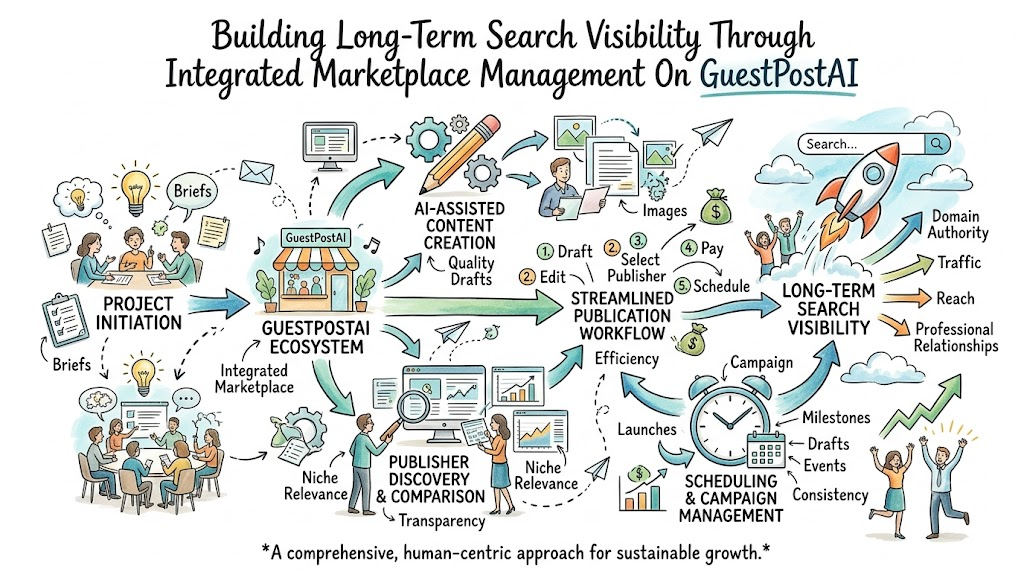
GuestPostAI serves as an integrated software solution designed to streamline the guest blogging workflow within a single, user-friendly platform. Rather than forcing teams to jump between separate content generators, image editors, outreach spreadsheets, and payment portals, the platform unifies these core tasks into one organized environment. Users can generate structured article drafts, edit text, design relevant visuals, and explore a searchable publisher marketplace complete with transparent pricing in USD and INR.
+----------------------------------------------------------------------------------+
|                            GUESTPOSTAI WORKFLOW SYSTEM                           |
+----------------------------------------------------------------------------------+
|  [Drafting & Visuals]  -->  [Publisher Discovery]  -->  [Schedule & Monitor]     |
|  * AI Draft Generator       * Searchable Database       * Flexible Scheduling    |
|  * Image Creator            * Transparent USD/INR       * Live Link Verification |
|  * Reusable Templates       * Pay-Per-Publication       * Multi-Role Tracking    |
+----------------------------------------------------------------------------------+
Operating on a flexible pay-per-publication model instead of requiring recurring subscription fees, the platform allows businesses to pay strictly for the placements they select. Built-in scheduling features and administrative controls help teams coordinate campaigns, manage client projects, and maintain consistent publishing schedules effortlessly. Positioned as a powerful workflow enablement tool, the platform enhances human strategy and editorial oversight, making guest post management more efficient and scalable.
Practical Example of an Integrated Campaign
Consider a digital marketing agency handling guest post outreach for three distinct clients in the finance, SaaS, and e-commerce industries. Under a traditional disconnected workflow, agency staff would waste hours creating content in separate documents, emailing outreach proposals to dozens of publishers, tracking responses across complex spreadsheets, and managing payments through third-party tools. This fragmented process inevitably leads to delayed approvals, lost communication, and scaling bottlenecks that burn through team resources.
By shifting to an integrated campaign workflow, the agency can centralize all client initiatives within a single management workspace. Account managers can quickly build structured briefs using reusable templates, refine AI-generated drafts in an interactive editor, and match content directly with vetted target publishers listed in a searchable marketplace database. Once payments are finalized, the team can schedule publication dates to align perfectly with client product launches. Centralizing content creation, publisher selection, payment processing, and link verification into one workflow eliminates administrative delays, dramatically improves operational efficiency, and ensures consistent quality across all client campaigns.
Best Practices for AI-Assisted Guest Posting
- Research target demographics thoroughly before building content briefs to ensure host alignment.
- Review recent publisher articles carefully to match unique writing styles, tones, and formatting rules.
- Construct clear, highly detailed prompts and content briefs to guide AI drafting tools effectively.
- Use AI tools purely for fast first-draft creation rather than publishing unedited, automated text.
- Fact-check every statistic, data claim, corporate quote, and technical statement thoroughly.
- Incorporate real-world case studies, expert commentary, and unique brand perspectives into every draft.
- Edit every generated article manually to refine paragraph transitions, tone, and overall readability.
- Integrate target keywords naturally into body paragraphs without resorting to search engine manipulation.
- Select publisher domains based on genuine topical relevance, domain health, and reader engagement metrics.
- Maintain clear tracking records of all live publication URLs, anchor text placements, and targeted keywords.
- Follow host disclosure rules and industry guidelines for sponsored or contributed articles transparently.
- Prioritize high editorial standards and audience value over sheer backlink publishing volume.
Common Guest-Posting Mistakes
- Publishing Low-Quality Content: Submitting unpolished, generic, or AI-generated content damages host relationships and hurts brand reputation.
- Ignoring Host Guidelines: Disregarding specific publisher requirements for word counts, formatting, or link limits leads to immediate rejections.
- Over-Optimizing Anchor Text: Forcing exact-match keywords into anchor text creates unnatural phrasing and risks search engine penalties.
- Targeting Irrelevant Sites: Securing links on websites outside your industry vertical dilutes topic authority and brings low-value referral traffic.
- Chasing Metric Shadows: Selecting host websites based entirely on high traffic figures without verifying audience engagement leads to poor results.
- Neglecting Human Editing: Skipping manual editorial reviews allows factual errors, repetitive phrasing, and awkward syntax to reach publishers.
- Conducting Blind Spam Outreach: Sending mass, template-driven pitch emails to random publishers damages domain reputation and drops response rates.
- Mishandling Publication Scheduling: Spreading placements randomly without coordinating them around product launches or PR events wastes campaign momentum.
- Failing to Disclose Partnerships: Hiding sponsored contributions violates editorial guidelines and risks damaging public audience trust.
- Focusing on Quantity Over Quality: Prioritizing high publication volumes over authoritative, well-researched guest articles yields disappointing long-term marketing results.
Limitations and Risks of AI Guest Posting
While AI-assisted guest posting offers significant operational speed, relying entirely on automation introduces serious risks that marketers must actively manage. AI content generators can occasionally produce inaccurate claims, hallucinate false metrics, or output repetitive, generic prose that lacks distinct brand character. Submitting raw, unedited AI drafts to quality publications almost always leads to swift rejection by host editors and damages your outreach reputation. Furthermore, search engines continue to refine algorithms to penalize low-quality, mass-produced content created solely for link manipulation. Over-automating your publishing workflow without rigorous human oversight can harm domain authority, trigger search penalties, and alienate target readers. Maintaining strict manual editing, thorough fact-checking, and thoughtful publisher selection remains essential for running safe, successful guest blogging campaigns.
Future of AI-Assisted Guest Posting
The future of AI-assisted guest posting lies in creating smarter, highly integrated content management systems rather than relying on fully automated writing tools. We can expect significant advancements in automated publisher discovery, where intelligent systems analyze domain authority, link health, and topical relevance to recommend optimal publishing venues instantly. Template management frameworks will become increasingly sophisticated, automatically adjusting draft structures to align with target site formatting rules and audience preferences. Additionally, improved project management tools will streamline multi-role team collaboration, payment workflows, and real-time link indexation tracking. As search engines prioritize original experience and content depth, successful guest posting strategies will blend automated workflow efficiency with human expertise, editorial oversight, and authentic relationship building.
FAQ Section
1. What is an AI guest posting platform?
An AI guest posting platform is an integrated software system that helps marketers create content, find publisher websites, manage payments, schedule posts, and track published links within a single streamlined workspace.
2. Can I publish AI content without editing it?
No, publishing raw AI text without human editing is risky. Automated drafts must be manually checked, fact-verified, and polished to ensure high content quality, accuracy, and host guideline compliance.
3. How does an AI guest post generator work?
An AI generator uses user inputs—such as titles, targeted keywords, audience details, and tone preferences—to automatically build structured, topic-focused article drafts ready for human editing and publication.
4. What is a guest post marketplace?
A guest post marketplace is a digital directory where content creators browse verified host websites, evaluate monthly traffic metrics, check prices, and submit articles directly to site owners.
5. Why is host website relevance important?
Publishing on topically relevant websites ensures your content reaches a genuinely interested audience, builds authentic niche authority, and yields higher-quality referral traffic than publishing on off-topic sites.
6. How does post scheduling improve campaigns?
Scheduling tools allow teams to coordinate guest post releases with wider marketing efforts—such as product launches, PR pushes, or seasonal sales—maximizing brand reach and promotional impact.
7. What is the difference between marketplaces and manual outreach?
Marketplaces offer clear pricing, instant site discovery, and rapid execution, whereas traditional manual outreach relies on personal relationship-building, custom email pitches, and negotiated publication terms over time.
8. How do publishers benefit from marketplaces?
Publishers can monetize web properties securely, set submission guidelines, review incoming content, and accept or reject guest posts easily without dealing with cluttered email inboxes.
9. Does AI guest posting guarantee higher search rankings?
No, AI tools simply streamline drafting and campaign organization. Organic search rankings still depend on overall content quality, domain authority, user engagement, and adherence to search engine guidelines.
10. What are reusable templates in guest posting?
Reusable templates are pre-set structural frameworks that establish heading orders, brand tones, and link formats, helping content teams maintain consistent quality across multiple client publishing campaigns.
11. What risks come with over-automating guest posting?
Over-automation can result in published factual errors, generic content, host rejections, diminished brand reputation, and potential search engine penalties for low-quality link building practices.
12. How does GuestPostAI assist marketing teams?
GuestPostAI simplifies guest blogging by unifying draft generation, image creation, publisher discovery, flexible scheduling, and campaign management into a cohesive, pay-per-publication platform.
Conclusion
Guest posting remains a powerful strategy for expanding online visibility, acquiring high-quality backlinks, and establishing long-term brand authority across digital channels. However, traditional outreach methods often break down under the weight of manual research, endless email threads, disjointed tracking tools, and inconsistent editorial management. Integrating artificial intelligence into drafting, publisher discovery, and campaign scheduling offers a modern, highly efficient path forward for agencies and marketing teams alike.
While advanced platforms streamline tedious administrative tasks and accelerate draft creation, human expertise remains irreplaceable. Thorough fact-checking, manual editorial refinement, and careful publisher vetting are essential to producing valuable articles that resonate with readers and satisfy strict host guidelines. Platforms like GuestPostAI exemplify this balanced approach, providing intuitive workflow software that supports efficient content creation and seamless publisher discovery while keeping editorial quality at the forefront. By blending smart automation tools with human strategy and rigorous editorial standards, businesses can execute scalable, impactful guest posting campaigns that build lasting digital authority.
