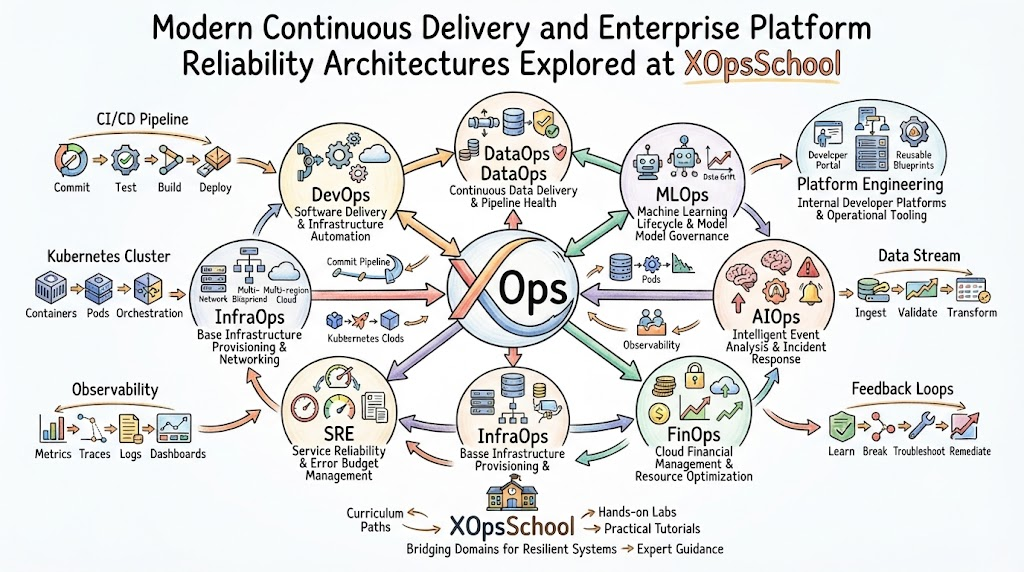
Modern software engineering relies heavily on interconnected platforms, distributed microservices, and continuous data streams. Because traditional operational silos create persistent friction, engineering leaders now look toward unified operational methodologies to bridge the gap between application deployment, data integrity, machine learning lifecycles, and underlying cloud infrastructure. Adopting cross-functional operational knowledge allows cross-functional teams to eliminate communication boundaries, reduce delivery failures, and scale their infrastructure seamlessly. Learning platforms like XOpsSchool highlight how unifying disciplines helps organizations adapt to rapid production changes. In this evolving landscape, modern IT operations adopt an overarching framework known as XOps, which serves as an umbrella approach connecting discrete practices into a cohesive, highly resilient engineering workflow across modern hybrid environments.
What Is XOps?
XOps represents an overarching operational philosophy where the variable “X” stands for any specialized technology domain, including development, data pipelines, machine learning models, platform security, and cloud infrastructure. Instead of treating these areas as isolated technical disciplines with disconnected metrics, this umbrella model treats continuous delivery, governance, and operational resilience as shared responsibilities across the entire software delivery lifecycle. For example, consider a modern predictive e-commerce application where core software features rely directly on continuously updated customer recommendation models. In this environment, application developers trigger continuous delivery workflows, data engineers run continuous data validation pipelines, machine learning engineers maintain automated model evaluation, and site reliability engineers oversee dynamic scaling and distributed telemetry. When security engineers implement automated identity policies, infrastructure teams provision declarative Kubernetes environments, and finance teams track runtime efficiency, the entire system functions as a unified ecosystem supported by interconnected operational practices.
What Does XOps Include?
The operational ecosystem integrates multiple operational disciplines that directly influence software velocity, security posture, data reliability, and production availability. Rather than replacing established methodologies, this model connects them through shared automation patterns, continuous feedback loops, and centralized governance frameworks.
| XOps Discipline | Primary Focus | Typical Responsibilities |
| DevOps | Continuous integration and deployment | Building automated delivery pipelines, managing artifact registries, and automating application releases. |
| DataOps | Data quality, orchestration, and continuous data delivery | Managing data pipeline orchestration, validating input schemas, and monitoring dataset integrity. |
| MLOps | Machine learning lifecycle management | Deploying trained models, tracking feature stores, versioning weights, and detecting drift. |
| AIOps | Intelligent IT operations and event analysis | Correlating high-volume alerts, identifying anomalous behavior, and automating incident triage. |
| SecOps | Continuous security and compliance automation | Scanning dependencies, running dynamic vulnerability checks, and enforcing identity policies. |
| FinOps | Cloud cost visibility and financial governance | Tracking infrastructure expenditures, optimizing resource allocation, and rightsizing clusters. |
| SRE | Systems reliability, availability, and error budgets | Defining service level objectives, designing failover mechanisms, and conducting post-incident reviews. |
| InfraOps | Hardware, virtualization, and base system health | Provisioning compute networks, managing host operating systems, and maintaining hypervisors. |
| Platform Engineering | Internal developer platforms and self-service portals | Building standardized deployment workflows, maintaining golden paths, and streamlining developer environments. |
Each specialized discipline contributes directly to the resilience and speed of modern technology organizations, transforming fragmented operations into a standardized engineering engine.
What Is XOpsSchool?
XOpsSchool functions as a dedicated technical learning and knowledge resource designed to help engineering professionals master modern, cloud-native operational paradigms without encountering promotional noise. The educational platform focuses on the convergence of modern IT delivery practices, covering real-world implementations across container orchestration, automated infrastructure provisioning, continuous deployment, and distributed telemetry. Technology professionals can access structured guides, deep technical explanations, and focused learning tracks designed to clarify how separate disciplines operate collectively in production systems. By providing detailed breakdowns of modern delivery concepts, the platform enables software developers, systems administrators, cloud practitioners, and engineering managers to bridge their individual knowledge gaps and navigate modern production ecosystems with practical engineering confidence.
Why Is XOps Important?
Modern digital architectures have evolved from monolithic deployments running on static virtual machines to distributed, multi-cloud microservices handling petabytes of data alongside real-time predictive models. This structural shift introduces massive operational complexity, making manual management across separate functional departments impossible to sustain without causing service outages or security breaches. When data pipelines fail silently, machine learning models experience drift, or cloud infrastructure costs spike due to untracked workloads, isolated teams inevitably struggle with finger-pointing and delayed remediation. Unifying operational practices eliminates these operational silos by establishing end-to-end operational ownership, consistent observability metrics, and automated cross-domain policies. As organizations face rigorous security standards, strict reliability budgets, and tight deployment deadlines, cross-functional operational alignment provides the visibility and consistency required to operate distributed software systems dependably.
Why Choose XOps Training?
Pursuing comprehensive cross-functional training enables technical professionals to expand their operational perspective beyond isolated scripts and single-purpose deployment tools. Rather than focusing exclusively on basic deployment pipelines, engineers explore how distributed logging, automated security policies, predictive alerting, and data validation interconnect across enterprise systems. This expanded skill set improves day-to-day engineering collaboration, allowing infrastructure specialists, application developers, and data practitioners to communicate effectively using shared architectural standards and deployment goals. Furthermore, mastering interconnected operational principles builds resilience into continuous delivery workflows, as engineers gain practical exposure to cloud-native platforms, self-healing architectures, and proactive observability strategies that strengthen complex production environments.
How Does XOps Training Work in Practice?
An effective cross-functional technical learning journey follows a structured, production-aligned progression that builds foundational systems expertise before introducing advanced automated workloads. Learners begin with core Linux systems administration, low-level networking, secure shell configurations, and Git collaboration workflows before progressing into continuous integration pipelines and automated container packaging. Next, engineers advance into Kubernetes cluster operations, declarative infrastructure as code using tools like Terraform, and managed cloud environments, establishing the foundation for distributed observability, automated security scanning, and reliability engineering practices. Finally, the training incorporates data pipeline orchestration, machine learning operational management, and intelligent event analysis, demonstrating how cross-domain automation ties every layer together through hands-on laboratory exercises and realistic disaster-recovery simulations rather than abstract theory.
XOps Certification: What Should You Look For?
When evaluating a professional technical credential in modern operational disciplines, engineers must look past superficial multiple-choice exams and prioritize programs that demand rigorous, hands-on technical validation. A high-value curriculum should feature realistic infrastructure deployment scenarios, requiring candidates to write declarative code, configure container orchestrators, establish secure network policies, build reliable data flows, and remediate broken deployments in live environments. Prospective learners should carefully inspect whether the evaluation assesses practical observability debugging, automated security checks, incident resolution under pressure, and cross-discipline operational integration across cloud providers. While a recognized credential validates dedicated study and structured foundational knowledge, engineers must treat certification as a structured learning milestone rather than an outright replacement for hands-on production troubleshooting experience.
XOps Tools: Understanding the Technology Stack
Modern cross-functional operations do not rely on a single, universal software vendor or an all-in-one commercial platform; instead, teams assemble modular, interoperable toolchains tailored to specific architecture and reliability demands.
| Operational Area | Example Tools | Practical Purpose |
| Version Control & GitOps | Git, GitHub, GitLab, Argo CD | Managing declarative configurations, code reviews, and automated state synchronization. |
| Continuous Integration | Jenkins, GitHub Actions, GitLab CI | Automating build validations, executing test suites, and producing container images. |
| Container Orchestration | Docker, Kubernetes, containerd | Packaging application runtimes, scaling pods, and managing distributed compute resources. |
| Infrastructure as Code | Terraform, OpenTofu, Pulumi | Defining immutable cloud topologies, network routes, and managed storage declaratively. |
| Configuration Management | Ansible, Puppet, Chef | Standardizing base OS packages, hardening node configurations, and managing state. |
| Telemetry & Observability | Prometheus, Grafana, OpenTelemetry | Scraping runtime metrics, monitoring saturation thresholds, and rendering visual dashboards. |
| Centralized Logging | Elastic Stack, Splunk, Loki | Aggregating distributed transaction logs, indexing events, and accelerating root-cause analysis. |
| Secrets & Security | HashiCorp Vault, Trivy, Snyk | Enforcing dynamic access credentials, scanning dependencies, and securing runtime secrets. |
| Operations Intelligence | Dynatrace, Datadog, BigPanda | Ingesting real-time event telemetry, correlating service alerts, and predicting anomalies. |
Engineering teams consistently choose, integrate, and swap these functional components based on system scale, architectural requirements, regulatory mandates, and platform maturity.
DevOps Training as the Foundation of XOps
Establishing a strong foundation in core continuous integration and delivery practices remains the critical starting point before tackling complex data or model lifecycle operations. Core principles including automated code packaging, trunk-based development, immutable infrastructure definitions, containerization standards, and continuous health checking introduce the essential automation habits required across all operational specializations. Once an engineer masters declarative deployments, blue-green delivery patterns, and fundamental infrastructure automation, applying those identical principles to data extraction pipelines, dynamic machine learning deployments, or automated security scans becomes a natural extension of established engineering practices. Without this baseline engineering discipline, advanced automated workflows quickly collapse under configuration drift and fragile manual interventions.
AIOps Training: Adding Intelligence to Operations
Intelligent IT operations leverage statistical modeling, machine learning algorithms, and real-time heuristics to ingest high-velocity system telemetry, correlate related alerts, and isolate root causes across distributed infrastructures. Rather than overwhelming on-call engineers with thousands of disconnected notifications during an unexpected outage, intelligent monitoring systems group related anomalies, infer dependency relationships, and initiate automated self-healing scripts to stabilize impacted nodes. However, engineers must understand that algorithmic operations depend entirely on reliable, high-quality telemetry data; feeding fragmented logs, noisy metrics, or inconsistent traces into predictive models guarantees misleading operational insights and ineffective remediation routines.
MLOps Training: Taking Machine Learning Into Production
Taking predictive and generative machine learning models from isolated experimental notebooks into reliable, highly available production systems requires combining standard continuous delivery techniques with specialized data and artifact versioning. Practitioners must build automated retraining pipelines, validate incoming feature data, package trained model weights into containerized serving runtimes, and track lineage across diverse training iterations. Furthermore, once an inference service runs live in production, engineers must continuously monitor latency, hardware resource consumption, data distribution shifts, and concept drift to trigger automated model retraining or rollbacks when inference accuracy falls below acceptable operational thresholds.
DataOps Training: Making Data Operations Reliable
Data operations brings software engineering discipline, automated testing, continuous integration, and declarative governance directly to modern enterprise data engineering workflows. Instead of manually inspecting transformation jobs and discovering broken reporting tables hours after an extraction job runs, teams implement automated schema validation, pipeline orchestration, continuous data lineage tracking, and proactive data observability. For example, if an upstream transactional database alters an order column schema unexpectedly, an automated pipeline catches the regression immediately, halts downstream ingestion, alerts data platform engineers, and prevents corrupted financial records from poisoning business intelligence dashboards or machine learning training sets.
Real-Life Scenarios and Production Challenges
- Cross-Disciplinary Release Outage: A retail organization pushed a newly trained fraud-detection service to a production cluster where the application code deployed cleanly, but the underlying data ingestion pipeline had quietly changed customer timestamp formats; the machine learning service began returning empty inference responses, triggering cascading checkout timeouts until cross-functional engineers traced the issue across data, model, and application tiers.
- Silent Pipeline Degradation: A financial analytics platform operated smoothly during regular trading hours, but an unmonitored upstream schema alteration caused daily aggregation tables to drop critical currency fields; because automated continuous testing was missing from the data workflow, analysts worked with incomplete data for two business days before engineering teams added proper schema validation.
- Alert Storm and Incident Fatigue: During a minor cloud network partition, an enterprise platform generated over four thousand discrete alerts across hundreds of microservice nodes within five minutes, completely overwhelming the on-call team until automated event correlation grouped the alerts into a single root-cause network ticket, allowing engineers to resolve the failure promptly.
- Untracked Compute Runaway: An engineering team spun up several specialized GPU-accelerated computing clusters for experimental machine learning training runs without implementing automated teardown policies, leading to thousands of dollars in wasted cloud spend within a single weekend before unified financial tracking and automated resource reclamation scripts were applied.
Common Operational Pitfalls to Avoid in Enterprise Workflows
- Treating Operations as Pure Tooling: Focusing exclusively on learning software tools rather than understanding underlying architectural workflows, distributed systems principles, and organizational delivery habits.
- Ignoring Telemetry Quality: Implementing complex dashboard systems and algorithmic analytics without first cleaning up noisy logs, inconsistent metrics, and disconnected distributed tracing pipelines.
- Skipping Declarative Infrastructure: Making manual configuration changes directly on live production servers instead of enforcing version-controlled infrastructure as code and declarative state management.
- Neglecting Continuous Security: Postponing vulnerability scans, secret rotations, and access reviews until late deployment stages rather than automating security validations directly inside delivery pipelines.
- Decoupling Data from Delivery Lifecycles: Allowing data pipelines and machine learning experiments to operate as unmonitored scripts outside version control, automated testing suites, and standardized deployment workflows.
- Over-Automating Prematurely: Attempting to build complex, self-healing remediation routines before manual troubleshooting steps, system boundaries, and steady-state metrics are fully understood and documented.
- Overlooking Cost Visibility: Provisioning dynamic, auto-scaling cloud resources without configuring budget thresholds, resource quotas, and continuous financial tracking across shared environments.
- Failing to Practice Chaos Engineering: Assuming production systems will survive unexpected cloud outages without intentionally testing dependency failures, latency spikes, and network partitions in controlled testing environments.
How XOpsSchool Can Support the Learning Journey
Engineers seeking to navigate modern operational architectures can use the educational resources available at XOpsSchool to explore the practical concepts underpinning modern software delivery and infrastructure management. The platform provides structured technical guides, hands-on learning resources, and architectural breakdowns focused on core disciplines like Kubernetes management, declarative infrastructure automation with Terraform, continuous delivery strategies, and distributed telemetry. Additionally, learners can explore intermediate and advanced operational topics such as reliability engineering practices, automated event correlation, continuous data pipeline validation, and production machine learning deployments. By contextualizing how disparate technologies function as a unified operational engine, the platform serves as an accessible educational reference point for engineers working to enhance their cross-functional technical capabilities across modern enterprise environments.
How to Get the Most From an XOps Course
To gain lasting competence from any operational curriculum, engineers must transition from passively reading tutorials to actively implementing, testing, and intentionally disrupting production-style environments. A proven educational methodology follows a clear cycle: first understand the foundational architectural concept, then implement it inside a local or cloud sandbox, deliberately introduce failure, troubleshoot the resulting breakages, document the root cause, automate the remediation, and measure the final performance impact. For example, instead of merely deploying a standard web service onto a Kubernetes cluster, learners should actively terminate nodes, throttle network bandwidth, inject faulty configuration maps, and introduce failing health checks to observe how the control plane responds. Investigating generated telemetry, isolating root causes through centralized logs, and codifying corrective automation transforms fragile theoretical understanding into deep, production-ready engineering muscle memory.
Frequently Asked Questions
1. What does the term XOps actually mean in modern enterprise computing?
XOps represents an umbrella operational framework that unifies distinct practices like DevOps, DataOps, MLOps, AIOps, and SecOps into a single continuous delivery and management lifecycle. Instead of treating software, data, models, and infrastructure as isolated technical silos, it promotes shared automation patterns, end-to-end operational visibility, and common reliability metrics across all engineering disciplines.
2. How does an umbrella operational approach differ from standard DevOps?
While traditional DevOps primarily concentrates on bridging the gap between application software development and infrastructure operations through continuous integration and deployment, the broader operational framework expands this methodology. It actively incorporates continuous data pipeline validation, machine learning lifecycle governance, intelligent telemetry analysis, security automation, and cloud cost management into the overall delivery process.
3. Which professionals gain the most value from exploring cross-functional operations?
Software developers, DevOps engineers, systems administrators, site reliability engineers, cloud architects, data engineers, and machine learning practitioners all benefit significantly from understanding interconnected operations. Gaining cross-functional operational knowledge helps technical professionals understand system dependencies, resolve cross-domain incidents faster, and design resilient, cloud-native architectures that operate reliably in production.
4. What foundational prerequisites should an engineer have before exploring cross-discipline operations?
Learners should possess a firm grasp of basic Linux operating system navigation, basic shell scripting, fundamental computer networking principles, and Git version control workflows. Having basic exposure to application development patterns and containerization concepts also accelerates an engineer’s ability to master multi-domain automation and distributed infrastructure management.
5. Why is declarative infrastructure as code essential to multi-domain workflows?
Declarative infrastructure as code allows engineering teams to define servers, network topologies, storage buckets, and access control policies using human-readable, version-controlled configuration files. This eliminates manual configuration errors, guarantees environmental consistency across staging and production, and provides a clear audit trail for infrastructure modifications across diverse operational teams.
6. What specific role does AIOps play in managing modern microservice architectures?
Intelligent operational tools ingest massive streams of distributed system telemetry to detect subtle performance anomalies, correlate related operational alerts, and isolate root causes across interconnected microservices. This prevents severe alert fatigue among on-call engineers and automates immediate incident triage before localized service degradations escalate into widespread customer-facing outages.
7. How does DataOps prevent downstream operational and analytical failures?
Data operations introduces version control, automated schema validation, continuous pipeline integration, and continuous data testing directly into data engineering pipelines. Catching malformed records, missing fields, or unexpected schema alterations early at ingestion points prevents corrupted datasets from breaking business intelligence dashboards or poisoning downstream machine learning models.
8. What core technical disciplines are covered under an effective multi-domain learning track?
A complete technical curriculum covers version control, automated continuous delivery pipelines, containerization, Kubernetes cluster orchestration, declarative infrastructure provisioning, distributed observability, automated security scanning, data pipeline orchestration, production machine learning lifecycles, and intelligent event correlation.
9. Does earning a technical certification guarantee success in production engineering roles?
A structured certification validates focused study, foundational theoretical knowledge, and disciplined mastery of core concepts, but it cannot replace real-world engineering troubleshooting experience. Enterprise engineering teams value practical problem-solving capabilities, production disaster-recovery experience, and hands-on laboratory work far more than paper credentials alone.
10. Can small startups benefit from implementing multi-domain operational practices?
Startups benefit immensely by establishing lightweight, automated operational foundations early, which prevents complex technical debt and operational silos from taking root as the company scales. Applying basic automated testing, declarative infrastructure definitions, and continuous data checks allows small engineering teams to release features rapidly while maintaining high platform stability.
11. What common technical tools are standard across multi-domain operational stacks?
Commonly adopted tools include Git, Docker, Kubernetes, Terraform, Jenkins, GitHub Actions, Argo CD, Prometheus, Grafana, the Elastic Stack, HashiCorp Vault, and various specialized cloud-native telemetry platforms. Organizations select, combine, and replace these open-source and enterprise components according to their specific architectural needs, security mandates, and infrastructure scale.
12. How does platform engineering complement modern cross-functional operational goals?
Platform engineering teams design, build, and maintain internal developer platforms that package complex infrastructure, deployment pipelines, security compliance checks, and observability setups into self-service golden paths. This reduces cognitive load for application, data, and machine learning engineers by allowing them to deploy and monitor their services independently without constant manual operational intervention.
Summary
Modern software architectures demand a fundamental transition away from fragmented operational silos toward unified, cross-functional engineering workflows that connect application delivery, reliable data pipelines, production machine learning models, and secure cloud infrastructure. By mastering the core principles of shared automation, declarative state management, comprehensive distributed telemetry, and proactive operational resilience, engineering teams can build platforms capable of supporting rapid innovation without sacrificing system availability or data integrity. Embracing a holistic operational mindset enables technical professionals to collaborate effectively across traditional discipline boundaries, ensuring that every layer of the enterprise technology stack remains scalable, secure, and resilient against inevitable production disruptions.
