Introduction
Beyond the sun-drenched ramparts of Nahargarh and the buzzing crowds jostling for selfies at Hawa Mahal, another dimension of Rajasthan’s capital quietly flourishes. While mainstream travel checklists push visitors through open-air tourist traps under blistering desert sunbeams, Jaipur’s true artistic and aristocratic legacy thrives behind climate-tempered arches, serene palace corridors, and private gallery wings.
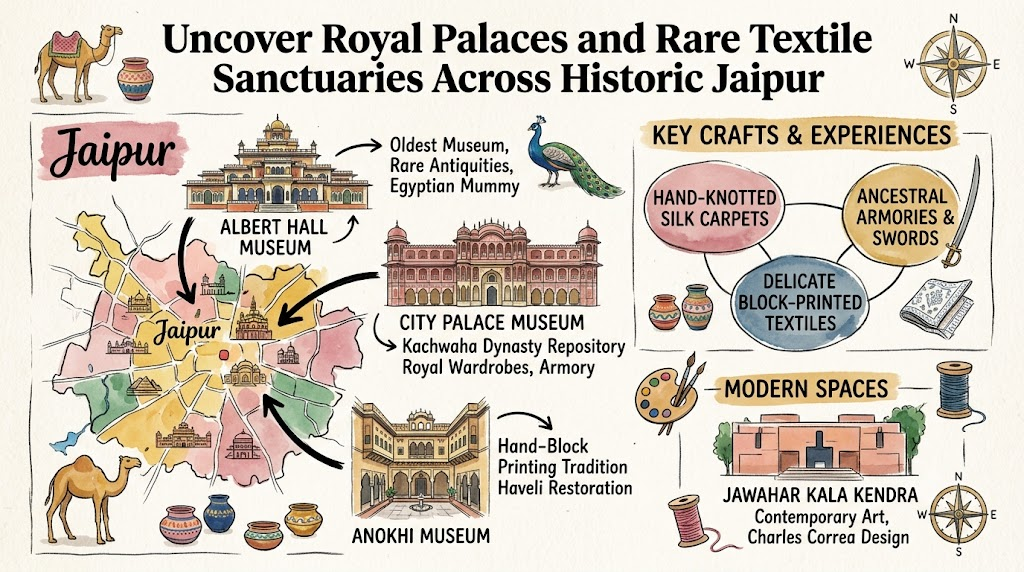
Stepping inside these sheltered architectural sanctums reveals an intimate world of hand-knotted silk carpets, ancestral armories, and delicate block-printed textiles. These indoor retreats do not merely provide solace from midday heat; they connect you deeply to royal patronage, creative intellect, and centuries of living craftsmanship that generic sightseeing simply ignores.
Albert Hall Museum’s ornate indoor gallery.
Why Jaipur is a must-visit city
Jaipur stands as an essential pillar in global travel because it was India’s first planned city, conceptualized in 1727 by Maharaja Sawai Jai Singh II and architect Vidyadhar Bhattacharya according to Shilpa Shastra principles. Geographically situated along ancient trade routes and backed by the protective Aravalli range, the Pink City harmonizes warrior grit with unmatched artistic sophistication. Modern accessibility is seamless: broad expressways link it to New Delhi in under four hours, direct flights connect Jaipur International Airport to major global hubs, and a central railway network makes it effortless for solo backpackers, couples, and luxury families to navigate.
The classic Golden Triangle travel circuit places Jaipur alongside Delhi and Agra, yet Jaipur holds the richest regional craft concentration. Exploring the indoor circuit offers travelers a balanced alternative to outdoor hill forts, focusing instead on world-class museology, heritage textiles, royal residential archives, and contemporary visual arts.
| Key Fact | Details |
|---|---|
| Location & Coordinates | Eastern Rajasthan, Northern India |
| Best Travel Season | October to March (Pleasant weather; indoor spots great year-round) |
| Nearest Transit Hubs | Jaipur International Airport (JAI), Jaipur Junction (JP) |
| Primary Indoor Specialties | Royal armories, Mughal-Rajput miniatures, hand-block printing, Indo-Saracenic museology |
| Ideal Indoor Circuit Duration | 2 to 3 days |
Best Places or Experiences
Albert Hall Museum
Commissioned in 1876 during the visit of the Prince of Wales, this monument stands as the pinnacle of Indo-Saracenic design in Rajasthan. Designed by Sir Samuel Swinton Jacob, its vaulted interior corridors, stone jaali screens, and carved plaster pillars showcase a seamless aesthetic synthesis of Islamic arches and Hindu architecture.
Inside, natural light filters across massive halls that house an eclectic royal collection. Walking along its mezzanine walkways lets you inspect centuries of Persian Persian garden carpets, stone sculptures, metal craft, and even an authentic Ptolemaic-era Egyptian mummy resting inside an atmospheric central chamber.
- Location: Ram Niwas Garden, Kailash Puri, roughly 4 km south of the walled city center.
- Why it is worth visiting: It is the oldest museum in Rajasthan, preserving rare antiquities, royal decorative arts, and international heritage collections under one roof.
- Best things to do: View the 2,300-year-old Egyptian mummy named Tutu, admire the massive 17th-century Persian Garden Carpet, and study miniature portraits of Amber rulers.
- Best time to visit: Arrive between 11:00 AM and 1:00 PM for fewer school groups and clear ambient lighting through the clerestory windows.
- Ideal for whom: History buffs, architecture students, and curious culture lovers.
- Travel tip: The museum remains open for night viewings under floodlights, but daytime offers superior visibility for studying fine catalog details.
Maharaja Sawai Man Singh II Museum (City Palace)
Nestled within the fortified inner sanctuaries of the City Palace complex, this museum functions as a living repository of the Kachwaha dynasty. While tourists gather in public courtyards, the indoor halls of Mubarak Mahal and the Sarvato Bhadra armory display the personal wardrobes, ceremonial regalia, and battle gear of Jaipur’s former monarchs.
The textile wing displays embroidered pashminas, brocade royal gowns, and the astonishingly massive quilted garments of Maharaja Sawai Madho Singh I. Adjacent arms galleries present Damascus steel swords, jewel-encrusted daggers, and historic matchlocks that provide an unfiltered look into Rajput defensive mastery.
Mubarak Mahal’s intricate sandstone pavilion.
- Location: J.D.A. Market, Pink City, walking distance from Hawa Mahal.
- Why it is worth visiting: Unmatched collection of historic Rajput textiles, personal royal letters, miniature paintings, and antique weapons.
- Best things to do: Examine the gigantic 1.2-meter-wide brocade royal robes, inspect the ivory-inlaid ceremonial blades, and marvel at the massive silver Gangajalis jars.
- Best time to visit: 12:30 PM to 3:00 PM, avoiding outdoor midday sun while exploring climate-controlled galleries.
- Ideal for whom: Aristocratic history lovers, antique collectors, and luxury travelers.
- Travel tip: Upgrade to the composite ticket that includes interior access to Chandra Mahal’s painted rooms like the blue-washed Sukh Niwas.
Anokhi Museum of Hand Printing
Housed in the restored Chanwar Palkiwalon ki Haveli beneath the towering walls of Amer Fort, this specialist museum is dedicated entirely to traditional hand-block printing. The restored 16th-century stone townhouse exemplifies adaptive heritage conservation, blending natural limestone plaster with tranquil indoor corridors.
Each floor unfolds the history, chemistry, and geometric precision of wooden block printing techniques across Bagru, Sanganer, and Kaladera. Visitors can walk between curated display cases showing rare natural dyes, historical block-printed textiles, and interactive tables where artisans demonstrate precision stamping.
Anokhi Museum’s quiet heritage haveli courtyard.
- Location: Kheri Gate, Amer, approximately 11 km north of central Jaipur.
- Why it is worth visiting: The only institution worldwide focused exclusively on documenting and reviving historic Rajasthani hand-block printing techniques.
- Best things to do: Watch master printers hand-stamp silk scarves, study vintage 19th-century wooden block stamps, and print your own commemorative cloth square on-site.
- Best time to visit: 10:30 AM to 1:00 PM when natural courtyard daylight illuminates artisan demonstrations.
- Ideal for whom: Fashion designers, textile fans, craft enthusiasts, and slow travelers.
- Travel tip: Combine this trip with Amer Fort, but visit Anokhi first during midday heat when open fort ramparts are scorching.
Jawahar Kala Kendra
Designed by legendary modernist architect Charles Correa, Jawahar Kala Kendra is a sprawling arts center that pays contemporary homage to the city’s original cosmological layout. Its planetary nine-square design features quiet interior art galleries, print studios, and tranquil libraries.
Walking through the indoor galleries of Chaturvedik and Surekh, visitors encounter modern Indian contemporary art, avant-garde sculpture, and documentary photography. Its interior spaces contrast cool red brick finishes with vibrant folk murals and sheltered open sky shafts.
Modernist geometry at Jawahar Kala Kendra.
- Location: Jawaharlal Nehru Marg, Jhalana Doongri, roughly 6 km south of the Old City.
- Why it is worth visiting: It acts as Jaipur’s premier venue for modern art, indie literature, and avant-garde theater, away from tourist crowds.
- Best things to do: Browse rotating contemporary art installations, grab cold coffee in the retro Indian Coffee House canteen, and read inside the arts library.
- Best time to visit: 3:00 PM to 6:00 PM when gallery exhibits transition into evening theater rehearsals or creative talks.
- Ideal for whom: Contemporary artists, solo writers, modern architecture lovers, and students.
- Travel tip: Check the digital notice board at the reception desk for impromptu classical music performances or book launches.
Museum of Legacies
Housed inside an authentic 19th-century Pandit mansion within the Old City’s Kishanpole Bazar, this government-restored heritage house champions indigenous arts. The indoor rooms preserve original lime-plaster arches, quiet courtyards, and wooden ceilings that feel intimate and uncommercialized.
Galleries display diverse cultural treasures from across the state: giant Pichwai paintings from Nathdwara, blue pottery works by master craftsmen, and massive Rajasthani brass vessels. It offers a calm, uncrowded journey through Rajasthan’s artistic traditions right in the center of the bustling old town.
- Location: Kishanpole Bazar, Walled City, approximately 2 km from Chandpole Metro Station.
- Why it is worth visiting: A quiet, budget-friendly heritage mansion featuring fine folk embroidery, indigenous paintings, and terracotta collections.
- Best things to do: Admire intricate Nathdwara Pichwai hangings, view life-size wooden puppetry sets, and photograph the restored indoor haveli arches.
- Best time to visit: 11:00 AM to 2:00 PM, an ideal indoor shelter while exploring the crowded markets of Kishanpole.
- Ideal for whom: Folk art lovers, vintage decor hunters, and budget travelers seeking peaceful spots.
- Travel tip: Entry fees are nominal, and photography is generally permitted without heavy tripod restrictions.
Offbeat Exploration: Hidden Gems Tourists Miss
Gyan Museum
Located in the Sitapura Industrial Area, this private gem houses the collection of legendary gem connoisseur Gyan Chand Dhaddha. Designed by French architect Paul Mathieu, the minimalist interior showcases antique Mughal emeralds, seventeenth-century hookahs, miniature paintings, and rare pocket watches.
Kripal Kumbh Studio
Located in residential Bani Park, this private home studio was founded by the revivalist of Jaipur Blue Pottery, late Padma Shri Kripal Singh Shekhawat. It offers a tranquil gallery space where travelers can escape the noise, view archival blue pottery vases, and purchase authentic quartz-glazed ceramic tiles directly from artisans.
Sanjay Sharma Museum
Situated along the Amer Road near Jal Mahal, this private family museum displays a vast personal archive of rare manuscripts, ancient handwritten horoscopes, board games, and historic Indian culinary vessels. It reveals centuries of private scholarly life that standard state museums rarely showcase.
Detailed Practical Guidance for Travelers
| Destination | Standard Entry Fee | General Timings | Best Local Food Options Nearby | Recommended Nearby Attractions |
|---|---|---|---|---|
| Albert Hall Museum | ₹50 (Indian), ₹300 (Foreigner) | 9:00 AM – 5:00 PM, 7:00 PM – 10:00 PM | Rawat Mishthan Bhandar (Pyaaz Kachori) | Ram Niwas Garden, Jaipur Zoo |
| City Palace MSMS II Museum | ₹300 (Indian), ₹1000 (Foreigner) | 9:30 AM – 5:00 PM | The Tattoo Cafe & Lounge (Opposite Hawa Mahal) | Jantar Mantar, Hawa Mahal |
| Anokhi Museum | ₹80 (Adults), ₹50 (Students) | 10:30 AM – 5:00 PM (Closed Mondays) | 1135 AD (Fine Dining at Amber Fort) | Amber Fort, Panna Meena Ka Kund |
| Jawahar Kala Kendra | Free entry (Events ticketed separately) | 10:00 AM – 8:00 PM | Indian Coffee House (Inside the campus) | World Trade Park, Smriti Van |
| Museum of Legacies | ₹20 (Indian), ₹100 (Foreigner) | 12:00 PM – 8:00 PM (Closed Mondays) | Laxmi Mishthan Bhandar (Ghewar & Kachori) | Bapu Bazar, Isarlat Sargasooli |
Logistics & On-Ground Navigation
Local Transport Options
- Jaipur Metro: Fast, clean, and fully air-conditioned; ideal for hopping from Mansarovar to Chandpole and Badi Chaupar inside the Walled City.
- Auto-Rickshaws & E-Rickshaws: Essential for short hauls through narrow Old City alleys; always confirm a flat price before starting your ride.
- App-Based Taxis (Uber/Ola): The most comfortable, air-conditioned option for traveling longer distances between the central city, Jawahar Kala Kendra, and Amer.
- Chauffeur-Driven Day Rentals: Booking a private car for an 8-hour shift is the best stress-free strategy for visiting multiple indoor museums in one day.
Budget Planning
- Backpacker / Budget Tier: Budget ₹1,200 to ₹1,800 per day. Stay in boutique hostel dorms around Bani Park, eat street kachoris and thalis, travel via Metro and e-rickshaws, and purchase composite museum tickets.
- Comfort / Mid-Range Tier: Budget ₹4,500 to ₹8,500 per day. Stay in converted heritage havelis, take private Uber rides, dine at sit-down courtyard restaurants, and book full-access royal palace tickets.
Safety and Inclusivity Tips
- Families: Indoor museums like Albert Hall and City Palace are stroller-accessible on ground levels, but watch children carefully around delicate unglazed artifacts.
- Couples: Studios like Kripal Kumbh and the gardens of Jawahar Kala Kendra offer quiet, uncrowded backdrops for relaxed dates away from loud tour groups.
- General Safety: Beware of unauthorized street “guides” outside City Palace and Amer; hire only certified department of tourism guides carrying official photo IDs.
Strategic Travel Planning Guardrails
Travel Planning Tips for Jaipur
- Buy the Composite Tourism Ticket: The Rajasthan Department of Tourism offers a discounted multi-monument pass covering Albert Hall alongside major outdoor forts.
- Embrace UPI Digital Payments: Almost all museum counters, boutique handicraft shops, and modern cafes accept Indian UPI scanners, though keeping small cash handy helps for e-rickshaws.
- Schedule Mondays Carefully: Be aware that several specialty indoor venues, including the Anokhi Museum and Museum of Legacies, remain closed on Mondays for maintenance.
- Pack Light Slip-On Footwear: Several museum wings and royal temples require shoe removal; slip-on loafers or secure sandals save hassle.
- Carry a Refillable Insulated Flask: While indoor venues provide shade, Rajasthan’s dry desert air dehydrates quickly, especially during afternoon museum walks.
Common Mistakes to Avoid
- Overcrowding Single-Day Schedules: Trying to combine distant museums in Sitapura or Amer with Old City bazaars on the same day wastes hours in city traffic.
- Assuming All Blue Pottery is Real: Street kiosks often sell painted ceramic clay; real blue pottery uses clay-free quartz powder and is sold at reputable studios like Kripal Kumbh.
- Skipping Museum Bookstores: Institutional bookshops at Anokhi and Jawahar Kala Kendra hold rare, out-of-print art books that commercial city stores rarely stock.
- Ignoring Midday Heat Windows: Wandering open fort courtyards between 12:00 PM and 3:00 PM leads to exhaustion; use those specific hours for indoor museum galleries.
- Falling for Factory Commission Touts: Drivers who insist on driving you to “exclusive government craft emporiums” usually collect heavy sales commissions on marked-up items.
Suggested Itinerary Blueprints
Day Quick Dash (Central Heritage Art Express)
- Target Audience: Busy weekenders wanting high-impact cultural immersion without heat fatigue.
- Morning: Begin at 9:30 AM inside Mubarak Mahal & MSMS II Museum at the City Palace before tour buses arrive.
- Afternoon: Head south to Albert Hall Museum for a cool two-hour stroll, followed by Pyaaz Kachori at Rawat.
- Late Afternoon: End your run at Jawahar Kala Kendra with contemporary art exhibitions and a relaxed filter coffee.
Day Deep-Dive (Textile, Craft & Royal Living)
- Day 1: Dedicate the morning to the Anokhi Museum of Hand Printing in Amer. Relocate by afternoon to the Old City for the Museum of Legacies, finishing with an authentic Thali meal at LMB.
- Day 2: Spend a relaxed morning inside City Palace’s private archive wings, explore the Kripal Kumbh Blue Pottery Studio in Bani Park, and finish with sunset views from Nahargarh’s indoor palace corridors.
Complete Weekend Travel Plan (The Ultimate Walled City & Modern Trail)
- Friday Evening: Arrive, settle into a boutique heritage haveli in C-Scheme, and enjoy an ambient dinner inside a restored palace courtyard.
- Saturday: Complete the royal indoor loop: City Palace Galleries in the morning, followed by the Museum of Legacies at midday, and Albert Hall Museum’s floodlit interior by evening.
- Sunday: Head north to Amer’s Anokhi Museum in the morning, stop by the private Sanjay Sharma Museum, and wrap up your weekend exploring the contemporary design wings of Jawahar Kala Kendra.
Common Tourist Mistakes to Avoid
Geographic Blunders
Attempting to visit the Anokhi Museum in Amer and Jawahar Kala Kendra on Jawaharlal Nehru Marg on the same afternoon creates a frustrating, hour-long trek through peak cross-city traffic. Group northern hill attractions together and dedicate a separate day to the southern modern corridors.
Commercial Traps
Spending precious leisure time in crowded tourist emporiums along Amer Road traps you in inflated sales pitches. Genuine handcraft preservation happens in specialized hubs like the Anokhi workshops, the Kripal Kumbh studio, and regulated state-run Rajasthali outlets.
Neglecting Modern and Alternative Zones
Many visitors restrict themselves entirely to the historic 1727 pink-walled grid, entirely missing out on the thriving cultural pulse of C-Scheme and Malviya Nagar. These neighborhoods boast independent bookshops, artisan specialty coffee roasters, and dynamic visual art collectives.
Transport Overpayment
Hailing unmetered auto-rickshaws directly outside main gates often invites exorbitant quotes. Cross-check rates against rideshare applications like Uber or Ola before negotiating, or take the Jaipur Metro to avoid city center gridlock.
Luxury Dining Bias
Confining your meals to hotel buffets means missing Jaipur’s legendary street gastronomy. Authentic culinary soul lives in local institutions—sipping fresh lassi from clay kulhads at Lassiwala on MI Road or savoring spicy dal-baati at traditional neighborhood kitchens.
Frequently Asked Questions
1. What is the best indoor place to escape the summer heat in Jaipur?
The Maharaja Sawai Man Singh II Museum inside the City Palace complex is the best place to escape the heat. Its thick historic sandstone masonry, covered royal courtyards, and well-ventilated museum galleries keep you cool while exploring world-class royal artifacts and centuries-old court costumes.
2. Are indoor museums in Jaipur open on public holidays and weekends?
Most prominent museums, such as Albert Hall Museum and the City Palace Museum, remain open seven days a week, including weekends and most national holidays. However, unique specialized spots like the Anokhi Museum of Hand Printing and the Museum of Legacies consistently remain closed to visitors every Monday.
3. Which indoor museum in Jaipur is best for children and families?
Albert Hall Museum is an absolute favorite for family visits. Children are captivated by its diverse exhibits, which include antique musical instruments, intricate royal armor, taxidermy, life-size dioramas of Rajasthani folk dancers, and a fascinating, authentic 2,300-year-old Egyptian mummy displayed in the central basement gallery.
4. How much time should I dedicate to visiting the Albert Hall Museum?
Plan to spend at least two to two and a half hours inside Albert Hall Museum. This gives you enough time to thoroughly examine the rare Persian Garden Carpet, read historical information cards, observe miniature paintings, and admire the detailed carved stone archways without rushing through the expansive wings.
5. Is photography allowed inside Jaipur’s indoor heritage spots?
Standard non-flash mobile photography is broadly permitted in most galleries at the Albert Hall Museum, Jawahar Kala Kendra, and Museum of Legacies. However, professional camera tripods, camera lenses, and flash photography are strictly banned inside, especially around delicate miniature paintings and historical royal textile exhibits.
6. Can I purchase authentic block-printed textiles directly at the Anokhi Museum?
Yes, the Anokhi Museum has an on-site boutique shop. It sells genuine hand-block-printed garments, home furnishings, accessories, and organic cotton quilts. Purchasing here ensures you receive verified, artisan-crafted goods produced using historic woodblock stamping techniques rather than cheap, machine-printed synthetic imitations.
7. Are indoor museums in Jaipur accessible for wheelchair users?
Modern art spaces like Jawahar Kala Kendra provide smooth, level ramp accessibility throughout their primary galleries. Historic buildings like City Palace offer good ground-level access, but older monuments like Albert Hall have high exterior stone plinths and narrow stairways that can present navigation hurdles for mobility-impaired visitors.
8. What makes Jawahar Kala Kendra structurally unique compared to traditional palaces?
Jawahar Kala Kendra was designed by celebrated modern Indian architect Charles Correa using a modernist nine-square grid layout. This floor plan directly mirrors the astronomical Navagraha plan behind Maharaja Sawai Jai Singh II’s 1727 layout of Jaipur, seamlessly uniting traditional Vastu cosmology with contemporary exposed red sandstone walls.
9. Do I need to book entry tickets for indoor museums in advance?
Advance online booking is rarely required for the majority of state-run museums, including Albert Hall or Museum of Legacies, where tickets can be purchased quickly on arrival. However, booking your City Palace Museum tickets online during the peak winter travel season saves valuable time by letting you bypass long courtyard ticket queues.
10. What should I wear when visiting indoor heritage sites and museums in Jaipur?
Modest, comfortable clothing made from breathable natural fabrics like cotton or linen is ideal. Certain palace rooms, ongoing temple courtyards, and private galleries require visitors to take off their footwear before entering, so wearing slip-on shoes or comfortable sandals will make security checks much simpler throughout the day.
11. Is there an all-in-one pass for visiting multiple museums in Jaipur?
Yes, the Rajasthan Department of Tourism issues a convenient composite entry ticket valid for two consecutive days. This pass covers standard entry into the Albert Hall Museum alongside several prominent outdoor historical landmarks, including Amber Fort, Hawa Mahal, Jantar Mantar observatory, and Nahargarh Fort, saving you considerable money.
12. What is the best way to travel between different indoor spots across Jaipur?
Using mobile ride-hailing services like Uber or Ola is the most convenient and comfortable way to move between distant sights. For destinations nestled inside the bustling Walled City, riding the Jaipur Metro to Chandpole or Badi Chaupar lets you skip surface traffic jams entirely.
Conclusion
Choosing an indoor cultural journey through Jaipur transforms a standard desert holiday into an intimate encounter with royal lineage, artistic precision, and architectural genius. Stepping behind these grand portals rewards the discerning traveler with serene contemplation, timeless craftsmanship, and the quiet dignity of a city that lives vibrantly through its protected arts.
