Introduction
While hordes of weekend travelers rush into generic hotel lobbies or pack tight monument corridors, a completely different rhythm pulses just past the ridge lines of the Pink City. The real Rajasthan is not confined within polished sandstone lobbies; it breathes across open salt pans, scrub forests, and wind-carved Aravalli hills.
Trading crowded city boulevards for canvas tents under vast desert skies reconnects you to the ancient pastoral spirit of this land. Here, morning arrives not with traffic horns, but with peacock calls echoing across ancient granite ridges and quiet campfires flickering beneath crystalline starlight.
Why Jaipur is a must-visit city
Jaipur stands as the cultural crown of India’s northern heritage circuit, perfectly balancing deep historical royalty with raw geographical drama. Flanked by the rugged Aravalli range and bordered by semi-arid desert expanses, the region provides immediate access to diverse natural landscapes within a two-hour radius. Its world-class connectivity—anchored by Jaipur International Airport, superfast Vande Bharat rail connections, and modern multi-lane expressways like the Delhi-Mumbai Expressway—makes spontaneous outdoor getaways effortless.
The surrounding camping circuit sweeps from the ancient salt-crusted horizon of Sambhar in the west to the dense wildlife corridors of Sariska and Achrol in the north. This diverse topographical belt accommodates luxury glampers seeking royal canopy suites, off-road overlanders looking for wild terrain, and eco-conscious trekkers eager to disconnect.
| Travel Dimension | Key Detail |
| Geographic Zone | Eastern Rajasthan / Aravalli Hill Belt |
| Ideal Camping Season | October to March (Crisp nights, clear skies) |
| Nearest Transit Hubs | Jaipur International Airport (JAI), Jaipur Junction (JP) |
| Top Terrains | Inland Salt Flats, Scrub Forests, Granitic Hills, Desert Dunes |
| Average Circuit Radius | 30 km to 120 km from City Center |
Best Places or Experiences
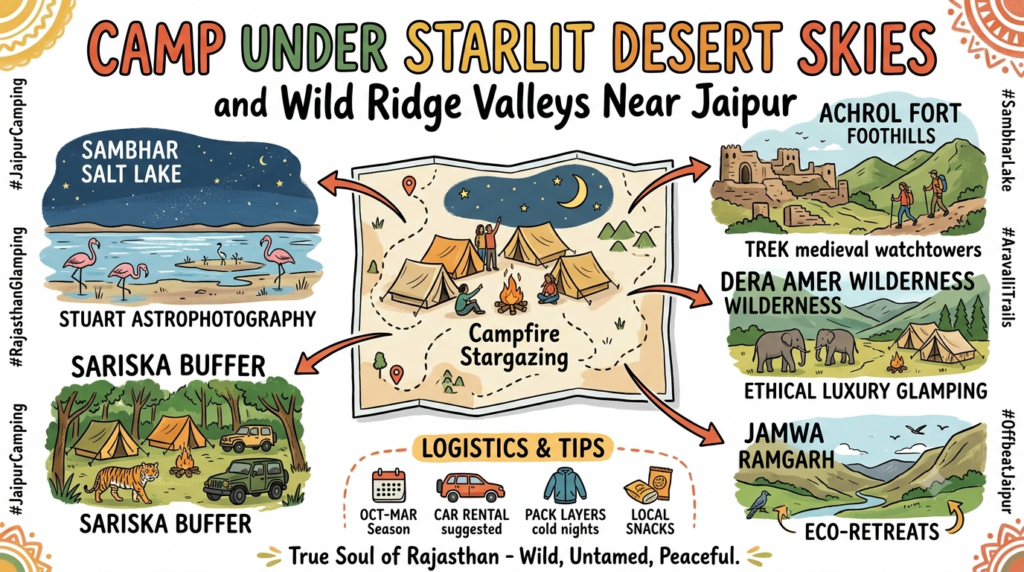
Sambhar Salt Lake
Spanning across the horizon like a blinding white mirage, Sambhar Lake is India’s largest inland saline wetland. Camping along these ancient flats feels like setting foot on another planet, where endless cracked earth dissolves directly into mirror-like water horizons. In the 19th century, British administrators carved historic railway lines directly over the brine to haul salt, leaving behind a hauntingly beautiful industrial heritage frozen in time.
When darkness settles over Sambhar, light pollution vanishes entirely, making it one of northern India’s premier astrophotography sanctuaries. During winter dawns, thousands of migratory greater and lesser flamingos paint the water edges in brilliant blush pink.
- Location: Sambhar Lake Basin, Phulera Tehsil, approximately 80 km west of Jaipur.
- Why it is worth visiting: Unmatched celestial stargazing, expansive salt flats, and winter flamingo colonies.
- Best things to do: Capture deep-sky astrophotography, ride the heritage British-era salt train, and spot migratory waterfowl near Shakambhari Mata temple.
- Best time to visit: November to February; late afternoons capture surreal golden reflections on the brine.
- Ideal for whom: Stargazers, photographers, off-road campers, and solitude seekers.
- Travel tip: Never drive personal vehicles directly onto wet salt crusts without a local recovery guide, as vehicle tires sink rapidly into the soft brine beneath.
Achrol Niwas & Fort Foothills
Achrol sits quietly along the old Delhi highway, flanked by steep, jagged granite hills crowned by the crumbling ramparts of the 16th-century Achrol Fort. Camping in this secluded valley brings you face-to-face with traditional Dhundhar pastoral culture, surrounded by sprawling farmland and wild acacia forests.
The area is famous for adventure campsites offering a mix of Swiss luxury tents and rugged trekking bases. Waking up to golden sunlight illuminating the ruins of the medieval watchtowers offers an intoxicating dose of history wrapped in raw mountain serenity.
- Location: Achrol Village, NH-48 corridor, roughly 35 km north of Jaipur.
- Why it is worth visiting: Dramatic hill-fort backdrops paired with accessible hiking routes and active adventure camps.
- Best things to do: Trek the unmarked trail up to Achrol Fort, practice night rappel sessions, and cycle through quiet rural hamlets.
- Best time to visit: October through March; dawn offers magical mist rolling through the valley gorges.
- Ideal for whom: Adventure enthusiasts, weekend corporate groups, and active families.
- Travel tip: Wear thick-soled hiking boots with deep tread, as the scree slopes approaching the fort ruin are loose and slippery.
Dera Amer Wilderness Valley
Nestled in a private wilderness valley behind the Amer royal forests, Dera Amer represents the zenith of ethical luxury glamping. Bordering the protected reserved forests of the Aravalli hills, this re-wilded estate serves as a sanctuary for rescued elephants, camels, and indigenous wildlife.
Staying here immerses travelers in authentic Rajput hunting-camp aesthetics without compromising on ecological sensitivity. Towering white canvas suites with teakwood accents rest under native Khejri trees, while evenings unfold with lanterns, live folk instruments, and organic farm-to-table cuisine.
- Location: Kookas / Amer Valley, approximately 25 km northeast of central Jaipur.
- Why it is worth visiting: Intimate, ethical interactions with rescued elephants in a completely preserved natural habitat.
- Best things to do: Walk alongside free-roaming elephants through the scrub forest, take guided twilight bird walks, and dine under open stars.
- Best time to visit: October to March; early mornings are prime for spotting resident peacocks, nilgai, and deer.
- Ideal for whom: Luxury couples, conservationists, wildlife enthusiasts, and families.
- Travel tip: Reserve your canvas suite at least two months in advance for the winter peak season, as available inventory is deliberately capped to protect the habitat.
Jamwa Ramgarh Valley
Centering on the historic Ramgarh basin that once fed Jaipur’s water needs, Jamwa Ramgarh is an untamed countryside haven ringed by dramatic cliff faces. Surrounded by the dense Ramgarh Wildlife Sanctuary, this region delivers a serene woodland retreat far removed from highway commerce.
Campsites here focus on eco-retreats, bonfires, and nature immersion. The gentle lap of seasonal streams and the rustle of dry deciduous forests create a restorative environment where travelers can unwind in canvas tents pitched under star-dusted canopies.
- Location: Jamwa Ramgarh Tehsil, roughly 40 km east of Jaipur.
- Why it is worth visiting: Untamed green ravines, quiet bird sanctuaries, and historic bund walls dating to the late 19th century.
- Best things to do: Birdwatch along the reservoir embankments, hike into dry river beds, and visit the historic Jamwai Mata temple.
- Best time to visit: Mid-September to February, when post-monsoon greenery remains lush across the ravines.
- Ideal for whom: Eco-travelers, writers, backpackers, and tranquil family retreats.
- Travel tip: Mobile network signals can drop drastically inside the deeper gorges; download offline topographic maps before leaving the highway.
Sariska Buffer Outposts
Perched at the northern border of Jaipur district where it yields to Alwar, the scrub forest buffers of Sariska provide wilderness camping on the territory of the royal Bengal tiger. These thorn-forest riverbanks and dramatic limestone outcroppings have witnessed centuries of warrior legends and royal hunts.
Safari-style tented camps along the perimeter offer an authentic taste of classic jungle living. Nights bring the distant alarm calls of spotted deer and sambar, reminding you that true apex predators navigate the rocky ravines just beyond your camp perimeter.
- Location: Viratnagar / Sariska South Boundary, approximately 90 km north of Jaipur.
- Why it is worth visiting: Raw jungle ambiance, morning wildlife safaris, and ancient Buddhist rock edicts nearby.
- Best things to do: Embark on an open 4×4 forest safari, sit around a guarded forest bonfire, and explore the ancient rock shelters of Bairat.
- Best time to visit: October to March; December dawns are freezing but offer superior game-viewing visibility.
- Ideal for whom: Wildlife photographers, thrill seekers, and wildlife enthusiasts.
- Travel tip: Pack thermal layers and windproof jackets; open-top safari drives at dawn through the valley drop into single-digit temperatures.
Offbeat Exploration: Hidden Gems Tourists Miss
The Buddhist Monasteries of Viratnagar (Bairat)
Just an easy detour from northern valley campsites lie the circular ruins of Bijak-ki-Pahari, dating back to the Mauryan emperor Ashoka in the 3rd century BCE. Scrambling up these giant granite boulders reveals ancient monastery foundations and expansive views across the scrub wilderness, without a single tourist tour bus in sight.
Chandlai Lake Stargazing Strip
Located just 30 kilometers south of Jaipur along Kota road, this shallow rainwater basin attracts thousands of migratory shovelers, pintails, and flamingos between November and February. Pitching a daytime bivouac here lets you watch bird-flight silhouettes carve across the sunset before brilliant Milky Way arms appear overhead.
Nahargarh Biological Valley Edge
Hidden directly beneath the rear mountain ridges of Nahargarh Fort, this quiet forest stretch offers rugged walking paths lined with native Dhok trees. It allows nature lovers to experience desert ridge ecosystems without traveling hours from city limits.
Detailed Practical Guidance for Travelers
| Destination | Standard Entry Fee | General Timings | Best Local Food Options Nearby | Recommended Nearby Attractions |
| Sambhar Salt Lake | Free (Organized camps: ₹2,000–₹6,000) | Open 24/7 (Camps check-in 2:00 PM) | Fresh Bajre ki Roti & Lahsun Chutney at village dhabas | Shakambhari Mata Temple, Salt Processing Museum |
| Achrol Fort Foothills | Free (Camps: ₹1,800–₹4,500) | Open 24/7 (Trekking best at 06:00 AM) | Spicy Dal Baati Churma along NH-48 highway dhabas | Achrol Fort ruins, Chandwaji market |
| Dera Amer Valley | Private Camp Rates (From ₹18,000) | Check-in 02:00 PM / Check-out 11:00 AM | Curated multi-course Rajasthani organic dinners on-site | Amer Fort, Anokhi Museum of Hand Printing |
| Jamwa Ramgarh | Free (Eco-resort tents: ₹2,500–₹5,000) | Open 24/7 (Reservoir gates close at dusk) | Hot Pyaaz Kachoris and fresh rabdi from local village stalls | Jamwai Mata Temple, Ramgarh Lake Dam |
| Sariska Buffer | Free (Jungle tents: ₹3,500–₹9,000) | Forest entries 06:00 AM – 06:00 PM | Authentic Gatte ki Sabzi and Ker Sangri at countryside stays | Bhangarh Fort, Viratnagar Ashokan Rock Edict |
Logistics & On-Ground Navigation
Local Transport Options
- Self-Drive SUVs & Cars: Renting a vehicle from Jaipur airport or station is ideal for Sambhar and Sariska, granting absolute freedom across unpaved village lanes.
- Private Chauffeured Cabs: The safest choice for luxury glampers heading to Dera Amer or Achrol. Book through registered city operators on a flat 8-hour or outstation package.
- Local Passenger Trains: Budget adventurers can take morning passenger trains from Jaipur Junction to Phulera Junction for Sambhar Lake, followed by local shared jeeps.
- Intercity Road Buses: State transport (RSRTC) buses running along the Delhi highway regularly drop passengers at Achrol or Chandwaji junctions.
Budget Planning
- Budget / Backpacker Tier (₹1,500 – ₹2,800 per day): Travel via public bus or shared transport, pitch pre-arranged basic ground tents or stay at eco-hostel campsites, and enjoy meals at highway dhabas.
- Mid-Range / Comfort Glamping Tier (₹5,500 – ₹12,000 per day): Private taxi transfers, comfortable Swiss cottage tents with attached washrooms, hosted bonfire buffet dinners, and guided safari activities.
Safety and Inclusivity Tips
- For Families: Stick to fenced private camping properties in Achrol or Dera Amer featuring permanent washrooms, backup generators, and clean dining areas.
- For Couples: Choose private boutique wilderness retreats over chaotic mass-campsite grounds to enjoy quiet starry evenings and secluded dining.
- General Outdoor Safety: Carry sturdy flashlights, insect repellent, and basic emergency kits. Never wander into unlit thorn scrub at night due to wild boars, snakes, and rocky drops.
Strategic Travel Planning Guardrails
Travel Planning Tips for Jaipur Outdoors
- Pre-Book Winter Weekends: Campsites near Jaipur fill weeks ahead between November and January; book your tent slots early.
- Bring Sufficient Cash: Small village tea stalls and countryside puncture repair shops rarely have functioning QR scanners due to spotty cell service.
- Prepare Thermal Layering: Desert weather changes quickly; warm 28°C afternoons routinely drop to crisp 6°C nights by the campfire.
- Verify Camp Access Roads: Many rural sites end in rough dirt tracks; confirm with your camp host whether a standard hatchback can reach their gates.
- Observe Sacred Etiquette: Dress respectfully with covered shoulders and knees when hiking past rural shrines or village wells.
Common Mistakes to Avoid
- Driving onto Saline Sludge: Reckless drivers frequently beach rental cars on Sambhar Lake’s soft silt, resulting in expensive tractor rescue charges.
- Underestimating Wilderness Chill: Traveling in December with only light cardigans leaves you freezing inside unheated canvas tents.
- Leaving Trash in Wilderness Zones: Discarding plastic bottles and snack wrappers harms grazing desert wildlife and spoils pristine rural environments.
- Skipping Local Dhaba Food: Dining exclusively on generic pasta at resort buffets deprives you of wood-fired rotis and smoky baatis.
- Relying on Single Ride Hails: Hailing an Uber out to rural areas like Jamwa Ramgarh is easy, but finding an app-based cab for the return trip to the city is virtually impossible.
Suggested Itinerary Blueprints
Day Quick Dash (The Salt Flat Starlight Loop)
- Target Audience: Fast-moving weekenders and photography enthusiasts.
- 1:00 PM: Depart central Jaipur along the Ajmer highway toward Sambhar.
- 3:30 PM: Check into your lakeside tent camp, sip hot masala chai, and view historic salt locomotives.
- 5:30 PM: Watch the sunset turn the brine flats into a golden reflective mirror.
- 8:30 PM: Enjoy a fireside dinner followed by high-magnification stargazing.
- Next Morning: Early sunrise birdwatching walk, hot breakfast, and return to Jaipur by noon.
Day Deep-Dive (Aravalli Ridge & Wilderness Circuit)
- Day 1: Drive north to Achrol Valley. Check into an adventure camp. Spend the afternoon hiking to the fort battlements, followed by an evening barbecue around the campfire.
- Day 2: Early morning departure to Jamwa Ramgarh. Explore the old dam perimeter, enjoy a village-cooked lunch, and pitch riverside valley tents for a quiet wilderness night.
Complete Weekend Travel Plan (The Heritage Safari Expedition)
- Friday Evening: Check into a luxury glamping suite at Dera Amer. Unwind under the trees with live folk music and a traditional Rajasthani dinner.
- Saturday: Enjoy a sunrise walk with elephants. Depart after breakfast for the Sariska forest buffer. Check into a safari camp, take an afternoon 4×4 jungle drive, and unwind by the night fire.
- Sunday: Morning trek around the ancient ruins of Viratnagar. Savor a late highway lunch at an authentic road dhaba, and drive comfortably back to Jaipur.
Common Tourist Mistakes to Avoid
- Geographic Blunders: Attempting to visit Sambhar Lake (far west) and Jamwa Ramgarh (far east) on the same day forces you to spend six frustrating hours stuck in city bypass traffic.
- Commercial Traps: Booking crowded mega-campsites set up on highway shoulders that blast loud party music instead of delivering an authentic, quiet wilderness stay.
- Neglecting Modern/Alternative Zones: Overlooking charming neighborhood coffee roasters and artisan bakeries in Jaipur’s C-Scheme when stocking up on camping treats before heading out.
- Transport Overpayment: Agreeing to arbitrary auto-rickshaw fares to highway junctions without checking standard app rates or setting flat round-trip prices.
- Luxury Dining Bias: Eating only at high-end resort restaurants and missing out on smoky, authentic kadai doodh (slow-cooked milk) and fresh kachoris at village intersections.
Frequently Asked Questions
1. Is it legal and safe to pitch a self-owned tent anywhere near Sambhar Lake?
While the expansive salt flats seem open and wild, large tracts are restricted industrial areas owned by Sambhar Salts Limited or protected under the Ramsar wetland convention. Always seek permission from local village sarpanches or base your tents on private camping grounds to avoid trespassing penalties and dangerous marsh mud.
2. What safety precautions are necessary when camping near the Aravalli hills?
The Aravalli scrub forests are natural corridors for wild leopards, hyenas, and venomous scorpions. Campers should never pitch solitary ground tents in thick scrub without boundary fencing. Ensure your campsite maintains an active night watchman, carries bright lanterns, and keeps a clear open perimeter around all sleeping quarters.
3. Are there luxury glamping options near Jaipur with modern bathroom facilities?
Yes, retreats like Dera Amer near Kookas and several luxury safari operators around Achrol provide five-star comforts under canvas. These boutique properties feature attached solid-masonry bathrooms, running hot water, authentic antique furniture, air-cooling systems, and dedicated butler services while preserving the outdoor wilderness aesthetic.
4. How cold does it get during winter nights at outdoor camps near Jaipur?
Winter nights between December and January are surprisingly cold due to rapid radiant heat loss from the desert sands and rocky hills. Temperatures regularly dip between 4°C and 8°C. Travelers must carry heavy thermal base layers, fleece-lined caps, windproof jackets, and ensure their camp operator provides heavy quilted blankets or room warmers.
5. Can standard small rental cars easily navigate the roads leading to Achrol and Sambhar?
Most primary highways to Achrol and Sambhar are smooth multi-lane tarmac roads. However, the final two-kilometer approaches leading across sand tracks or unpaved riverbeds require care. While hatchbacks reach established gates safely, high-clearance crossovers or four-wheel-drive vehicles provide peace of mind when crossing sandy dry nullahs.
6. What are the best months to observe migratory birds during a camping trip?
The best birdwatching season runs strictly from November through February. During this period, tens of thousands of migratory waterfowl, including flamingos, pelicans, and northern pintails, settle across Sambhar Lake and Chandlai Lake. Warmer spring months cause these seasonal water basins to dry up rapidly, scattering the avian flocks.
7. Are desert and hill campsites around Jaipur suitable for elderly travelers?
Many well-managed glamping resorts provide flat walking paths, walk-in canvas rooms without step hazards, and on-demand golf carts or battery cars. However, rugged wilderness ground camps with uneven rocky terrain and floor bedding are unsuitable. Always confirm bathroom step levels and walking distances directly with the campsite manager before booking.
8. What kind of wildlife might you realistically encounter on camping fringes?
The scrub valleys surrounding Jaipur host a vibrant nocturnal ecosystem. Campers frequently spot blue bulls (nilgai), desert foxes, Indian hares, civet cats, and crested porcupines. While leopards roam the deeper ridges of Jhalana, Amer, and Sariska, they avoid well-lit campfires and loud human presence around active camp perimeters.
9. Is mobile network coverage available at all popular camping locations?
Most open locations around Sambhar Lake and the main Achrol valley maintain stable 4G and 5G connectivity on major Indian networks. However, once you venture into the deep river ravines of Jamwa Ramgarh or the secluded hill-gorges of Sariska, signal bars can disappear completely, making offline maps and power banks essential.
10. Do local camps offer authentic regional Rajasthani food options on site?
Yes, the majority of established wilderness camps pride themselves on regional dining. Guests can expect wood-fired Dal Baati Churma, smoky Laal Maas prepared in brass handis, fresh Bajre ki Roti with garlic chutney, and morning parathas served with churned white butter, all sourced directly from neighboring dairy farmers and agricultural fields.
11. What activities are usually provided by organized adventure campsites?
Most adventure campsites offer a combination of guided sunrise ridge hikes, outdoor rappelling, natural boulder climbing, target archery, mountain cycling, and night star-walks. In open plains like Sambhar Lake, operators also arrange thrilling ATV rides across dried salt tracks and tours of the historic salt processing works.
12. How far in advance should I make reservations for high-season camping?
For weekend stays between November and Republic Day in January, glamping tents and curated adventure camps should be booked at least three to four weeks in advance. Prime holiday weekends around New Year’s Eve and the annual Pushkar and Jaipur Literature Festival periods routinely sell out months ahead.
Conclusion
Trading the gilded, crowded corridors of mainstream vacation spots for a wind-swept canvas tent near Jaipur transforms a predictable holiday into an enduring memory. As your campfire turns to quiet embers under a brilliant canopy of stars and the cool Aravalli breeze rustles through the thorn canopy, you will uncover the true soul of Rajasthan—wild, untamed, deeply peaceful, and boundlessly hospitable.
