Introduction
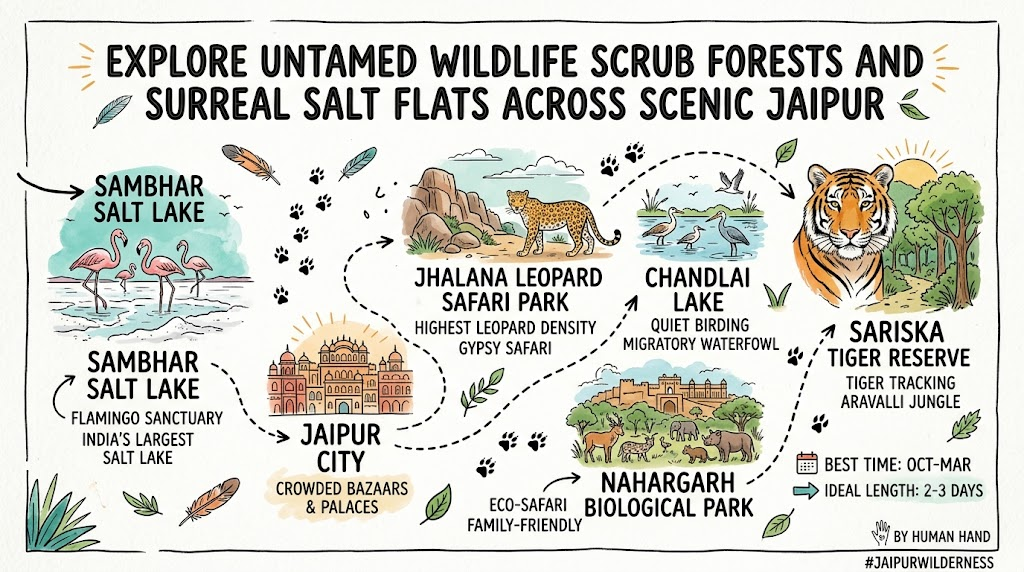
Most travelers envision Jaipur through a postcard of crowded bazars, amber-lit palaces, and bustling heritage alleys. Yet just past the medieval stone gateways, the relentless rhythm of the city gives way to silent ridges, ancient scrub forests, and salt-crusted horizons. While commercial tourist circuits push visitors through congested corridors, authentic rejuvenation thrives in the untamed wilderness cradled by the world’s oldest fold mountains.
The Aravalli landscape around Jaipur is deeply rooted in raw ecological power and timeless pastoral serenity. From surreal inland salt expanses teeming with migratory pink flamingos to hidden leopard sanctuaries nestled within city limits, stepping into Jaipur’s natural backyard bridges royal grandeur with soul-stirring wildlife escapades.
i
Leopard encounter at Jhalana Safari Park.
Why Jaipur is a must-visit city
Jaipur stands as a masterclass in urban planning and geographical balance, anchored in Rajasthan’s famed Golden Triangle travel circuit. Beyond its iconic terra-cotta fortifications and astronomical marvels, the capital region serves as a vital ecological corridor where the dry deciduous forests of Northern India transition into the semi-arid Thar threshold. Its unique microclimates nurture an astonishing density of apex predators, avian migrants, and indigenous flora that few urban regions on the planet can match.
Accessibility is seamless across every traveler bracket. The city connects effortlessly through high-speed national expressways (NH48, Delhi-Mumbai Expressway), the North Western Railway grid, and direct air links at Jaipur International Airport. The surrounding nature circuit branches out radially, allowing travelers to transition from five-star heritage hotels to silent wildlife lookouts within a 30 to 120-minute drive.
| Travel Dimension | Key Metric / Factor |
|---|---|
| Geographic Zone | Eastern Rajasthan, Aravalli Hill Range |
| Ideal Wilderness Season | October to March (Pleasant days, crisp migratory season) |
| Transit Network | NH48, Delhi-Mumbai Expressway, Jaipur Junction (JP), Jaipur Airport (JAI) |
| Top Ecosystem Highlights | Inland saline wetlands, dry deciduous scrub jungles, rocky leopard canyons |
| Optimal Nature Circuit Length | 2 to 3 days for a complete weekend loop |
Best Places or Experiences
Sambhar Salt Lake
Spanning hundreds of square kilometers across Jaipur, Nagaur, and Ajmer districts, Sambhar is India’s largest inland saline lake. The landscape is pure atmospheric drama: an endless, blinding-white horizon of salt crust where the sky mirrors shallow waters, broken only by vintage narrow-gauge salt trains and distant temple silhouettes.
During winter, the wetland transforms into an avian sanctuary of global significance, drawing hundreds of thousands of greater and lesser flamingos alongside pelicans, avocets, and sandpipers. The profound stillness of the salt flats at sunrise feels like stepping onto another planet, untainted by the chaos of city life.
Migratory flamingos at Sambhar Salt Lake.
- Location: Phulera/Sambhar Tehsil, approximately 75–80 km west of central Jaipur via the Jaipur-Ajmer Expressway.
- Why it is worth visiting: A Ramsar-designated wetland offering surreal salt-flat vistas and the largest winter flamingo congregation in Northern India.
- Best things to do: Spot thousands of pink flamingos near Shakambhari Mata temple, photograph the historic colonial British brine train, and stargaze across unpolluted dark skies.
- Best time to visit: November to February for peak bird migrations; early mornings (6:30 AM to 9:30 AM) offer magical golden-hour light.
- Ideal for whom: Wildlife photographers, slow travelers, birders, and landscape artists.
- Travel tip: Never drive personal vehicles deep onto the damp salt crust; mud beneath the dry surface traps vehicles instantly. Stick to firm peripheral tracks.
Jhalana Leopard Safari Park
Carved right into the rocky southeastern foothills of Jaipur, Jhalana is a 23-square-kilometer reserve that boasts one of the highest leopard densities on earth. Once the private hunting reserve of the Jaipur royalty, this forest of dhok trees, babool, and thorny scrub has become a globally celebrated conservation success story.
Unlike vast national parks where big cats remain elusive, Jhalana’s compact size and open terrain provide exceptionally frequent daylight sightings of leopards lounging on rocky crags. Striped hyenas, desert foxes, blue bulls (nilgai), spotted deer, and over 120 species of birds share this rugged city forest.
- Location: Malviya Nagar Industrial Area peripheral fringe, barely 12–15 km from Jaipur city center.
- Why it is worth visiting: Guaranteed thrill of tracking wild leopards in an open 4×4 Gypsy just minutes outside the urban skyline.
- Best things to do: Track apex leopards through Zone 1 and Zone 2, spot rare nocturnal striped hyenas near waterholes, and photograph raptors resting on dhok canopies.
- Best time to visit: October to April; the morning safari (6:30 AM – 9:00 AM) brings active hunting behavior, while evening slots yield striking twilight silhouettes.
- Ideal for whom: Wildlife photographers, adventure enthusiasts, families, and solo safari lovers.
- Travel tip: Book open Gypsy permits online through the official Rajasthan forest portal well in advance to secure prime morning tracking tracks.
Sariska Tiger Reserve
Spread across the dramatic valleys and steep gorges of Alwar, Sariska represents an awe-inspiring wilderness retreat 866 square kilometers wide. Surrounded by towering Aravalli scarps, the forest weaves through dense dhok canopies, ruined medieval fortresses, and crystal waterholes.
Sariska holds the historic distinction of being the world’s first reserve to successfully relocate Bengal tigers. The experience here is a full-throttle jungle expedition where the roars of wild cats echo past ancient 10th-century temples and abandoned palace outposts.
Rugged Aravalli wilderness near Sariska.
- Location: Alwar District, roughly 110–115 km northeast of Jaipur via NH48 and SH248A.
- Why it is worth visiting: An authentic tiger reserve offering dramatic deep-jungle safaris amidst raw historical ruins and mountain backdrops.
- Best things to do: Embark on an early morning tiger tracking safari, explore the ancient Kankwari Fort hidden deep inside the core jungle, and birdwatch along Siliserh Lake on the drive in.
- Best time to visit: October to March for cool safari weather; March to May for heightened predator sightings around shrinking waterholes. Chokhiwadi Forest Retreat
- Ideal for whom: Big-cat trackers, road-tripping groups, nature enthusiasts, and weekend campers.
- Travel tip: Enter through the Tehla Gate on the southwestern side of the park; it sees significantly fewer crowds than the busy Alwar Gate.
Chandlai Lake
Tucked quietly beside the Kota Highway, Chandlai Lake is a peaceful, 140-year-old inland freshwater body that remains off the typical tourist radar. Free from commercial boat piers and ticket kiosks, the lake is an undisturbed sanctuary for regional ecology.
Every winter, the calm waters of Chandlai become a refuge for over 10,000 migratory waterfowl traveling the Central Asian Flyway. Red-crested pochards, bar-headed geese, black-winged stilts, and flamingos forage alongside gentle, wind-swept banks surrounded by wide rural pastures.
- Location: Tonk Road (NH52), around 30 km south of central Jaipur.
- Why it is worth visiting: An uncommercialized, peaceful birding paradise perfect for quiet morning contemplation without safari booking hassles.
- Best things to do: Spot rare waterfowl using spotting scopes, capture pristine reflections of morning mist, and enjoy peaceful picnics along the earthen embankments.
- Best time to visit: November to February between 6:30 AM and 10:00 AM, when flocks actively feed near the water’s edge.
- Ideal for whom: Serious birders, amateur ornithologists, couples seeking quiet spaces, and outdoor sketch artists.
- Travel tip: Bring professional zoom lenses or high-power binoculars; since the banks are open, wading birds maintain a respectful distance from shorelines.
Nahargarh Biological Park
Sprawling beneath the formidable granite ramparts of Nahargarh Fort, this biological sanctuary covers over 700 hectares of protected Aravalli woodland. It acts as a vital biodiversity buffer zone for the city, safeguarding native scrub vegetation and endemic wildlife.
The park features dedicated eco-safari tracks where Asiatic lions, Bengal tigers, and Indian panthers roam across spacious, naturalized open-range habitats. Walking through the open nature trails reveals the incredible floral resilience of indigenous dhok and ronjh trees that have anchored Rajasthan’s terrain for millennia.
- Location: Jaipur-Delhi Highway (NH48), roughly 25 km north of Jaipur city. Qvki
- Why it is worth visiting: A family-friendly ecological corridor combining scenic Aravalli foothills with effortless wildlife viewing.
- Best things to do: Board the open-air electric buggy safari, explore the indigenous botanical section, and trek along guided nature trails in the buffer zone.
- Best time to visit: July to February; late afternoons (3:00 PM – 5:30 PM) provide pleasant shade and active animal movement.
- Ideal for whom: Multi-generational families, school groups, botany students, and casual day-trippers.
- Travel tip: Arrive early on weekends to secure open-top golf cart and safari tickets, which sell out fast during peak holiday months.
Jamwa Ramgarh Sanctuary & Lake
Historically famous as the sprawling water source that quenched Jaipur’s thirst and hosted royal rowing regattas, Jamwa Ramgarh sits within a stunning amphitheater of high mountain ridges. While the central lake bed varies with seasonal rains, the surrounding wildlife sanctuary remains a verdant haven.
The dense, untouched forest serves as a vital sanctuary for nilgai, wild boars, golden jackals, chital, and resident raptors. The winding, dramatic drive through rural villages and dry riverbeds showcases quintessential Rajasthani countryside at its most tranquil.
- Location: Jamwa Ramgarh Road, approximately 35 km northeast of Jaipur.
- Why it is worth visiting: Dramatic mountain valley landscapes with an off-the-grid feel, far removed from modern tour buses.
- Best things to do: Drive through winding mountain passes, explore historic check-dams and birding trails, and visit the serene 10th-century Jamwai Mata temple. Qvki
- Best time to visit: August to November; the post-monsoon period carpets the rugged hillsides in lush, vivid green.
- Ideal for whom: Offbeat road-trippers, motorcycle touring riders, trekking groups, and solitude seekers.
- Travel tip: Pack sufficient food and drinking water in your vehicle, as commercial restaurants are virtually non-existent near the core valley. Qvki
Offbeat Exploration: Hidden Gems Tourists Miss
Nevta Dam Wetland
Situated off the Ajmer Road, Nevta Dam is a local insider secret that comes alive right after the monsoon. The vast expanse of clear freshwater draws purple moorhens, painted storks, and kingfishers. Local villagers graze cattle against wide-open water views, offering photographers dramatic, clutter-free sunset compositions.
Kishan Bagh Sand Dunes & Rewilding Park
Located at the base of the Nahargarh hills in Vidyadhar Nagar, Kishan Bagh is a masterwork of ecological restoration. Curated by naturalist Pradip Krishen, this park re-creates the native, prehistoric Roon landscape of the Thar desert. Elevated wooden boardwalks guide visitors past indigenous rocks, desert grasses, and flowering desert shrubs.
Smriti Van Nature Trails
Hidden in plain sight on Jawaharlal Nehru Marg, Smriti Van is a 108-acre ravine forest that feels miles away from the city center. Built across natural water drainage channels, its silent, winding dirt trails feature hundreds of native tree species and wild peacocks, making it the perfect morning escape for trail runners and birders.
Detailed Practical Guidance for Travelers
| Destination | Standard Entry Fee | General Timings | Best Local Food Options Nearby | Recommended Nearby Attractions |
|---|---|---|---|---|
| Sambhar Salt Lake | Free (Permit fees apply for special rail cars) | Open 24 Hours (Daylight recommended) | Fresh highway dhabas at Dudu / Highway NH48 | Shakambhari Mata Temple, Salt Train Yard |
| Jhalana Safari Park | Approx. ₹800 – ₹1,200 per person (Gypsy + Entry) | Morning (6:30 AM–9:30 AM), Evening (3:30 PM–6:30 PM) | Kanha Restaurant (Malviya Nagar), World Trade Park food court | Jawahar Kala Kendra, Smriti Van |
| Sariska Tiger Reserve | Approx. ₹1,100 – ₹1,600 (Indian), ₹2,500+ (Foreigner) | Safari slots: 6:00 AM–9:30 AM, 2:30 PM–6:00 PM | Resort dining at Tehla / Highway dhabas on SH248A | Bhangarh Fort, Siliserh Lake Palace |
| Chandlai Lake | Free access | Dawn to Dusk (Best 6:30 AM–10:00 AM) | Traditional roadside dal baati stalls along Tonk Road | Sitapura craft hubs, Chaksu heritage baoris |
| Nahargarh Biological Park | Approx. ₹50 (Entry) + ₹60 (Electric vehicle) | 8:30 AM – 5:30 PM (Closed Tuesdays) | Highway dhabas on Delhi-Jaipur Highway (Kukas) | Nahargarh Fort, Amber Palace, Stepwell Panna Meena |
| Jamwa Ramgarh | Free (Forest permits may apply for core tracks) | Sunrise to Sunset | Local highway tea stalls and village kachori vendors | Jamwai Mata Temple, Ramgarh Dam ruins |
Logistics & On-Ground Navigation
Local Transport Options
- Self-Drive Cars & Motorbikes: The most liberating way to explore rural nature spots like Sambhar, Chandlai, and Jamwa Ramgarh, giving you flexibility for dawn photography.
- Private Taxi Hire: Outstation cabs or hired city sedans easily navigate Sariska and Sambhar for reliable day trips and hassle-free returns.
- App-Based Cabs (Uber/Ola): Seamless for intra-city hops to Jhalana Safari Park and Smriti Van; never take them for out-of-town trips where return rides cannot be booked.
- Auto-Rickshaws & E-Rickshaws: Ideal for inner-city connections, but completely unsuitable for highway destinations like Nahargarh Biological Park or Chandlai Lake.
Budget Planning
- Backpacker Tier (₹1,500 – ₹2,500 per day): Stay in boutique social hostels in central Jaipur, travel by rented scooters or local state buses to highway junctions, eat at roadside dhabas, and focus on free nature sites like Chandlai and Sambhar.
- Mid-Range / Comfort Tier (₹5,500 – ₹11,000 per day): Base yourself in a charming heritage haveli, hire an air-conditioned private taxi for day excursions, take official Jhalana and Sariska 4×4 Gypsy safaris, and dine at reputed heritage resort restaurants.
Safety and Inclusivity Tips
- For Families: Stick to structured spots like Nahargarh Biological Park and Jhalana Safari; open Gypsy tracks and dedicated amenities ensure a secure, stress-free time with children.
- For Couples: Early morning trips to Sambhar Lake and Jamwa Ramgarh offer unmatched privacy, open horizons, and romantic mountain backdrops.
- General Outdoor Safety: Always step cautiously around thorn-scrub terrain; wear sturdy closed shoes, hydrate generously, and never step out of your vehicle in wild leopard or tiger zones.
Strategic Travel Planning Guardrails
Travel Planning Tips for Jaipur Nature Trips
- Book Forest Safaris Months Ahead: Wildlife Gypsy slots for Jhalana and Sariska sell out weeks in advance for winter weekends; reserve via the Rajasthan SSO forest portal early. Chokhiwadi Forest Retreat
- Pack Smart Triple-Layer Clothing: Open morning safaris in December and January face freezing Aravalli wind chills; bring windbreakers, beanies, and fleece layers. Chokhiwadi Forest Retreat
- Carry Cash for Village Stalls: While UPI is widely accepted across Jaipur, cellular data often drops near the Sambhar salt flats and Jamwa Ramgarh valleys.
- Pre-Download Offline Maps: Cell coverage drops significantly across interior stretches of Sariska, Bhangarh, and Sambhar Lake; save the regions offline on your phone.
- Respect Natural Corridors: Keep voices low, do not honk near wetlands, and never leave non-biodegradable plastics behind in wilderness zones.
Common Mistakes to Avoid
- Driving Ordinary Cars onto Salt Crusts: Every year dozens of tourists ruin their rental cars by driving onto the deceptive mudflats of Sambhar Lake.
- Assuming Jhalana is a Typical City Zoo: Jhalana is an untamed forest reserve with free-roaming apex predators; always heed your naturalist’s guidelines. GoWithGuide
- Overcrowding Your Single-Day Schedule: Attempting to visit Sambhar in the west and Sariska in the north on the same day leads to extreme travel fatigue.
- Ignoring the Noon Sun: Even during winter, mid-day semi-arid sun causes rapid dehydration; plan your nature activities strictly around dawn and late afternoon.
- Skipping binoculars or Long Lenses: Visiting bird sanctuaries without optical gear leaves you struggling to see distant migratory flamingos and raptors.
Suggested Itinerary Blueprints
1. Day Quick Dash (The Urban Wilderness Trail)
- Target Audience: Weekend travelers with under 24 hours to spare in Jaipur.
- Morning (6:00 AM – 9:30 AM): Pre-booked open Gypsy safari tracking leopards through the rugged canyons of Jhalana Safari Park. GoWithGuide
- Mid-Day: Relaxed exploration of native desert flora at Kishan Bagh Rewilding Park followed by lunch at C-Scheme.
- Afternoon/Sunset: Gentle walk through the ravine trails of Smriti Van or a sunset viewpoint drive up Nahargarh hill.
2. Day Deep-Dive (The Dual Ecology Odyssey)
- Target Audience: Weekend explorers who want to experience both wetlands and scrub forests.
- Day 1 (Western Saline Trail): Depart at 6:00 AM for Sambhar Salt Lake. Spend the morning photographing flamingos and the brine railway, picnic near Shakambhari Mata, and return by mid-afternoon for evening tea in Jaipur. Qvki
- Day 2 (Southern Wetland & City Safari): Dawn birdwatching along the pristine banks of Chandlai Lake. Return to Jaipur for an afternoon rest, concluding with an evening leopard tracking drive in Jhalana. GoWithGuide
3. Complete Weekend Travel Plan (The Grand Aravalli Wilderness Loop)
- Friday Afternoon: Arrive in Jaipur, check into a boutique stay, and take a quiet sunset walk inside Smriti Van.
- Saturday (Sariska Deep Jungle): Depart early morning via NH48 to Sariska Tiger Reserve. Check into a forest lodge near Tehla, take an afternoon tiger tracking safari, and stargaze by a campfire at night. Qvki+ 1
- Sunday (Forts & Salt Horizons): Early dawn birding around Sariska buffer, morning explore of the scenic Aravalli passes, and a relaxed drive back toward Jaipur with a brief stop at historic stepwells. Chokhiwadi Forest Retreat
Common Tourist Mistakes to Avoid
- Geographic Blunders: Attempting to combine Sambhar Salt Lake (far west) with Sariska or Jamwa Ramgarh (far northeast) on the same day wastes your entire trip in chaotic highway transit.
- Commercial Traps: Spending sunny weekend mornings walking around modern shopping malls when Jaipur’s outer forest sanctuaries are at their most vibrant.
- Neglecting Modern/Alternative Zones: Missing out on green, tree-lined districts like Malviya Nagar and C-Scheme, which offer tranquil cafes and direct access to wilderness pockets.
- Transport Overpayment: Taking unmetered roadside auto-rickshaws for suburban trips without checking standard app rates on Uber or Ola.
- Luxury Dining Bias: Sticking exclusively to generic hotel buffet spreads while ignoring legendary highway dhabas serving piping hot dal baati churma and spicy kachoris.
Frequently Asked Questions
1. What is the single best time of year to explore nature spots around Jaipur?
The optimal period is between October and March when daytime temperatures hover pleasantly between 18°C and 26°C. Migratory birds arrive in massive flocks at Sambhar and Chandlai wetlands, while animals in Sariska and Jhalana frequently bask out in the mild morning sun rather than retreating into deep shade.
2. Can I visit Sambhar Salt Lake as a half-day trip from Jaipur?
Yes, Sambhar Lake is around 75 km away and takes 1.5 to 2 hours each way via the Ajmer Expressway. Leaving Jaipur by 6:00 AM allows you to enjoy early flamingo sightings, explore the historic salt pans, and comfortably return to the city by early afternoon for lunch.
3. Do I need to book my Jhalana leopard safari permits in advance?
Advance booking through the official Rajasthan Single Sign-On (SSO) forest portal is strongly recommended, especially for weekends between November and February. Since Gypsy slots are strictly capped to protect the habitat, walk-in permits are rarely guaranteed during the peak winter travel season.
4. Is it safe to drive personal sedans to Chandlai Lake?
Yes, Chandlai Lake is located just off the smooth multi-lane Tonk Road (NH52), and access roads leading to the earthen bunds are paved. However, park your vehicle on firm gravel patches and avoid driving down toward muddy shores where tires can easily lose traction.
5. How does Jhalana Safari Park compare to Sariska Tiger Reserve?
Jhalana is an intra-city scrub reserve focused almost exclusively on leopards, striped hyenas, and raptors across a compact 23-square-kilometer zone. Sariska is an 800+ square-kilometer national park with Bengal tigers, ancient jungle ruins, and deep Aravalli valleys requiring a multi-day trip.
6. Are migratory flamingos present at Sambhar Lake throughout the year?
No, flamingos are winter visitors that arrive in late October and stay until March. While a few resident birds may linger into early summer near perennial brine canals, the signature pink carpets containing thousands of birds require the seasonal winter waters.
7. Can we walk independently inside the core zones of Jamwa Ramgarh Sanctuary?
No, entering core sanctuary zones without an authorized forest guard or permit is strictly prohibited under wildlife protection regulations. However, driving through scenic buffer passes, visiting the Ramgarh reservoir banks, and exploring local village trails are completely open to the public.
8. What essentials should I pack for an open Gypsy morning safari in winter?
Mornings in open 4×4 safari vehicles are bitterly cold due to sharp wind chill. Pack a thermal base layer, windproof jacket, gloves, and a warm beanie. Carry sunglasses, a telephoto lens or binoculars, and government-issued photo identification matching your safari permit.
9. Are there clean dining options near Sambhar Salt Lake?
Commercial culinary options near the lake beds are very limited. It is best to carry packed dry snacks and bottled water, or stop for freshly cooked parathas and dal baati at established family-run highway dhabas along the Jaipur-Ajmer Expressway.
10. Is Nahargarh Biological Park suitable for elderly family members?
Yes, Nahargarh Biological Park is one of the most accessible nature destinations around Jaipur. It offers smooth paved paths and rentable open-air battery-operated electric golf carts that transport visitors comfortably across animal viewing enclosures without strenuous uphill walking.
11. Can drones be flown for landscape photography at Sambhar Lake?
Droning is strictly restricted across many zones of Sambhar Lake due to sensitive migratory bird nesting habitats and local railway regulations. Flying drones near flamingo flocks disturbs wildlife and can lead to immediate equipment confiscation and steep fines by forest authorities.
12. Is a day trip to Sariska practical from Jaipur without staying overnight?
Yes, leaving Jaipur by 5:30 AM via NH48 gets you to Sariska’s Tehla or Alwar gate in roughly 2.5 hours, in time for the morning safari. However, booking an overnight forest stay makes the experience far more relaxing and lets you take both dawn and dusk drives.
Conclusion
Trading the crowded bazaars of the Pink City for the timeless silence of the Aravalli hills rewards travelers with a profound sense of wonder. Listening to the alarm call of a chital deer in Jhalana, watching thousands of pink wings glide across the white crust of Sambhar, or watching the morning sun illuminate ancient granite valleys restores the soul in ways standard vacations never could. Jaipur’s natural sanctuary reminds us that true luxury is found in raw silence, untouched wilderness, and the untamed beauty of the living earth.
