Introduction
While the typical modern vacation often dissolves into sterile beach resorts or congested tourist corridors, stepping into Jaipur pulls you into a living, breathing saga of royal valor and architectural brilliance. Instead of superficial attractions designed solely for quick selfies, Rajasthan’s legendary capital demands that you slow down and tune into echoes of chivalry, strategic military intellect, and artistic devotion.
Every weathered crenelation along the rugged Aravalli ridges narrates tales of Kachhwaha rulers who defended their homeland with fierce loyalty. Walking these storied ramparts connects you directly with centuries-old dynastic rituals, sacred ceremonies, and master craftsmanship that continue to shape the Pink City’s authentic identity today.
Why Jaipur is a must-visit city
Jaipur stands as an indispensable chapter in world travel because it represents India’s first planned city founded upon ancient Vastu Shastra and Vedic principles. Established in 1727 by the visionary astronomer-king Maharaja Sawai Jai Singh II, the city represents the zenith of Rajput political maturity, urban foresight, and artistic patronage. Geographically anchored between the arid Thar Desert and the lush Gangetic plains, it became a wealthy trading powerhouse protected by impenetrable mountain fortresses. Today, high-speed expressways like the Delhi-Mumbai Expressway, extensive rail connectivity from major Indian metros, and an international airport make it seamlessly accessible for luxury connoisseurs, backpacking culture seekers, and multigenerational families.
The classical Rajput heritage circuit revolves around two interconnected experiences: the hillside military citadels overlooking the jagged ridges of Amer, and the symmetrical, terracotta-hued urban grid of the Old Walled City. Travelers journeying through this loop transition from sheer defensive bastions into poetic royal courtyards, where defensive architecture effortlessly gives way to opulent, mirrored staterooms and royal astronomical observatories.
| Key Travel Parameter | Regional Details & Insights |
| Geographic Coordinates | 26.9124° N, 75.7873° E (Eastern Rajasthan) |
| UNESCO World Heritage Status | Jaipur City Walled Area (Inscribed 2019), Amber Fort (Hill Forts of Rajasthan, 2013), Jantar Mantar (2010) |
| Peak Climatic Window | October to March (Crisp sunny days: 18°C–28°C; cool desert evenings: 8°C–14°C) |
| Gateway Hubs | Jaipur International Airport (JAI), Jaipur Junction (JP), Sindhi Camp Bus Station |
| Signature Craft Traditions | Blue Pottery, Hand-Block Print Textiles, Kundan-Meenakari Jewelry, Miniature Paintings |
Best Places or Experiences
Amber Fort
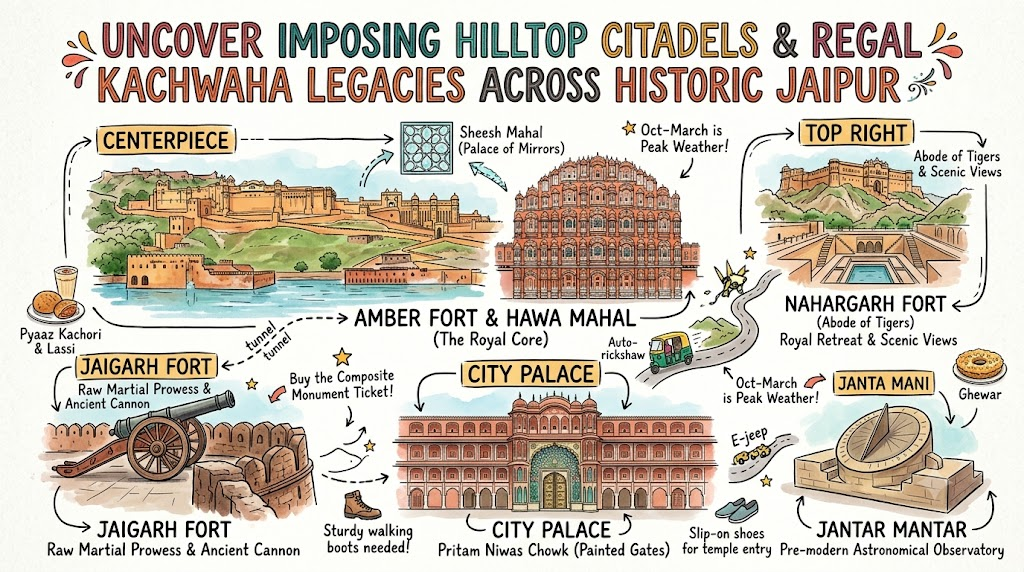
Perched dramatically above the shimmering waters of Maota Lake, Amber Fort (Amer Fort) served as the fortified seat of the Kachhwaha Rajputs for centuries before Jaipur was founded on the plains below. Constructed predominantly from yellow and pink sandstone by Raja Man Singh I starting in 1592, the complex expanded under successive rulers into a sublime union of Rajput defensive grit and Mughal aesthetic symmetry. Its defensive gates, including the grand Suraj Pol, opened inward toward expansive military muster yards that led royalty to lavish private retreats.
Inside, the fort houses the world-renowned Sheesh Mahal (Palace of Mirrors), where thousands of hand-cut convex Belgian glass mirrors are inlaid into plaster walls, capable of turning the light of a single candle into an entire constellation of stars. Adjoining it stands the Diwan-i-Aam with its double row of lotus-carved columns, the floral-frescoed Ganesh Pol gateway, and the sacred Sukh Niwas, which utilized clever indoor water-cooling channels to battle the desert heat.
- Location: Devising the Amer Sector along the Delhi-Jaipur highway, approximately 11 km north of Jaipur’s walled city center.
- Why it is worth visiting: It represents the grandest fusion of Rajput martial defense and Persian decorative elegance within the UNESCO Hill Forts network.
- Best things to do: Stand inside the radiant Sheesh Mahal to study convex glass reflections, descend to the pristine Sila Devi temple sanctum for morning prayers, and explore the subterranean tunnel system connecting directly to Jaigarh Fort.
- Best time to visit: Arrive at 8:00 AM sharp to explore uncrowded courtyards in gentle morning light, or return at 6:30 PM for the atmospheric sound and light show.
- Ideal for whom: Architectural historians, avid travel photographers, and multi-generational families fascinated by royal lifestyle.
- Travel tip: Skip the controversial elephant rides; instead, walk up through the pedestrian cobblestone gate or hire an approved e-jeep from the lower parking pavilion.
Jaigarh Fort
Rising menacingly over the rocky promontory known as Cheel ka Teela (Hill of Eagles), Jaigarh Fort was engineered strictly for defensive dominance and state security. Commissioned by Sawai Jai Singh II in 1726 to protect the palace complex of Amber directly beneath it, Jaigarh is a fortress of stark stone, uninterrupted ramparts, and imposing watchtowers that were never breached by invading armies. Unlike the delicate residential palaces below, Jaigarh evokes raw martial prowess, complete with defensive moats, deep weapon caches, and sophisticated rainwater harvesting subterranean reservoirs.
The fortress famously houses the legendary Jaivana Cannon, which was the world’s largest cannon on wheels at the time of its casting in 1720. The cannon required four pairs of elephants to swivel and carried a barrel weighing nearly 50 tons, serving as an indomitable psychological deterrent throughout the region. The fort grounds also contain a preserved medieval foundry where smelting furnaces, mechanical gear systems, and cast molds highlight Rajput metallurgy.
- Location: Cheel ka Teela, Aravalli Mountain Range, 15 km north of central Jaipur.
- Why it is worth visiting: Unbroken, non-commercialized military fortress showcasing ancient foundries, underground supply vaults, and the legendary Jaivana cannon.
- Best things to do: Stand beside the monumental Jaivana Cannon atop the highest rampart, walk through the underground artillery museum, and look through the arched watchtowers for 360-degree views of Amber Fort.
- Best time to visit: Late afternoon between 3:00 PM and 5:00 PM, when golden hour highlights the raw stone ramparts.
- Ideal for whom: Military history buffs, engineering geeks, and solo adventurers who appreciate rugged fortress architecture.
- Travel tip: Wear thick-soled walking boots; the internal stone ramps are expansive, rough-hewn, and demand considerable uphill walking.
Nahargarh Fort
Constructed in 1734 by Sawai Jai Singh II and later expanded in 1868, Nahargarh Fort (meaning “Abode of Tigers”) forms an impenetrable northern barrier crowning the sheer ridge of the Aravalli hills. Originally named Sudarshangarh, legend suggests the fort was renamed after the spirit of Nahar Singh Bhomia, a Rathore prince whose restless presence haunted the site until a dedicated shrine was consecrated on the grounds. The fort served primarily as a mountain retreat and hunting lodge, offering royal guards a strategic view across the plain.
The crown jewel of Nahargarh is the Madhavendra Bhawan, an extraordinary two-story palace designed by Sawai Madho Singh. It features nine identical residential suites built for each of the king’s nine queens, linked by private inner corridors that allowed the Maharaja to visit any consort without the others knowing. Each suite features vivid Rajasthani fresco work, delicate scalloped arches, and private rooftop terraces that offer breathtaking panoramic views over Jaipur’s urban expanse.
- Location: Ridge of the Aravalli hills, approximately 19 km by winding road from Jaipur city center.
- Why it is worth visiting: Offers the single most dramatic panoramic overlook of the entire urban grid of Jaipur, alongside brilliant architectural symmetry inside Madhavendra Bhawan.
- Best things to do: Explore the hidden interconnecting corridors of the nine royal queen apartments, photograph the geometric stepwell (Baori) featured in several films, and watch the sunset from the western ramparts.
- Best time to visit: 4:30 PM to 6:30 PM to catch both the sunset over the horizon and the sparkling city lights below.
- Ideal for whom: Couples seeking romantic vantage points, urban landscape photographers, and modern design enthusiasts.
- Travel tip: Avoid lingering long past dark if navigating by two-wheeler, as the winding forest mountain road is unlit and frequented by local wildlife.
The City Palace
Situated at the direct geographic center of the old walled city, the City Palace complex remains the beating heart of Jaipur’s regal Kachhwaha dynasty. Begun by Sawai Jai Singh II simultaneously with the city’s founding, the palace expanded over three centuries into a sprawling labyrinth of courtyards, staterooms, gardens, and royal residences. It represents a sublime architectural dialogue between traditional Rajput courtyard design, classical Mughal proportions, and European colonnaded facades.
The palace still houses the royal family of Jaipur in the magnificent multi-story Chandra Mahal, with its peacock crest and fluttering dynastic standard. Visitors entering through the grand Mubarak Mahal are greeted by a museum of royal textiles and ceremonial armor, while the inner Pritam Niwas Chowk leaves travelers spellbound with its four world-famous painted doorways. These four doorways represent the four seasons and Hindu deities, including the breathtaking Peacock Gate, which symbolizes the monsoon through vivid enamel glass inlays.
- Location: Tulsi Marg, Gangori Bazar, J.D.A. Market, Pink City core.
- Why it is worth visiting: The official royal residence of Jaipur’s titular royals, housing private antique armories, royal ceremonial garments, and the world’s largest sterling silver vessels.
- Best things to do: Photograph the four season-themed doorways within the Pritam Niwas Chowk, marvel at the two enormous Gangajali silver urns in the Sarvato Bhadra courtyard, and book a specialty private tour to see the upper staterooms of the Chandra Mahal.
- Best time to visit: 9:30 AM to 11:30 AM before midday tour groups arrive in the public courtyards.
- Ideal for whom: Cultural connoisseurs, textile enthusiasts, luxury travelers, and fine-art lovers.
- Travel tip: Purchase the Royal Grandeur access ticket if your budget permits; it unlocks access to the private blue-room (Sukh Niwas) and mirror-inlaid chamber (Rang Mandir) within the Chandra Mahal.
Hawa Mahal
Rising five stories from the bustling commercial artery of Badi Chaupar like an elaborate, crowned honeycomb, Hawa Mahal (Palace of Winds) is Jaipur’s most recognizable architectural icon. Commissioned in 1799 by the poet-king Sawai Pratap Singh and designed by royal architect Lal Chand Ustad, the building was constructed using red and pink sandstone to mimic the crown of Lord Krishna, to whom the Maharaja was devoted. Remarkably, the building is little more than a monumental facade, narrowing in some sections to less than a foot deep on the upper floors.
Behind its celebrated pink facade lie 953 intricately carved jharokhas (casement windows) fitted with delicate sandstone lattice screens. This architectural wonder was designed primarily to allow royal women observed under the strict purdah system to watch everyday street life, royal processions, and festivals without being seen by the public. The delicate stone screens also harnessed the Venturi aerodynamic effect, pulling breezes through narrow channels to cool the entire palace structure during the scorching desert summers.
- Location: Hawa Mahal Road, Badi Chaupar, J.D.A. Market, Pink City.
- Why it is worth visiting: An architectural and aerodynamic masterwork featuring almost a thousand screened windows that capture cool air and offer glimpses into 18th-century royal life.
- Best things to do: Climb the narrow, ramped interior passages to look through the colored Belgian stained glass windows, explore the open-air fountain courtyard behind the facade, and snap photos of the street life below through the small stone grilles.
- Best time to visit: 7:30 AM to 9:00 AM, when early morning sunlight strikes the eastern pink sandstone facade.
- Ideal for whom: Street photographers, architectural researchers, and cultural sightseers.
- Travel tip: For the classic postcard photograph, cross the street and head up to the open-air rooftop cafes directly opposite the monument during the golden morning hour.
Jantar Mantar
Located adjacent to the City Palace gates, Jantar Mantar is the world’s most monumental stone astronomical observatory. Commissioned between 1728 and 1734 by Sawai Jai Singh II, who was an accomplished mathematician and astronomer, this UNESCO World Heritage site features 19 monumental stone instruments. Disappointed by the inaccuracies of small brass astrolabes, Jai Singh constructed these massive stone and marble instruments to calculate celestial coordinates, track planetary movements, and predict solar eclipses with incredible precision.
The site is dominated by the Brihat Samrat Yantra, the world’s largest stone sundial, which stands 27 meters tall. Its massive shadow moves smoothly across finely calibrated marble scales, measuring local solar time to an accuracy of two seconds. Other ingenious structures, such as the Jai Prakash Yantra, feature hollow hemispherical bowls built into the ground that allow astronomers to map cosmic constellations directly against the horizon.
- Location: Gangori Bazar, J.D.A. Market, within the central palace quadrant.
- Why it is worth visiting: The most sophisticated and best-preserved pre-modern astronomical observatory on Earth, demonstrating the intellectual and scientific achievements of the Rajputs.
- Best things to do: Watch the shadow move across the marble scales of the giant Brihat Samrat Yantra, study the zodiac alignment instruments at the Rasivalaya Yantra, and step inside the subterranean bowls of the Jai Prakash Yantra.
- Best time to visit: 11:30 AM to 1:30 PM, when the sun reaches its zenith and casts dramatic, sharp shadows across the instrument markings.
- Ideal for whom: Science and astronomy enthusiasts, history buffs, mathematicians, and inquisitive travelers.
- Travel tip: Do not wander through on your own without context; hire an officially licensed Rajasthan Tourism guide at the entrance to explain the complex mechanics of each astronomical instrument.
Offbeat Exploration: Hidden Gems Tourists Miss
Gaitore Ki Chhatriyan
Tucked away in a tranquil valley beneath the shadows of Nahargarh Fort lies Gaitore Ki Chhatriyan, the royal cremation ground of the Kachhwaha rulers. While standard tour buses bypass this quiet sanctuary, travelers who make the trip find a breathtaking forest of exquisitely carved white marble cenotaphs (chhatris). The most remarkable memorial honors Maharaja Sawai Jai Singh II, featuring twenty carved pillars adorned with sculpted peacocks, maidens, and mythological scenes. It is one of the quietest historical sites in the city, where you can admire stone carvings without jostling through tourist crowds.
Panna Meena Ka Kund
Located just north of Amber Fort in the historic village of Amer, this 16th-century stepwell is an extraordinary work of hydraulic engineering and geometric artistry. Panna Meena Ka Kund was built as a communal water catchment where villagers gathered for conversation, prayers, and cooling rest. The stepwell features an intricate diamond lattice of interlocking symmetrical stairs built into ochre walls. Its unique architectural rhythm ensures that ascending and descending the steps requires following distinct, deliberate footpaths.
Sisodia Rani Ka Bagh
Situated 6 km east of Jaipur along the road to Agra, Sisodia Rani Ka Bagh was built in 1728 as a peaceful retreat for the Udaipur princess who became Sawai Jai Singh II’s second queen. The multi-tiered garden retreat combines traditional Mughal Charbagh garden layouts with expressive Rajput wall frescoes that illustrate the divine love of Radha and Krishna. Terraced water cascades, trickling fountains, and quiet pavilion arches make this spot an oasis away from the noisy downtown markets.
Detailed Practical Guidance for Travelers
| Destination | Standard Entry Fee | General Timings | Best Local Food Options Nearby | Recommended Nearby Attractions |
| Amber Fort | ₹100 (Indians), ₹550 (Foreigners) | 8:00 AM – 5:30 PM, 6:30 PM – 9:15 PM | 1135 AD (Inside Fort), Jagat Shiromani Sweets | Anokhi Museum of Hand Printing, Panna Meena Kund |
| Jaigarh Fort | ₹150 (Indians), ₹300 (Foreigners) | 9:00 AM – 5:00 PM | Jaigarh Fort Canteen, The Stag Restro Cafe | Amber Fort Subterranean Tunnel, Aravalli Viewpoints |
| Nahargarh Fort | ₹50 (Indians), ₹200 (Foreigners) | 10:00 AM – 5:30 PM | Padao Open Air Restaurant, Once Upon a Time | Jaipur Wax Museum, Charan Mandir |
| City Palace | ₹300 (Courtyards), ₹3,000 (Chandra Mahal) | 9:30 AM – 5:00 PM, 7:00 PM – 10:00 PM | Baradari Restaurant (In-house), Laxmi Mishthan Bhandar | Jantar Mantar, Hawa Mahal, Johari Bazar |
| Hawa Mahal | ₹50 (Indians), ₹200 (Foreigners) | 9:00 AM – 5:00 PM | Wind View Cafe, Tattoo Cafe, Samrat Ki Kachori | Badi Chaupar Market, Sireh Deori Bazar |
| Jantar Mantar | ₹50 (Indians), ₹200 (Foreigners) | 9:00 AM – 5:00 PM | Rawat Mishthan Bhandar, Indian Coffee House | City Palace, Tripolia Gate, Isarlat Minaret |
Logistics & On-Ground Navigation
Local Transport Options
- App-Based Cabs (Uber & Ola): Readily available throughout central Jaipur and provide reliable, fixed prices without the need to haggle. They are the most convenient option for reaching hill forts like Nahargarh and Jaigarh.
- Auto-Rickshaws & E-Rickshaws: Ideal for navigating the crowded lanes of the Old Walled City where cars get stuck in traffic. Always insist on using the meter or negotiate a fixed price before getting in.
- Jaipur Metro: A clean, modern elevated and underground transit line running from Mansarovar to Badi Chaupar. It drops you off just steps from Hawa Mahal, Jantar Mantar, and City Palace.
- Self-Drive Scooters & Private Day Taxis: Renting a scooter gives you complete freedom to explore the winding scenic roads of the Aravalli hills, while full-day private cabs (averaging ₹1,800 to ₹2,500 for an 8-hour block) offer air-conditioned comfort for groups.
Budget Planning
- Backpacker / Cultural Hosteler Tier (₹1,500 – ₹2,500 per day): Stay in boutique heritage hostels in Bani Park or MI Road (₹600–₹1,000 for a dorm bed). Eat breakfast kachoris and thalis at local sweet shops (₹400–₹600), travel using the Metro and shared e-rickshaws (₹200), and use composite government monument passes to keep sightseeing costs down.
- Mid-Range / Heritage Comfort Tier (₹5,500 – ₹10,000 per day): Stay in restored heritage havelis or boutique guest properties (₹3,500–₹6,500 per night). Dine at comfortable restaurants like Baradari or 1135 AD (₹1,500–₹2,500), hire a full-day private car with a dedicated driver (₹2,200), and pay for licensed museum guides along the way.
Safety and Inclusivity Tips
- For Families: The hill fortresses feature uneven, ancient flagstones, steep gradients, and open ramparts. Keep a close watch on small children near fort parapets and stepwells, and bring lightweight strollers only inside the flat courtyards of the City Palace.
- For Couples: Nahargarh Fort and Padao restaurant offer beautiful, romantic sunset views, but avoid staying out late in secluded forest pull-offs along the hill roads after dark.
- General Safety & Street Awareness: Jaipur is generally a welcoming destination, but be on guard against persistent gem-deal scams and aggressive auto drivers around monument gates. Keep personal bags zipped in crowded markets like Bapu Bazar to protect against opportunistic pickpocketing.
Strategic Travel Planning Guardrails
Travel Planning Tips for Jaipur
- Purchase the Composite Monument Ticket: Buy the Rajasthan Tourism composite ticket at your first monument; for a flat fee (₹300 for Indians, ₹1,000 for foreigners), it grants entry to Amber Fort, Hawa Mahal, Jantar Mantar, Nahargarh, and Albert Hall across two consecutive days.
- Carry a Mix of Cash and UPI Apps: While major ticketing booths and upscale heritage shops accept cards and mobile payments, street-food stalls, shoe-storage attendants at temples, and e-rickshaws deal almost exclusively in cash.
- Dress Modestly and Respectfully: While comfortable walking attire is fine for fortress exploration, cover your shoulders and knees when entering active temples like Govind Dev Ji or the Sila Devi sanctum inside Amber Fort.
- Wear Comfortable, Slip-On Footwear: You will easily walk 12,000 to 18,000 steps a day across cobblestones, rough inclines, and palace stairs. Slip-on shoes save time at temples and museums where shoes must be removed.
- Hydrate Constantly with Electrolytes: Even during the winter months, the dry desert air and afternoon sun will quickly dehydrate you. Carry a reusable water bottle and drink fresh coconut water or spiced buttermilk (chaas) throughout the day.
Common Mistakes to Avoid
- Visiting Monuments in the Heat of the Day: Scheduling Amber Fort or Jaigarh between 12:00 PM and 3:00 PM guarantees harsh glare, long lines, and draining heat. Start early at 8:00 AM or wait until the late afternoon.
- Falling for the “Gem & Carpet Export” Scam: Be wary of friendly drivers or strangers offering to take you to “government-approved emporiums” or wholesale gemstone workshops. These are commissioned-based shops with steep markups.
- Assuming Amber, Jaigarh, and Nahargarh Are the Same Stop: While all three forts crown the same mountain ridge, they are distinct complexes. Traveling between Nahargarh and Amber requires a 30-to-40-minute drive around the hills.
- Skipping the City’s Iconic Street-Food Culture: Don’t eat all your meals inside your hotel dining room. Missing out on freshly fried Pyaaz Kachori at Rawat or rich lassi served in clay cups on MI Road means missing Jaipur’s culinary soul.
- Rushing the Old City in a Moving Vehicle: The historic pink-walled city is best enjoyed on foot. Get out of your cab to explore the narrow lanes of Johari Bazar and Tripolia Bazar, where century-old traditional craft guilds still work today.
Suggested Itinerary Blueprints
Day Quick Dash (The Classic Royal Citadel Route)
- Target Audience: Business travelers, short weekend trippers, and quick-stop travelers looking to hit the main highlights.
- Morning (8:00 AM – 12:30 PM): Head straight to Amber Fort to explore the Sheesh Mahal, courtyards, and scenic ramparts before the midday crowds arrive. Stop for photos at Jal Mahal and Panna Meena Ka Kund along the way back.
- Afternoon (1:00 PM – 4:00 PM): Enjoy a traditional Rajasthani lunch on MI Road, then head into the Pink City to tour the City Palace courtyards and study the astronomical instruments at Jantar Mantar.
- Late Afternoon & Sunset (4:30 PM – 6:30 PM): Walk over to capture the facade of Hawa Mahal in the golden light, then enjoy a cup of chai at a rooftop cafe across the street.
Day Deep-Dive (Dynastic Heritage & Living Culture Circuit)
- Day 1: Fortresses of the Northern Ridge
- Morning: Explore the battlements, foundries, and the massive Jaivana Cannon at Jaigarh Fort, then take the underground passage down into Amber Fort.
- Afternoon: Tour the textile museum at Anokhi Museum of Hand Printing in Amer village, followed by lunch at 1135 AD.
- Evening: Drive along the winding ridges to Nahargarh Fort to explore the suites of Madhavendra Bhawan and watch the sunset over the city.
- Day 2: The Symmetrical Royal City
- Morning: Photograph the morning sun on the facade of Hawa Mahal, then visit the royal sanctum at Govind Dev Ji Temple during morning prayer.
- Afternoon: Take your time wandering through the staterooms and museums of the City Palace, followed by an educational guided walk through Jantar Mantar.
- Evening: Explore the spice and jewelry stalls of Johari Bazar, then wrap up your day with a visit to the illuminated Albert Hall Museum.
Complete Weekend Travel Plan (The Definitive Kachhwaha Experience)
- Friday (Arrival & Royal Immersion):
- Arrive in Jaipur, check into a restored heritage haveli, and enjoy an evening walk around the illuminated gates of the Pink City. Savor a glass of fresh lassi at Lassiwala on MI Road.
- Saturday (The Fortress Ridge & Royal Tombs):
- Spend the morning exploring Amber Fort and the stepwell at Panna Meena Ka Kund.
- Head up to Jaigarh Fort to inspect the artillery works and royal armory.
- In the afternoon, escape the crowds at the quiet marble cenotaphs of Gaitore Ki Chhatriyan.
- Catch the sunset from the ramparts of Nahargarh Fort, then head down into town for dinner at a traditional Rajasthani restaurant.
- Sunday (Science, Palaces & Historic Bazaars):
- Start with early morning photographs of Hawa Mahal, followed by a comprehensive tour of the City Palace and Jantar Mantar.
- Spend the afternoon shopping for authentic blue pottery, handmade leather mojris, and block-printed textiles in Bapu Bazar and Kishanpole Bazar.
- Conclude your weekend trip with tea and snacks in the gardens of Sisodia Rani Ka Bagh before heading to the airport or train station.
Common Tourist Mistakes to Avoid
- Geographic Blunders: Don’t try to visit Nahargarh Fort, City Palace, and Amber Fort in a haphazard order. Group your trip into two distinct geographic days: dedicate one full day to the northern Amer fort ridge and another to the downtown Pink City grid.
- Commercial Traps: Avoid spending hours in modern shopping centers on the outskirts of the city. Modern retail centers look the same everywhere, while Jaipur’s authentic spirit lives in its historic street bazars and certified artisan cooperatives.
- Neglecting Modern/Alternative Zones: Don’t spend your entire trip inside the historic core. Modern, leafy neighborhoods like C-Scheme and Civil Lines offer art galleries, independent roasteries, and quiet, leafy streets that showcase contemporary Rajasthani culture.
- Transport Overpayment: Always check prices on rideshare apps like Uber or Ola before agreeing to a price with roadside auto-rickshaws outside major monuments. This gives you a clear baseline and keeps you from paying inflated tourist rates.
- Luxury Dining Bias: Eating exclusively in five-star hotel restaurants disconnects you from the region’s culinary roots. Street vendors and multi-generational sweet shops serve authentic, flavor-packed dishes that luxury dining rooms rarely match.
Frequently Asked Questions
1. What is the single best time of year to explore Jaipur’s Rajput monuments?
The best time to visit is between October and March, when Rajasthan enjoys pleasant winter weather. Daytime temperatures stay between 20°C and 25°C, making it comfortable to walk around outdoor stone forts and palaces without the intense heat of summer.
2. Can I easily see Amber Fort, Jaigarh Fort, and Nahargarh Fort on the same day?
Yes, you can visit all three forts in one day because they sit along the same Aravalli mountain ridge. Start early at Amber Fort to beat the morning tour crowds, move up to Jaigarh midday, and finish your afternoon at Nahargarh to catch the sunset over Jaipur.
3. Is the composite monument entry ticket worth buying in Jaipur?
The composite ticket is an exceptional value for travelers planning to visit multiple heritage landmarks. It costs a fraction of buying individual tickets and covers Amber Fort, Hawa Mahal, Jantar Mantar, Nahargarh Fort, and Albert Hall Museum across two consecutive days, saving you both time and money.
4. How much time should I set aside to properly tour Amber Fort?
Plan to spend at least two and a half to three hours to explore Amber Fort properly. The complex includes four courtyards, the mirrored Sheesh Mahal, private palace apartments, and the subterranean passage leading toward Jaigarh Fort, which requires plenty of walking.
5. What is the difference in experience between Amber Fort and Jaigarh Fort?
Amber Fort served as a lavish residential palace featuring decorative mirror mosaics, carved marble arches, and lush gardens. In contrast, Jaigarh Fort was built as a rugged military fortress focused on defense, housing cannon foundries, watchtowers, and the massive Jaivana Cannon.
6. Is it possible to go inside the Hawa Mahal, or can you only view it from the street?
You can enter and explore the entire interior of Hawa Mahal. Visitors can walk up the sloping ramps behind the facade, look through the colored glass windows, and enjoy views over Jantar Mantar and the City Palace from the upper balconies.
7. Why does the City Palace have different ticket prices?
The standard ticket covers the public courtyards, Mubarak Mahal, and museum galleries. A higher-tier ticket grants access to the private staterooms of Chandra Mahal, including the blue-walled Sukh Niwas and mirror-adorned Sabha Niwas, where the titular royal family still resides today.
8. How do I get to Nahargarh Fort if I don’t have a rental car?
The easiest way to reach Nahargarh Fort is by booking an app-based cab or hiring a private taxi for a half-day trip. While auto-rickshaws can make the steep climb, negotiating return fares from the hilltop after sunset can be tricky without pre-arranged transport.
9. Are guided tours necessary when visiting Jantar Mantar?
Hiring an officially licensed guide or renting an audio guide is well worth it at Jantar Mantar. The stone instruments look like abstract sculptures at first glance, and a knowledgeable guide helps explain how these 18th-century tools track time and planetary movements.
10. What should I wear when touring historic forts and active palaces?
Wear lightweight, breathable cotton clothing and sturdy walking shoes that can handle uneven cobblestones. Bring along a light scarf or shawl, as you will need to cover your shoulders and head if you step inside active shrines like the Sila Devi Temple at Amber Fort.
11. Is photography permitted inside all the historic royal sites?
Standard still photography with personal cameras and smartphones is permitted at nearly every monument, though some locations charge a small camera fee. Tripods and commercial video gear generally require special advance permits from the Archaeological Survey of India or palace management.
12. What authentic Rajput dishes should I try while visiting Jaipur?
Be sure to sample Dal Baati Churma, rich Laal Maas (a traditional slow-cooked mutton curry with local red chilies), crispy Ghewar, and freshly fried Pyaaz Kachori. These dishes capture the hearty flavors of royal feasts and traditional desert cooking.
Conclusion
Exploring the historic Rajput heart of Jaipur is an unforgettable journey through human courage, scientific curiosity, and enduring architectural beauty. Standing atop these ancient hill fortresses as desert winds sweep across the mountain ridge, you feel a deep connection to the visionary kings and master builders who shaped this pink-walled sanctuary. Choosing to immerse yourself in these historic courtyards rewards you with an authentic, lasting connection to one of the world’s great royal civilizations.
