Introduction
While most travelers flock to cookie-cutter luxury resorts or rush through crowded tourist hubs, a truly immersive brush with living royalty demands something deeper. Jaipur offers far more than passive sightseeing; it invites you to walk through the corridors of sovereign dynasties whose traditions still breathe within rose-tinted ramparts.
Here in Rajasthan’s storied capital, architecture is not a static relic of the past. The grand royal complexes showcase an unbroken lineage of art, statecraft, and ceremonial elegance, granting travelers an intimate window into royal heritage that modern resort towns simply cannot replicate.
Why Jaipur is a must-visit city
Jaipur anchors India’s celebrated Golden Triangle circuit, holding monumental cultural and historical weight as the country’s first planned medieval city. Conceived in 1727 by Maharaja Sawai Jai Singh II alongside master planner Vidyadhar Bhattacharya, its grid-based Vedic urban design merged defensive fortification with palatial splendour. Today, world-class expressways like the Delhi-Mumbai Expressway, extensive rail connectivity, and a modern international airport ensure smooth transit for luxury seekers, solo backpackers, and multi-generational families.
The royal travel circuit forms an interconnected corridor linking the walled old city to the northern Aravalli ridge. Palaces here range from lakeside pavilions designed for monsoon leisure to sprawling urban compounds that remain official royal residences.
| Key Fact | Details |
|---|---|
| State & Coordinates | Rajasthan, Northern India (26.9124° N, 75.7873° E) |
| Peak Royal Season | October to March (Mild daytime temperatures, festive cultural calendar) |
| Connectivity Hubs | Jaipur International Airport (JAI), Jaipur Junction (JP), Delhi-Mumbai Expressway |
| Architectural Idiom | Rajput-Mughal Fusion, Shilpa Shastra grid planning, red & pink sandstone |
| Primary Circuit Transit | Metro Line 1, pre-paid auto-rickshaws, chauffeur-driven heritage cabs |
Best Places or Experiences
City Palace
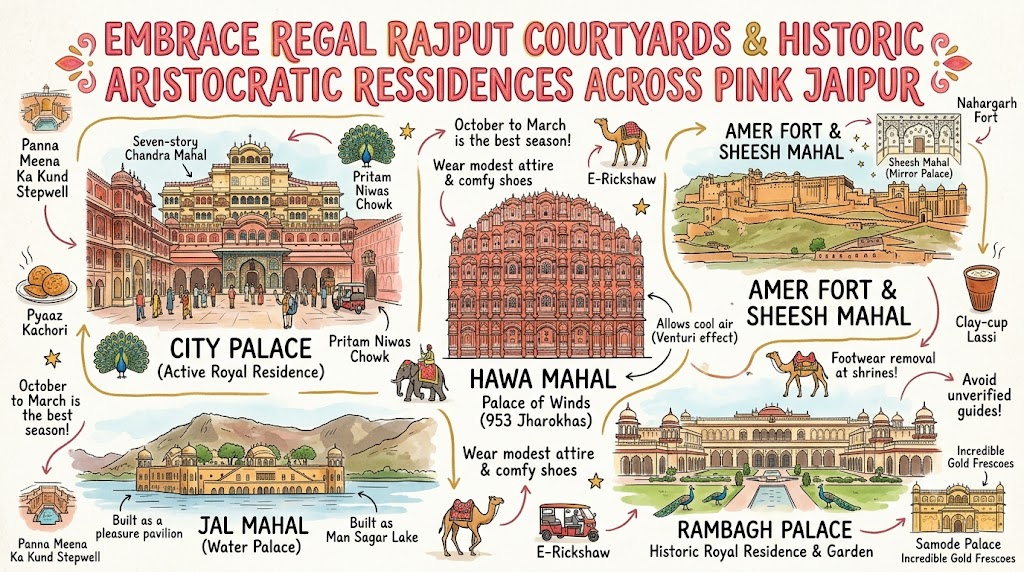
Occupying a sprawling complex in the center of the old city, the City Palace represents the administrative and spiritual heartbeat of the Kachhwaha Rajputs. Commissioned by Maharaja Sawai Jai Singh II, the site seamlessly blends Mughal, Rajput, and European architectural elements across a sequence of vast open courtyards, marble pavilions, and formal gardens. Even today, the titular royal family resides within the soaring seven-story Chandra Mahal, while the lower levels preserve museums of miniature paintings, royal costumes, and ancient weaponry.
Walking through the famous Pritam Niwas Chowk reveals four ceremonial gates adorned with vibrant peacock and floral motifs representing the seasons. The Diwan-i-Khas houses the monumental sterling silver vessels, recognized by the Guinness World Records, which carried sacred Ganga water across oceans for a royal coronation.
- Location: J.D.A. Market, Pink City, approximately 4.5 km from Jaipur Junction Railway Station.
- Why it is worth visiting: It remains an active royal residence where museum-grade treasures and sovereign architecture survive in pristine condition.
- Best things to do: Book the exclusive Chandra Mahal tour to see the mirror-inlaid Sukh Niwas, admire the intricate peacock gate in Pritam Niwas Chowk, and inspect the giant silver Gangajalis in the Diwan-i-Khas.
- Best time to visit: Early morning right at 9:30 AM before tourist crowds gather, or during evening night-viewing tours.
- Ideal for whom: History buffs, architecture lovers, and luxury travelers seeking private curator-led experiences.
- Travel tip: Upgrade to the Royal Grandeur ticket at the counter to gain private access to the inner royal apartments otherwise cordoned off from standard ticket holders.
Hawa Mahal
Rising five stories along the edge of Johari Bazar, the Hawa Mahal (Palace of Winds) is one of the most remarkable architectural facades in Asia. Built in 1799 by Maharaja Sawai Pratap Singh and designed by Lal Chand Ustad, the structure was shaped like the crown of Lord Krishna. Its unique honeycombed exterior allowed the women of the royal court to watch street life and processions unnoticed, honoring the purdah customs of the era.
Engineered with 953 delicately carved jharokhas (casements), the palace creates a Venturi effect that channels cool air through narrow corridors even during scorching desert summers. Devoid of regular stairs, the upper tiers rely on gentle ramps designed for palanquins carrying royal ladies in ceremonial robes.
The 953 jharokhas of Hawa Mahal.
- Location: Hawa Mahal Road, Badi Choupad, roughly 5 km from central Jaipur hotels.
- Why it is worth visiting: It is an engineering marvel of natural convective cooling and delicate pink sandstone masonry.
- Best things to do: Climb the internal ramps to the top tier for a panoramic view of Jantar Mantar, watch morning sunlight stream through stained-glass windows, and photograph the facade from across the street.
- Best time to visit: Sunrise between 7:00 AM and 8:30 AM when early sunlight sets the red and pink sandstone glowing.
- Ideal for whom: Street photographers, design buffs, and cultural travelers.
- Travel tip: Avoid roadside street hawkers blocking the outer gates by entering through the quiet rear courtyard via the Anandpol gate.
Jal Mahal
Floating serenely in the waters of Man Sagar Lake against the backdrop of the rugged Nahargarh hills, Jal Mahal (Water Palace) was built as an exclusive pleasure pavilion. Constructed under Maharaja Madho Singh I in the mid-18th century, it served as a summer retreat and duck-hunting lodge for the Jaipur royals.
The building features five distinct levels, four of which remain submerged when the lake is at full capacity. Built from dense pink sandstone, its fortified underwater arches and lime-mortar masonry have withstood constant water immersion for over two centuries.
Jal Mahal reflected across Man Sagar Lake.
- Location: Amer Road, approximately 8 km north of Jaipur city center.
- Why it is worth visiting: A rare example of low-rise aquatic palace architecture surrounded by mountain ridges.
- Best things to do: Stroll along the wide paved promenade at dusk, watch migratory waterfowl feeding along the marshy lake shores, and photograph the illuminated palace reflection after twilight.
- Best time to visit: Late afternoon between 5:30 PM and 7:00 PM for golden-hour lighting followed by night illuminations.
- Ideal for whom: Couples, romantic travelers, and landscape photographers.
- Travel tip: The palace interior is closed to general public tours, so bring a telephoto lens to capture the ornate rooftop chhatris from the lakeside promenade.
Amer Fort & Sheesh Mahal
Perched atop Cheel ka Teela (Hill of Eagles), Amer Fort served as the ancestral seat of the Kachhwahas before Jaipur’s foundation. Commenced by Raja Man Singh I in 1592 and expanded by Mirza Raja Jai Singh, the palace compound combines red sandstone and white marble across four cascading terraced courts.
The crowning gem within is the world-renowned Sheesh Mahal (Mirror Palace), constructed for royal winter residence. Its interior walls and ceilings are covered in convex Belgian glass mirrors and concave foil inlays that reflect a single candle flame across the entire vaulted chamber like a starfield
.
Gleaming mirror inlays of Sheesh Mahal.
- Location: Amer Town, roughly 11 km northeast of central Jaipur.
- Why it is worth visiting: One of India’s most magnificent hill forts, preserving immaculate mirror mosaics and Rajput-Mughal fresco work.
- Best things to do: Examine the floral relief carvings in the Sheesh Mahal, visit the ornate Ganesh Pol gate, and walk the secret subterranean tunnel leading to Jaigarh Fort.
- Best time to visit: 8:00 AM for early morning cool breezes or 6:30 PM for the atmospheric night-viewing sound and light program.
- Ideal for whom: History enthusiasts, families, and lovers of military architecture.
- Travel tip: Skip the elephant rides at the base ramp and either take the shuttle jeeps or walk up the stone ramparts from the Suraj Pol entrance.
Rambagh Palace
Originally conceived in 1835 as a garden house for the queen’s favorite handmaiden, Rambagh Palace was gradually transformed into the principal royal residence of Maharaja Sawai Man Singh II and Maharani Gayatri Devi. Surrounded by 47 acres of manicured Mughal-style gardens, this palace showcases transition-era architecture where classical Rajput cupolas meet Edwardian colonnades.
Today operated as an iconic heritage palace hotel, Rambagh offers visitors an authentic taste of early 20th-century royal lifestyle. Dining under crystal chandeliers in the former ballroom or taking afternoon high tea on the Verandah preserves a bygone world of princely hospitality.
- Location: Bhawani Singh Road, C-Scheme outskirts, 4 km south of the walled city.
- Why it is worth visiting: It provides the ultimate lived-in royal experience, letting visitors dine and relax where royalty once held court.
- Best things to do: Reserve afternoon tea on The Verandah looking onto peacocks on the lawn, dine inside the Suvarna Mahal ballroom, and tour the royal polo trophy room.
- Best time to visit: Late afternoon from 4:00 PM to 6:30 PM for high tea and twilight cocktails.
- Ideal for whom: Luxury connoisseurs, honeymooners, and heritage travelers.
- Travel tip: Non-resident guests must reserve afternoon tea or dining tables at least 48 to 72 hours in advance to gain entry past the security gates.
Samode Palace
Nestled into a quiet amphitheater of the Aravalli hills roughly an hour north of Jaipur, Samode Palace was built for the hereditary noble Rawats of Samode. Over 450 years old, this secluded palace stands out for its extraordinary private fresco work and delicate stone carvings.
The Sultan Mahal and Durbar Hall feature wall-to-wall floral paintings, hand-painted hunting tapestries, and ceiling murals adorned with pure gold leaf. Surrounded by a rustic rural village, it offers a peaceful, unhurried contrast to Jaipur’s busy urban palaces.
- Location: Samode Village, approximately 42 km north of Jaipur via the NH48 corridor.
- Why it is worth visiting: It houses some of the most vibrant, intact fresco painting and mirror craft in northern India away from urban crowds.
- Best things to do: Photograph the hand-painted frescoes inside Sultan Mahal, take a quiet walk through the village lanes below the palace, and relax in the courtyard gardens.
- Best time to visit: Midday between 11:00 AM and 3:00 PM as a tranquil day excursion from the city center.
- Ideal for whom: Slow travelers, art scholars, and couples seeking secluded heritage escapes.
- Travel tip: Hire a private chauffeur for the round-trip journey, as finding return app-based taxis from Samode back to Jaipur is nearly impossible.
Offbeat Exploration: Hidden Gems Tourists Miss
Sisodia Rani ka Bagh
Built in 1728 for the Udaipur princess who married Maharaja Sawai Jai Singh II, this terraced garden palace sits in a green mountain gorge along the Agra Highway. It features cascading water fountains, painted pavilions showcasing Krishna legends, and tiered flower beds that provided royal women a peaceful retreat away from court politics.
Char Chhota Cenotaphs at Gaitore
Resting quietly at the foot of Nahargarh Fort, Gaitore Ki Chhatriyan houses the royal marble and sandstone cenotaphs of the Kachhwaha kings. Each dome’s carvings reflect the unique artistic style of the monarch’s reign, surrounded by quiet gardens that remain blissfully empty of big tour groups.
Royal Stepwell of Panna Meena Ka Kund
Located just behind the northern ramparts of Amer, this 16th-century stepwell is an engineering marvel of crisscrossing geometric stone stairways. While crowds rush to Amer Fort’s main entrance, this serene spot lets you admire ancient rainwater harvesting architecture and striking stone symmetries in relative quiet.
Detailed Practical Guidance for Travelers
| Destination | Standard Entry Fee | General Timings | Best Local Food Options Nearby | Recommended Nearby Attractions |
|---|---|---|---|---|
| City Palace | ₹300 (Indian) / ₹700 (Foreigner); Museum Only | 9:30 AM – 5:00 PM; 7:00 PM – 10:00 PM | Rawat Mishthan Bhandar, The Palace Cafe | Jantar Mantar, Hawa Mahal |
| Hawa Mahal | ₹50 (Indian) / ₹200 (Foreigner) | 9:00 AM – 5:00 PM | Wind View Cafe, Tattoo Cafe (Opposite facade) | Johari Bazar, Bapu Bazar |
| Jal Mahal | Free (Promenade viewing) | 24 Hours Open (Lighting 6:30 PM – 10:30 PM) | Jal Mahal Ice Cream Parlour, The Verandah | Kanak Vrindavan, Amer Road Craft Village |
| Amer Fort & Sheesh Mahal | ₹100 (Indian) / ₹550 (Foreigner) | 8:00 AM – 5:30 PM; 6:30 PM – 9:15 PM | 1135 AD (Inside Fort), Jagat Shiromani Cafe | Jaigarh Fort, Panna Meena Ka Kund |
| Rambagh Palace | Free (Reservation required for dining/tea) | 12:00 PM – 11:30 PM (For restaurant guests) | Suvarna Mahal, Steam Lounge Bar | Central Park, Albert Hall Museum |
| Samode Palace | ₹1,000 (Visitor entry cover charge) | 10:00 AM – 6:00 PM | Courtyard Restaurant (Samode Palace) | Samode Bagh, Samode Village Bazaars |
Logistics & On-Ground Navigation
Local Transport Options
- Jaipur Metro: Line 1 (Pink Line) runs from Mansarovar straight into Badi Choupad, dropping you within steps of Hawa Mahal and City Palace for less than ₹25.
- Auto-Rickshaws & E-Rickshaws: Abundant across every corner of the old city. Always negotiate beforehand or use Uber Auto to lock in fixed rates.
- App-Based Taxis: Uber and Ola operate reliably across Jaipur for trips out to Amer, Jal Mahal, and Samode.
- Chauffeur-Driven Day Rentals: For multi-palace circuits spanning northern forts down to C-Scheme, hiring a dedicated cab for 8 hours (₹1,800 to ₹2,500) ensures hassle-free transit.
Budget Planning
- Backpacker & Heritage Explorer (₹1,800 – ₹3,000 / day): Stay in heritage hostels in Bani Park, travel via Metro and e-rickshaws, eat traditional kachoris and thalis, and stick to standard monument tickets.
- Comfort & Royal Indulgence (₹8,000 – ₹18,000 / day): Stay in authentic haveli boutique hotels, book high-tier palace museum access (Chandra Mahal), hire private day cars, and reserve high tea or dinner at restored royal palaces like Rambagh.
Safety and Inclusivity Tips
- For Families: The vast flagstone courtyards of City Palace and Amer Fort are stroller-friendly in main sections, though staircases in Hawa Mahal require baby carriers. Keep children well-hydrated under midday sun.
- For Couples: Evening walks along the Jal Mahal promenade and sunset dinners at 1135 AD inside Amer Fort offer safe, romantic settings with attentive security.
- General Safety: Watch your step on polished marble steps, keep your valuables zipped in crowded bazaars, and cross streets carefully around chaotic roundabouts.
Strategic Travel Planning Guardrails
Travel Planning Tips for Jaipur
- Target October through March: Winter brings mild sunny days between 18°C and 26°C, making walking tours through vast open stone courtyards enjoyable.
- Book Heritage Composite Passes: Buy the government composite ticket at your first monument to skip ticket counter lines at Amer and Hawa Mahal.
- Rely on UPI and Small Cash: While palace counters and fine-dining spots take credit cards, small street vendors, auto drivers, and shoe-check stands require small rupee notes or UPI QR codes.
- Carry Slip-On Shoes and Socks: Several palatial shrines require removing footwear; thick socks keep your feet comfortable on sun-baked flagstones.
- Pack Modest, Breathable Attire: Light cotton linens with covered shoulders respect local cultural norms while keeping you cool.
Common Mistakes to Avoid
- Packing Distant Sights into One Day: Trying to visit both Amer Fort in the north and Samode Palace outside the city in a single afternoon leaves you exhausted in traffic.
- Ignoring Government Auto Stands: Taking unregulated curbside rickshaws outside monument gates often leads to inflated quotes.
- Skipping Regional Street Vendors: Eating exclusively in Westernized hotel dining rooms deprives you of legendary local specialties like pyaaz kachori and laal maas.
- Overpaying Unverified Guides: Always look for official, badged Department of Tourism licenses before hiring private palace guides.
- Underestimating Monument Walking: Palaces cover massive acreage; wearing stiff formal footwear quickly leads to sore feet.
Suggested Itinerary Blueprints
Day Quick Dash (The Royal Core)
Designed for travelers with just 24 hours to soak in Jaipur’s royal splendor.
- Morning (8:30 AM – 1:00 PM): Catch early morning light across Hawa Mahal’s facade, then explore the inner chambers of City Palace and Jantar Mantar.
- Afternoon (1:30 PM – 4:30 PM): Enjoy lunch in the old city, followed by a scenic drive past Jal Mahal toward the sprawling courtyards of Amer Fort.
- Evening (5:30 PM – 8:00 PM): Savor high tea or twilight drinks at a heritage hotel in C-Scheme before catching an evening flight or train.
Day Deep-Dive (Palaces & Fortified Ridges)
A balanced two-day itinerary for a thorough royal exploration.
- Day 1 (Urban Sovereignty): Dedicate the morning to City Palace, followed by Hawa Mahal and the royal gardens at Sisodia Rani ka Bagh. Spend the evening browsing traditional craft stalls in Bapu Bazar.
- Day 2 (Fortress Palaces & Lakes): Spend the morning touring the grand pavilions of Amer Fort and the stepwell of Panna Meena Ka Kund. In the afternoon, stop by Jal Mahal, explore the cenotaphs at Gaitore, and enjoy sunset from Nahargarh Fort.
Complete Weekend Travel Plan (The Sovereign Experience)
A full three-day loop covering the best of Jaipur’s royalty.
- Friday: Arrive, check into an authentic heritage haveli, and enjoy a regal Rajasthani dinner featuring laal maas or a traditional vegetarian thali.
- Saturday: Explore Amer Fort and Sheesh Mahal early, head down to Panna Meena Ka Kund, stop at Jal Mahal for lunch, and spend late afternoon strolling through City Palace. End the night with dinner at 1135 AD inside Amer Fort.
- Sunday: Take a morning day trip to Samode Palace to explore its gold-leaf frescoed halls. Return to Jaipur for afternoon high tea at Rambagh Palace before departing.
Common Tourist Mistakes to Avoid
Geographic Blunders
Jaipur is divided into distinct zones: the walled Pink City, the modern southern extensions, and the northern Aravalli corridor. Group sights geographically to avoid wasting hours in cross-town traffic. Visit Amer Fort, Jal Mahal, and Gaitore together in the north, and save City Palace, Hawa Mahal, and the old city markets for a separate, dedicated day.
Commercial Traps
Avoid spending valuable afternoon hours in commercial shopping showrooms along the Amer bypass that promise “exclusive royal artisan access.” These locations often charge inflated commissions to pay tour bus operators. Instead, walk through authentic state handicraft emporiums like Rajasthali or explore the historic guild markets in the old city.
Neglecting Modern Alternative Zones
Do not confine your trip entirely to the walled city ramparts. Vibrant neighborhoods like C-Scheme and Civil Lines boast restored colonial-era properties, contemporary art galleries, indie coffee roasters, and peaceful tree-lined streets that reveal modern Jaipur’s creative energy.
Transport Overpayment
Never accept flat-rate quotes from auto-rickshaw drivers waiting right outside monument exits without checking your phone first. Open an app like Uber or Ola to see the prevailing street fare, then either book directly through the app or use that figure to negotiate a fair cash rate.
Luxury Dining Bias
While fine-dining restaurants inside restored palaces serve magnificent food, avoiding street-level eateries causes you to miss the real flavors of the city. Make sure to taste a fresh, clay-cup lassi on MI Road or sample fresh pyaaz kachoris from historic sweetshops like Rawat.
Frequently Asked Questions
1. Can tourists visit the private residential quarters of the Jaipur royal family inside City Palace?
Yes, travelers can access the private royal quarters inside Chandra Mahal by purchasing the premium Royal Grandeur ticket. This specialized pass includes access to the blue-and-white Sukh Niwas, the mirror-inlaid Rang Mandir, and the Shobha Niwas, guided by an official palace curator while standard tickets only cover outer museum courtyards.
2. Is Jal Mahal open for tourists to explore its internal underwater chambers?
No, the interior of Jal Mahal is currently closed to the general public due to conservation and structural preservation guidelines. Visitors can admire its striking aquatic architecture, surrounding Aravalli hills, and night illuminations from the landscaped walking promenade along the lake shore on the Amer Road corridor.
3. What is the most scenic time to photograph the facade of Hawa Mahal?
The best time to photograph Hawa Mahal is right at sunrise, between 7:00 AM and 8:30 AM. During these early morning hours, the rising sun hits the pink and red sandstone facade directly, while street traffic on the busy road remains light and manageable for unobstructed photography.
4. How much time should I set aside to tour Amer Fort and the Sheesh Mahal?
Plan for at least two and a half to three hours to explore Amer Fort comfortably. The complex covers four large courtyards, the mirror-inlaid Sheesh Mahal, private hammams, and underground tunnels, requiring considerable walking up stone ramps and stairs that shouldn’t be rushed.
5. Are visitors who are not staying at Rambagh Palace allowed to visit the property?
Yes, non-resident visitors can experience Rambagh Palace by booking afternoon high tea at The Verandah or a lunch or dinner reservation at Suvarna Mahal. You must book these reservations 48 to 72 hours in advance to ensure smooth entry past the main security gate.
6. What is the dress code when visiting the historic palaces in Jaipur?
While there is no strict government-enforced dress code for palace museums, choosing modest, breathable clothing that covers shoulders and knees is recommended. Wearing respectful attire helps when passing through active courtyards and shrines, while slip-on shoes make footwear removal easier at designated sanctums.
7. Is hiring a local guide worth it at City Palace and Amer Fort?
Hiring an official, licensed tour guide is well worth the cost to appreciate the architectural geometry, history, and royal legends of these vast complexes. Look for guides with verified identity badges from the Department of Tourism near the ticket counters, and agree on the fee upfront.
8. Can you reach both Jaigarh Fort and Amer Fort through the interior palace tunnels?
Yes, visitors can walk through the restored subterranean passage that connects the Man Singh Palace courtyard within Amer Fort up to the military watchposts of Jaigarh Fort. The stone tunnel was originally built as a secret escape route for royal family members during armed sieges.
9. Are photography permits required for cameras and phones inside Jaipur’s royal palaces?
Smartphones do not require special permits for casual photography inside standard palace museum sections. However, professional DSLR cameras, tripods, and commercial video equipment require separate permit fees at the ticket windows, and photography is strictly forbidden inside certain inner sanctums and private portrait galleries.
10. What is the difference between Amber Palace and Amer Fort?
Amber Palace and Amer Fort refer to the exact same royal monument in the historic town of Amer. “Amer” is the traditional, locally recognized Hindi spelling derived from the Ambikeshwar temple, while “Amber” was an Anglicized phonetic spelling introduced and popularized during the British colonial period.
11. Is Samode Palace practical to visit as a half-day trip from central Jaipur?
Yes, Samode Palace is located roughly 42 kilometers north of Jaipur, making it an easy half-day excursion. The drive takes about one hour each way along the national highway, allowing you to spend two to three relaxing hours exploring its hand-painted frescoed halls and rural surroundings.
12. Are Jaipur’s royal palaces wheelchair accessible for travelers with mobility concerns?
The main courtyards of City Palace offer step-free access and flat flagstones suitable for wheelchairs. However, historic structures like Hawa Mahal and Amer Fort feature steep ramps, raised stone thresholds, and narrow stairwells that can be challenging for travelers with significant mobility limitations.
Conclusion
Choosing an immersive royal journey across Jaipur’s palaces rewards you with far more than postcard-perfect pictures. Standing beneath the shimmering ceiling of the Sheesh Mahal, feeling the breeze through Hawa Mahal’s sandstone lattices, or watching twilight fall across the water at Jal Mahal connects you to centuries of living history and princely elegance.
