Introduction
While standard tourist itineraries funnel visitors into crowded souvenir corridors and cookie-cutter tour buses, Jaipur reveals its true royal soul to those who pause and listen to its morning rhythms. Long before the midday heat hits the pink terracotta facades of the Old City, the ancient streets wake up to the crackle of frying pyaz kachoris, the rich aroma of coal-brewed masala chai, and the gentle chiming of temple bells. Founded in 1727 by Maharaja Sawai Jai Singh II, Jaipur is a living, breathing canvas where centuries-old Rajput chivalry, Mughal design aesthetics, and vibrant culinary traditions interlock seamlessly.
Stepping off the beaten path into Jaipur’s walled bazaars delivers an unmatched sensory immersion. Here, historic craftsmanship is not locked away inside static glass cases; it thrives in open-air artisan stalls, heritage eateries, and sacred stepwells where locals have gathered for generations. Beyond the magnificent sandstone fortresses lies a destination anchored in deep cultural pride, legendary hospitality, and a legendary food culture that turns every breakfast into a celebration of flavor.
Why Jaipur is a must-visit city
Jaipur stands as the undisputed crown jewel of India’s Golden Triangle, representing a pivotal chapter in South Asian architectural history and urban planning. Unlike medieval cities that evolved organically without structure, Jaipur was engineered using ancient Vastu Shastra principles and grid layouts, making it India’s first planned heritage city. Its cultural weight is recognized globally by its UNESCO World Heritage status, offering travelers an unparalleled passage into royal lifestyle, world-class jewelry craftsmanship, and vibrant textile arts.
Practically, Jaipur offers phenomenal accessibility for every traveler archetype. Located just 260 kilometers from New Delhi, it is connected via modern six-lane expressways, direct high-speed railway networks (including Vande Bharat Express), and an international airport. Whether you are a solo backpacker navigating on e-rickshaws, a couple seeking atmospheric boutique heritage stays, or a family exploring vast royal palaces, Jaipur’s hospitality infrastructure accommodates every preference effortlessly.
| Category | Key Information |
| Geographic Region | Eastern Rajasthan, Aravalli Hill Range, India |
| Best Travel Season | October to March (Mild, pleasant winter weather) |
| Ideal Trip Duration | 3 to 4 Days for a complete cultural and culinary dive |
| Primary Connectivity | Jaipur International Airport (JAI), Jaipur Junction Rail Hub, Delhi-Jaipur Expressway |
| Cultural Status | UNESCO World Heritage City (Inscribed 2019) |
Best Places or Experiences
Amer Fort & Palace Complex
Perched dramatically atop the craggy Cheel ka Teela (Hill of Eagles) in the Aravalli range, Amer Fort is a breathtaking masterpiece of Rajput military and artistic brilliance. Constructed in 1592 by Raja Man Singh I and expanded by Mirza Raja Jai Singh, the fort seamlessly blends Hindu architectural elements with opulent Mughal palace interiors. Its grand red sandstone and yellow marble courtyards overlook the tranquil Maota Lake, reflecting centuries of royal grandeur.
Walking through the Sun Gate (Suraj Pol) brings you into immense public assembly grounds, leading toward the legendary Sheesh Mahal (Mirror Palace). Decorated with thousands of imported concave mirrors and glass inlays, the Sheesh Mahal illuminates entirely with a single candle flame. The intricate frescoed archways of the Ganesh Pol and the cool marble breezes of the Sukh Niwas showcase the incredible lifestyle of Rajasthan’s historic rulers.
- Location: Amer Town, 11 km north of Jaipur city center.
- Why it is worth visiting: Unmatched hilltop fortress architecture featuring the world-famous Sheesh Mahal mirror work.
- Best things to do: Explore the subterranean passages, admire the mirror reflections in Sheesh Mahal, and photograph Maota Lake from the Diwan-i-Aam courtyard.
- Best time to visit: 8:00 AM to 10:30 AM (to beat tourist crowds and afternoon heat) or 6:30 PM for the sound and light show.
- Ideal for whom: History enthusiasts, photographers, architecture lovers, and families.
- Travel tip: Avoid elephant rides; take the official RTDC jeep option or walk up the cobblestone ramp via Suraj Pol for a stunning approach.
Hawa Mahal (Palace of Winds)
Built in 1799 by Maharaja Sawai Pratap Singh, Hawa Mahal stands as Jaipur’s most iconic visual landmark. Designed by architect Lal Chand Ustad, this five-story pink and red sandstone structure resembles the crown of Lord Krishna. Its remarkable honeycombed facade features 953 meticulously carved small windows known as jharokhas, framed by intricate lattice gingerbread woodwork.
The palace was constructed to allow royal ladies of the court to observe daily street life, royal processions, and bazaar festivities down in Johari Bazaar without being seen by the public. The ingenious ventilation system utilizes the Venturi effect, channeling air through the tiny latticed openings to naturally cool the interior chambers even during scorching summer months.
- Location: Badi Chaupar, Johari Bazaar Road, Walled City, Jaipur.
- Why it is worth visiting: One of the world’s most unique architectural facades engineered for natural climate control.
- Best things to do: Climb to the upper levels for views of the City Palace, view the stained-glass window room in morning light, and photograph the facade from across the street.
- Best time to visit: 7:30 AM to 9:00 AM (early morning golden sunlight illuminates the pink facade beautifully).
- Ideal for whom: Photographers, heritage lovers, solo travelers, and culture buffs.
- Travel tip: The best facade photographs are taken from the rooftop cafes directly across the main street (such as Wind View Cafe).
The Walled City Breakfast Trail
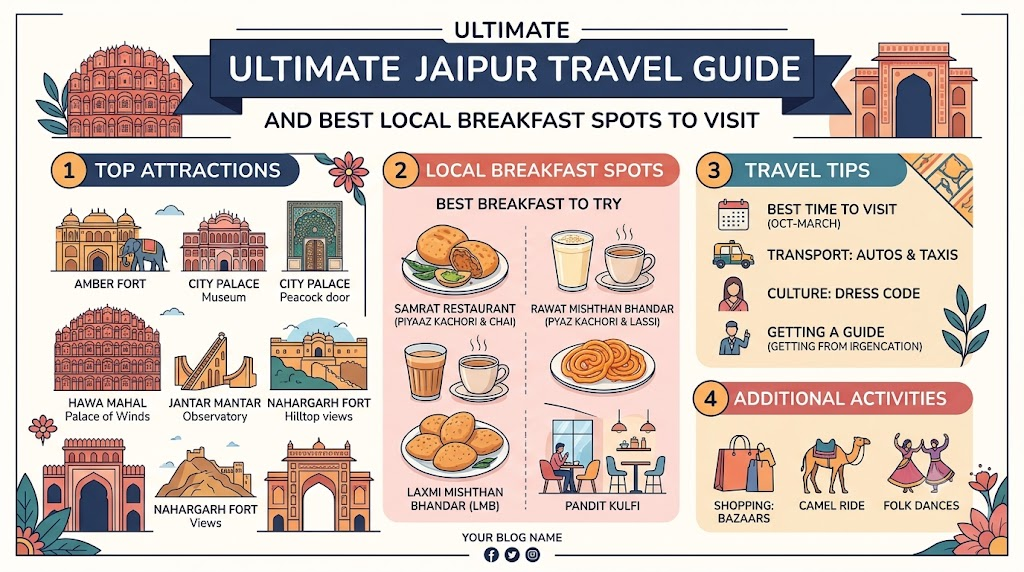
No visit to Jaipur is authentic without experiencing its century-old morning breakfast culinary rituals. Deep inside the pink city gates, historic halwais (sweetmakers) and street food vendors start firing up giant iron cauldrons before dawn. This culinary circuit is anchored by legendary institutions like Rawat Mishthan Bhandar, Samrat Restaurant on Chaura Rasta, and the iconic Laxmi Mishthan Bhandar (LMB) in Johari Bazaar.
The star of Jaipur’s morning table is the world-famous Pyaz Kachori—a deep-fried, golden pastry filled with spiced onions, nigella seeds, and aromatic herbs. Paired with sweet piping-hot jalebis, smoky coal-cooked chai from Sahu Chai Stall, and creamy kulhad lassi from MI Road, this breakfast trail reveals the rich, living food heritage of Rajasthan.
- Location: Old Walled City (Chaura Rasta, Johari Bazaar, and Station Road).
- Why it is worth visiting: Unfiltered exposure to authentic regional flavors, recipes passed down for 4 generations, and vibrant street life.
- Best things to do: Eat freshly fried Pyaz Kachori at Rawat or Samrat, sip coal-brewed tea at Sahu Chai, and finish with crispy Mawa Jalebis at LMB.
- Best time to visit: 7:00 AM to 9:30 AM (when items are fried fresh and morning street temperatures are crisp).
- Ideal for whom: Foodies, culture explorers, budget travelers, and morning walkers.
- Travel tip: Always request your kachori served fresh off the stove with sweet tamarind and spicy mint chutney; carry cash as small street counters rarely take cards.
Jantar Mantar Astronomical Observatory
Constructed between 1728 and 1734 by the astronomer king Maharaja Sawai Jai Singh II, Jantar Mantar is a UNESCO World Heritage site housing nineteen architectural astronomical instruments. These colossal stone structures were engineered to measure time, predict eclipses, track star locations, and determine planetary declination using the naked eye with astonishing accuracy.
The park contains the Vrihat Samrat Yantra, the world’s largest stone sundial, standing 27 meters tall. Its shadow moves visibly at a rate of 1 millimeter per second, measuring local solar time to an accuracy of two seconds. The mathematical precision and scientific foresight displayed in this open-air observatory remain an astounding testament to 18th-century Indian scientific mastery.
- Location: Kanwar Nagar, adjacent to City Palace and Tripolia Bazaar.
- Why it is worth visiting: The world’s largest stone astronomical observatory and an unprecedented historic scientific monument.
- Best things to do: Watch the shadow shift on the giant Samrat Yantra sundial, examine the Jai Prakash Yantra bowl instruments, and hire an approved guide to explain celestial mechanics.
- Best time to visit: 11:00 AM to 1:30 PM (when the sun is high and shadows on the sundials are crisp and easiest to read).
- Ideal for whom: Science buffs, history enthusiasts, students, and curious mind travelers.
- Travel tip: Hire an official certified tour guide at the entrance; without expert explanation, the complex instruments can look like abstract modern art sculptures.
City Palace & Chandra Mahal
Occupying nearly one-seventh of Jaipur’s walled grid, the City Palace complex has served as the administrative and ceremonial seat of the Maharaja of Jaipur since 1727. The palace exhibits a fusion of Shilpa Shastra, Rajput, Mughal, and European revivalist architecture. While portions of the palace remain a private royal residence, vast courtyard sections and museums are open to public exploration.
Key highlights include the Mubarak Mahal (a textiles and costume museum), the Diwan-i-Khas featuring two silver urns certified by the Guinness World Records as the largest sterling silver vessels in the world, and the magnificent Pritam Niwas Chowk. This inner courtyard features four peacock gates representing the four seasons and Hindu deities, showcasing incredible enamel painting and plaster relief work.
- Location: Tulsi Marg, Gangori Bazaar, J.D.A. Market, Pink City.
- Why it is worth visiting: A royal living museum displaying extraordinary royal collections, courtly textiles, and historic weaponry.
- Best things to do: Photograph the intricate Peacock Gate in Pritam Niwas Chowk, view the giant silver water vessels in Diwan-i-Khas, and inspect royal ceremonial attire in Mubarak Mahal.
- Best time to visit: 9:30 AM or 3:30 PM (to avoid midday tour groups).
- Ideal for whom: Royal history enthusiasts, art connoisseurs, luxury travelers, and families.
- Travel tip: Consider purchasing the full museum ticket access or the elite Royal Splendor tour if you wish to enter the private Chandra Mahal state rooms.
Albert Hall Museum & Ram Niwas Garden
Set inside the lush Ram Niwas Garden just outside the historic city gates, the Albert Hall Museum is the oldest museum in Rajasthan. Designed by Sir Samuel Swinton Jacob and opened in 1887, the building is a masterclass in Indo-Saracenic revival architecture, featuring carved stone arches, ornate chattris, and decorative courtyard tilework.
The museum houses an extensive collection of ancient artifacts, including Persian carpet masterpieces, carved ivory, ceremonial armor, metalware, fine miniature paintings, and a genuine 2,300-year-old Egyptian mummy. At night, the entire stone building is lit with golden floodlights, creating a magical atmosphere as thousands of pigeons flutter around its domes.
- Location: Ram Niwas Garden, Museum Road, Adarsh Nagar.
- Why it is worth visiting: Rajasthan’s premier museum displaying ancient arts and unique historical antiquities inside a majestic building.
- Best things to do: View the ancient Egyptian mummy exhibit, admire royal miniature paintings, and photograph the exterior night light illumination.
- Best time to visit: 4:00 PM to 6:00 PM for museum halls, staying until 7:00 PM to see the exterior night lights turn on.
- Ideal for whom: Art lovers, museumgoers, budget travelers, and night photographers.
- Travel tip: The museum offers a night viewing ticket (7:00 PM – 10:00 PM) which provides a cooler, quiet experience under golden night lighting.
Offbeat Exploration: Hidden Gems Tourists Miss
Panna Meena ka Kund (Hidden Stepwell)
Tucked away near the northern edge of Amer village lies Panna Meena ka Kund, an exquisite 16th-century geometric stepwell that most day-trippers overlook. Built with symmetrical crisscrossing staircases that descend into a cool water reservoir, this architectural wonder served as a community gathering space and rainwater harvesting center for centuries. The shadow play created by its geometric stairs at different times of the day is a dream for creative photographers.
Galtaji Temple (The Sacred Sun & Monkey Valley)
Located in a deep mountain pass 10 kilometers east of Jaipur, Galtaji is an ancient Hindu pilgrimage complex built into a narrow granite gorge. Blessed with natural freshwater springs that fill seven sacred stone water tanks (kunds), the complex features pink sandstone temples decorated with painted wall frescoes. Home to hundreds of friendly rhesus macaque monkeys, climbing to the hilltop Sun Temple at sunset provides views across the entire Jaipur valley.
Nahargarh Fort Sunset Point & Padao Open Air Lounge
While Amer Fort attracts daytime crowds, locals head to Nahargarh Fort perched on the edge of the Aravalli ridge for late afternoon views. Constructed in 1734 as a defensive retreat, its rooftop open-air restaurant, Padao, offers unobstructed 360-degree views of the entire Pink City. Watching the sun set over the urban grid below as the city lights turn on across the valley is an unforgettable Jaipur experience.
Detailed Practical Guidance for Travelers
| Destination | Standard Entry Fee | General Timings | Best Local Food Options Nearby | Recommended Nearby Attractions |
| Amer Fort | ₹200 (Indian) / ₹1000 (Foreign) | 8:00 AM – 5:30 PM | 1135 AD (Fine dining), local kachori stalls in Amer town | Panna Meena Stepwell, Jaigarh Fort |
| Hawa Mahal | ₹100 (Indian) / ₹600 (Foreign) | 9:00 AM – 5:00 PM | Wind View Cafe, Laxmi Mishthan Bhandar (LMB) | Johari Bazaar, Sireh Deori Bazaar |
| Old City Food Trail | Nominal food costs (₹30–₹80 per snack) | 7:00 AM – 10:00 PM | Rawat, Samrat Restaurant, Sahu Chai, Lassiwala | Bapu Bazaar, Tripolia Bazaar |
| Jantar Mantar | ₹100 (Indian) / ₹600 (Foreign) | 9:00 AM – 5:00 PM | Surya Mahal, Indian Coffee House | City Palace, Tripolia Gate |
| City Palace | ₹300 (Indian) / ₹1000 (Foreign) | 9:30 AM – 5:00 PM | The Baradari Palace Cafe, Palace Canteen | Jantar Mantar, Govind Dev Ji Temple |
| Albert Hall Museum | ₹100 (Indian) / ₹600 (Foreign) | 9:00 AM – 5:00 PM, 7:00 PM – 10:00 PM | Masala Chowk (Food court), Gulab Ji Chai | Ram Niwas Garden, Jaipur Zoo |
Logistics & On-Ground Navigation
Local Transport Options
- Auto-Rickshaws & E-Rickshaws: E-rickshaws are the most efficient way to navigate the congested lanes of the Old City (Johari Bazaar, Chaura Rasta). Agree on a fare beforehand or use app-based booking services.
- App-Based Cabs (Ola / Uber / Rapido): Highly reliable for longer transit between the Old City, C-Scheme, Amer Fort, and the airport. Bike taxis (Rapido) work well for solo travelers.
- Jaipur Metro: Modern, clean, and air-conditioned. The Pink Line connects Mansarovar to Badi Chaupar, dropping you right at the doorstep of Hawa Mahal and Johari Bazaar.
- Private Drivers / Car Rentals: Ideal for day trips covering out-of-town monuments like Amer Fort, Jaigarh, Nahargarh, and Galtaji in a single seamless trip.
Budget Planning
- Backpacker / Budget Tier (₹1,500 – ₹2,500 per day): Stays in heritage hostel dorms (C-Scheme or Bani Park), meals at local street halwais and breakfast stalls (₹400/day), public transport via metro and e-rickshaws, composite entry tickets for sights.
- Mid-Range / Comfort Tier (₹4,500 – ₹9,000 per day): Stays in boutique boutique heritage hotels, private app-based auto/cab transport, meals at atmospheric rooftop restaurants and heritage cafes, and private guided monument tours.
Safety and Inclusivity Tips
- For Families: Jaipur is welcoming to multi-generational family travel. Choose heritage hotels with courtyard gardens to relax after midday sightseeing. Keep kids hydrated during temple climbs.
- For Couples: Indulge in rooftop sunset dinners at Nahargarh Fort, quiet morning walks around Jal Mahal lake, and heritage stay stays in C-Scheme.
- General Street Safety: Watch out for aggressive street hawkers outside major monuments like Hawa Mahal. A polite but firm “Nahin, Chahiye” (No, thank you) will allow you to continue unbothered.
Strategic Travel Planning Guardrails
Travel Planning Tips for Jaipur
- Book Heritage Stays Early: Peak winter season (November through February) sees high demand. Secure bookings for boutique heritage havelis at least 2 months in advance.
- Carry Cash for Old City Food: While digital payments (UPI) are common, traditional morning breakfast stalls and small bazaar artisans often prefer small cash notes.
- Buy the Composite Monument Ticket: Available at major Archaeological Survey of India (ASI) sights, this ticket covers multiple attractions (Amer Fort, Hawa Mahal, Jantar Mantar, Nahargarh, Albert Hall) at a discounted price.
- Dress Respectfully for Temples: Cover shoulders and knees when visiting active places of worship like Galtaji or Govind Dev Ji Temple; wear slip-on footwear for convenience.
- Stay Hydrated: Rajasthan’s dry climate can dehydrate you quickly, even in winter. Carry a reusable water bottle and sip fresh sugarcane juice or lime soda throughout the day.
Common Mistakes to Avoid
- Over-packing Daily Itineraries: Jaipur’s sights require walking and leisure time. Do not try to fit more than 3 major sights into a single day.
- Shopping Only in Tourist Showrooms: Avoid driver-recommended commission gift shops along the highway; shop directly with bazaar artisans in Johari, Bapu, and Kishanpole bazaars.
- Ignoring the Early Morning Hours: Visiting sights after 11:00 AM means enduring heat and crowded spaces. Early mornings offer cool temperatures, golden photographic light, and quiet streets.
- Skipping Street Food Breakfasts: Sticking exclusively to hotel buffet breakfasts deprives you of Jaipur’s authentic culinary soul—its legendary kachoris, jalebis, and lassi.
- Taking Unmetered Transport Without Negotiating: Always negotiate auto-rickshaw fares beforehand or cross-reference pricing using ride-hailing apps to ensure fair rates.
Suggested Itinerary Blueprints
1-Day Quick Dash (The Royal Highlights Express)
- Morning (7:30 AM – 11:30 AM): Start with an authentic Pyaz Kachori and Chai breakfast at Samrat on Chaura Rasta. Visit Hawa Mahal for morning photos, followed by a quick walk through Jantar Mantar.
- Afternoon (12:00 PM – 4:00 PM): Explore the courtly courtyards of City Palace. Take a short cab ride up to Amer Fort for a 2-hour guided walkthrough.
- Evening (5:00 PM – 8:00 PM): Head to Nahargarh Fort for a breathtaking sunset over the Pink City, followed by dinner in C-Scheme.
2-Day Deep-Dive (Heritage, Bazaars & Culinary Heritage)
- Day 1:
- Morning: Early morning street food breakfast at Rawat (Station Road). Explore Amer Fort, Panna Meena ka Kund, and Jaigarh Fort.
- Afternoon: Lunch at 1135 AD inside Amer. Visit Jal Mahal photo point on the return drive.
- Evening: Stroll through Johari and Bapu Bazaars; attend the evening evening light view at Albert Hall Museum.
- Day 2:
- Morning: Old City morning walk starting with coal chai at Sahu Chai Stall and Jantar Mantar. Explore City Palace and Pritam Niwas Chowk.
- Afternoon: Try local Rajasthani Thali (Dal Baati Churma) at LMB. Visit the hidden Galtaji Monkey Temple.
- Evening: Sunset views at Padao Lounge (Nahargarh Fort) and dinner in C-Scheme cafe district.
3-Day Complete Weekend Travel Plan (The Ultimate Jaipur Immersion Loop)
- Friday: Arrive in Jaipur. Check into a heritage haveli. Evening stroll around Ram Niwas Garden, Albert Hall night lighting, and street food tasting at Masala Chowk.
- Saturday: Royal fort circuit day. Morning at Amer Fort and Panna Meena Kund. Midday exploration of Jaigarh Fort and the world’s largest cannon on wheels (Jaivana). Sunset above the city at Nahargarh Fort.
- Sunday: Old City cultural and culinary immersion. Morning breakfast trail at Samrat and LMB. Visit Hawa Mahal, Jantar Mantar, and City Palace. Afternoon shopping for block-print textiles, blue pottery, and silver jewelry in Tripolia Bazaar. Departure.
Common Tourist Mistakes to Avoid
- Geographic Blunders: Trying to combine geographically opposed zones—such as visiting Amer Fort in the far north and Galtaji Temple in the far east—on the same rushed morning. Group sights by geographic clusters instead.
- Commercial Traps: Spending precious vacation hours inside modernized, sterile shopping malls on the outskirts rather than soaking in the historic, atmospheric bazaar lanes of the Old City.
- Neglecting Modern/Alternative Zones: Forgetting to explore Jaipur’s contemporary artistic side. Neighborhoods like C-Scheme and Ashok Nagar feature leafy residential streets, world-class modern coffee shops, art galleries, and stylish boutiques.
- Transport Overpayment: Accepting fixed high rates from street rickshaw drivers without checking ride-sharing apps (Uber, Ola, Rapido) to establish fair pricing.
- Luxury Dining Bias: Eating exclusively inside high-end international hotel restaurants. Missing out on street-level culinary vendors like Rawat, Lassiwala, and Sahu Chai deprives you of Jaipur’s genuine culinary identity.
Frequently Asked Questions
1. What is the single best breakfast item to try in Jaipur for authentic local flavor?
The undisputed signature breakfast item in Jaipur is the Pyaz Kachori—a deep-fried, golden pastry stuffed with a spiced onion and herb filling. It is best paired with sweet tamarind chutney and freshly fried jalebis for the ultimate sweet-and-savory local breakfast combination.
2. Which iconic eatery serves the most famous Pyaz Kachori in Jaipur?
Rawat Mishthan Bhandar on Station Road is globally famous as the home of Jaipur’s definitive Pyaz Kachori. Other exceptional local favorites include Samrat Restaurant in Chaura Rasta and Laxmi Mishthan Bhandar (LMB) in Johari Bazaar.
3. What is the best time of year to visit Jaipur for comfortable sightseeing?
The optimal travel window is during the winter months from October to March. Temperatures range between 15°C and 25°C, providing ideal weather for exploring open-air forts, palace courtyards, and vibrant bazaar streets.
4. How many days are recommended for a complete Jaipur travel itinerary?
A 3-day itinerary is ideal for experiencing Jaipur’s primary sights, royal forts, historic astronomical sites, bazaar shopping trails, and rich street food culture without feeling rushed.
5. Are elephant rides still recommended at Amer Fort?
No, elephant rides at Amer Fort are increasingly discouraged due to animal welfare concerns. Tourists can comfortably access the fort entrance via RTDC government jeep services, private taxi cars, or an enjoyable walking climb through the historic Suraj Pol gate.
6. Is Jaipur safe for solo female travelers?
Yes, Jaipur is widely considered one of India’s safest travel destinations for solo women. Standard travel common sense applies: dress modestly in traditional areas, avoid isolated places late at night, and use verified app-based transport services for night travel.
7. Can I explore the Old Walled City of Jaipur on foot?
Yes, walking is the absolute best way to experience the Pink City bazaars. However, because streets are busy, pairing brief walking segments with nimble e-rickshaws helps navigate longer stretches between gates comfortably.
8. What is the difference between Amer Fort, Jaigarh Fort, and Nahargarh Fort?
Amer Fort is the opulent royal palace complex. Jaigarh Fort is the military fortress located directly above Amer, built to defend it. Nahargarh Fort sits on the ridge overlooking the main city grid, offering the best panoramic sunset views.
9. Do street food breakfast stalls in Jaipur accept digital payments or credit cards?
While large restaurants accept cards, most traditional street food stalls and small tea counters accept cash or Indian UPI digital payments. Carrying small cash bills (₹20, ₹50, ₹100) is highly recommended.
10. What are the top souvenirs to purchase in Jaipur’s bazaars?
Top authentic buys include handcrafted blue pottery, authentic block-printed textiles (Jaipuri razai quilts), silver jewelry in Johari Bazaar, traditional bandhani bandhej sarees, and camel leather footwear (mojris) in Bapu Bazaar.
11. Is a guide necessary when visiting Jantar Mantar observatory?
Yes, hiring a certified tour guide at Jantar Mantar is highly recommended. Without an expert explanation of celestial calculations, the complex stone instruments appear simply as geometric structures.
12. Where can travelers taste authentic Dal Baati Churma in Jaipur?
For an authentic, high-quality Rajasthani thali featuring Dal Baati Churma, visit Laxmi Mishthan Bhandar (LMB) in Johari Bazaar or Thali House on MI Road.
Conclusion
Jaipur is far more than a collection of postcard pink palaces and grand hilltop stone fortresses; it is an enduring celebration of human heritage, culinary artistry, and royal grandeur. Stepping into its sunrise streets—where the fragrance of boiling spiced chai meets the crisp air of ancient bazaars—offers a deep, transformative connection to India’s living traditions. By choosing to slow down, explore its quiet geometric stepwells, and sample its legendary century-old breakfast stalls, you unlock an authentic journey that stays warmly etched in your memory long after your travel days are done.
