Introduction
Modern engineering teams build and ship software faster than ever, relying on rapid development lifecycles, cloud platforms, and automated pipelines. However, as organizations adopt architectures like microservices, Docker containers, Kubernetes orchestrators, REST APIs, and third-party open-source dependencies, the attack surface expands exponentially. Traditional security practices—where security checks occur manually at the very end of the release cycle—create severe bottlenecks, delay releases, and often miss critical vulnerabilities. Modern software delivery demands continuous security integration embedded directly into everyday development operations. This comprehensive guide explores how organizations integrate security across the entire software delivery lifecycle, covering essential strategies, toolchains, automation frameworks, supply chain protections, and cloud infrastructure safeguards. To learn more about modern engineering strategies, visit DevSecOpsNow.
Understanding DevSecOps
DevSecOps represents the structural convergence of development, security, and operations, replacing isolated security audits with continuous, shared security responsibility across engineering teams. Instead of treating security as an external gateway, DevSecOps embeds security practices throughout every phase of the Software Development Lifecycle (SDLC) through a methodology known as shift-left security. By utilizing automated security testing, real-time developer feedback loops, and policy-driven controls, teams identify and remediate security flaws when code is written rather than in production environments. Practical DevSecOps practices incorporate continuous code analysis, automated dependency checking, infrastructure verification, and runtime security monitoring to build resilient systems without slowing down deployment velocity.
Secure Coding Practices
Developers follow standardized secure coding guidelines, input validation rules, and threat modeling frameworks to prevent common vulnerabilities like SQL injection, cross-site scripting, and broken access controls directly at the source code level.
Static Application Security Testing (SAST)
Automated SAST engines analyze uncompiled source code inside repository pull requests, highlighting syntax-level security flaws and logic defects before code merges into main branches.
Dynamic Application Security Testing (DAST)
DAST tools simulate real-world attacks against running staging applications, identifying runtime vulnerabilities, authentication failures, exposed endpoint errors, and server configuration weaknesses without requiring source code access.
Software Composition Analysis (SCA)
SCA solutions automatically scan project manifests and open-source packages to identify known security vulnerabilities, license compliance risks, and outdated dependencies integrated into application builds.
Secrets Scanning
Automated secret detection algorithms Continuously inspect git commits, pull requests, build logs, and environment configurations to intercept accidentally exposed API keys, private certificates, cloud credentials, and database tokens.
Infrastructure as Code (IaC) Scanning
IaC analysis tools scan Terraform files, CloudFormation templates, and ARM blueprints prior to cloud provisioning, detecting overly permissive security groups, exposed storage buckets, and missing encryption settings.
Container Scanning
Container security scanners inspect Docker images and base layers within container registries, identifying vulnerable operating system packages, embedded binaries, missing security patches, and risky root execution permissions.
Software Bill of Materials (SBOM)
An SBOM creates a machine-readable inventory listing every software component, library, module, and transitive dependency used to build an application, simplifying vulnerability tracking and supply chain management.
Policy-as-Code
Policy-as-Code frameworks express governance and compliance rules as executable code, allowing automated policy engines to evaluate cloud infrastructure, Kubernetes manifests, and build pipelines against strict organizational guidelines.
Runtime Monitoring
Runtime application self-protection and security monitoring tools inspect live production environments, detecting unexpected process executions, anomalous network traffic, file system modifications, and unauthorized memory access.
Why Organizations Are Adopting DevSecOps
Modern application ecosystems heavily rely on distributed architectures utilizing tools like Git, CI/CD pipelines, Docker, Kubernetes, Terraform, AWS, Azure, Google Cloud, APIs, and vast open-source repositories. While these technologies dramatically increase feature delivery speed, they introduce complex security risks that manual inspection processes cannot adequately manage. Organizations adopt DevSecOps to establish automated security controls that match their deployment pace, allowing engineering teams to discover vulnerabilities early, accelerate remediation, improve cross-team collaboration, maintain continuous compliance visibility, and significantly reduce the financial cost associated with late-stage production security fixes.
DevSecOps Consulting Services
Organizations seeking to modernize their engineering workflows often leverage DevSecOps Consulting Services to establish structured, enterprise-wide security strategies tailored to their technological ecosystems. Professional consulting involves evaluating existing development processes, analyzing CI/CD pipelines, assessing cloud architecture, reviewing Kubernetes security postures, selecting appropriate automation toolchains, and designing custom transformation roadmaps. External consulting expertise proves essential when companies encounter complex compliance requirements, struggle with developer adoption resistance, migrate traditional applications to cloud-native platforms, or need to align disparate engineering, security, and operations teams around a unified security strategy.
DevSecOps Implementation Services
Transitioning from abstract security strategies to operational reality requires tailored DevSecOps Implementation Services that integrate security controls directly into active delivery channels. Implementation teams configure automated scanners inside code repositories, build secure CI/CD pipelines, establish policy enforcement mechanisms, set up vulnerability dashboards, and automate remediation workflows. This hands-on process ensures that security verification occurs silently in the background, providing immediate feedback to developers without creating unnecessary friction or slowing down release cadences.
Static Application Security Testing – SAST
SAST implementation integrates static code analyzers into code repositories, automatically reviewing developer commits against security rulesets, identifying coding flaws, and providing clear, actionable remediation guidance directly within active pull request comments.
Dynamic Application Security Testing – DAST
DAST configuration involves setting up automated web application scanners inside staging environments, testing live application interfaces for injection attacks, session management issues, broken authorization, and unhandled server errors during build verification stages.
Software Composition Analysis – SCA
SCA implementation automates open-source dependency tracking across build pipelines, blocking vulnerable packages, alerting teams to license policy violations, and identifying transitive dependency risks before software builds reach production registers.
Secrets Scanning
Secrets scanning controls install git hooks, repository monitors, and pipeline gates that immediately flag accidentally committed credentials, forcing automatic revocation and preventing sensitive keys from entering public or private source code repositories.
Infrastructure as Code Security
IaC security implementation embeds static configuration checks into Terraform and CloudFormation deployment scripts, preventing infrastructure deployments if security misconfigurations, unencrypted storage volumes, or public access permissions are detected.
Container Security
Container security implementation enforces image base hardening, automates vulnerability scans inside container registries, validates image signatures using cryptographic tools, and enforces non-root container runtime policies across build stages.
Kubernetes Security
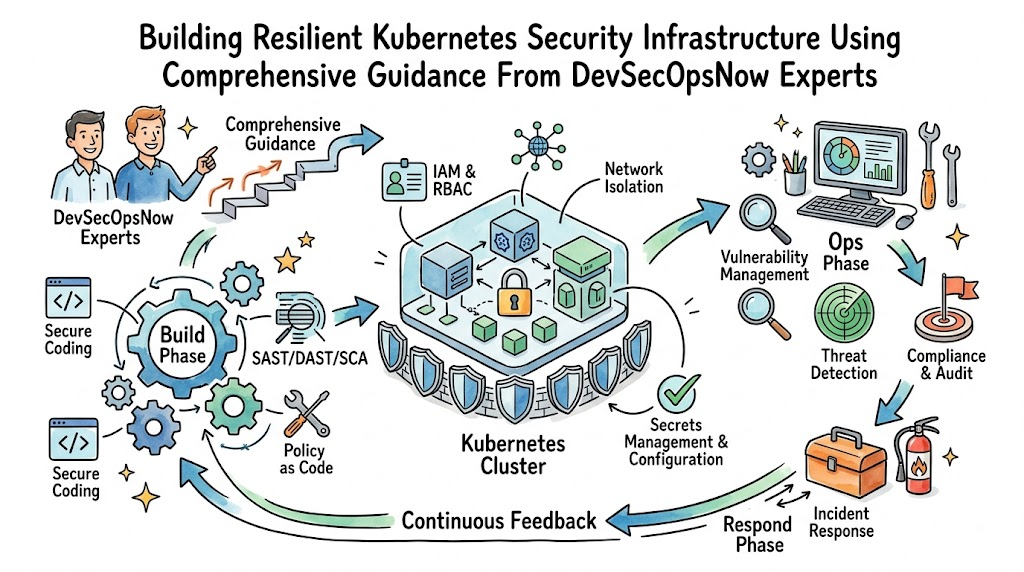
Managing containerized applications at scale introduces unique architectural risks, making Kubernetes Security Consulting Services essential for hardening cluster infrastructure. Kubernetes security spans cluster access management, workload isolation, container runtime protection, and configuration enforcement. Implementing granular Role-Based Access Control (RBAC) ensures users and service accounts operate under strict least-privilege principles. Utilizing Network Policies isolates pod communication, preventing unauthorized lateral movement within clusters. Enforcing Admission Controls via controllers like Open Policy Agent (OPA) Gatekeeper or Kyverno blocks non-compliant manifests, while specialized secrets management systems keep sensitive configuration data encrypted and segregated from application container images.
Role-Based Access Control (RBAC)
Kubernetes RBAC configures precise authorization policies, restricting cluster access, API operations, and namespace permissions based on verified user roles and automated service identities.
Network Policies
Network policies act as internal cluster firewalls, controlling traffic flow between pods, namespaces, and external endpoints to isolate critical workloads and block unauthorized network requests.
Admission Controls
Admission controllers inspect, mutate, and validate incoming Kubernetes API requests against enterprise security policies before object configurations are persisted into the cluster state database.
Secrets Management
Dedicated secrets management tools securely store, rotate, distribute, and encrypt sensitive operational data, preventing plain-text credentials from being stored inside code repositories or exposed container environment variables.
Container Image Security
Container image security policies mandate that clusters only execute scanned, trusted, and cryptographically signed container images sourced from authenticated, private container registries.
Kubernetes Configuration Security
Configuration security routines continuously audit cluster control planes, worker node operating systems, API server flags, and manifest settings against CIS benchmarks to eliminate dangerous misconfigurations.
Runtime Security
Runtime security engines monitor container behavior at the Linux kernel level, detecting abnormal process calls, unauthorized file modifications, and unexpected network connections inside active cluster pods.
Cluster Access Management
Cluster access management integrates corporate single sign-on (SSO) systems, multi-factor authentication, and short-lived credentials to secure control plane access for administrators and automated tools.
Cloud Security
Securing dynamic infrastructure requires expert Cloud Security Consulting Services focused on multi-cloud environments across AWS, Azure, and Google Cloud platforms. Cloud security centers on building robust Identity and Access Management (IAM) controls, automating network segment isolation, establishing continuous encryption across data at rest and in transit, and maintaining comprehensive audit logging. By integrating Cloud Security Posture Management (CSPM) and Infrastructure as Code security checks, organizations can detect cloud configuration drift, eliminate exposed storage endpoints, enforce strict workload execution parameters, and maintain constant visibility across hyper-scale cloud assets.
Identity and Access Management (IAM)
IAM systems establish identity-based security perimeters, enforcing zero-trust access controls, multi-factor authentication, least-privilege permissions, and temporary credential issuance across all cloud infrastructure services.
Cloud Network Security
Cloud network security utilizes virtual private clouds (VPCs), subnets, transit gateways, and micro-segmentation rules to isolate sensitive workloads, monitor network traffic, and restrict external public access points.
Cloud Configuration Security
Configuration security automates cloud asset evaluation against industry security benchmarks, immediately alerting teams to misconfigured storage buckets, unencrypted databases, and exposed administration ports.
Data Encryption
Encryption protocols protect sensitive data across its lifecycle, enforcing strong cryptographic standards for data at rest within cloud storage and data in transit across public and private networks.
Logging and Monitoring
Centralized cloud logging engines aggregate system events, API calls, and administrative access logs into secure repositories, enabling automated threat detection, real-time alerting, and historical forensics.
Infrastructure as Code Security
IaC security continuously validates cloud deployment templates against strict organizational guidelines before infrastructure provisioning pipelines apply changes to live cloud environments.
Workload Security
Cloud workload security protects virtual machines, serverless functions, and container instances by enforcing vulnerability patching, endpoint protection, and strict network isolation policies.
Cloud Security Posture Management (CSPM)
CSPM platforms continuously scan multi-cloud infrastructure environments, detecting configuration drift, identifying compliance violations, and prioritizing security risks for automated or manual remediation.
Software Supply Chain Security
Modern applications are rarely written entirely from scratch; they assemble third-party modules, open-source libraries, and container base images. Consequently, securing modern software requires dedicated Software Supply Chain Security Services to protect build environments from malicious dependencies, compromised package repositories, and unauthorized pipeline tampering. Securing the supply chain involves verifying artifact integrity through cryptographic code signing, hardening CI/CD build runners against unauthorized access, enforcing strict package repository access controls, and maintaining continuous visibility over every external library integrated into enterprise software releases.
Understanding Software Bill of Materials (SBOM)
A Software Bill of Materials (SBOM) acts as a comprehensive, structured nested inventory listing every component, third-party library, and open-source module integrated into an application build. Organizations rely on SBOMs to maintain complete visibility over their software supply chain, allowing security teams to immediately locate systems affected by newly disclosed zero-day vulnerabilities. Generating SBOMs automatically during build pipelines improves software transparency, simplifies vendor security audits, streamlines license compliance checks, and enables rapid risk assessment across complex, distributed software applications.
CI/CD Pipeline Security
Because CI/CD platforms control application deployment and maintain administrative access to cloud environments, they represent high-value targets for malicious actors. Hardening pipeline security requires implementing strict access controls, enforcing protected git branches, running build jobs within isolated temporary environments, and securely managing build-time credentials. Pipelines must mandate cryptographic verification for incoming code commits, restrict deployment approval workflows to authorized engineering leads, log all build executions for auditing, and embed automated scanning checks directly into deployment stages to stop unsafe releases automatically.
Policy-as-Code
Policy-as-Code transforms governance rules into executable, version-controlled policy scripts, replacing manual compliance reviews with real-time, automated verification across engineering pipelines. By defining rules in code, security teams ensure that compliance checks run consistently across local development machines, CI/CD pipelines, and runtime infrastructure environments.
Rule Definition → Pipeline Interception → Policy Evaluation → Pass/Fail Gate
- Non-Root Containers: Enforce runtime rules requiring container images to execute under unprivileged user accounts.
- Storage Encryption: Block storage provisioning scripts that fail to define static encryption parameters.
- Trusted Registries: Intercept deployment manifests specifying container images hosted outside authenticated company registries.
- Workload Constraints: Validate Kubernetes deployment files to guarantee resource limits and security contexts are fully configured.
- Network Restrictions: Automatically reject infrastructure templates that open administrative ports to public network routes.
Automating these rules eliminates human review oversights, speeds up developer workflows, maintains continuous governance visibility, and standardizes enterprise compliance policies across distributed cloud environments.
DevSecOps Assessment Services
Organizations uncertain about their current security posture utilize DevSecOps Assessment Services to evaluate their technical maturity, identify architectural risks, and chart a structured improvement strategy. Maturity assessments evaluate application security checks, CI/CD security controls, cloud infrastructure settings, secrets management approaches, dependency tracking workflows, governance policies, and cross-team security culture. By measuring existing practices against recognized security benchmarks, assessments deliver prioritize actionable transformation roadmaps that guide engineering teams toward sustainable security adoption.
DevSecOps Maturity Model
Evaluating DevSecOps progression requires assessing organizational capabilities across people, process, technology, automation, governance, and cross-team collaboration.
| Level | Characteristics | Core Practices |
| Initial | Reactive, manual security testing performed late in development. | Periodic manual code audits, legacy point-in-time penetration testing, ad-hoc patching. |
| Developing | Basic security scanning added to individual project workflows. | Basic SAST execution, manual credential management, early dependency tracking. |
| Integrated | Automated security scanners embedded into standard CI/CD pipelines. | Automated SAST/SCA build gates, centralized secrets management, cloud security scanning. |
| Automated | Orchestrated, policy-driven security controls running across all systems. | Policy-as-Code enforcement, automated container checks, full supply chain tracking. |
| Optimized | Continuous metrics-driven optimization and real-time runtime security. | Automated risk prioritization, real-time runtime blocking, continuous improvement feedback. |
Vulnerability Management
Effective vulnerability management extends beyond finding software flaws; it requires establishing a structured lifecycle to handle security findings efficiently without overwhelming development teams.
Discovery → Validation → Classification → Prioritization → Assignment → Remediation → Verification → Reporting
- Discovery: Automated tools continuously scan repositories, container images, and cloud environments to uncover known vulnerabilities.
- Validation: Security teams review findings to eliminate false positives and verify real threat exploitability.
- Classification: Flaws are categorized based on vulnerability type, system component, and potential blast radius.
- Prioritization: Risks are rated using Common Vulnerability Scoring System (CVSS) metrics alongside contextual business impact.
- Assignment: Validated vulnerabilities are routed directly into developer issue-tracking systems with clear remediation context.
- Remediation: Engineering teams patch, update, or reconfigure systems to resolve the reported security flaws.
- Verification: Automated pipeline scans re-test modified code to confirm successful flaw resolution.
- Reporting: Centralized security dashboards log resolution times, tracking metrics for governance and compliance visibility.
Focusing remediation efforts on severe, highly exploitable flaws protecting sensitive assets ensures that engineering capacity remains focused on resolving high-risk security items.
DevSecOps Managed Services
Maintaining robust security across evolving infrastructure can strain internal engineering resources, leading organizations to leverage DevSecOps Managed Services for operational continuity. Managed security providers deliver dedicated expertise to manage security platforms, maintain scanning engines, monitor CI/CD pipelines, update policy-as-code rulesets, review vulnerability alerts, and assist development teams with remediation guidance. This ongoing operational support ensures enterprise cloud and Kubernetes environments remain compliant, secure, and fully optimized without placing excessive administrative burdens on internal staff.
Penetration Testing Services
While automated tools excel at finding known configuration flaws and syntax bugs, specialized Penetration Testing Services provide essential manual security assessments that simulate sophisticated cyberattacks. Expert penetration testers evaluate web applications, APIs, cloud setups, networks, and container environments to locate complex logic flaws, authorization bypasses, and multi-stage exploit paths that automated scanners miss. Combining continuous automated scanning with periodic manual penetration testing ensures comprehensive, deep-tier security coverage across all operational platforms.
DevSecOps Training
Building a secure engineering culture relies on comprehensive DevSecOps Training programs that equip technical professionals with practical secure development skills. Effective training covers secure SDLC principles, CI/CD pipeline defense, static and dynamic analysis techniques, dependency risk management, cloud hardening, Kubernetes cluster security, secrets handling, and automated policy implementation. By mastering modern security tools and defensive practices, developers and engineers learn to identify and correct vulnerabilities naturally during standard coding and infrastructure configuration workflows.
Corporate DevSecOps Training
Enterprises scale security adoption by delivering custom Corporate DevSecOps Training designed around real-world technology stacks and internal workflows. Tailored programs provide specialized, role-focused learning paths to address specific engineering responsibilities.
- Software Developers: Learn secure coding patterns, local IDE static analysis, dependency vulnerability remediation, and secrets handling using tools like SonarQube and GitHub Actions.
- DevOps Engineers: Focus on pipeline hardening, automated build verification, container security scanning, and secure deployment integrations across platforms like Jenkins, GitLab CI, and Docker.
- Platform Engineers: Master Infrastructure as Code security, policy-as-code integration, and automated environment provisioning using Terraform, Open Policy Agent, and CloudFormation.
- Kubernetes Engineers: Gain deep expertise in cluster hardening, RBAC configuration, custom admission controllers, network policy implementation, and container runtime security.
- Cloud & Security Engineers: Study multi-cloud security architecture, Identity and Access Management, CSPM tracking, and real-time incident monitoring across AWS, Azure, and GCP platforms.
- Engineering Managers: Focus on security metrics tracking, risk management frameworks, compliance governance, and fostering collaborative security cultures across engineering departments.
Hands-on lab environments allow participants to practice exploiting and fixing realistic security vulnerabilities, ensuring teams gain immediate practical skills applicable to their daily operational tools.
Example DevSecOps Pipeline
- Developer Commit: A developer pushes new code and creates a pull request in the source repository.
- Secrets Scan: Pre-commit hooks and repository monitors scan files to block exposed keys or credentials.
- SAST Execution: Static analysis tools inspect the raw code to highlight syntax-level security defects.
- Dependency Scan: SCA engines verify third-party packages against known vulnerability databases.
- Software Build: The application code compiles into executable binaries or container image artifacts.
- Container Scan: Scanners analyze base images and binaries inside the container registry for known CVEs.
- IaC Scan: Infrastructure scripts are analyzed to block misconfigured cloud deployment settings.
- Staging Deployment: Hardened artifacts deploy into an isolated, production-like staging environment.
- DAST Execution: Automated dynamic tools run active security tests against live staging endpoints.
- Policy Validation: Policy engines audit the complete build against enterprise compliance rules.
- Production Release: Verified, cryptographically signed application artifacts deploy safely to production.
- Runtime Monitoring: Security tools actively monitor live production environments to detect and block threats.
DevSecOps Implementation Roadmap
Successfully embedding security into delivery pipelines requires a phased implementation approach that prevents operational disruption and supports sustainable team adoption.
- Phase 1 – Assessment & Strategy: Evaluate existing development workflows, review cloud infrastructure, identify security gaps, and define a clear transformation roadmap.
- Phase 2 – Core Foundations: Establish centralized secrets management, implement git pre-commit hooks, and standardize basic repository security guidelines.
- Phase 3 – Pipeline Integration: Embed automated SAST, SCA dependency checking, and container image scanning directly into existing CI/CD build workflows.
- Phase 4 – Infrastructure & Policy Automation: Introduce IaC static checks, implement policy-as-code validation frameworks, and establish secure baseline templates.
- Phase 5 – Dynamic & Runtime Security: Configure automated DAST scanning in staging environments and deploy runtime protection tools across production clusters.
- Phase 6 – Metrics & Optimization: Track vulnerability remediation rates, refine scanner alerting rules to eliminate noise, and continuously optimize pipeline velocity.
Common DevSecOps Challenges
Security Alert Overload
Excessive false positives from misconfigured automated scanners overwhelm development teams, leading to alert fatigue and ignored security findings.
- Recommendation: Fine-tune scanner rulesets, calibrate severity thresholds to match application contexts, and prioritize actionable, high-severity findings.
Developer Resistance
Engineering teams may resist security integrations if automated checks significantly delay build times or disrupt existing workflows.
- Recommendation: Shift security checks into developer IDEs, automate pull request feedback, and ensure pipeline security scans execute rapidly.
Tool Fragmentation
Managing multiple isolated security tools creates fragmented risk visibility, duplicate alert reports, and administrative overhead.
- Recommendation: Centralize findings within unified vulnerability management dashboards that consolidate alerts across SAST, SCA, and cloud security tools.
Lack of Security Ownership
Development teams often view security as an external department’s responsibility, leading to low engagement with security practices.
- Recommendation: Establish security champion programs within engineering units to cultivate shared ownership and practical security awareness.
Skills Gaps
Engineering teams may lack the specialized expertise needed to configure advanced cloud security tools or remediate complex vulnerabilities.
- Recommendation: Provide role-based, hands-on training tailored to modern tools, cloud platforms, and container ecosystems.
Poor Tool Integration
Security software added as disconnected external checks causes manual intervention points and slows delivery speed.
- Recommendation: Select security platforms that offer native integration APIs, automated ticketing routes, and direct CI/CD pipeline extensions.
Excessive Pipeline Delays
Running heavy, unoptimized security scans during every commit slows release channels and frustrates developers.
- Recommendation: Optimize scan logic by running fast incremental checks during pull requests and scheduling deep-tier scans asynchronously.
Inconsistent Security Policies
Varying security rules across development, staging, and production environments lead to unexpected compliance failures late in deployment.
- Recommendation: Codify security rules using Policy-as-Code frameworks to enforce identical, version-controlled policies across all environments.
DevSecOps Metrics
Establishing clear metrics ensures that security automation improves protection outcomes without hindering engineering velocity.
| Metric | Purpose |
| Mean Time to Remediate (MTTR) | Tracks the average time required for engineering teams to patch verified security vulnerabilities. |
| Critical Vulnerability Volume | Measures the total number of open, unresolved high-severity flaws across active production systems. |
| Security Test Coverage | Monitors the percentage of software repositories and pipelines with active automated security scanning. |
| Secrets Detected | Tracks the frequency of hardcoded credentials intercepted by repository scanning controls. |
| Dependency Risk Rate | Monitors the proportion of open-source packages containing unpatched known security flaws. |
| Policy Violation Count | Measures how often infrastructure or container configurations fail automated policy-as-code checks. |
| Secure Deployment Rate | Tracks the percentage of application releases passing all automated security gates without policy overrides. |
Effective security metrics focus on measuring process efficiency, vulnerability reduction speed, and deployment quality rather than inflating scan execution volumes.
Choosing a DevSecOps Service Model
Organizations often require distinct engagement frameworks based on their internal resources, technical maturity, and short-term transformation goals.
- DevSecOps Consulting Services: Ideal for organizations needing strategic guidance, architectural reviews, tool selection advice, and custom transformation planning.
- DevSecOps Assessment Services: Best suited for companies seeking an objective evaluation of their existing security controls, maturity gaps, and compliance posture.
- DevSecOps Implementation Services: Designed for teams requiring hands-on assistance to build secure pipelines, configure scanners, and establish automated policy gates.
- DevSecOps Managed Services: Perfect for enterprises seeking ongoing operational support, pipeline monitoring, platform maintenance, and continuous vulnerability management.
- Cloud Security Consulting Services: Aimed at organizations needing specialized architecture design, IAM optimization, and governance controls across AWS, Azure, or GCP.
- Kubernetes Security Consulting Services: Tailored for companies scaling container environments that require deep cluster hardening, RBAC configuration, and runtime security.
- Software Supply Chain Security Services: Essential for organizations focused on securing open-source dependencies, build pipelines, artifact integrity, and SBOM management.
- Penetration Testing Services: Recommended for businesses needing thorough, manual attack simulations to evaluate application, API, and infrastructure defenses.
- DevSecOps Training: Suitable for individual professionals and engineering groups seeking to build practical secure development and automation skills.
- Corporate DevSecOps Training: Tailored for enterprises requiring structured, role-specific learning paths and hands-on labs for development, DevOps, and cloud teams.
Frequently Asked Questions
1. What is the main difference between DevOps and DevSecOps?
DevOps focuses on automating software delivery and improving collaboration between development and operations teams to increase release velocity. DevSecOps builds upon this model by embedding security testing, policy controls, and risk management directly into automated delivery pipelines, ensuring security is maintained without slowing down deployment speeds.
2. How does shift-left security improve application safety?
Shift-left security moves security testing early into the development lifecycle, allowing developers to detect and fix code defects, dependency flaws, and misconfigurations while writing code. Resolving vulnerabilities early significantly lowers remediation costs, reduces release friction, and prevents security issues from reaching live production environments.
3. Why are automated security scanners alone insufficient for complete security?
Automated scanners excel at catching known syntax defects, configuration errors, and documented library vulnerabilities. However, they struggle to identify complex business logic flaws, authorization bypasses, and multi-step exploit paths, which require periodic manual penetration testing and expert architecture reviews to detect.
4. What is a Software Bill of Materials (SBOM) and why is it important?
An SBOM is a structured, machine-readable inventory of every third-party component, open-source library, and dependency used within an application. It provides visibility into the software supply chain, allowing security teams to quickly identify exposed systems when new zero-day vulnerabilities are disclosed.
5. How does Policy-as-Code enforce compliance in cloud pipelines?
Policy-as-Code defines compliance guidelines as version-controlled code, allowing policy engines to automatically evaluate cloud configurations, container manifests, and build settings against organizational rules. Non-compliant deployments are intercepted and blocked automatically before changes are applied to production environments.
6. Can DevSecOps practices be applied to legacy systems?
Yes, DevSecOps principles apply to legacy applications, though implementation strategies differ. While modern containerized apps leverage full pipeline automation, legacy systems benefit from automated secrets detection, static code analysis, configuration audits, and secure staging deployment checks adapted to existing build processes.
7. How do organizations prevent security tools from slowing down CI/CD pipelines?
Teams keep pipelines fast by running quick incremental scans during pull requests, caching dependency checks, and shifting comprehensive scans to asynchronous background workflows. Configuring clear severity rules ensures pipelines gate releases only for critical, actionable security findings.
8. What role does Kubernetes security play in modern cloud delivery?
Kubernetes orchestrates containerized workloads, making cluster security vital for operational stability. Securing Kubernetes involves enforcing Role-Based Access Control, defining pod network policies, managing application secrets, isolating container runtimes, and verifying manifests using automated admission controllers.
9. How frequently should organizations perform penetration testing alongside automated scanning?
While automated security scans run continuously within build pipelines, organizations should conduct manual penetration testing at least annually or after major architectural changes. Regular manual testing validates automated controls and uncovers complex vulnerabilities that automated scanners miss.
10. What is the difference between SAST and DAST?
SAST inspects uncompiled source code from the inside out without executing the application, identifying coding bugs and syntax defects early. DAST tests running applications from the outside in, simulating real-world attacks to identify runtime weaknesses, authentication flaws, and configuration issues.
11. How do companies measure the success of a DevSecOps transformation?
Success is measured using practical metrics like reduced Mean Time to Remediate (MTTR), lower volumes of production vulnerabilities, high security scan coverage across repositories, faster release cycles, and decreased security policy violations across cloud environments.
12. What are the first steps to starting a DevSecOps adoption strategy?
Organizations should start by assessing their existing delivery processes, identifying security bottlenecks, and establishing centralized secrets management. Teams can then introduce lightweight static code and dependency scanning into active CI/CD pipelines before expanding into advanced cloud policy automation.
Conclusion
DevSecOps transforms software security from a reactive bottleneck into an automated, continuous capability embedded directly within modern delivery pipelines. By integrating security checks across CI/CD workflows, securing cloud and Kubernetes environments, protecting the software supply chain, and automating vulnerability management, organizations can release software rapidly while maintaining robust security defenses. Achieving lasting DevSecOps success relies on combining automated toolchains with strong cross-team collaboration, continuous role-based training, and a practical engineering culture focused on ongoing security improvement.
