Introduction
The DevSecOps Certified Professional (DSOCP) is a critical milestone for engineers looking to integrate security into the heart of the DevOps lifecycle. This guide is designed for software engineers, security professionals, and technical leaders who recognize that “security as an afterthought” is no longer a viable business strategy in a cloud-native world. We are currently seeing a massive shift where security is shifting left, making DevSecOps a core requirement for platform engineering and modern SRE roles. This comprehensive guide will help you navigate the certification landscape, evaluate the return on investment, and decide how to align this credential with your long-term career goals in the global tech market.
What is the DevSecOps Certified Professional (DSOCP)?
The DevSecOps Certified Professional (DSOCP) represents a shift from traditional, siloed security audits to automated, continuous security integration within the CI/CD pipeline. It exists to bridge the gap between rapid software delivery and the stringent security requirements of modern enterprises. Unlike theoretical certifications, the DSOCP focuses on production-ready skills, teaching engineers how to automate vulnerability scanning, manage secrets, and ensure compliance without slowing down the development team. It aligns perfectly with the transition toward “Security-as-Code,” where every infrastructure change and code commit is validated through a rigorous, automated security lens.
Who Should Pursue DevSecOps Certified Professional (DSOCP)?
This certification is highly beneficial for DevOps engineers and SREs who want to specialize in the security domain to increase their market value. Cloud architects and security analysts will find it useful for understanding how to apply security controls in high-velocity environments. In both the Indian and global markets, there is a massive demand for engineering managers who can lead DevSecOps transformations. Even beginners with a foundational understanding of Linux and automation can use this path to leapfrog into high-paying security-focused roles, while experienced professionals use it to formalize their expertise in modern cloud-native security tools.
Why DevSecOps Certified Professional (DSOCP)
As we move deeper into 2026, the complexity of cloud-native environments—driven by microservices and AI-integrated workflows—has made security more volatile than ever. The DevSecOps Certified Professional (DSOCP) provides a future-proof skill set that remains relevant regardless of which specific cloud provider or CI tool wins the market. Enterprises are moving away from generalist roles toward specialized security engineers who can write code and manage infrastructure. This certification proves you have the longevity to handle supply chain security and automated compliance, offering a high return on career investment by making you an indispensable asset in any high-compliance engineering organization.
DevSecOps Certified Professional (DSOCP) Certification Overview
The training and certification program is delivered via the DevSecOps Certified Professional (DSOCP) and is officially hosted on devopsschool. The program adopts a highly practical, lab-based assessment approach that moves beyond simple multiple-choice questions to validate real-world troubleshooting skills. Ownership of the curriculum is maintained by industry practitioners, ensuring that the structure reflects the latest shifts in the CNCF landscape. The certification is structured to take a learner from the core principles of security automation to advanced architectural patterns for securing distributed systems at scale.
DevSecOps Certified Professional (DSOCP) Certification Tracks & Levels
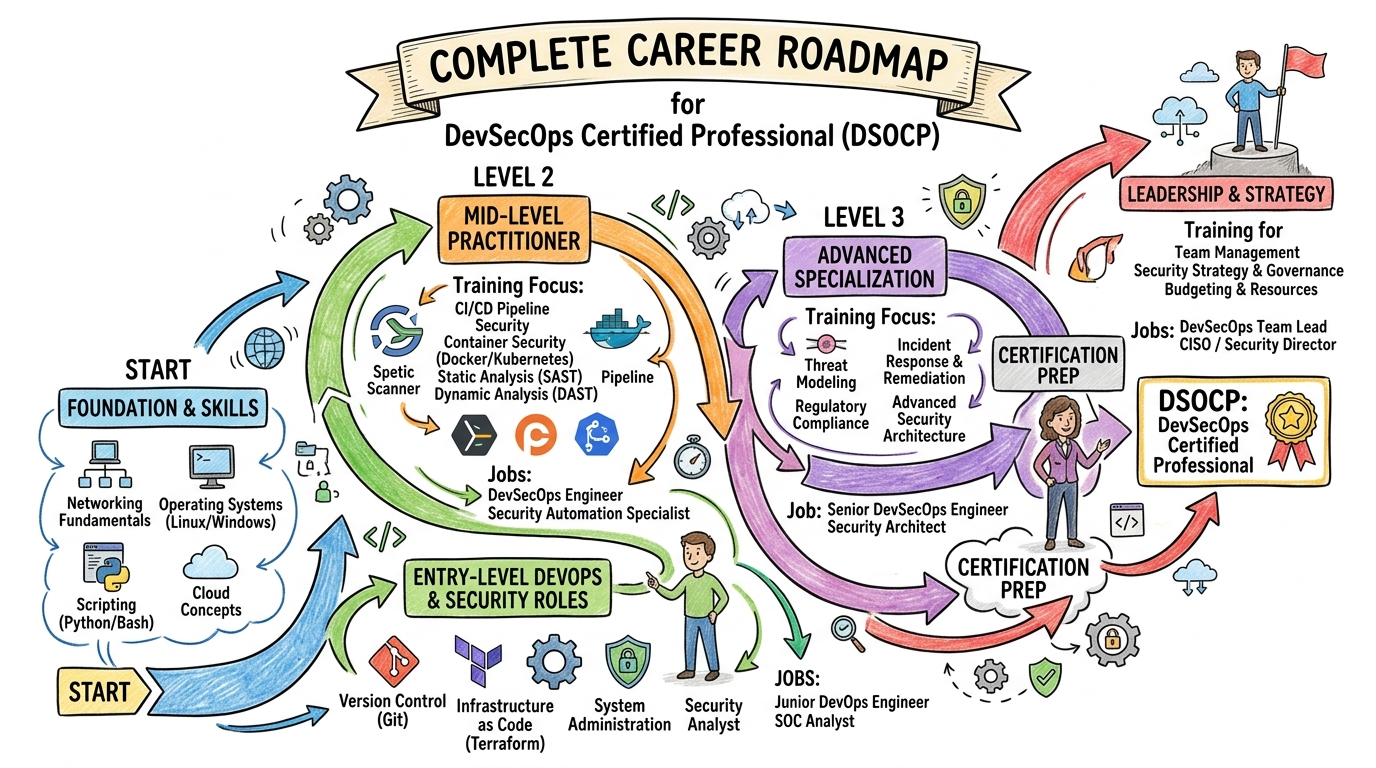
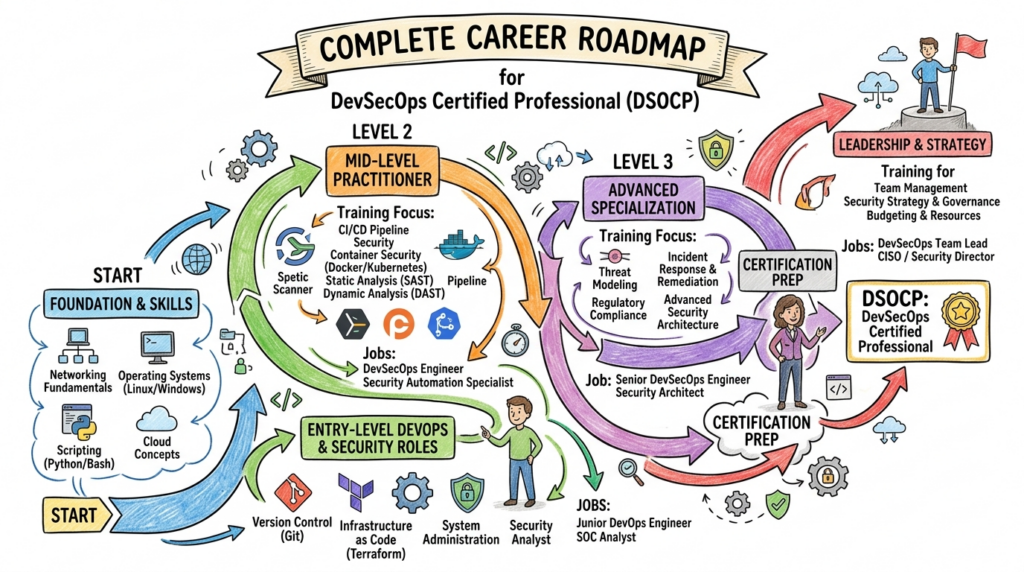
The certification is categorized into foundation, professional, and advanced levels to cater to different career stages. The Foundation level focuses on the “Shift Left” philosophy and basic scanning tools, while the Professional level (DSOCP) dives deep into pipeline integration and secrets management. Advanced tracks branch into specialized domains like Cloud-Native Security or DevSecOps for AIOps. These levels are designed to align with career progression, moving a professional from a contributor to an architect and eventually a strategic leader who can design secure-by-default organizational ecosystems.
Complete DevSecOps Certified Professional (DSOCP) Certification Table
| Track | Level | Who it’s for | Prerequisites | Skills Covered | Recommended Order |
| Core DevSecOps | Foundation | Junior Engineers | Basic Linux/Git | SAST, DAST, SCA basics | 1 |
| DSOCP | Professional | DevOps/SRE | 2+ years experience | Pipeline Security, Vault | 2 |
| Expert | Advanced | Security Architects | DSOCP Certified | Threat Modeling, Compliance | 3 |
Detailed Guide for Each DevSecOps Certified Professional (DSOCP) Certification
DevSecOps Certified Professional (DSOCP) – Professional Level
What it is
This certification validates a professional’s ability to design and implement a secure software development lifecycle (SSDLC). It confirms that the holder can effectively integrate security tools into CI/CD pipelines without creating bottlenecks.
Who should take it
It is designed for DevOps engineers, SREs, and Security Engineers with at least two years of experience in automation. It is ideal for those wanting to take ownership of organizational security posture.
Skills you’ll gain
- Implementing Static and Dynamic Analysis (SAST/DAST) in Jenkins/GitLab.
- Automated Container Image Scanning and Registry Security.
- Managing sensitive data using HashiCorp Vault.
- Infrastructure as Code (IaC) scanning for Terraform and CloudFormation.
- Compliance monitoring and automated auditing techniques.
Real-world projects you should be able to do
- Build a fully automated CI/CD pipeline that fails builds based on high-severity security vulnerabilities.
- Deploy a zero-trust architecture for microservices using a Service Mesh.
- Implement automated secrets rotation for a production-grade database.
Preparation plan
- 7–14 Days: Focus on understanding the core philosophy of DevSecOps. Review the tools in the ecosystem (SonarQube, Snyk, Trivy) and set up a basic local environment.
- 30 Days: Dive deep into the hands-on labs. Integrate at least three security tools into a CI/CD pipeline and practice fixing the vulnerabilities identified in the reports.
- 60 Days: Perform complex threat modeling exercises. Focus on advanced topics like supply chain security (SBOM) and hardening Kubernetes clusters for production.
Common mistakes
- Focusing too much on specific tool syntax rather than the underlying security principles.
- Neglecting the “cultural” aspect of DevSecOps, which involves collaboration between developers and security teams.
- Ignoring the performance impact of security scans on the total build time.
Best next certification after this
- Same-track option: DevSecOps Expert / Architect Level.
- Cross-track option: Certified Kubernetes Security Specialist (CKS).
- Leadership option: Certified Information Systems Security Professional (CISSP).
Choose Your Learning Path
DevOps Path
This path focuses on the seamless integration of security into the existing DevOps workflow. Engineers start by mastering CI/CD and then layer in security gates to ensure that every release is scanned for vulnerabilities. It is the most common entry point for those already working in automation and cloud infrastructure roles.
DevSecOps Path
The dedicated DevSecOps path prioritizes security-first thinking in every engineering decision. Professionals on this path move beyond just using tools; they focus on threat modeling, risk assessment, and building “Golden Paths” that are secure by default. This is ideal for specialists who want to be the primary security authority within an engineering pod.
SRE Path
The Site Reliability Engineering (SRE) path treats security as a fundamental component of system reliability. In this track, you learn how security incidents impact uptime and how to use error budgets to manage security debt. It bridges the gap between infrastructure stability and system hardening.
AIOps / MLOps Path
This modern path explores the intersection of AI and security. It involves securing the data pipelines used for machine learning and ensuring that AI models themselves are not susceptible to adversarial attacks. This is a high-growth area for engineers working in data-heavy environments.
DataOps Path
The DataOps path centers on securing the data lifecycle, from ingestion to storage and analytics. It focuses on data masking, encryption at rest and in transit, and ensuring that big data pipelines comply with global regulations like GDPR or CCPA.
FinOps Path
This unique path combines financial accountability with security. It focuses on how security configurations (like oversized firewalls or redundant logging) impact cloud costs. Professionals learn to balance the cost of security tools with the actual risk reduction they provide to the business.
Role → Recommended DevSecOps Certified Professional (DSOCP) Certifications
| Role | Recommended Certifications |
| DevOps Engineer | DSOCP Foundation & Professional |
| SRE | DSOCP Professional + Chaos Engineering |
| Platform Engineer | DSOCP Advanced + Kubernetes Security |
| Cloud Engineer | DSOCP Professional + Cloud Provider Security |
| Security Engineer | DSOCP Expert + Pentesting |
| Data Engineer | DSOCP DataOps Track |
| FinOps Practitioner | DSOCP Foundation + FinOps Certified |
| Engineering Manager | DSOCP Foundation + Leadership Track |
Next Certifications to Take After DevSecOps Certified Professional (DSOCP)
Same Track Progression
Once you have mastered the professional level, the next logical step is to move toward an “Architect” or “Expert” designation. This involves looking at the macro-level of security, such as designing multi-cloud security strategies and implementing enterprise-wide governance frameworks that span hundreds of microservices.
Cross-Track Expansion
To become a truly versatile engineer, consider expanding into the Cloud-Native Security (CKS) or SRE domains. Understanding how security interacts with system performance and container orchestration allows you to solve complex problems that purely security-focused or purely operations-focused engineers might miss.
Leadership & Management Track
For those aiming for CISO (Chief Information Security Officer) or VP of Engineering roles, the technical foundation of DSOCP should be paired with management certifications. Focusing on risk management, compliance auditing, and strategic planning will help you transition from the terminal to the boardroom.
Training & Certification Support Providers for DevSecOps Certified Professional (DSOCP)
DevOpsSchool
This provider offers extensive, instructor-led training specifically tailored for the DSOCP curriculum. Their approach is highly practical, focusing on industry-standard tools and real-world scenarios. They are a primary resource for engineers in India and globally who need a structured environment and expert mentorship to master DevSecOps concepts.
Cotocus
Cotocus specializes in high-end technical consulting and training. They provide a deep dive into the integration aspects of DevSecOps, helping professionals understand the nuances of various cloud environments. Their training is often favored by corporate teams looking to upskill quickly on specific project requirements.
Scmgalaxy
As a long-standing community hub, Scmgalaxy provides a wealth of resources, tutorials, and documentation for DevSecOps. They focus on the “Software Configuration Management” side of the house, ensuring that version control and build automation are secured from the ground up before moving into broader security domains.
BestDevOps
BestDevOps focuses on career-oriented training paths that help individuals transition into DevOps and DevSecOps roles. Their methodology is geared toward job readiness, providing hands-on labs that simulate the daily challenges faced by security-focused engineers in modern tech companies.
devsecopsschool
This is a dedicated platform for everything security-related in the DevOps world. They offer specialized courses that go beyond the basics, covering niche areas like supply chain security and cloud-native defensive strategies, making it a go-to for serious security practitioners.
sreschool
SREschool focuses on the reliability aspect of the engineering lifecycle. Their support for DSOCP candidates involves teaching how security integrates with monitoring, observability, and incident response, which is crucial for engineers managing large-scale distributed systems.
aiopsschool
This provider is at the forefront of the AI revolution, offering guidance on how to secure AI-driven operations. For DSOCP students, they offer insights into how security automation can be enhanced through machine learning and how to protect the integrity of AI models.
dataopsschool
DataOpsschool provides specialized training for data engineers and architects. Their focus is on ensuring that the DSOCP principles are applied to data lakes, warehouses, and streaming pipelines, emphasizing the protection of sensitive information throughout the data lifecycle.
finopsschool
FinOpsschool helps engineers understand the financial impact of their security and operational decisions. They provide a unique perspective for DSOCP candidates, teaching them how to optimize security spending and ensure that security tools are providing the best value for the organization.
Frequently Asked Questions (General)
- How difficult is the DSOCP exam?It is moderately challenging because it requires hands-on knowledge rather than just memorization. If you have practical experience with CI/CD tools, you will find it manageable.
- How long does it take to prepare for the certification?For a working professional, 30 to 60 days of consistent study is usually sufficient to cover the labs and theoretical concepts.
- Are there any prerequisites for taking the DSOCP?While there are no strict legal requirements, a solid understanding of Linux, Git, and basic DevOps pipelines is highly recommended.
- What is the ROI of getting DevSecOps certified?Professionals often see a significant salary bump (15-25%) and gain access to more specialized, senior-level roles in the tech industry.
- Can I take the exam online?Yes, the certification is designed to be accessible globally via online proctored environments.
- How long is the certification valid?Typically, the certification is valid for two to three years, after which you may need to renew or upgrade to a higher level.
- Does DSOCP cover specific cloud providers like AWS or Azure?The principles are cloud-agnostic, but the labs often use common cloud tools to demonstrate how security is applied in real environments.
- Is this certification recognized in India?Yes, it is highly regarded by major Indian IT firms and startups that are moving toward global security standards.
- What tools are covered in the DSOCP?You will likely work with tools like Jenkins, SonarQube, Snyk, Trivy, Vault, and various container security scanners.
- Does it cover Kubernetes security?Yes, container and orchestration security are core modules of the DSOCP professional level.
- Is there a community for DSOCP students?Yes, providers like DevOpsSchool and Scmgalaxy maintain active communities for peer-to-peer learning and support.
- How does this differ from a standard DevOps certification?A standard DevOps cert focuses on delivery speed and reliability, whereas DSOCP adds the layer of automated security and risk mitigation.
FAQs on DevSecOps Certified Professional (DSOCP)
- What is the primary focus of the DSOCP curriculum?The core focus is “Shift Left” security automation within modern software pipelines.
- Does the course include hands-on labs?Yes, the program is built around practical labs that simulate production security challenges.
- Is threat modeling included in the DSOCP?Yes, understanding how to identify and mitigate threats early in the design phase is a key component.
- Can I skip the Foundation level?If you have significant industry experience, you can move straight to the Professional level.
- Are the labs based on Open Source tools?The course primarily uses popular open-source and industry-standard tools for maximum career portability.
- Is supply chain security covered?Yes, modern topics like SBOM (Software Bill of Materials) are increasingly central to the curriculum.
- How are the assessments conducted?Assessments are designed to test your ability to implement security gates and fix vulnerabilities in real-time.
- Is this certification suitable for managers?Yes, it provides the technical context necessary for managers to lead security-conscious engineering teams.
Final Thoughts: Is DevSecOps Certified Professional (DSOCP) Worth It?
From a mentor’s perspective, the answer is a pragmatic yes. In an industry where “DevOps” is becoming the baseline, specialization is the only way to maintain a competitive edge. Security is no longer a niche department; it is a fundamental engineering skill. The DevSecOps Certified Professional (DSOCP) doesn’t just give you a badge; it forces you to think about system integrity and risk in a way that makes you a better architect and a more reliable engineer. If you are tired of the “find and fix” treadmill and want to build systems that are “secure by design,” this is the right path for your career. It is an investment in your technical maturity and your long-term relevance in a rapidly evolving market.
