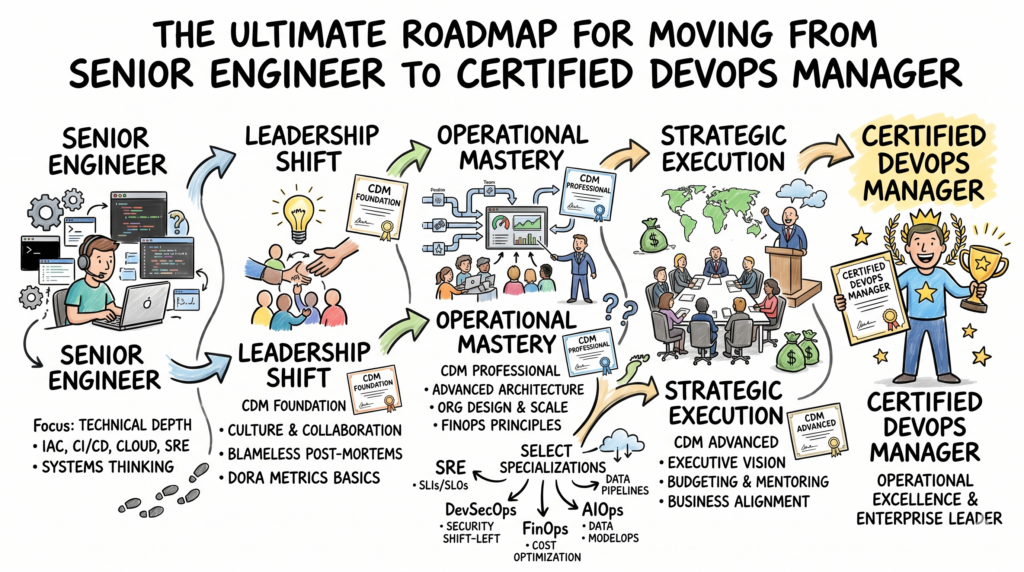
Introduction
The Certified DevOps Manager (CDM) is the definitive benchmark for engineering leaders stepping into modern operational roles. This guide is built specifically for seasoned engineers, tech leads, and aspiring managers who want to cut through the noise and understand how to lead high-performing teams. In today’s cloud-native landscape, bridging the gap between technical execution and business strategy is the most critical skill you can possess. By mastering the concepts in this guide, professionals can make informed, strategic decisions about their career trajectory and leadership journey.
What is the Certified DevOps Manager (CDM)?
The Certified DevOps Manager (CDM) represents a shift from individual technical contribution to holistic system and team leadership. It exists to validate a professional’s ability to architect delivery pipelines, foster collaborative cultures, and align operational metrics with enterprise goals. Rather than focusing purely on theoretical frameworks, this certification emphasizes real-world, production-focused learning. It perfectly aligns with modern engineering workflows, ensuring that leaders can implement scalable enterprise practices effectively.
Who Should Pursue Certified DevOps Manager (CDM)?
This credential is ideal for senior engineers, Site Reliability Engineers (SREs), and cloud professionals looking to transition into management. It also heavily benefits existing engineering managers who need to modernize their leadership approach to fit DevOps paradigms. Beginners can use it as a north star for their career map, while experienced professionals use it to formalize their hard-earned knowledge. Given the massive scale of enterprise IT operations, this certification holds tremendous global relevance, particularly in India’s rapidly expanding tech leadership sector.
Why Certified DevOps Manager (CDM)
As we navigate 2026, the demand for leaders who can orchestrate complex, automated environments is higher than ever. Tooling changes constantly, but the foundational principles of continuous delivery, team topology, and operational excellence remain permanent. The Certified DevOps Manager (CDM) helps professionals stay relevant by focusing on architectural patterns and human systems rather than fleeting software trends. The return on time and career investment is substantial, often accelerating promotions to Principal or Director levels.
Certified DevOps Manager (CDM) Certification Overview
This comprehensive program is delivered via and is officially hosted on devopsschool. The certification assessment approach is highly practical, moving away from simple multiple-choice questions toward scenario-based problem solving. It evaluates your ability to handle real-world outages, design resilient workflows, and manage cross-functional conflicts. The structure is transparent and rigorously maintained by industry experts, ensuring high standards of ownership and relevance.
Certified DevOps Manager (CDM) Certification Tracks & Levels
The journey typically begins at a foundation level, where candidates solidify their understanding of agile and continuous integration principles. Progressing to the professional tier, the Certified DevOps Manager (CDM) validates your capability to actively manage and scale these practices across multiple teams. Advanced levels push into executive strategy, covering deep specializations in areas like SRE, FinOps, and enterprise architecture. This tiered approach ensures that your certification aligns perfectly with every stage of your career progression.
Complete Certified DevOps Manager (CDM) Certification Table
| Track | Level | Who it’s for | Prerequisites | Skills Covered | Recommended Order |
| Leadership | Foundation | Aspiring Leads | 2+ years IT | Agile, CI/CD Basics, Team Dynamics | 1 |
| Leadership | Professional | Senior Engineers, Managers | 4+ years IT | Pipeline Architecture, Value Stream, Culture | 2 |
| Leadership | Advanced | Directors, Head of Ops | CDM Professional | Enterprise Strategy, FinOps, Org Design | 3 |
Detailed Guide for Each Certified DevOps Manager (CDM) Certification
Certified DevOps Manager (CDM) – Foundation
What it is
This certification validates your baseline understanding of collaborative engineering cultures. It proves you understand the vocabulary and the basic mechanics of continuous delivery.
Who should take it
Junior to mid-level engineers aiming for team lead roles should start here. It is also suitable for traditional project managers trying to understand modern delivery workflows.
Skills you’ll gain
- Understanding of Value Stream Mapping basics.
- Ability to define and measure lead time and cycle time.
- Basic conflict resolution within cross-functional teams.
- Knowledge of foundational version control and automation concepts.
Real-world projects you should be able to do
- Map a simple deployment pipeline from code commit to production.
- Draft a blameless post-mortem report for a minor incident.
- Facilitate a basic retrospective meeting for an engineering squad.
Preparation plan
- 7-14 Days: Focus entirely on core vocabulary and agile manifesto principles. Review basic pipeline architectures.
- 30 Days: Integrate practical case studies. Read up on common cultural bottlenecks in traditional enterprises.
- 60 Days: Deep dive into metrics. Understand how to track DORA metrics and apply them to fictional team scenarios.
Common mistakes
- Focusing too much on specific tools (like Jenkins or GitHub Actions) instead of the process.
- Ignoring the cultural and human elements of DevOps.
- Failing to understand the difference between Continuous Delivery and Continuous Deployment.
Best next certification after this
- Same-track option: Certified DevOps Manager (CDM) Professional.
- Cross-track option: Certified SRE Foundation.
- Leadership option: Certified Agile Leadership.
Certified DevOps Manager (CDM) – Professional
What it is
This is the core credential that validates your ability to lead, architect, and optimize engineering delivery at scale. It proves you can manage both the technical systems and the human systems that build them.
Who should take it
Senior engineers, current engineering managers, and cloud architects who are responsible for team output and system reliability. Intent should be mastering operational leadership.
Skills you’ll gain
- Advanced Value Stream optimization and bottleneck removal.
- Designing robust, secure, and scalable CI/CD enterprise architectures.
- Implementing and managing DORA metrics across multiple departments.
- Leading cultural transformations and managing engineering burnout.
- Budgeting and resource allocation for cloud operations.
Real-world projects you should be able to do
- Architect and execute a migration from a monolithic release cycle to microservices continuous delivery.
- Design an enterprise-wide incident response playbook.
- Implement a holistic feedback loop utilizing observability tools to influence product development.
- Restructure a siloed organization into platform and stream-aligned teams.
Preparation plan
- 7-14 Days: Sprint through organizational design frameworks and advanced metric analysis.
- 30 Days: Focus on scenario-based learning. Practice designing solutions for complex, multi-team deployment failures.
- 60 Days: Conduct mock architectural reviews and leadership scenario planning. Master the balance between speed and reliability.
Common mistakes
- Approaching scenarios purely as an engineer rather than a manager.
- Underestimating the importance of security and compliance in the management track.
- Neglecting the financial implications (FinOps) of architectural decisions.
Best next certification after this
- Same-track option: Certified DevOps Executive.
- Cross-track option: Certified DevSecOps Manager.
- Leadership option: Enterprise Architecture Certification.
Choose Your Learning Path
DevOps Path
The standard DevOps path focuses heavily on optimizing the software development life cycle. It requires a deep understanding of CI/CD, configuration management, and developer experience. As a manager on this path, your primary goal is to reduce friction for developers while maintaining high deployment frequency. You will act as the bridge between software creation and production deployment.
DevSecOps Path
Security can no longer be an afterthought; it must be shifted left. This path trains leaders to integrate security compliance directly into the development pipeline without slowing down feature delivery. You will focus on automated vulnerability scanning, secure coding practices, and compliance auditing. Managing this path means balancing aggressive market timelines with rigorous risk mitigation.
SRE Path
The Site Reliability Engineering path treats operations as a software problem. Leaders in this track focus on SLIs, SLOs, and error budgets to mathematically balance reliability with innovation. You will manage incident response teams, architect highly available systems, and champion a blameless engineering culture. It is heavily focused on production stability and systemic resilience.
AIOps / MLOps Path
This futuristic path is for leaders managing infrastructure that supports artificial intelligence, or using AI to manage infrastructure. You will oversee data pipelines, model training environments, and predictive anomaly detection systems. Managing here requires understanding both traditional software delivery and the unique, non-deterministic lifecycle of machine learning models.
DataOps Path
Data pipelines require the same rigor as application code. The DataOps path focuses on bringing continuous integration and delivery to data engineering. Managers in this track ensure data quality, govern data access, and optimize warehouse performance. You will lead teams that provide the critical analytical infrastructure for the entire enterprise.
FinOps Path
Cloud costs can spiral out of control without dedicated oversight. The FinOps path teaches leaders to manage cloud economics, bringing financial accountability to the variable spend model of cloud computing. You will work closely with finance and engineering to optimize resources, purchase reserved instances, and design cost-effective architectures. This is crucial for maintaining company profitability.
Role → Recommended Certified DevOps Manager (CDM) Certifications
| Role | Recommended Certifications |
| DevOps Engineer | CDM Foundation, SRE Foundation |
| SRE | CDM Professional, SRE Advanced |
| Platform Engineer | CDM Professional, DevSecOps Professional |
| Cloud Engineer | CDM Foundation, FinOps Practitioner |
| Security Engineer | CDM Foundation, DevSecOps Manager |
| Data Engineer | CDM Foundation, DataOps Leader |
| FinOps Practitioner | CDM Professional, FinOps Advanced |
| Engineering Manager | CDM Professional, CDM Advanced / Executive |
Next Certifications to Take After Certified DevOps Manager (CDM)
Same Track Progression
Once you have mastered the core management principles, deep specialization is the next logical step. Progressing down the same track involves moving from team-level management to enterprise-level operational strategy. You will tackle certifications that focus on scaling practices across hundreds of teams and managing organizational change. This solidifies your position as a master of delivery operations.
Cross-Track Expansion
Broadening your skill set makes you a more versatile leader. If you are strong in deployment pipelines, expanding into the SRE or DevSecOps tracks provides a holistic view of the engineering ecosystem. Cross-track expansion ensures you do not have blind spots in security, reliability, or data management. A multi-disciplined manager is an invaluable asset to any modern tech company.
Leadership & Management Track
For those aiming for the C-suite, transitioning fully into executive leadership is the ultimate goal. Subsequent certifications should focus on business administration, enterprise architecture, and financial strategy. You will move away from technical implementation and focus entirely on aligning technology initiatives with board-level business objectives. This track builds the vision required for VP or CTO roles.
Training & Certification Support Providers for Certified DevOps Manager (CDM)
DevOpsSchool
DevOpsSchool is a premier destination for those seeking the Certified DevOps Manager (CDM) credential, offering a curriculum deeply rooted in enterprise realities. Their approach goes far beyond basic tool training, emphasizing the strategic and cultural shifts required to lead high-performing engineering teams. Instructors at DevOpsSchool bring decades of production experience, ensuring that candidates learn how to handle multi-million dollar budgets, cross-departmental politics, and complex architectural migrations. Their structured programs provide continuous mentorship, ensuring that managers are not just certified, but truly prepared for the boardroom. For professionals looking for an authoritative, rigorous, and globally recognized training partner, DevOpsSchool remains an industry standard for operational leadership.
Cotocus
Cotocus bridges the critical gap between high-level consulting and hands-on technical training for the Certified DevOps Manager (CDM). They are uniquely positioned to help leaders understand how to implement automated infrastructure while navigating legacy enterprise constraints. Cotocus focuses heavily on project-based learning, forcing candidates to solve the exact types of friction they will face in the real world. Their training modules dive deep into value stream mapping, workflow optimization, and continuous delivery pipelines. By leveraging their extensive background in corporate consulting, Cotocus ensures that aspiring managers learn how to align technical DevOps initiatives with overarching business goals and ROI metrics effectively.
Scmgalaxy
Scmgalaxy thrives on the power of community-driven learning and collaborative knowledge sharing, making it a unique provider for the Certified DevOps Manager (CDM). They have built a massive repository of open-source resources, tutorials, and forums that supplement their formal certification training. For a manager, understanding how to leverage community knowledge is a vital skill, and Scmgalaxy embeds this into their teaching methodology. Their courses focus on practical configuration management, continuous integration patterns, and fostering open communication within engineering teams. By training with Scmgalaxy, candidates tap into a global network of peers, ensuring their leadership strategies remain fresh, peer-reviewed, and deeply aligned with open-source philosophies.
BestDevOps
BestDevOps focuses strictly on the continuous delivery pipeline and the tooling ecosystems that support it, offering a highly pragmatic approach to the Certified DevOps Manager (CDM). They advocate for a tool-agnostic leadership style, teaching managers how to evaluate, select, and implement the right technologies without vendor lock-in. Their curriculum is highly structured, guiding candidates through the nuances of pipeline management, release orchestration, and automated testing frameworks. BestDevOps excels at teaching leaders how to measure developer productivity and system efficiency using concrete metrics. For engineering managers who want to maintain a strong, hands-on understanding of the technical delivery process, BestDevOps offers a highly targeted and effective training path.
devsecopsschool
devsecopsschool provides specialized support for the Certified DevOps Manager (CDM) by injecting rigorous security principles into every layer of management training. In modern environments, a manager who ignores security is a liability. This provider teaches leaders how to champion the “shift-left” methodology, integrating compliance, vulnerability scanning, and threat modeling directly into the SDLC. Their curriculum covers the legal and financial ramifications of data breaches, training managers to communicate security needs to executive boards. By focusing on DevSecOps, they ensure that newly minted managers can accelerate product delivery while maintaining an ironclad security posture across all enterprise applications.
sreschool
sreschool tailors its Certified DevOps Manager (CDM) preparation around the harsh realities of production environments and system reliability. They teach engineering managers how to adopt the Site Reliability Engineering mindset, treating operational problems as software engineering challenges. Candidates learn how to manage incident command structures, craft blameless post-mortems, and negotiate Service Level Objectives (SLOs) with product teams. sreschool emphasizes the mathematical approach to reliability, utilizing error budgets to balance the pace of innovation with system stability. For leaders who will be ultimately responsible for system uptime and managing on-call engineering teams, sreschool provides indispensable, battle-tested operational wisdom.
aiopsschool
aiopsschool represents the cutting edge of infrastructure leadership, preparing Certified DevOps Manager (CDM) candidates for the next wave of automation. They focus on teaching leaders how to integrate machine learning and predictive analytics into daily IT operations. Managers learn how to design intelligent alerting systems that reduce alert fatigue and automate root-cause analysis during major incidents. The curriculum covers the lifecycle of MLOps, ensuring leaders know how to deploy and monitor AI models in production environments safely. For forward-thinking managers who want to future-proof their careers and leverage AI to reduce operational overhead, aiopsschool offers a visionary training experience.
dataopsschool
dataopsschool supports the Certified DevOps Manager (CDM) track by focusing on the complex world of data engineering and analytical operations. As data becomes the most valuable asset in an enterprise, managing the pipelines that process it requires specialized leadership. This provider teaches managers how to apply agile and continuous delivery principles to data warehousing and machine learning datasets. Candidates learn about data governance, pipeline testing, and ensuring data quality at a massive scale. By training with dataopsschool, leaders gain the niche skills required to break down silos between software engineering and data science teams, driving true analytical agility.
finopsschool
finopsschool delivers critical financial acumen to candidates pursuing the Certified DevOps Manager (CDM), addressing the number one pain point of modern cloud computing: cost overruns. They teach engineering leaders how to read cloud billing data, forecast infrastructure spend, and architect systems for financial efficiency. Managers learn how to foster a culture of cost accountability within their engineering teams without stifling innovation. The training covers strategies for reserved instances, spot fleet management, and multi-cloud financial operations. For any manager who holds budget responsibility, finopsschool provides the absolute necessary skills to maximize cloud ROI and satisfy the CFO.
Frequently Asked Questions (General)
What exactly does a DevOps Manager do on a daily basis?
They facilitate communication between engineering, operations, and product teams. They monitor delivery metrics, remove workflow bottlenecks, and architect the overarching automation strategy for the enterprise.
Is coding experience strictly required to be a successful manager in this field?
While you don’t need to write production code daily, a strong background in scripting and understanding software architecture is essential to earn the respect of your engineers.
How long does it typically take to transition from engineer to manager?
With dedicated focus and a certification like the Certified DevOps Manager (CDM), it usually takes 1 to 2 years to transition smoothly into a formal leadership role.
Does this certification expire or require renewal?
Most high-tier management certifications recommend continuous learning. It is generally advised to refresh your credentials or take advanced modules every three years.
What is the return on investment (ROI) for getting certified?
The ROI is generally high, as certified management professionals often see a 20-30% salary bump and gain access to higher-tier architectural and director-level interviews.
Is it better to get a technical certification or a management certification first?
Always secure your technical foundation first. You cannot effectively manage a delivery pipeline if you do not fundamentally understand how the underlying technology operates.
How difficult is the certification exam for a complete beginner?
It is highly challenging for absolute beginners, as the exam assumes a working knowledge of enterprise environments, cross-team dynamics, and basic cloud architecture.
Can I take the exam online from my home country?
Yes, the certification is designed for a global audience and utilizes proctored online examination systems, making it accessible from India and worldwide.
Do I need a background in agile methodologies to succeed?
Yes, agile is the foundational philosophy behind modern operations. A strong grasp of sprints, kanban, and iterative delivery is non-negotiable.
Will this certification help me if I work in a strictly on-premise environment?
Absolutely. The principles of continuous delivery, cultural collaboration, and value stream optimization apply equally to on-premise, hybrid, and cloud environments.
How much time should a working professional dedicate to studying?
Working professionals should aim for 8-10 hours a week for approximately two months to fully absorb the material and prepare for scenario-based questions.
Does this path lead to a Chief Technology Officer (CTO) role?
Yes, mastering operational delivery and team management is a vital stepping stone. It provides the architectural and leadership experience required for top executive positions.
FAQs on Certified DevOps Manager (CDM)
What makes the Certified DevOps Manager (CDM) different from standard agile certifications?
Standard agile certifications focus primarily on project management, sprint ceremonies, and software development lifecycles. The Certified DevOps Manager (CDM) goes much deeper into the technical execution and operational realities of software delivery. It bridges the gap between how code is written and how it survives in a production environment. You are tested not just on team dynamics, but on your ability to design robust CI/CD pipelines, manage cloud infrastructure budgets, and handle severe production incidents. It is a highly specialized blend of technical architecture and human management.
Are there any specific prerequisites required before registering for the Certified DevOps Manager (CDM)?
While there are no strict gatekeeping blocks to register, succeeding requires practical experience. It is highly recommended that candidates have at least four years of hands-on experience in IT operations, software engineering, or system administration. You should be intimately familiar with version control systems, basic cloud architecture, and automation concepts. Attempting the exam without having felt the pain of a failed deployment or a misaligned team will make the scenario-based questions incredibly difficult to contextualize and answer correctly.
How is the Certified DevOps Manager (CDM) exam structured and assessed?
The assessment moves away from simple rote memorization. You will not pass by simply defining acronyms. The exam is structured around complex, real-world scenarios. You will be presented with failing organizational structures, broken deployment pipelines, and high-stress incident response situations. You must choose the best strategic path to resolve the issue while balancing speed, security, and cost. This format ensures that only those who truly understand the holistic nature of engineering management can earn the credential.
Can pursuing the Certified DevOps Manager (CDM) help me if I am currently a traditional project manager?
Yes, but be prepared for a steep learning curve. Traditional project managers often focus on timelines, scopes, and budgets. The Certified DevOps Manager (CDM) requires you to understand the technical mechanics of the pipelines you are managing. It will transition your mindset from managing “projects” to managing “products” and continuous value streams. It is the perfect bridge for project managers who want to remain relevant in cloud-native organizations, provided they are willing to learn the underlying technical concepts.
Why is devopsschool considered the authoritative platform for the Certified DevOps Manager (CDM)?
devopsschool has built its reputation on strict industry alignment and practitioner-led curriculum. The material for the Certified DevOps Manager (CDM) is not created by career academics; it is curated by Principal Engineers, CTOs, and active SREs who deal with enterprise-scale problems daily. By hosting the certification, devopsschool ensures that the syllabus evolves alongside the industry, reflecting current best practices in FinOps, AI-driven operations, and advanced security integrations, rather than relying on outdated legacy models.
How does the Certified DevOps Manager (CDM) address the cultural aspects of engineering?
Technology is usually the easy part; people are hard. The certification places a massive emphasis on organizational psychology and cultural transformation. It teaches leaders how to break down toxic silos between developers and operations teams. You will learn how to champion a blameless culture, where failures are treated as systemic flaws rather than human errors. The curriculum provides actionable frameworks for reducing engineering burnout, increasing psychological safety, and fostering an environment of continuous, fearless innovation.
Will the Certified DevOps Manager (CDM) teach me specific tools like Kubernetes or Terraform?
No, and this is by design. The certification is deliberately tool-agnostic. Tools like Kubernetes, Terraform, or Jenkins will eventually be replaced by newer technologies. The Certified DevOps Manager (CDM) focuses on the enduring architectural patterns and management strategies that apply regardless of the toolchain. You will learn why you need container orchestration or infrastructure as code, and how to manage the teams implementing them, rather than the specific command-line syntax of a current tool.
What is the immediate career impact of adding the Certified DevOps Manager (CDM) to my resume?
Adding this credential immediately signals to recruiters and executives that you are ready for strategic leadership. It differentiates you from senior engineers who only want to code and shows a commitment to organizational success. Professionals frequently report that this certification opens doors to roles like Director of Platform Engineering, Head of Cloud Operations, or VP of Engineering. It serves as verified proof that you can handle the pressure of managing complex technical systems and the people who build them.
Final Thoughts: Is Certified DevOps Manager (CDM) Worth It?
If you are serious about stepping away from the IDE and moving into a role where your decisions impact the entire enterprise, the Certified DevOps Manager (CDM) is entirely worth it. It provides the structured knowledge needed to navigate the chaos of modern software delivery. It won’t write your code for you, but it will teach you how to build a team that writes exceptional code, ships it safely, and maintains it profitably. Treat this certification as an investment in your executive future.
