Introduction
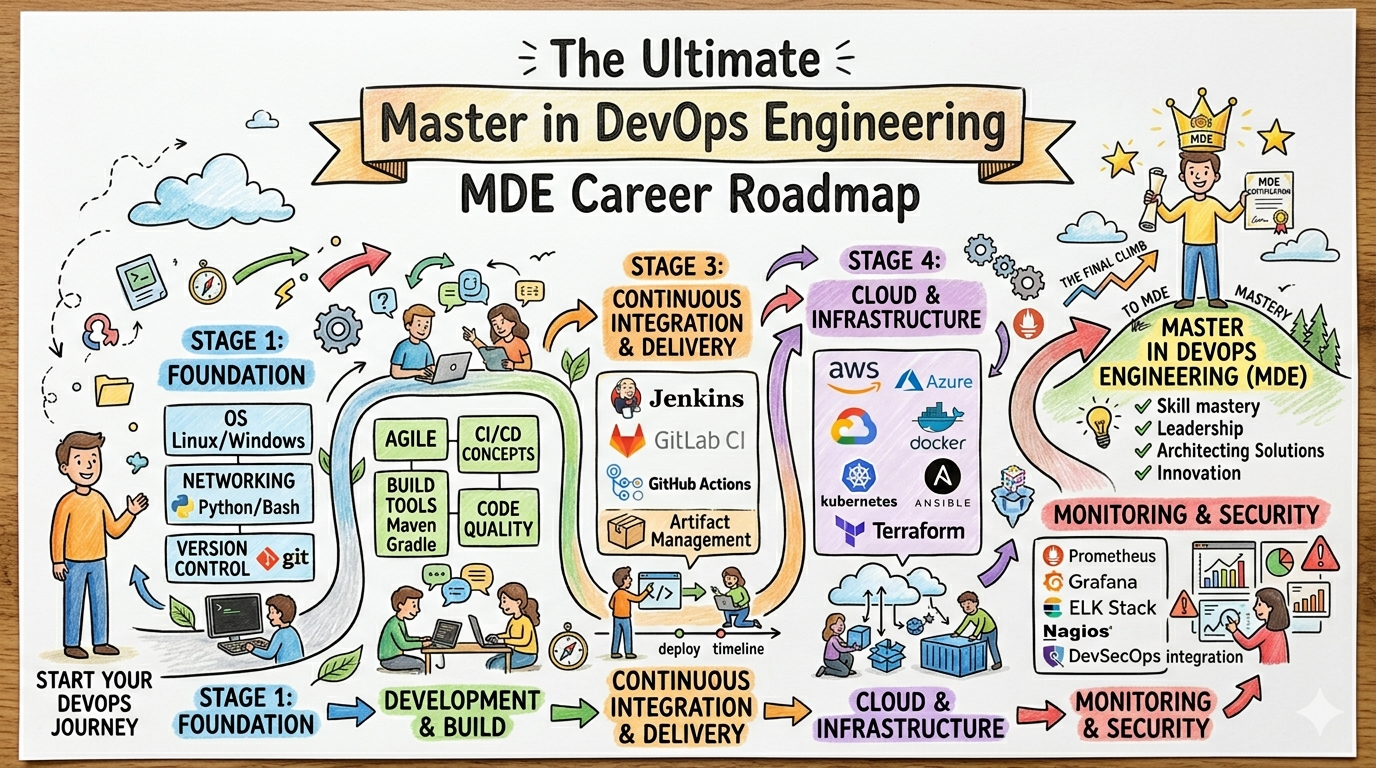
The Master in DevOps Engineering (MDE) represents the pinnacle of modern technical leadership in the software delivery lifecycle. This guide is designed for engineers and managers who recognize that the “DevOps” title is no longer just about writing YAML files, but about architecting resilient, scalable, and secure systems. As the industry shifts toward platform engineering and automated governance, having a structured roadmap like the MDE is essential for staying ahead of the curve. By reading this guide, you will gain a clear understanding of how to navigate the complex landscape of modern engineering and make informed decisions about your professional development.
What is the Master in DevOps Engineering (MDE)?
The Master in DevOps Engineering (MDE) is a comprehensive professional program designed to bridge the gap between theoretical knowledge and production-grade execution. Unlike basic certifications that focus on a single tool, MDE exists to provide a holistic view of the entire ecosystem, from infrastructure as code to observability and site reliability. It emphasizes a hands-on approach where learners are expected to solve real-world architectural challenges that mirror enterprise-level environments. This program aligns perfectly with the current shift toward cloud-native workflows, ensuring that engineers can manage high-velocity release cycles without sacrificing stability.
Who Should Pursue Master in DevOps Engineering (MDE)?
This program is specifically built for those currently in the trenches of software development and operations. Software engineers looking to transition into infrastructure, SREs wanting to deepen their automation skills, and cloud architects aiming for better delivery pipelines will find immense value here. Security and data professionals will also benefit from the cross-functional modules that integrate DevSecOps and DataOps principles. Whether you are a beginner in India looking to break into the global market or a seasoned manager leading a technical department, the MDE provides the technical depth required to lead modern engineering teams.
Why Master in DevOps Engineering (MDE)
As we move through 2026, the demand for “T-shaped” engineers—those with deep expertise in one area and broad knowledge across others—has never been higher. The MDE is valuable because it focuses on core engineering principles that survive the rise and fall of specific tools. While a specific CLI might change, the logic of CI/CD, container orchestration, and automated scaling remains constant. Pursuing this certification ensures longevity in your career by making you an expert in the systems that run the modern world. The return on investment is seen not just in salary hikes, but in the ability to solve complex production issues that others cannot.
Master in DevOps Engineering (MDE) Certification Overview
The program is delivered via the official Master in DevOps Engineering (MDE) course and is hosted on the devopsschool platform. This certification is structured as a multi-tier journey that assesses a candidate’s ability to design, implement, and maintain complex systems. It is not a simple multiple-choice exam; the assessment approach is practical, requiring candidates to demonstrate ownership over the code and the infrastructure it runs on. The structure is designed to be modular, allowing professionals to balance their learning with a full-time job while gradually building a world-class portfolio.
Master in DevOps Engineering (MDE) Certification Tracks & Levels
The MDE program is organized into three primary levels to cater to different stages of professional growth. The Foundation level focuses on the “Day 0” and “Day 1” operations, covering basic automation and culture. The Professional level dives deep into specialized tracks like SRE, FinOps, and DevSecOps, focusing on “Day 2” operations and scaling. Finally, the Advanced level is designed for architects and leads who must oversee the entire engineering strategy. This tiered approach ensures that your learning path aligns perfectly with your current job responsibilities and your future career aspirations.
Complete Master in DevOps Engineering (MDE) Certification Table
| Track | Level | Who it’s for | Prerequisites | Skills Covered | Recommended Order |
| Core DevOps | Foundation | Junior Engineers | Linux, Git Basics | CI/CD, Docker, IaC | First |
| SRE Track | Professional | Ops/SRE Roles | Core DevOps Exp | SLIs/SLOs, Monitoring | Second |
| Security | Professional | Security Engineers | Cloud Knowledge | DevSecOps, Scanning | Third |
| Platform | Advanced | Architects | 5+ Years Exp | K8s, Mesh, IDP | Fourth |
| FinOps | Professional | Managers/Leads | Cloud Billing Exp | Cost Opt, Governance | Optional |
Detailed Guide for Each Master in DevOps Engineering (MDE) Certification
Master in DevOps Engineering (MDE) – Foundation Level
What it is
This certification validates a candidate’s grasp of the fundamental pillars of DevOps, focusing on the automation of software delivery and infrastructure management. It serves as the baseline for all advanced engineering tracks.
Who should take it
This is ideal for junior developers, system administrators, and fresh graduates who want to understand how modern software is built and shipped in a professional environment.
Skills you’ll gain
- Mastery of Version Control (Git) and branching strategies.
- Building automated CI/CD pipelines with industry-standard tools.
- Understanding containerization basics and microservices architecture.
- Fundamentals of Infrastructure as Code (Terraform/Ansible).
Real-world projects you should be able to do
- Deploy a fully automated pipeline for a multi-tier web application.
- Containerize a legacy application and move it to a cloud environment.
- Automate the provisioning of development environments using IaC.
Preparation plan
- 7-14 Days: Focus on the core philosophy and mastering Git commands and Docker basics.
- 30 Days: Build three different pipelines using different CI tools to understand the logic behind them.
- 60 Days: Deep dive into cloud provider services and practice writing Terraform scripts for complex setups.
Common mistakes
- Focusing too much on tool syntax rather than the underlying process logic.
- Neglecting the “Dev” part of DevOps by not understanding how the application code works.
Best next certification after this
- Same-track option: MDE Professional Level
- Cross-track option: Cloud Provider Associate Certification
- Leadership option: Certified Scrum Master (CSM)
Master in DevOps Engineering (MDE) – Professional Level
What it is
The Professional Level validates your ability to manage production-scale environments. It moves beyond “making things work” to “making things work reliably, securely, and at scale.”
Who should take it
Experienced DevOps engineers, SREs, and Platform engineers who have at least 2-3 years of hands-on experience in managing cloud environments.
Skills you’ll gain
- Advanced Kubernetes orchestration and cluster management.
- Implementing comprehensive monitoring, logging, and tracing (Observability).
- Advanced automation of security checks within the pipeline (DevSecOps).
- Deep understanding of high availability and disaster recovery strategies.
Real-world projects you should be able to do
- Architect a multi-region, highly available Kubernetes cluster.
- Implement a full-stack observability suite using Prometheus and Grafana.
- Set up automated compliance and security scanning for all container images.
Preparation plan
- 7-14 Days: Review advanced networking concepts and container security best practices.
- 30 Days: Practice troubleshooting complex cluster failures in a lab environment.
- 60 Days: Conduct a mock “Production Readiness Review” for a sample enterprise application.
Common mistakes
- Over-complicating the architecture when a simpler solution would be more stable.
- Ignoring the cost implications of high-availability setups in the cloud.
Best next certification after this
- Same-track option: MDE Advanced/Architect Level
- Cross-track option: FinOps Certified Practitioner
- Leadership option: Engineering Manager Track
Choose Your Learning Path
DevOps Path
The DevOps path focuses on the speed and quality of delivery. Engineers on this path spend their time optimizing pipelines and ensuring that developers have a frictionless path to production. You will focus heavily on CI/CD, automated testing, and release orchestration. This is the core path for those who love the intersection of coding and operations.
DevSecOps Path
The DevSecOps path is for those who believe security is everyone’s responsibility. It involves shifting security to the left by integrating automated scanning, secret management, and compliance-as-code directly into the engineering workflow. This path is high in demand as companies face increasing threats and regulatory requirements. You will become the bridge between security teams and developers.
SRE Path
The Site Reliability Engineering (SRE) path focuses on the health and performance of systems after they are deployed. You will learn how to define SLIs and SLOs, manage error budgets, and perform incident response. This path is deeply technical and requires a strong understanding of systems internals and distributed systems. It is perfect for those who enjoy solving puzzles in high-pressure environments.
AIOps / MLOps Path
This path is for the data-driven engineer who wants to apply DevOps principles to Machine Learning models. It involves building pipelines that not only ship code but also train and deploy models at scale. You will deal with data versioning, model monitoring, and automated retraining. As AI becomes integrated into every product, this path offers massive career growth.
DataOps Path
DataOps is the application of agile and DevOps practices to data management. On this path, you will focus on building reliable data pipelines and ensuring data quality across the organization. You will work closely with data scientists and analysts to automate the flow of information. It is an essential role for any organization that relies on big data for decision-making.
FinOps Path
FinOps is a cultural practice and financial management discipline that brings accountability to cloud spend. On this path, you will learn how to optimize cloud costs without sacrificing performance. You will work with finance, engineering, and business teams to ensure every dollar spent on the cloud is justified. This is a critical role for large-scale enterprises with massive cloud bills.
Role → Recommended Master in DevOps Engineering (MDE) Certifications
| Role | Recommended Certifications |
| DevOps Engineer | MDE Foundation + MDE Professional (Core) |
| SRE | MDE Professional (SRE Track) + Observability Specialist |
| Platform Engineer | MDE Advanced (Architecture) + Kubernetes Specialist |
| Cloud Engineer | MDE Foundation + Cloud Provider Professional |
| Security Engineer | MDE Professional (DevSecOps Track) |
| Data Engineer | MDE Professional (DataOps Track) |
| FinOps Practitioner | MDE Professional (FinOps Track) |
| Engineering Manager | MDE Foundation + MDE FinOps + Leadership Track |
Next Certifications to Take After Master in DevOps Engineering (MDE)
Same Track Progression
After completing the MDE levels, the natural progression is to seek deep specialization in specific technologies. For example, if you focused on the core DevOps track, you might pursue advanced Kubernetes certifications (CKA/CKAD) or specific cloud architect titles (AWS Solutions Architect Professional). This cements your status as a subject matter expert who can handle any technical challenge in that domain.
Cross-Track Expansion
In 2026, versatility is power. An engineer who understands both SRE and FinOps is much more valuable than one who only knows how to build pipelines. Use your MDE foundation to branch out into neighboring fields. This cross-pollination of skills allows you to see the “big picture” of the business, making you an ideal candidate for senior staff engineer roles.
Leadership & Management Track
For those looking to move away from the terminal and into people management, the MDE provides the technical credibility needed to lead. From here, you should focus on certifications like PMP, Scrum Master, or specialized Engineering Leadership courses. Your deep technical background from the MDE will ensure you are a leader who understands the challenges your team faces daily.
Training & Certification Support Providers for Master in DevOps Engineering (MDE)
DevOpsSchool
DevOpsSchool is a premier destination for those seeking the MDE certification, offering a blend of live instructor-led sessions and extensive lab access. Their curriculum is deeply rooted in industry requirements, ensuring that every student graduates with the practical skills needed for top-tier tech roles.
Cotocus
Cotocus focuses on high-end technical training with a strong emphasis on cloud-native technologies. They provide excellent support for the MDE tracks, particularly in Kubernetes and advanced automation, helping professionals transition into senior engineering roles with confidence.
Scmgalaxy
Scmgalaxy is a vast knowledge hub that has supported the DevOps community for years. They offer specialized resources and community-driven support for the MDE program, making it an excellent place for continuous learning and staying updated with the latest tools.
BestDevOps
BestDevOps offers a streamlined approach to the MDE certification, focusing on career-ready skills and resume-building projects. Their trainers are active industry professionals who bring real production scenarios into the classroom, ensuring a highly relevant learning experience.
devsecopsschool
This provider is the go-to resource for the security-focused tracks within the MDE. They specialize in teaching how to integrate security into every stage of the lifecycle, offering deep dives into container security, vault management, and automated compliance.
sreschool
Sreschool is dedicated entirely to the art and science of reliability. For those pursuing the SRE track of the MDE, they offer unmatched depth in monitoring, incident management, and post-mortem analysis, preparing you for the most demanding SRE roles globally.
aiopsschool
Aiopsschool bridges the gap between traditional operations and machine learning. They support the MDE MLOps track by providing specialized labs for model deployment and automated data pipelines, catering to the growing demand for AI-driven infrastructure.
dataopsschool
Dataopsschool focuses on the data engineering aspects of the MDE. They provide the tools and training necessary to automate data flows and ensure data integrity, which is vital for professionals moving into big data and analytics operations.
finopsschool
Finopsschool addresses the crucial need for cloud cost management. They provide the framework and training for the FinOps track of the MDE, teaching engineers and managers how to balance technical performance with financial efficiency in a cloud-first world.
Frequently Asked Questions (General)
How difficult is the Master in DevOps Engineering (MDE) exam?
The exam is designed to be challenging and focuses on practical application. It requires a solid understanding of both theory and hands-on execution in a lab environment.
How much time does it take to complete the MDE program?
Most professionals complete the full program within 4 to 6 months, depending on their existing experience and the amount of time they can dedicate each week.
Are there any prerequisites for starting the MDE?
Basic knowledge of Linux, at least one programming language, and a general understanding of the software development lifecycle are highly recommended before starting.
What is the ROI of getting an MDE certification?
Professionals often see a significant increase in salary and job opportunities, as the MDE validates high-demand skills that are currently in short supply in the global market.
Can I take the MDE certification online?
Yes, the program is designed to be accessible globally through online learning platforms that include virtual labs and instructor-led webinars.
Is the MDE certification recognized globally?
Absolutely. The MDE curriculum is based on industry standards used by major tech companies worldwide, making it highly valuable in India, the US, Europe, and beyond.
Does the program cover specific cloud providers like AWS or Azure?
While the MDE focuses on tool-agnostic principles, it uses major cloud providers for its labs, ensuring you gain transferable skills across any cloud environment.
Is there a recertification requirement?
To ensure professionals stay updated with the fast-moving tech landscape, a periodic review or advanced module completion is usually recommended every two years.
What kind of support is available during the course?
Most providers like DevOpsSchool offer 24/7 lab support, community forums, and direct access to mentors for troubleshooting and career advice.
Can I skip the Foundation level if I have experience?
If you have significant hands-on experience, you may be able to move directly to Professional tracks, though a quick review of Foundation concepts is always beneficial.
How are the practical labs structured?
Labs are hosted in cloud environments where you are given a set of requirements and must build the infrastructure or pipeline from scratch to meet them.
Does MDE help with job placements?
Many training providers offer career support, including resume reviews and interview preparation, specifically tailored to the roles targeted by the MDE tracks.
FAQs on Master in DevOps Engineering (MDE)
Is the Master in DevOps Engineering (MDE) suitable for developers?
Yes, developers who want to understand the infrastructure their code runs on will find it incredibly useful for building more efficient and resilient applications.
How does MDE differ from a standard AWS or Azure certification?
While cloud certifications focus on a specific provider’s services, MDE focuses on the engineering processes and culture that work across all platforms and tools.
What is the most popular track within the MDE program?
Currently, the SRE and DevSecOps tracks are seeing the highest demand due to the industry’s focus on reliability and cybersecurity.
Do I need to be an expert in coding for MDE?
You don’t need to be a senior developer, but you should be comfortable with scripting (Bash/Python) and understanding application logic to succeed in automation tasks.
How does MDE address the rise of AI in DevOps?
The MDE program includes specific tracks for AIOps and MLOps, teaching you how to manage the infrastructure needed for modern AI-driven applications.
Is the certification valid in the Indian job market?
Yes, India has one of the largest demands for DevOps professionals, and MDE is highly regarded by top Indian IT firms and global GCCs.
Are the exams proctored?
Yes, to maintain the integrity of the certification, exams are typically proctored and require the successful completion of a practical project or lab assessment.
Can a team or organization take the MDE program together?
Many providers offer corporate training packages for MDE, which is a great way to align an entire engineering department on the same set of best practices.
Final Thoughts: Is Master in DevOps Engineering (MDE) Worth It?
If you are looking for a “magic bullet” that will give you a job overnight without effort, then no certification is worth it. However, if you are a serious professional who wants a structured, rigorous path to mastering the most important engineering discipline of our time, the MDE is an exceptional investment. It moves you away from being a “tool operator” and turns you into a “system architect.” In a world where technology changes every week, the principles you learn in this program will provide the stability and growth your career needs. My advice? Don’t just collect the badge—embrace the mindset of continuous improvement that the MDE represents.
