Introduction
The Certified DevOps Architect (CDA) program is a specialized track designed for engineers who want to move beyond basic automation and start designing high-level systems. This guide is written for professionals who are tired of just running tools and want to understand how to build a reliable, scalable, and secure software delivery pipeline.
In today’s world of cloud-native systems and platform engineering, having a certificate is not enough; you need to understand the architecture behind the tools. This guide helps you see the bigger picture of how a DevOps Architect fits into a modern enterprise and how you can make better decisions for your career growth.
What is the Certified DevOps Architect (CDA)?
The Certified DevOps Architect (CDA) is a professional validation that focuses on the design and implementation of complex DevOps ecosystems. It is not just about learning how to use a single tool like Jenkins or Docker; it is about how these tools work together to solve business problems.
This program exists because companies now need leaders who can look at a messy manual process and turn it into a streamlined, automated workflow. It emphasizes real-world production environments where things often go wrong and teaches you how to build systems that are resilient enough to handle those failures.
Who Should Pursue Certified DevOps Architect (CDA)?
This certification is best suited for experienced software engineers, system administrators, and cloud professionals who already have a basic understanding of the cloud. If you are an SRE or a platform engineer looking to move into a leadership or design role, this path will give you the technical depth you need.
It is also highly valuable for engineering managers and technical leaders in India and global markets who need to oversee large-scale migrations. Beginners can use this as a roadmap, but the content is most beneficial for those who have spent time managing servers or writing code in a professional setting.
Why Certified DevOps Architect (CDA)
The demand for skilled architects is growing because software systems are becoming more complex every day. As companies move toward microservices and multi-cloud environments, they need someone who can ensure everything stays connected and secure.
Earning this credential shows that you have the longevity to stay relevant even when specific tools change or become obsolete. It is a long-term investment in your career that helps you move away from daily “firefighting” and into a role where you are building the future of the company’s infrastructure.
Certified DevOps Architect (CDA) Certification Overview
The program is delivered via and is officially hosted on devopsschool. The certification is structured to be practical, meaning the assessment isn’t just a multiple-choice test but a validation of your ability to solve real problems.
It covers everything from initial planning to monitoring and feedback loops in a production setting. Ownership of the learning process stays with the candidate, allowing you to focus on the modules that are most relevant to your current or future job roles.
Certified DevOps Architect (CDA) Certification Tracks & Levels
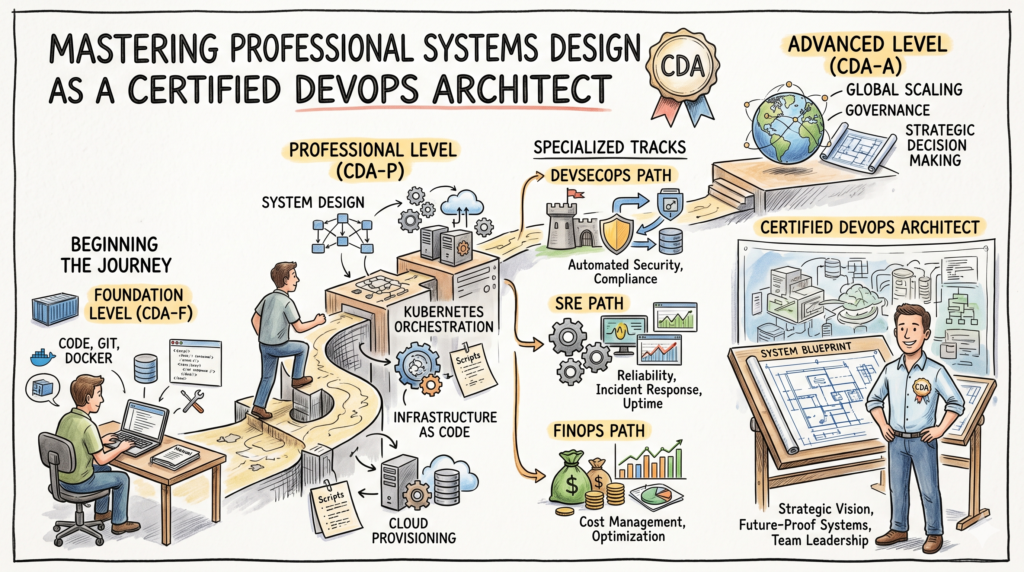
The certification is broken down into three main levels: Foundation, Professional, and Advanced. Each level is designed to match where you are in your career journey and what kind of responsibilities you are ready to take on.
Specialization tracks allow you to focus on specific areas like SRE, FinOps, or Cloud Security after you master the core architecture principles. This alignment ensures that as you grow in your career, your certifications reflect your increasing expertise and leadership ability.
Complete Certified DevOps Architect (CDA) Certification Table
| Track | Level | Who it’s for | Prerequisites | Skills Covered | Recommended Order | Official Link |
| Core Architecture | Foundation | Junior Engineers | Basic Linux/Cloud | CI/CD Basics, Docker | First | Link |
| System Design | Professional | Mid-level Pros | 2+ years IT exp | Kubernetes, IAC | Second | Link |
| Mastery | Advanced | Senior Leads | 5+ years IT exp | Global Scaling, Security | Third | Link |
| Specialist | Expert | Architects | Advanced level | Multi-cloud, Governance | Optional | Link |
Detailed Guide for Each Certified DevOps Architect (CDA) Certification
Certified DevOps Architect (CDA) – Foundation Level
What it is
This level validates your basic understanding of the DevOps lifecycle and the core tools used in modern software delivery. It proves you understand how code moves from a laptop to a production server.
Who should take it
This is for developers and system admins who want to formalize their knowledge of automation. It is a great starting point for anyone new to the architect mindset.
Skills you’ll gain
- Mastery of Git workflows and version control strategies.
- Understanding of containerization using Docker.
- Basic setup of CI/CD pipelines for simple applications.
Real-world projects you should be able to do
- Build a Docker image for a web application and host it.
- Create a basic Jenkins or GitHub Actions pipeline to automate testing.
Preparation plan
- 7–14 days: Focus on core DevOps philosophy and basic command-line tools for automation.
- 30 days: Practice setting up local environments with virtual machines and containers.
- 60 days: Complete a small end-to-end project where code is deployed automatically upon a git push.
Common mistakes
- Spending too much time on theory and not enough time on the command line.
- Ignoring the importance of culture and collaboration in DevOps.
Best next certification after this
- Same-track option: Professional Level CDA.
- Cross-track option: Certified Kubernetes Administrator.
- Leadership option: Project Management basics.
Certified DevOps Architect (CDA) – Professional Level
What it is
This level confirms your ability to design robust systems using orchestration and Infrastructure as Code (IaC). It focuses on making sure your infrastructure is repeatable and scalable.
Who should take it
Mid-career professionals who are responsible for managing production clusters and cloud environments. It is ideal for those who want to lead technical teams.
Skills you’ll gain
- Designing scalable Kubernetes clusters for high availability.
- Using Terraform or Ansible to manage cloud resources.
- Implementing advanced monitoring and logging solutions.
Real-world projects you should be able to do
- Deploy a multi-node application across different cloud zones.
- Automate the provisioning of an entire staging environment using code.
Preparation plan
- 7–14 days: Deep dive into Kubernetes architecture and resource management.
- 30 days: Learn how to write reusable modules for Infrastructure as Code.
- 60 days: Practice troubleshooting complex failures in a distributed system.
Common mistakes
- Over-complicating the design for small projects.
- Failing to document the architecture properly.
Best next certification after this
- Same-track option: Advanced Level CDA.
- Cross-track option: DevSecOps Professional.
- Leadership option: Team Lead or Principal Engineer track.
Certified DevOps Architect (CDA) – Advanced Level
What it is
The advanced level is about governance, security, and global scale. It validates your expertise in managing large-scale, enterprise-grade DevOps implementations that span multiple teams and regions.
Who should take it
Senior engineers and practicing architects who are making high-level decisions for their organizations. This is the top tier of technical achievement in the CDA track.
Skills you’ll gain
- Designing global traffic management and disaster recovery plans.
- Integrating security at every layer of the architecture.
- Managing costs and efficiency in large cloud accounts.
Real-world projects you should be able to do
- Design a zero-downtime migration strategy for a legacy system to the cloud.
- Build a centralized security dashboard for an entire company’s infrastructure.
Preparation plan
- 7–14 days: Study enterprise design patterns and compliance requirements.
- 30 days: Review case studies of large-scale cloud failures and how to prevent them.
- 60 days: Develop a full architectural blueprint for a hypothetical global enterprise.
Common mistakes
- Ignoring the cost implications of high-end architectural choices.
- Focusing too much on technology and not enough on business goals.
Best next certification after this
- Same-track option: CTO or V.P. of Engineering tracks.
- Cross-track option: AI and MLOps architecture.
- Leadership option: Certified IT Director.
Choose Your Learning Path
DevOps Path
This path is for those who want to master the standard delivery cycle. You will focus on speed, reliability, and removing bottlenecks between developers and operations. It is the most common path and provides a very solid foundation for any IT career.
DevSecOps Path
Security is no longer an afterthought, and this path proves it. You will learn how to automate security scans and policy checks within the architect’s framework. This is a high-demand area as more companies face cyber threats.
SRE Path
Site Reliability Engineering focuses on the operations side of architecture. You will learn about error budgets, service level objectives, and how to keep systems running at 99.99% uptime. This is perfect for those who love deep technical troubleshooting.
AIOps / MLOps Path
This path combines the CDA principles with machine learning workflows. You will design systems that can automatically detect problems using AI and manage the lifecycle of ML models. It is the future of intelligent infrastructure.
DataOps Path
DataOps is about managing the flow of data with the same discipline we use for code. This path is for architects who want to work with big data pipelines and ensure data quality and availability. It is essential for data-driven companies.
FinOps Path
Cloud costs can spiral out of control quickly, and FinOps architects prevent that. You will learn how to design systems that are cost-aware and how to report spending back to the business. This role is becoming vital for large enterprise leaders.
Role → Recommended Certified DevOps Architect (CDA) Certifications
| Role | Recommended Certifications |
| DevOps Engineer | CDA Foundation + CDA Professional |
| SRE | CDA Professional + SRE Specialist |
| Platform Engineer | CDA Professional + Kubernetes Master |
| Cloud Engineer | CDA Foundation + Cloud Specific Professional |
| Security Engineer | CDA Foundation + DevSecOps Specialist |
| Data Engineer | CDA Foundation + DataOps Path |
| FinOps Practitioner | CDA Foundation + FinOps Track |
| Engineering Manager | CDA Foundation + Leadership Modules |
Next Certifications to Take After Certified DevOps Architect (CDA)
Same Track Progression
Once you complete the advanced level, you should look into deep specialization. This means becoming an expert in one specific cloud provider like AWS or Azure, but at the “Solutions Architect” level to complement your CDA knowledge.
Cross-Track Expansion
Broadening your skills is a smart move. If you are a core architect, consider moving into DevSecOps or AIOps. Learning how to apply your architectural skills to new domains makes you more versatile and valuable to your employer.
Leadership & Management Track
For those who want to lead people instead of just systems, the next step is moving toward a CTO or Director role. Your technical background as a CDA will give you the respect and knowledge needed to manage high-performing engineering teams.
Training & Certification Support Providers for Certified DevOps Architect (CDA)
DevOpsSchool
This platform is a leader in providing hands-on training for architects. They focus heavily on real-world labs and practical assignments rather than just theory. Their trainers are often working professionals who bring actual industry scenarios into the classroom. This makes the learning experience very grounded and useful for your day-to-day work.
Cotocus
This provider is known for its customized corporate training programs. They excel at taking a team and leveling them up together on specific architectural principles. Their approach is very flexible and focuses on solving specific technical challenges that a company might be facing. It is a great choice for those who want a tailored learning path.
Scmgalaxy
As one of the oldest communities in the DevOps space, this provider offers a wealth of community-driven knowledge. Their training programs are deeply rooted in the history of configuration management and version control. They provide a lot of free resources and forums where you can learn from the mistakes and successes of others in the field.
BestDevOps
This provider focuses on making complex topics simple. Their study materials are designed to be easy to follow, making them a good choice for people who are transitioning into architecture from other roles. They offer a very supportive environment with plenty of mentors to help you when you get stuck on a difficult concept.
DevSecOpsSchool
If you want to focus strictly on the security side of architecture, this is the place to go. They specialize in teaching how to integrate security tools into the CI/CD pipeline. Their courses are very specific and provide deep technical training on vulnerability scanning, compliance as code, and secure coding practices.
Sreschool
For those who care about uptime and system reliability, this provider offers specialized tracks in SRE. They teach you how to apply the CDA mindset to operational stability. You will learn about monitoring, alerting, and incident management in a way that is structured and professional.
Aiopsschool
This provider is at the cutting edge of the industry. They teach you how to use artificial intelligence to manage your infrastructure. Their CDA-related courses focus on automated anomaly detection and self-healing systems. It is an excellent choice for architects who want to stay ahead of the technology curve.
Dataopsschool
This site focuses on the intersection of big data and DevOps. They teach you how to build pipelines that handle massive amounts of information without breaking. Their training is essential for anyone working in a data-heavy environment where speed and accuracy are both critical requirements.
Finopsschool
As companies look to save money on their cloud bills, this provider is becoming increasingly popular. They teach the financial side of architecture. You will learn how to design systems that are not just fast, but also cheap to run. It is a very practical skill set that business leaders highly value.
Frequently Asked Questions
How difficult is the CDA certification?
It is a challenging program because it requires you to think about how different systems work together. It is not just about memorizing facts but about applying logic to complex problems.
How much time does it take to get certified?
Most professionals take between three to six months to complete the core levels. This depends on your prior experience and how much time you can dedicate to studying each week.
What are the prerequisites for the CDA?
You should have a basic understanding of Linux, some experience with at least one cloud provider, and a general knowledge of how software is developed and deployed.
What is the return on investment (ROI) for this?
The ROI is usually very high because it opens doors to senior roles and leadership positions. Most people see a significant jump in their career opportunities and salary after becoming an architect.
Can I take the exam online?
Yes, most providers offer online proctored exams so you can take the test from the comfort of your home or office.
Do I need to know how to code?
You don’t need to be a professional developer, but you should be comfortable reading code and writing scripts in languages like Python or Bash.
Is there a renewal process for the CDA?
Yes, usually you need to renew your certification every two to three years to ensure your skills are still up to date with the latest industry standards.
Does this certification help with remote job opportunities?
Absolutely. Architects are in high demand for remote roles because they can design and manage systems from anywhere in the world.
Which level should I start with?
If you have less than two years of experience in DevOps, start with the Foundation level. If you are already a working professional, you might be able to start at the Professional level.
Are there lab environments provided?
Yes, most training providers like devopsschool provide cloud-based labs where you can practice your skills in a safe, real-world environment.
How does this compare to cloud-specific architect certs?
The CDA is tool-agnostic, meaning it teaches you the principles that apply to any cloud. It is a great way to show you are not locked into just one vendor.
Can this help me move into management?
Yes, the CDA gives you the technical authority and the big-picture mindset that are necessary for moving into engineering management or technical leadership.
FAQs on Certified DevOps Architect (CDA)
Is the CDA focused only on tools?
No, it focuses more on design principles and how to solve business problems using those tools. It is about the “why” and “how” of architecture.
What is the most important skill for a CDA?
The ability to see the whole system at once and understand how a change in one area will affect everything else.
Does CDA cover Kubernetes?
Yes, Kubernetes is a core part of the Professional and Advanced levels because it is the standard for modern architecture.
Is it valuable in the Indian market?
Yes, India has a massive demand for DevOps Architects as more companies migrate to the cloud and adopt microservices.
Can I self-study for the CDA?
You can, but it is much faster and easier to use a structured program from a provider like devopsschool to ensure you don’t miss anything.
Is there a community for CDA holders?
Yes, there are many forums and groups where you can connect with other architects to share ideas and career advice.
Does it cover cloud security?
Yes, security is integrated into every level of the program because a good architect must always think about protection.
What is the average salary for a CDA?
While it varies by region, architects are generally among the highest-paid professionals in the IT industry.
Final Thoughts: Is Certified DevOps Architect (CDA) Worth It?
If you are looking to take the next big step in your career, the answer is yes. Moving from a role where you follow instructions to a role where you create the plan is a huge shift. This certification gives you the tools, the knowledge, and the confidence to make that transition.
In the long run, tools will come and go, but the ability to design a solid architecture will always be in demand. It is a practical, career-focused investment that pays off by making you a leader in your field. Stick to the learning path, do the labs, and focus on solving real problems, and you will see the results in your career growth.
