Introduction
Jaipur is an absolute masterpiece of heritage, but let’s be honest: sometimes the constant hum of e-rickshaws, the crowded bazaars of the Walled City, and the standard tourist trails leave you craving a change of pace. When the weekend rolls around, most travelers blindly flock to the heavily commercialized hubs, entirely missing out on the raw, soul-stirring energy hidden just a few hours past the city limits. If you want to escape the predictable vacation traps and dive into a space where deep cultural roots, authentic interactions, and unhurried rhythms still exist, the Ajmer-Pushkar Circuit is your ultimate escape.
This twin-city oasis balances intense spiritual devotion with bohemian tranquility. Tucked just behind the ancient Aravalli ridges, it offers a dramatic sensory shift from the Pink City’s regal grandeur to something far more intimate and mystical.
Why Ajmer-Pushkar is a must visit city
Geographically separated by the rugged Nag Pahar (Snake Mountain), Ajmer and Pushkar function as two sides of the same cultural coin. Ajmer represents an ancient bastion of Sufi mysticism and strategic historical weight, serving as the seat of power for Prithviraj Chauhan before evolving into a world-renowned spiritual epicentre. Pushkar, on the other hand, is a geological anomaly—a holy lake cradled by sand dunes and mountains, holding one of the world’s very few temples dedicated to Lord Brahma.
For travelers leaving Jaipur, this circuit is remarkably accessible. Whether you are a solo backpacker looking for hipster rooftop cafes, a couple seeking a serene lakeside sunset, or a family exploring rich architecture, the seamless connectivity via the NH48 highway and smooth rail links makes it a completely stress-free journey. It is a travel circuit where time slows down, allowing you to actually absorb your surroundings rather than just check spots off a list.
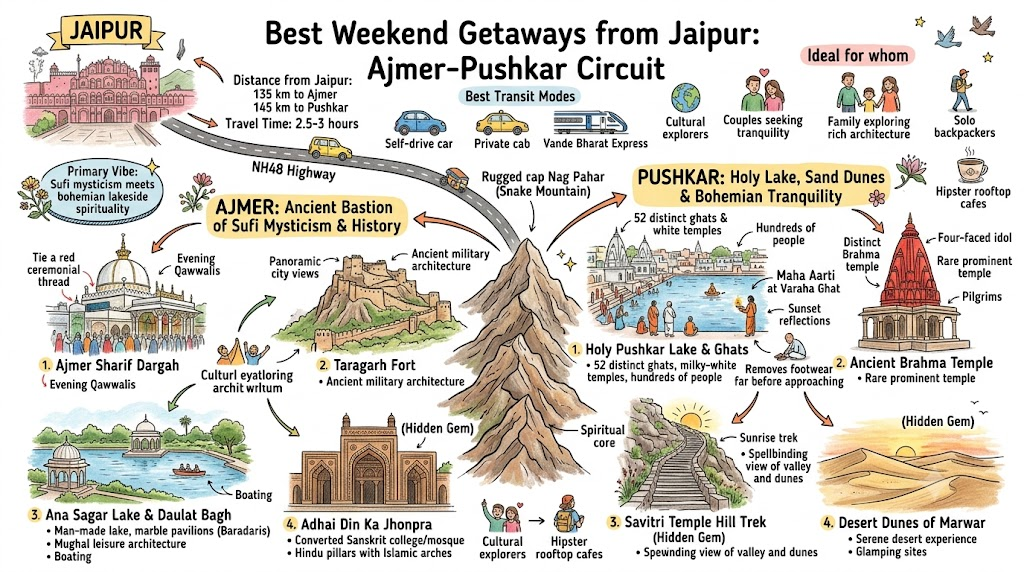
| Key Metric | Details & Data |
| Distance from Jaipur | 135 km to Ajmer |
| Travel Time | 2.5 to 3 hours via NH48 |
| Best Transit Mode | Self-drive car, private cab, or Vande Bharat Express |
| Primary Vibe | Sufi mysticism meets bohemian lakeside spirituality |
Best Places or Experiences
The Holy Pushkar Lake & Ghats
Pushkar Lake is a stunning, semi-circular water body framed by 52 distinct ghats and hundreds of milky-white temples. According to local lore, the lake was formed when Lord Brahma dropped a lotus petal to defeat a demon, causing water to burst forth from the desert floor.
The atmosphere here is thick with the scent of burning incense, the soft ringing of temple bells, and the melodic cadence of evening prayers. Walking along the stone steps as the sun sets over the water is an unforgettable sensory experience that instantly grounds you.
- Location: Central Pushkar town, roughly 145 km from Jaipur.
- Why it is worth visiting: It is the spiritual core of the region, offering a raw look into ancient living traditions and breathtaking sunset views.
- Best things to do: Attend the mesmerizing evening Maha Aarti at Varaha Ghat, witness traditional evening ragas performed by local musicians, and capture the golden hour reflections from Jaipur Ghat.
- Best time to visit: October to March, specifically during the late afternoon from 4:30 PM to 6:30 PM to catch the setting sun.
- Ideal for whom: Cultural explorers, couples seeking tranquility, and photography enthusiasts.
- Travel tip: You must remove your footwear far before approaching the stone steps of the ghats; always keep a sharp lookout for aggressive priests offering unsolicited blessings in exchange for exorbitant donations.
Ajmer Sharif Dargah
The final resting place of the revered Sufi saint Khwaja Moinuddin Chishti, this 13th-century shrine is a monumental pillar of peace and multi-faith devotion. Built with marble and gold plating across multiple Mughal eras, the complex features massive courtyards where thousands gather daily.
The energy here peaks during the evening Qawwalis (devotional Sufi music), where ancient instruments and raw vocal talent create an emotionally charged atmosphere that transcends religious boundaries.
- Location: Old City area, Ajmer, approximately 135 km from Jaipur.
- Why it is worth visiting: It is one of the most sacred Sufi shrines globally, renowned for its architectural beauty and intense spiritual energy.
- Best things to do: Tie a red ceremonial thread (mannat ka dhaga) at the marble screen, sit in the inner courtyard for the live evening Sufi Qawwali sessions, and observe the massive bronze cooking cauldrons (degs) used to feed the community.
- Best time to visit: Early morning around 6:00 AM to beat the intense crowds, or late evening during prayer hours.
- Ideal for whom: History buffs, spiritual seekers, and architecture lovers.
- Travel tip: Ensure your head is covered with a scarf or handkerchief before entering, and carry your footwear in your bag or use monitored shoe stalls to avoid theft.
The Ancient Brahma Temple
Dating back structurally to the 14th century, though its foundations are thousands of years older, this is the most prominent temple in the world dedicated to Lord Brahma. Constructed with distinct stone slabs, a bright red spire (shikhara), and adorned with a structural hamsa (goose) motif, it stands as a unique monument in Hindu architecture.
Inside, the four-faced idol of Brahma sits in the inner sanctum, attracting pilgrims from every corner of the globe who come to pay respects to the creator.
- Location: Near the main Pushkar Lake market ridge, Pushkar.
- Why it is worth visiting: A rare opportunity to visit a functional temple dedicated to Brahma, featuring a fascinating architectural layout.
- Best things to do: Examine the silver coins embedded in the marble floors placed by devotees, climb the stone steps for a view of the market below, and explore the small hidden shrines within the courtyard.
- Best time to visit: Winter months, early morning between 7:00 AM and 9:00 AM for a peaceful darshan.
- Ideal for whom: Religious pilgrims, family travelers, and historical researchers.
- Travel tip: Electronic items, large bags, and cameras are strictly banned inside the main temple compound; use the secure lockers located outside the main gates.
Taragarh Fort (Ajmer)
Perched dramatically on a steep hillside overlooking the city, Taragarh Fort (Star Fort) is one of the oldest hill forts in India, built in 1354 AD. It features massive stone ramparts, giant water reservoirs carved directly out of solid rock, and ruined palaces that offer a rugged look at pre-Mughal Rajput defense architecture.
The panoramic views from the top stretch out across the entirety of Ajmer city and the glittering Ana Sagar Lake, making the steep climb completely worthwhile.
- Location: Taragarh Hill, Ajmer, accessible via a winding mountain road.
- Why it is worth visiting: Exceptional military architecture combined with unmatched bird’s-eye views of the surrounding valley.
- Best things to do: Explore the giant cannon Garbha Gunjan, walk through the remnants of the grand gateway arches, and watch the city lights blink on at dusk.
- Best time to visit: November to February, during the early morning hours to avoid the midday sun.
- Ideal for whom: Adventure seekers, trekkers, and history enthusiasts.
- Travel tip: The road leading up the hill is narrow and incredibly steep; hire a local auto-driver or experienced cab operator rather than driving a low-clearance vehicle yourself.
Ana Sagar Lake & Daulat Bagh
Ana Sagar is a vast, man-made lake commissioned by Anaji Chauhan (the grandfather of Prithviraj Chauhan) between 1135 and 1150 AD. Later, Emperor Shah Jahan added polished white marble pavilions (Baradaris), while Jahangir laid out the lush Daulat Bagh gardens alongside the banks.
It is a perfect example of Mughal leisure architecture, where cool lake breezes rustle through manicured lawns, offering an idyllic spot to unwind after a long day of exploring.
- Location: Northern sector of Ajmer city.
- Why it is worth visiting: Beautiful blend of Rajput engineering and Mughal landscaping with breezy lakeside walkways.
- Best things to do: Stroll along the marble Baradaris for classic photos, take a scenic boat ride across the lake to the island park, and relax under the shade of trees in Daulat Bagh.
- Best time to visit: 4:00 PM to 7:00 PM when the marble pavilions reflect the changing evening sky.
- Ideal for whom: Families, couples looking for quiet walks, and casual strollers.
- Travel tip: Combine this visit with a street food stops nearby to enjoy local snacks right next to the water.
Offbeat Exploration: Hidden Gems Tourists Miss
Savitri Temple Hill Trek
Perched on top of the Ratnagiri Hill, this temple is dedicated to Brahma’s estranged wife, Goddess Savitri. While there is a modern ropeway available, the real joy lies in tackling the steep 1.5 km stone staircase early in the morning. Reaching the peak just as the sun cracks over the horizon gives you a spellbinding view of the entire Pushkar valley, its surrounding dunes, and the holy lake shimmering below.
Adhai Din Ka Jhonpra
Located right beyond the Dargah enclosure, this is a brilliant architectural marvel that most tourists walk right past. Originally a Sanskrit college, it was converted into a mosque in 1192 AD by Qutb-ud-din Aibak within just two and a half days (hence the name). The structure retains its original, intricately carved Hindu temple pillars, seamlessly merged beneath giant Islamic arches and calligraphic sandstone screens.
The Desert Dunes of Marwar
Most people assume you have to travel all the way to Jaisalmer to see sand dunes, but Pushkar has its own beautiful patch of desert terrain on its western fringes. Skipping the loud, commercial camel cart safaris and walking out into the quiet sands near modern luxury glamping sites rewards you with an incredibly serene, untracked desert sunset experience.
Detailed Practical Guidance for Travelers
| Destination | Standard Entry Fee | General Timings | Best Local Food Options Nearby | Recommended Nearby Attractions |
| Pushkar Lake & Ghats | Free | Open 24 hours | Rabdi Malpua at Halwai Gali | Brahma Temple |
| Ajmer Sharif Dargah | Free | 5:00 AM – 9:00 PM | Mutton Korma & Biryani at Madina Hotel | Adhai Din Ka Jhonpra |
| Brahma Temple | Free | 6:00 AM – 8:30 PM | Dal Baati Churma at Sunset Cafe | Varaha Ghat |
| Taragarh Fort | Free | 8:00 AM – 7:00 PM | Local tea stalls at hill base | Prithviraj Smarak |
| Ana Sagar Lake | Free (Boating extra) | 8:00 AM – 8:00 PM | Chaat & Kulfi at the lakeside promenade | Daulat Bagh |
Logistics & On-Ground Navigation
Local Transport Options
- Railways: Regular trains run from Jaipur Junction to Ajmer (including the ultra-fast Vande Bharat Express, taking just 2 hours). From Ajmer, Pushkar is a 30-minute cab ride away.
- Auto-Rickshaws & E-Rickshaws: These are the absolute lifelines of both towns. They navigate the narrow lanes of Ajmer’s old bazaars and Pushkar’s market loops with ease. Always bargain and fix prices before hopping in.
- Car Rentals & Two-Wheelers: Renting a scooter in Pushkar (around ₹400 per day) is the absolute best way to explore the open country roads and foothills at your own pace.
Budget Planning
- Backpacking/Budget Tier: ₹1,200 – ₹1,800 per day. Includes stays in vibrant social hostels in Pushkar, meals at local dhabas, street food, and commuting via shared e-rickshaws.
- Mid-Range/Comfort Tier: ₹4,500 – ₹7,500 per day. Includes stays in heritage havelis or desert boutique resorts, private AC cab rentals, dining at popular rooftop cafes, and paid guiding services.
Safety and Inclusivity Tips
- For Families: Stick to early morning temple visits to avoid heavy crowds and heat. Keep young children close in the dense, chaotic markets of Ajmer.
- For Couples: Pushkar’s lakeside cafes offer an incredibly safe, relaxed bohemian vibe. However, keep public displays of affection to a minimum near holy ghats to respect local traditions.
- General Safety: Watch out for pickpockets in the dense lanes leading to the Ajmer Dargah. Politely but firmly say “no” to persistent street vendors or fake guides offering cheap gems and stones.
Strategic Travel Planning Guardrails
Travel Planning Tips for Ajmer-Pushkar
- Digital vs. Cash: While UPI and digital payments are widely accepted in cafes and hotels, carry hard cash (₹500–₹1,000 in change) for shoe stalls, auto rides, and small temple donations.
- Respecting Boundaries: Dress conservatively. Cover your shoulders and knees when visiting all active religious structures.
- Booking Strategy: If you plan to visit during the iconic Pushkar Camel Fair (usually in November), book your stays at least 4 to 5 months in advance; prices skyrocket up to five times the standard rates.
- Hydration Prep: The desert sun can be brutal even in the winter months; carry reusable water bottles and sun protection for hill climbs.
Common Mistakes to Avoid
- Over-packing your days: Trying to do the Dargah, Taragarh Fort, and Pushkar Lake all in a single afternoon will leave you exhausted and stuck in traffic.
- Accepting “Free” Flowers: On the Pushkar ghats, local priests will hand you rose petals for a “free prayer.” Once the prayer finishes, they will aggressively demand thousands of rupees as a religious offering.
- Missing out on street food: Avoiding the small, buzzing local halwais because they look rustic means missing out on the best culinary experiences in Rajasthan.
- Driving in old bazaars: Do not attempt to drive a hatchback or SUV into the lanes of old Ajmer or Pushkar town; you will get stuck in an endless gridlock.
Suggested Itinerary Blueprints
1. Day Quick Dash (The Spiritual Sprint)
- Target Audience: Time-strapped travelers or weekend warriors looking for a rapid refresh.
- Routing:
- 07:00 AM: Depart Jaipur via NH48.
- 10:00 AM: Arrive at Ajmer Sharif Dargah for a peaceful morning exploration.
- 12:30 PM: Quick walk to see the architectural marvel of Adhai Din Ka Jhonpra.
- 01:30 PM: Drive over the scenic Nag Pahar pass directly into Pushkar for a late lunch.
- 04:00 PM: Visit the holy Brahma Temple.
- 05:30 PM: Watch the golden sunset over Pushkar Lake from the Jaipur Ghat before heading back to Jaipur by 9:00 PM.
2. Day Deep-Dive (Heritage & Culture Split)
- Day 1 (The Soul of Ajmer): Leave Jaipur at 8:00 AM. Check into an Ajmer hotel by 11:00 AM. Spend your afternoon wandering the white marble pavilions of Ana Sagar Lake and Daulat Bagh. At 4:30 PM, take a local auto up to Taragarh Fort for panoramic sunset views over the valley. Wind down with an authentic Mughlai dinner near the old city center.
- Day 2 (The Bohemian Pushkar Vibe): Drive to Pushkar early at 6:30 AM to catch the sunrise trek up Savitri Hill. Head down for a hearty breakfast of Falafel wraps or traditional Kachoris. Spend the afternoon shopping for silver jewelry and indie clothing in the main bazaar. End your weekend soaking in the evening Maha Aarti at Varaha Ghat before driving back to Jaipur.
3. Complete Weekend Travel Plan (The Leisure Loop)
- Friday Evening: Drive down from Jaipur after work around 5:00 PM. Check into a serene desert resort or a stylish boutique glamping site on the outskirts of Pushkar. Enjoy a quiet dinner under the stars.
- Saturday: Dedicate your morning to exploring the 52 holy ghats of Pushkar Lake. Have a leisurely lunch at a rooftop cafe overlooking the water. By late afternoon, book a Jeep safari to watch the sunset over the desert dunes.
- Sunday: Checkout after breakfast and head into Ajmer. Spend your afternoon exploring the historic layers of Ajmer Sharif Dargah and the nearby ancient structural ruins. Enjoy a lakeside walk by Ana Sagar before returning to Jaipur in the evening.
Common Tourist Mistakes to Avoid
- Geographic Blunders: Do not schedule a trip to Taragarh Fort in Ajmer and a desert safari in Pushkar within the exact same two-hour window. The winding mountain pass separating the two towns requires slow, careful driving.
- Commercial Traps: Avoid spending your afternoon inside the newer, generic shopping complexes in modern Ajmer. Stick to the atmospheric old markets like Dargah Bazaar or Pushkar’s main street for authentic local products.
- Neglecting Modern/Alternative Zones: Don’t miss out on Pushkar’s fantastic, alternative cafe culture. The town is home to global travelers, resulting in world-class vegan bakeries, wood-fired pizzerias, and great fusion food spaces tucked quietly away from the main temples.
- Transport Overpayment: Local auto-drivers frequently quote exorbitant prices (often upwards of ₹400 for short hops) to travelers. Always cross-check rates using local ride-sharing apps where available, or ask your hotel front desk for standard pricing benchmarks.
- Luxury Dining Bias: If you only dine inside high-end, air-conditioned resort restaurants, you will completely miss out on the true culinary heart of the region—like the legendary wood-fired wood-pushed rabdi dishes cooked on small street-corners.
Frequently Asked Questions
1. What is the exact distance between Jaipur and Pushkar, and how long does it take by road?
The road distance between Jaipur and Pushkar is approximately 145 kilometers via the NH48 highway. Under normal traffic conditions, a self-drive car or private taxi will take between 2.5 to 3 hours. The route is highly commercial, completely paved, and features multiple well-equipped rest stops and fuel stations along the way.
2. Can we easily visit both Ajmer and Pushkar in a single weekend trip?
Yes, they make a perfect twin-city weekend circuit. Because they are separated by only 15 kilometers (about a 30-minute drive across the scenic Nag Pahar mountain pass), you can easily base yourself in the quiet surroundings of Pushkar while taking quick half-day trips to explore the historical and heritage sites of Ajmer.
3. Is photography allowed inside the Ajmer Sharif Dargah and the Brahma Temple?
General photography of the courtyards and architecture is permitted in parts of the Ajmer Dargah, but cameras must be turned off inside the inner sanctum of the tomb. In contrast, the Brahma Temple enforces a strict ban on all electronic items, including smartphones and cameras, within its entire main compound. Secure locker counters are available at the entrance.
4. What are the absolute must-try local dishes when visiting Pushkar?
You cannot leave Pushkar without trying the famous, sugary Rabdi Malpuas at the ancient sweet shops in Halwai Gali (especially at Laxmi Misthan Bhandar). Additionally, due to the massive influx of international backpackers over decades, Pushkar serves incredible, authentic Falafel wraps and wood-fired pizzas at places like La Pizzeria and Ganga Laffa.
5. Are there strict dress codes that travelers need to follow at the holy ghats?
While there is no formal uniform, you are legally and culturally required to dress conservatively when visiting the ghats and temples. Both men and women should keep their shoulders and knees fully covered. Additionally, footwear of all kinds must be taken off at least 50 meters away from the holy water’s edge.
6. How do we avoid getting scammed by priests at the Pushkar Lake ghats?
Politely decline anyone who approaches you offering free rose petals, threads, or special prayers for your family. These are commercial traps designed to corner tourists into paying large sums of money under psychological pressure. Stick to walking the ghats independently, and if you genuinely wish to perform a puja, arrange it through your verified hotel desk.
7. Which is the best mode of public transport to travel from Jaipur to Ajmer quickly?
The absolute fastest and most comfortable public transit option is the Jaipur-Ajmer Vande Bharat Express. It departs early in the morning from Jaipur Junction and drops you at Ajmer station in just about 2 hours. Alternatively, regular air-conditioned superfast buses run from Jaipur’s Sindhi Camp bus station every half hour.
8. Is alcohol and non-vegetarian food available in the town of Pushkar?
No. Pushkar is considered a highly sacred temple town, meaning there is a strict, comprehensive legal ban on both alcohol and non-vegetarian food within the city limits. All cafes and restaurants serve strictly vegetarian cuisine. If you are looking for non-vegetarian Mughlai food or bar lounges, you will need to head into nearby Ajmer city.
9. What can I buy as an authentic souvenir from the Pushkar local markets?
Pushkar’s vibrant street markets are world-renowned for high-quality handcrafted silver jewelry, rosewater products made from locally grown damask roses, embroidered patchwork textiles, and traditional leather journals or camel-bone artifacts. Always use your best bargaining skills, as initial prices quoted to tourists are highly inflated.
10. Is the road climb up to Taragarh Fort safe for amateur drivers?
The road leading up to Taragarh Fort from the base of Ajmer is incredibly narrow, features sharp hairpin turns, and has steep inclines without side railings in certain sections. If you are not highly confident in your hill-driving skills, it is highly recommended to park your vehicle at the base and hire a seasoned local auto-rickshaw driver.
11. When does the famous Pushkar Camel Fair take place, and should I visit then?
The Pushkar Camel Fair takes place annually in October or November, aligning with the auspicious Kartik Poornima festival. While it is an incredible cultural spectacle of hot air balloons, camel trading, and folk dances, it is also incredibly crowded and expensive. If you prefer a peaceful, relaxed holiday, avoid the fair dates and visit during the quieter winter months of December through February instead.
12. Are there good hostel options in Pushkar for solo backpackers traveling from Jaipur?
Yes, Pushkar has one of the best social hostel scenes in India. Renowned boutique chains offer highly secure, clean, and vibrant properties complete with swimming pools, co-working spaces, and organized group treks. They are perfect for solo travelers looking to meet like-minded explorers.
Conclusion
Choosing a weekend trip to the Ajmer-Pushkar circuit over a standard, predictable luxury getaway is an investment in your cultural perspective. As you sit on the white stone steps of the ghats watching the sky turn a deep violet, or listen to the soulful strains of a qawwali echo off old marble walls, the frantic stress of modern city life simply fades away. It is a journey that doesn’t just fill your camera roll—it leaves you with a deep sense of peace, a stories-driven connection to the past, and a renewed spirit that stays with you long after you drive back through the gates of the Pink City.
