Introduction
While hordes of hurried vacationers jostle for elbow room at souvenir kiosks and postcard palace gates, true wanderers seek raw tactical history. Perched high upon the Cheel ka Teela (Hill of Eagles) in the Aravalli range, Jaigarh Fort stands in stark contrast to crowded mainstream tourist traps.
Built not for delicate courtly indulgence but as an impregnable military citadel, this fortress delivers an uncompromising encounter with Rajput defense architecture. Walking these wind-carved battlements connects you directly to a bygone era of desert warfare, cannon foundries, and royal secrets.
.
Courtyards of Jaigarh Fort.
Why Jaipur is a must-visit city
Jaipur anchors Rajasthan’s cultural narrative, functioning as the crown jewel of India’s famed Golden Triangle travel circuit. Established in 1727 by Maharaja Sawai Jai Singh II, the city represents a masterclass in ancient Vedic town planning and unyielding mountain fortification. The surrounding Aravalli ridge forms a natural defensive wall, hosting an interconnected triad of citadels: Amer, Jaigarh, and Nahargarh.
Beyond its regal heritage, Jaipur offers seamless modern infrastructure that caters equally to adventurous solo backpackers, road-tripping couples, and comfort-focused multi-generational families. The city is effortlessly reached via the Delhi-Mumbai Expressway, broad-gauge railway junctions, and an active international airport.
| Key Fact | Details |
|---|---|
| Location & Altitude | Amer Ridge, Jaipur, Rajasthan (approx. 500 meters above sea level) |
| Architectural Style | Medieval Rajput Military Citadel with defensive watchtowers |
| Key Military Feature | Houses Jaivana, once the world’s largest wheeled cannon |
| Operational Hours | 9:00 AM to 5:00 PM Daily |
| Best Travel Season | October to March (Crisp mornings and pleasant afternoon breezes) |
Best Places or Experiences
Jaivana Cannon Enclosure
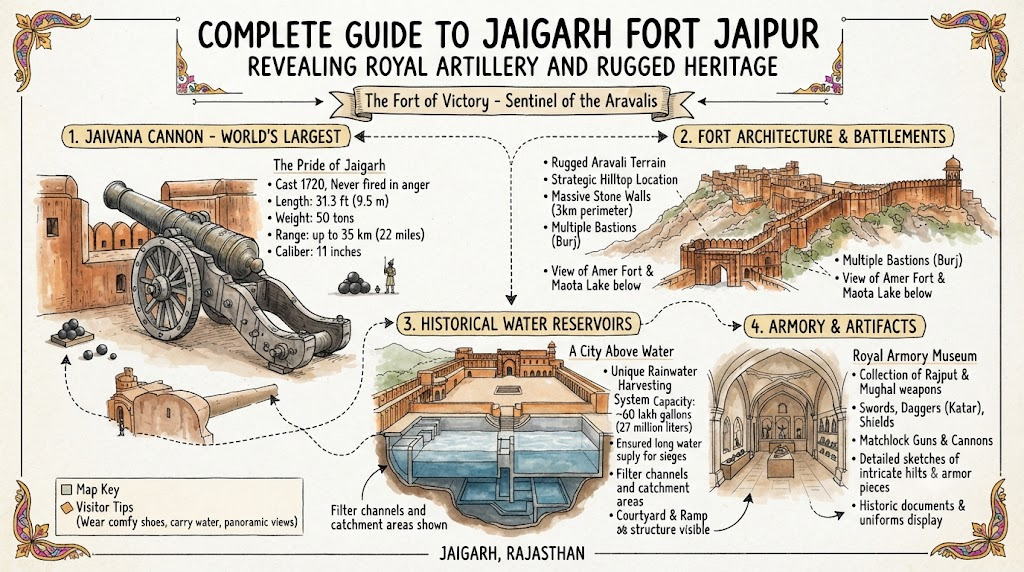
Stationed atop the fortress’s highest artillery bastion sits Jaivana, manufactured in 1720 within the fort’s own royal foundry. Commissioned during the reign of Maharaja Sawai Jai Singh II, this monumental weapon remains one of the greatest mechanical wonders of pre-industrial India.
The colossal bronze barrel measures over 20 feet in length, weighing nearly 50 metric tons, mounted on massive multi-spoke timber wheels. Standing before this giant weapon gives travelers a palpable sense of the incredible metallurgy and logistical mastery achieved by 18th-century Rajput engineers.
The historic Jaivana Cannon.
- Location: Top bastion of Jaigarh Fort, Amer zone, 15 km north of Jaipur city center.
- Why it is worth visiting: Witness the world’s largest operational cannon on wheels, an engineering marvel that was test-fired only once.
- Best things to do: Examine the ornate elephant engravings along the barrel tip, inspect the massive eight-ton wheel assemblies, and view the panoramic mountain valley below.
- Best time to visit: Early morning between 9:30 AM and 11:00 AM when the eastern sun highlights the engraved bronze surface.
- Ideal for whom: Military history buffs, engineering enthusiasts, and curious photographers.
- Travel tip: Wear a wide-brim hat, as the open artillery plateau offers zero shade during mid-day hours.
Subhat Niwas and Diwan-e-Khas
Subhat Niwas served as the central assembly hall where garrison commanders rallied soldiers, reviewed offensive plans, and distributed rations. Built with durable local red sandstone, the pavilion features sturdy multi-arched bays designed to withstand artillery shockwaves rather than flaunt opulent decorative plasterwork.
Adjoining this parade hall is the Diwan-e-Khas, an austere hall of private audience where the Maharaja held high-level war councils. Walking through these vaulted stone corridors reveals how utilitarian functionality dictated every single line of Jaigarh’s defensive construction.
- Location: Central palace courtyard complex inside Jaigarh Fort.
- Why it is worth visiting: Experience the authentic wartime council chambers of Rajput rulers, preserved without modernization.
- Best things to do: Spot the original flagstaff mountings, observe the acoustics beneath the vaulted arches, and photograph the stark symmetry of the stone pillars.
- Best time to visit: Late morning around 11:30 AM to capture clear light filtering through the stone archways.
- Ideal for whom: Architecture students, solo travelers, and cultural heritage seekers.
- Travel tip: Check the courtyard flagstone transitions carefully to spot old rain-funneling stone drains.
The Great Underground Water Reservoirs
Built to sustain a garrison through multi-year sieges, Jaigarh’s three massive subterranean water reservoirs represent an extraordinary ancient hydrological achievement. An ingenious mountain catchment network collected rainwater across a four-kilometer radius through open stone aqueducts and sand filtration pits.
The largest central tank possesses a storage capacity of roughly six million gallons of freshwater, complete with arched stone ceilings that prevented evaporation in harsh desert summers. These very cisterns sparked widespread legend in the 1970s when national authorities conducted an exhaustive search for hidden royal Kachwaha treasure.
- Location: Northern sector of the inner palace enclosure.
- Why it is worth visiting: Discover an ancient rainwater harvesting system that kept thousands of soldiers hydrated across decades of dry desert seasons.
- Best things to do: Peer through the arched viewing grates into the cavernous reservoir depths, trace the hillside canal aqueducts, and read the archived water-measurement plaques.
- Best time to visit: Midday between 12:00 PM and 1:30 PM when overhead sunlight penetrates deepest through the ceiling ventilation shafts.
- Ideal for whom: Civil engineering enthusiasts, history detectives, and sustainability thinkers.
- Travel tip: Do not toss coins or paper down the ventilation grates, as this protected heritage structure remains strictly conserved.
Royal Armoury and Cannon Foundry
Jaigarh Fort operated one of the most sophisticated military foundries in medieval Asia, favored by nearby iron ore deposits and secure mountaintop isolation. The on-site armoury now serves as a museum exhibiting authentic 16th- to 18th-century military paraphernalia used by the royal forces of Jaipur.
Within these secure stone vaults, visitors can examine rows of matchlock muskets, heavy Damascus-steel talwars, spiked iron war maces, and complete camel-mounted swivel guns. The foundry sector preserves the original gear systems, bellows, and casting pits where molten bronze was shaped into lethal military barrels.
- Location: South-western wing of the central courtyard.
- Why it is worth visiting: Inspect authentic preserved medieval weapon-casting apparatus and rare antique firearms.
- Best things to do: Examine the camel-mounted zamburak guns, read historical manufacturing rosters, and inspect genuine steel chainmail suits.
- Best time to visit: 1:00 PM to 2:30 PM, making it an ideal indoor stop during warm midday temperatures.
- Ideal for whom: Weapons enthusiasts, military collectors, and curious students.
- Travel tip: Photography rules are strictly enforced inside certain display rooms; look for wall placards before snapping photos.
Charbagh Garden Complex (Aram Mandir)
Nestled within the fortified perimeter sits the Aram Mandir and its classic Persian-style Charbagh garden, providing a touch of serenity amidst militaristic stone ramparts. This quadrant-divided garden features raised stone pathways, shallow marble water channels, and low-growing flowering shrubs.
From the wide veranda of the Aram Mandir, the Maharaja enjoyed unobstructed vistas across the fortified ridge toward Amer’s palaces. It provided royal commanders with a private sanctuary where they could relax while remaining protected inside the hilltop fortress.
- Location: Northern edge of the inner royal quarters.
- Why it is worth visiting: Admire an authentic geometric Charbagh garden built at an extreme mountain elevation.
- Best things to do: Walk the geometric sandstone pathways, sit beneath the shaded pillared verandas, and take in panoramic views of the Aravalli peaks.
- Best time to visit: 3:00 PM to 4:15 PM when long afternoon shadows highlight the symmetry of the garden beds.
- Ideal for whom: Couples, landscape design lovers, and relaxed wanderers.
- Travel tip: The stone benches near the northern balustrade offer a peaceful spot for a restful break away from tour groups.
The Subterranean Secret Escape Tunnel
Connecting Jaigarh Fort to the lower palace complex of Amer Fort, this underground tunnel represents defensive brilliance. Carved through bedrock, the passageway allowed royal family members and vital troops to evacuate Amer during an assault and reach the safety of high-altitude Jaigarh.
Walking through the restored initial stretches of this tunnel feels like stepping inside an espionage thriller. The vaulted stone walls, strategic peepholes, and dim torch-bracket recesses illustrate how the rulers anticipated every conceivable siege contingency.
- Location: Eastern perimeter wall, linking downward toward the Amer Palace gates.
- Why it is worth visiting: Traverse a real medieval military escape conduit that secured royal dynasties during major sieges.
- Best things to do: Walk through the accessible vaulted tunnel segment, inspect the defensive arrow slits along the path, and photograph the dramatic perspective of Amer Fort below.
- Best time to visit: 3:30 PM to 4:45 PM before evening gate closures.
- Ideal for whom: Thrill-seekers, active hikers, and history enthusiasts.
- Travel tip: Wear sturdy walking shoes with rubber grip, as the centuries-old flagstone flooring can be slick.
View of Amer Fort and Maota Lake.
Offbeat Exploration: Hidden Gems Tourists Miss
Sagar Lake Viewpoint
Just below the eastern defensive ramparts of Jaigarh lies Sagar, a 17th-century reservoir divided into upper and lower storage tiers. While millions look at Maota Lake, few venture to this quiet stone embankment that fed drinking water to both forts. The stone steps and octagonal watchtowers here offer absolute tranquility and stunning reflections of the ridge.
Diwa Burj Watchtower
The highest watchtower on the Jaigarh perimeter, known locally as Diwa Burj, served as the primary observation station for military sentries. From this vantage point, signal fires warned the entire valley of approaching armies. Today, it offers an unmatched 360-degree aerial panorama over Jaipur city, the dry deciduous Aravalli forests, and Amer’s defensive walls.
Kal Bhairav Temple Shrine
Tucked within an inconspicuous niche near the primary Awami Gate, this ancient shrine is dedicated to Lord Bhairav, the fierce guardian deity of the fortress. Before embarking on military campaigns, Rajput soldiers performed protective rituals here. The small temple remains an active spiritual enclave where visiting locals seek blessings away from bustling tourist routes.
Detailed Practical Guidance for Travelers
| Destination | Standard Entry Fee | General Timings | Best Local Food Options Nearby | Recommended Nearby Attractions |
|---|---|---|---|---|
| Jaivana Cannon Enclosure | ₹70 (Indian), ₹150 (Foreigner) | 9:00 AM – 5:00 PM | Jaigarh Fort Canteen (Masala Chai & Samosa) | Diwa Burj Watchtower, Royal Foundry |
| Subhat Niwas & Armoury | Included in General Entry | 9:00 AM – 5:00 PM | 1135 AD inside Amer Fort (Rajasthani Laal Maas) | Aram Mandir, Charbagh Complex |
| Underground Reservoirs | Included in General Entry | 9:00 AM – 5:00 PM | Jagat Shiromani Tea Stalls (Pyaaz Kachori) | Awami Gate, Kal Bhairav Temple |
| Amer-Jaigarh Secret Tunnel | Included in General Entry | 9:30 AM – 4:30 PM | Kokum Bistro, Amer Town (Traditional Thali) | Amer Palace, Kesar Kyari Garden |
| Sagar Lake Embankment | Free Public Access | Open sunrise to sunset | Local street vendors near Kheri Gate (Lassi & Mirchi Vada) | Panna Meena Ka Kund, Anokhi Museum |
Logistics & On-Ground Navigation
Local Transport Options
- App-Based Cabs: Uber and Ola provide straightforward drop-offs directly at Jaigarh’s Awami Gate car parking, eliminating mountain uphill climbs.
- Auto-Rickshaws: You can hire auto-rickshaws from Jaipur city center; negotiate a fixed round-trip fare that includes a 2-hour waiting duration.
- Jaipur City Bus (Route 5 or 29): Affordable state buses travel from Ajmeri Gate to Amer town base, from where you can take a local shared taxi up to the fort.
- Self-Drive Two-Wheelers: Renting a scooter from MI Road gives you the flexibility to cruise the winding mountain road connecting Nahargarh, Jaigarh, and Amer.
Budget Planning
- Backpacker Tier (₹1,800 – ₹2,500 per day): Travel via public buses and shared autos, enjoy local street kachoris and thalis, stay in Old City backpacker hostels, and explore fort ramparts independently without private guides.
- Comfort / Mid-Range Tier (₹5,500 – ₹9,000 per day): Hire an air-conditioned private taxi for the day, hire an authorized local heritage guide, dine at heritage restaurants like 1135 AD, and stay in restored boutique havelis in Bani Park.
Safety and Inclusivity Tips
- Families: The open battlements feature low parapet walls; keep children close and avoid running on elevated flagstone ledges.
- Couples: The western ramparts and Charbagh gardens offer safe, scenic strolling spots, though visitors should remain in visible zones away from isolated ruins.
- General Safety: Carry at least two liters of water per person, watch your step on steep stone ramps, and stay clear of troop monkeys near food stalls.
Strategic Travel Planning Guardrails
Travel Planning Tips for Jaipur
- Arrive at Opening Hour: Enter right at 9:00 AM to explore the wide artillery yards before midday heat and tour bus crowds arrive.
- Prioritize Digital Payments with Cash Backup: While ticket counters accept UPI and cards, poor mobile connectivity on the ridge makes spare cash essential.
- Wear Sturdy Rubber-Soled Footwear: You will walk several kilometers across rough flagstone, inclined ramps, and uneven stone stairs.
- Bundle Fort Visits Geographically: Combine Jaigarh with Amer Fort and Panna Meena Ka Kund on the same circuit to minimize transit time.
- Carry UV Protection: Sunscreen, UV sunglasses, and breathable cotton clothing are essential year-round under the harsh desert sun.
Common Mistakes to Avoid
- Walking Up Unprepared: Hiking up from Amer Fort via the stone trail during peak summer without water causes severe exhaustion.
- Rushing Through in One Hour: Jaigarh spans over three kilometers of defensive fortifications; allocate at least two to three hours for an enriching visit.
- Hiring Touts as Guides: Only hire Rajasthan Tourism Department authorized guides wearing visible identification badges.
- Discarding Plastic Waste: Jaigarh is a zero-tolerance heritage zone; carry all plastic bottles and snack wrappers back to designated waste bins.
- Ignoring the Foundry Museum: Skipping the foundry workshop deprives you of understanding the technological genius that made this fort self-reliant.
Suggested Itinerary Blueprints
Day Quick Dash (Artillery & Fort Summit Trail)
- Target Audience: Travelers on tight layovers wanting essential fort highlights without long hikes.
- 09:00 AM – 10:30 AM: Drive straight up to Jaigarh Fort’s Awami Gate. Marvel at the Jaivana Cannon and take in sweeping morning views from the cannon platform.
- 10:30 AM – 11:30 AM: Walk through the Royal Armoury, Subhat Niwas, and glimpse the massive central water cistern.
- 11:30 AM – 12:30 PM: Enjoy a quick scenic descent down to Amer town for local kachori and tea before heading onward.
Day Deep-Dive (Royal Defense & Ridge Exploration Trail)
- Day 1 (Palatial Glory & Underworld Secrets): Start early at 08:30 AM exploring Amer Palace. Around 1:00 PM, enter the subterranean escape tunnel to ascend toward Jaigarh Fort. Spend the afternoon exploring Jaigarh’s assembly halls, Aram Mandir, and Diwa Burj before enjoying sunset near Nahargarh.
- Day 2 (Artisan Traditions & Hidden Waters): Begin at 09:00 AM exploring the serene Sagar Lake reservoir. Continue down to Panna Meena Ka Kund stepwell, followed by an afternoon craft immersion at the Anokhi Museum of Hand Printing.
Complete Weekend Travel Plan (The Ultimate Northern Ridge Loop)
- Friday Afternoon: Arrive in Jaipur, check into a heritage haveli, and enjoy a stroll through the vibrant lanes of MI Road.
- Saturday: Dedicate the full day to the Amer-Jaigarh defensive complex. Explore Amer Fort in the morning, ascend to Jaigarh for an in-depth tour of the cannon foundry and armory, and dine at 1135 AD inside the fort walls.
- Sunday: Watch sunrise over Jal Mahal, explore Nahargarh Fort’s Madhavendra Bhawan, visit the Gaitore Royal Cenotaphs, and enjoy evening shopping in Johari Bazar.
Common Tourist Mistakes to Avoid
- Geographic Blunders: Attempting to visit Jaigarh Fort in the morning and rushing across the city to Patrika Gate or Chokhi Dhani for lunch wastes hours in urban traffic. Group northern ridge sites together.
- Commercial Traps: Getting steered by aggressive auto drivers into high-commission emporiums along Amer Road instead of enjoying quiet cultural sites like Sagar Lake.
- Neglecting Alternative Zones: Sticking solely to main tourist gates while missing the tranquil residential lanes and artisan workshops in Amer town.
- Transport Overpayment: Agreeing to arbitrary roadside cab fares without checking baseline rates on rideshare applications or negotiating firmly upfront.
- Luxury Dining Bias: Restricting meals to upscale hotel dining rooms, thereby missing legendary street culinary masters serving crisp dal baati churma and piping hot pyaaz kachoris.
Frequently Asked Questions
1. Is Jaigarh Fort connected directly to Amer Fort?
Yes, Jaigarh Fort is directly connected to Amer Fort through an ancient network of fortified ramparts and a subterranean escape tunnel. This underground corridor allowed royals and garrison troops to evacuate from the lower palace up to the heavily fortified citadel of Jaigarh during military sieges.
2. Was the massive Jaivana Cannon ever fired in real warfare?
The Jaivana Cannon was never used in actual battle because no rival army dared lay siege to Jaigarh Fort after its construction. It was test-fired only once by Maharaja Sawai Jai Singh II, reportedly propelling a fifty-kilogram shot nearly thirty-five kilometers toward the town of Chaksu.
3. Can visitors drive personal vehicles up to Jaigarh Fort entrance?
Yes, personal cars, rental scooters, and hired taxis can drive all the way up the mountain access road to the fort’s Awami Gate. Ample paid vehicle parking is situated right outside the main gate, which spares visitors the steep uphill hike from Amer.
4. How much time is required to explore Jaigarh Fort thoroughly?
A satisfying tour of Jaigarh Fort takes between two and three hours. This provides sufficient time to inspect the Jaivana Cannon, explore the armory museum, walk through the Charbagh gardens, view the underground water tanks, and photograph the panoramic Aravalli valley viewpoints.
5. Is Jaigarh Fort covered under the Jaipur Composite Entry Ticket?
No, Jaigarh Fort is a privately managed trust property owned by the royal family of Jaipur, so it is not included in the Rajasthan Department of Archaeology composite ticket. Visitors must purchase a separate entrance ticket at the gate or through official counters.
6. Is Jaigarh Fort wheelchair accessible for elderly travelers?
Jaigarh Fort features limited wheelchair accessibility due to historic cobblestone paths, inclined military ramps, and steep stone steps throughout the complex. While central courtyards can be navigated with physical assistance, viewing the cannon bastion and underground tunnel requires walking on uneven ground.
7. Are guided tours available on-site at Jaigarh Fort?
Yes, government-authorized tourist guides can be hired near the main ticket counter by Awami Gate. Hiring an authorized guide is recommended to understand the sophisticated water harvesting network, the intricate cannon foundry equipment, and the history behind the 1970s royal treasure search.
8. What should travelers wear when visiting Jaigarh Fort?
Visitors should wear lightweight, breathable cotton clothing along with comfortable walking shoes featuring reliable rubber grip. The fortress involves extensive walking over sun-exposed stone battlements, making UV sunglasses, a wide-brim sunhat, and plenty of drinking water absolute necessities for a pleasant outing.
9. Can you take commercial photographs or fly drones inside Jaigarh Fort?
Handheld personal photography and smartphone recording are permitted with the payment of nominal standard camera fees. However, flying civilian drones is strictly prohibited across the entire defensive ridge, and professional cinematic shoots require formal prior written permission from the private royal palace office.
10. What is the legend behind the hidden treasure of Jaigarh Fort?
Legend claims that the Kachwaha rulers kept vast royal wealth and war spoils safeguarded within Jaigarh’s subterranean water tanks. The tale gained international attention during the 1970s when the Indian government conducted a military search of the cisterns, though no official treasure was ever discovered.
11. Is food and drinking water available inside the fort complex?
A basic cafeteria operates inside the fort premises near the central courtyard, offering bottled water, hot tea, samosas, and simple packaged snacks. However, for a complete culinary meal, visitors are encouraged to dine at local restaurants in Amer town or the historic 1135 AD.
12. Can you walk from Jaigarh Fort to Nahargarh Fort along the ridge?
While an ancient defensive perimeter wall connects the ridge, walking directly between Jaigarh and Nahargarh across the ridge is prohibited for safety reasons. Travelers should take the paved, scenic six-kilometer hilltop road via car, auto-rickshaw, or scooter to travel safely between both forts.
Conclusion
Standing along the windblown red sandstone parapets of Jaigarh Fort, gazing out across the endless Aravalli ridges, reveals the true, unyielding soul of Rajput defense. Stepping away from manicured luxury palaces to walk these rugged military corridors rewards you with an authentic connection to India’s martial history that no crowded tourist plaza could ever hope to replicate.
