Introduction
Most travelers visiting Rajasthan get swept straight into congested queues at crowded fort gates or rushed tour buses. Yet, genuine travel magic reveals itself when you slow down and anchor yourself in a neighborhood rich with living history, classical craft guilds, and verdant public gardens. The southern threshold of Jaipur’s historic core offers exactly this authentic charm.
Standing proudly in Ram Niwas Garden, the iconic Indo-Saracenic facade of the Albert Hall Museum acts as a gateway connecting the old walled quarters with vibrant modern boulevards. Exploring the heritage landmarks, artisan quarters, and quiet gardens radiating outward from this central cultural anchor lets you experience the genuine soul of Jaipur away from mass-commercial tourist traps.
Indo-Saracenic marvel of Albert Hall Museum.
Why Jaipur is a must-visit city
Jaipur represents an essential chapter in global cultural travel, balancing 18th-century Vedic town planning with vibrant royal Rajput heritage. Geographically nestled against the ancient Aravalli Range, the Pink City has preserved authentic artisan guilds, culinary rituals, and royal institutions better than almost any other metropolitan center in Northern India.
Reaching Jaipur is effortless for every travel style thanks to modern expressways like the Delhi-Mumbai Expressway, frequent high-speed trains via Jaipur Junction, and direct international connectivity at Jaipur International Airport. The travel circuit surrounding Ram Niwas Garden and the adjoining historic bazaars presents a compact, walkable route showcasing royal architecture, heritage arts, and lively local food culture.
| Key Fact | Travel Detail |
|---|---|
| Location & Zone | Central Jaipur, Southern Walled City Border |
| Nearest Transit Hub | Jaipur Junction Railway Station (4.5 km away) |
| Best Exploring Season | October to March (Crisp mornings, pleasant afternoons) |
| Ideal Circuit Duration | Full Day (Morning cultural trail to evening night tour) |
| Travel Archetype | History enthusiasts, architecture buffs, photographers, families |
Best Places or Experiences
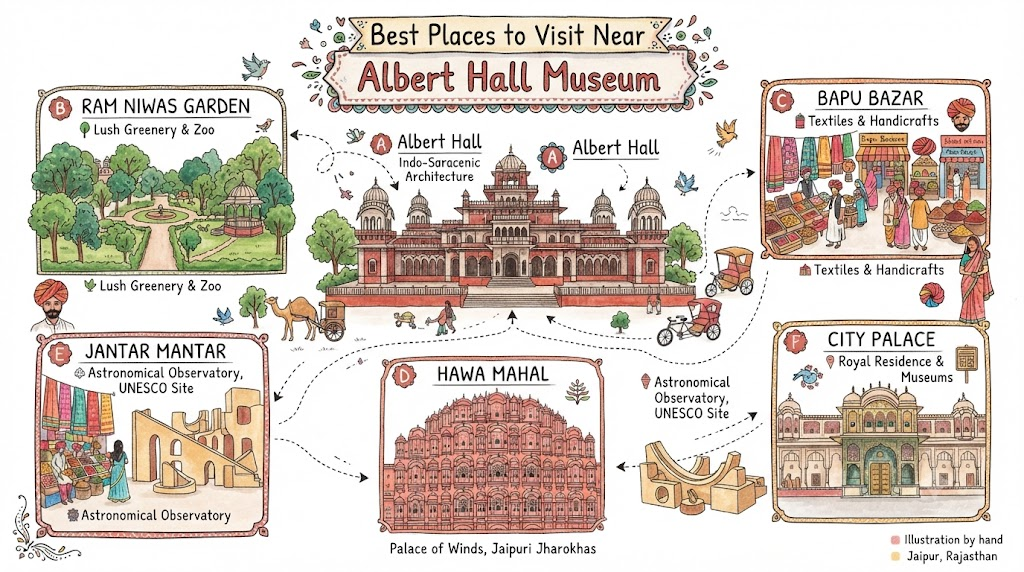
Ram Niwas Garden
Commissioned in 1868 by Maharaja Sawai Ram Singh II as a famine-relief project, Ram Niwas Garden spans over thirty lush acres surrounding the Albert Hall Museum. Originally designed as a sprawling Victorian pleasure ground, this historic green sanctuary still features shaded walking avenues, ancient banyan trees, and ornate colonial-era pavilions.
Strolling through these manicured lawns in the morning mist provides an immediate retreat from urban traffic. Locals gather here at dawn for yoga, classical morning ragas, and laughter clubs, while evening transforms the grounds into a relaxed social promenade bathed in golden lamplight.
- Location: Surrounding Albert Hall Museum, Ram Niwas Bagh, 4.5 km from Jaipur Railway Station.
- Why it is worth visiting: A peaceful green sanctuary that showcases historic landscape architecture and vibrant local public life.
- Best things to do: Walk through historic shaded tree avenues, photograph heritage fountains, and witness the golden evening illumination of the park.
- Best time to visit: Dawn between 6:00 AM and 8:00 AM or dusk around 6:30 PM.
- Ideal for whom: Nature lovers, morning walkers, solo travelers, and families.
- Travel tip: Enter through the northern gates near New Gate for the calmest walking paths away from traffic noise.
Bapu Bazar
Positioned just north of Ram Niwas Garden past New Gate, Bapu Bazar is Jaipur’s most atmospheric market for traditional Rajasthani textiles and leather goods. Flanked by uniform terracotta-pink porticos and wide pedestrian sidewalks, this bazaar offers a sensory feast of colorful textiles, fragrant perfumes, and handcrafted footwear.
The market is famous across India for authentic camel-leather mojris (embroidered slip-on shoes), block-printed Sanganeri bed linens, and lightweight cotton Jaipuri razais (quilts). Walking along these covered colonnades allows you to observe skilled shopkeepers practicing generations-old trading arts.
- Location: Bapu Bazar Road, between New Gate and Sanganeri Gate, 600 meters north of Albert Hall Museum.
- Why it is worth visiting: The premier marketplace in Jaipur for genuine camel-leather footwear, hand-block cottons, and traditional attires.
- Best things to do: Try on handcrafted embroidered mojris, shop for vegetable-dye cotton dress fabrics, and sample authentic street-side falooda kulfi.
- Best time to visit: Late afternoon between 3:00 PM and 6:00 PM when all shops are fully open.
- Ideal for whom: Souvenir hunters, culture lovers, photographers, and textile enthusiasts.
- Travel tip: Bargaining is expected; politely negotiate around twenty to thirty percent below the opening quoted rate.
Hawa Mahal
A short walk further into the walled city leads to the world-renowned “Palace of Winds,” built in 1799 by Maharaja Sawai Pratap Singh. Designed by architect Lal Chand Ustad in the form of Lord Krishna’s crown, this five-story pink and red sandstone facade features 953 intricately carved jharokhas (casements).
The building was engineered so royal women could observe vibrant street life and royal processions without being seen from outside. The sophisticated honeycomb lattice also channeled the Venturi effect, funneling refreshing breezes through the chambers during sweltering desert summers.
Iconic lattice facade of Hawa Mahal.
- Location: Badi Chaupar, J.D.A. Market, Pink City, 1.8 km north of Albert Hall Museum.
- Why it is worth visiting: An architectural feat of passive cooling and one of the finest examples of Rajput-Mughal decorative stonework.
- Best things to do: Climb the narrow internal ramps to the top tier for panoramic city views, inspect the colored stained-glass chambers, and photograph the facade in morning light.
- Best time to visit: Early morning between 8:00 AM and 10:00 AM when sunrise gilds the front facade.
- Ideal for whom: Architecture aficionados, photographers, history buffs, and couples.
- Travel tip: Cross the road to the rooftop cafes on the opposite side for unobstructed eye-level views of the entire palace facade.
Jantar Mantar
Constructed between 1728 and 1734 by the astronomer king Maharaja Sawai Jai Singh II, Jantar Mantar is a UNESCO World Heritage site and the world’s largest stone astronomical observatory. It features nineteen monumental architectural instruments designed to measure time, predict eclipses, and track celestial orbits using stone and marble.
The site is dominated by the Brihat Samrat Yantra, the world’s largest stone sundial, which stands twenty-seven meters tall and measures local solar time with an accuracy of two seconds. Walking through this geometric open-air park feels like stepping into a giant modernist sculpture garden where science meets art.
Ancient astronomical instruments at Jantar Mantar
- Location: Gangori Bazar, near City Palace, 2.2 km north of Albert Hall Museum.
- Why it is worth visiting: The peak of medieval Indian astronomy and geometry, preserved in pristine working condition.
- Best things to do: Check local solar time on the giant Samrat Yantra sundial, inspect the Jai Prakash Yantra hemispherical bowls, and hire an astronomer-guide.
- Best time to visit: Midday around 11:30 AM to 1:30 PM when the sun reaches its zenith and casts clear shadow lines on the dials.
- Ideal for whom: Science buffs, students, history lovers, and intellectual travelers.
- Travel tip: Hire an authorized government-certified guide at the ticket counter to decode the complex mathematical instruments.
City Palace Complex
Occupying a central seventh of the original walled grid, the City Palace was founded by Maharaja Sawai Jai Singh II when he relocated the Kachwaha capital from Amer to Jaipur in 1727. The complex seamlessly blends classical Rajput palatial design, sweeping Mughal arches, and European colonnades.
While part of the palace remains the private residence of Jaipur’s titular royal family, the public museum sections display royal costumes, ceremonial daggers, and historic battle weaponry. The inner Pritam Niwas Chowk courtyard is world-famous for its four painted gateways representing the four seasons.
- Location: Jalebi Chowk, near Jantar Mantar, 2.3 km north of Albert Hall Museum.
- Why it is worth visiting: The ceremonial and administrative heart of the Kachwaha dynasty filled with royal heirlooms and ornate courtyard architecture.
- Best things to do: Admire the Peacock Gate in Pritam Niwas Chowk, marvel at the giant sterling silver urns (Gangajalis) in Diwan-i-Khas, and tour the royal carriage museum.
- Best time to visit: Early morning at 9:30 AM or late afternoon around 3:30 PM.
- Ideal for whom: Heritage travelers, royal history enthusiasts, and luxury sightseers.
- Travel tip: Opt for the composite entry ticket if you plan to explore both royal courtyards and the textile gallery.
Ravindra Manch
Established in the 1960s on the southern edges of Ram Niwas Garden, Ravindra Manch serves as the primary modern epicenter for Jaipur’s vibrant theater, poetry, and classical performing arts scene. Designed to celebrate Nobel Laureate Rabindranath Tagore’s birth centenary, this cultural complex houses modern auditoriums, open-air amphitheaters, and art exhibition halls.
Attending an evening Rajasthani folk dance program or a Hindi play here connects you directly with the city’s contemporary creative community. The open lawns frequently host grassroots painters, book launches, and vocal musicians.
- Location: Southern corner of Ram Niwas Garden, 300 meters from Albert Hall Museum.
- Why it is worth visiting: The best venue in central Jaipur to catch affordable live local theater, Kathak recitals, and regional visual art.
- Best things to do: Catch an evening classical Kathak or folk theater performance, tour rotating contemporary art exhibitions, and mingle with local Jaipur artists.
- Best time to visit: Evenings between 6:00 PM and 8:30 PM when stage performances run.
- Ideal for whom: Theater enthusiasts, cultural travelers, backpackers, and solo creatives.
- Travel tip: Check the notice board outside the foyer in the morning to read the week’s schedule of free or low-cost artistic programs.
Offbeat Exploration: Hidden Gems Tourists Miss
The Egyptian Mummy Chamber of Albert Hall
Most casual tourists snap pictures of Albert Hall’s exterior without venturing into its quiet subterranean galleries. Tucked away on the lower level rests Tutu, an authentic female Egyptian mummy dating from the Ptolemaic period (circa 322–30 BCE). Donated to the museum in 1887, this remarkably preserved relic remains one of only a handful of genuine mummies displayed anywhere on the Indian subcontinent.
Kishanpole Bazar Artisan Marblesmiths
Just northwest of Albert Hall, beyond Ajmeri Gate, lies the stone-carving lane of Kishanpole Bazar. Here, traditional artisans carve detailed marble deities and stone latticework right on the street curb. Watching hammer-and-chisel craftsmen transform raw white Makrana marble into delicate filigree statues offers a fascinating peek into living craft guilds.
New Gate Pigeon Congregation at Sunrise
Every morning at daybreak, the wide plaza separating Albert Hall from New Gate becomes the scene of an age-old local ritual. Hundreds of locals gather to scatter grains for thousands of wild pigeons against the backdrop of pink arches and morning prayer calls. The dramatic flocking flights against the soft pastel sky make for an unforgettable, meditative morning sight.
Detailed Practical Guidance for Travelers
| Destination | Standard Entry Fee | General Timings | Best Local Food Options Nearby | Recommended Nearby Attractions |
|---|---|---|---|---|
| Ram Niwas Garden | Free entry (Park grounds) | 5:00 AM – 10:00 PM Daily | Pandit Kulfi, Shreenath Lassiwala | Albert Hall Museum, Jaipur Zoo grounds |
| Bapu Bazar | Free entry (Shopping market) | 11:00 AM – 9:00 PM Daily | Mahaveer Rabdi Bhandar, Gulab Ji Chai | Johari Bazar, Sanganeri Gate |
| Hawa Mahal | ₹50 (Indians), ₹200 (Foreigners) | 9:00 AM – 5:00 PM Daily | Tattoo Cafe, Wind View Cafe | Jantar Mantar, Sireh Deori Bazaar |
| Jantar Mantar | ₹50 (Indians), ₹200 (Foreigners) | 9:00 AM – 5:00 PM Daily | Midtown Multicuisine, Royal Cafe | City Palace, Govind Dev Ji Temple |
| City Palace | ₹300 (Indians), ₹700 (Foreigners) | 9:30 AM – 5:00 PM Daily | The Palace Cafe, Baradari Fine Dine | Jantar Mantar, Tripolia Bazar |
| Ravindra Manch | Varies by show (Many free) | 10:00 AM – 9:00 PM Daily | Masala Chowk Food Court | Ram Niwas Garden, Albert Hall Museum |
Logistics & On-Ground Navigation
Local Transport Options
- Jaipur Metro: The rapid underground line links Railway Station and Sindhi Camp to Badi Chaupar in the Old City, providing a fast route just a 15-minute walk from Albert Hall.
- Auto-Rickshaws: Green and yellow three-wheelers are ideal for hopping between Ram Niwas Garden and the inner bazaars. Agree on fares beforehand or insist on digital meter rates.
- E-Rickshaws: Battery-powered rickshaws navigate narrow walled lanes smoothly and charge modest hop-on fares of ₹10 to ₹30 per passenger.
- On-Foot Walking: The entire corridor from Albert Hall Museum through New Gate to Bapu Bazar and Hawa Mahal is walkable, flat, and pedestrian-friendly.
Budget Planning
- Backpacker Tier (₹1,200 – ₹2,200 per day): Stay in boutique hostels near MI Road, eat savory kachoris and street thalis at Masala Chowk, walk or take e-rickshaws, and purchase composite monument tickets.
- Mid-Range / Comfort Tier (₹4,500 – ₹8,500 per day): Stay in converted heritage havelis, hire an air-conditioned cab for daily hops, dine at heritage courtyard restaurants, and book certified guided monument tours.
Safety and Inclusivity Tips
- For Families: Stick to the paved pedestrian paths in Ram Niwas Garden and keep children close along busy intersections near Ajmeri Gate.
- For Couples: Morning visits to Jantar Mantar and sunset walks around the illuminated Albert Hall grounds offer tranquil, romantic, and harassment-free environments.
- General Safety: Stay alert around pickpockets in crowded Sunday evening markets at Bapu Bazar, and only drink sealed or filtered water from verified outlets.
Strategic Travel Planning Guardrails
Travel Planning Tips for Jaipur
- Purchase the Composite Entry Ticket: Rajasthan Tourism offers a combined ticket covering Albert Hall, Hawa Mahal, Jantar Mantar, Nahargarh, and Amber Fort at substantial discounts.
- Leverage Evening Light Illuminations: Albert Hall Museum is illuminated after dark with colorful LED floodlights, creating a stunning visual display.
- Embrace UPI Digital Payments: Almost every vendor, from boutique shops to street-side tea stalls, accepts Indian UPI digital payments; keep some backup paper cash for small temple donations.
- Dress for Sacred and Royal Spaces: When visiting royal precincts and inner temples, wear modest attire covering shoulders and knees to show cultural respect.
- Carry Sun Protection: Wide stone courtyards at Jantar Mantar and City Palace reflect glare; always pack sunglasses, sunblock, and a refillable metal water bottle.
Common Mistakes to Avoid
- Over-Packing Single-Day Agendas: Attempting to visit multiple distant hill forts and all inner city palaces in one afternoon leads to fatigue.
- Assuming Fixed Prices in Bazaars: Accepting the first quoted price on street-side handicrafts without gentle bargaining will drain your wallet.
- Relying Solely on Ride-Hailing Cabs in Bazaars: Cars frequently get stuck in narrow Old City gridlock; switch to walking or e-rickshaws inside the gates.
- Skipping Local Street-Level Food: Limiting your meals to standard hotel dining misses the authentic culinary heartbeat of Jaipur.
- Hiring Unverified Street Guides: Avoid touts loitering outside gates; hire only certified guides holding official Rajasthan Department of Tourism ID badges.
Suggested Itinerary Blueprints
Day Quick Dash (Heritage & Bazaar Express)
- Target Audience: Travelers on tight layovers wanting essential cultural highlights within a 5-hour window.
- Morning (8:30 AM – 11:30 AM): Photograph the exterior of Albert Hall, stroll through Ram Niwas Garden, and walk through New Gate into Bapu Bazar.
- Midday (11:30 AM – 1:30 PM): Head to Hawa Mahal for panoramic street views, grab lunch and lassi on MI Road, and complete quick souvenir shopping.
Day Deep-Dive (Royal Art & Living Culture Circuit)
- Day 1: Dedicate the morning to Albert Hall Museum’s interior collections and Ram Niwas Garden. Walk through New Gate into Bapu Bazar for textile shopping, and spend the evening enjoying street food at Masala Chowk.
- Day 2: Spend the morning exploring Jantar Mantar and the City Palace complex. After lunch, visit Hawa Mahal, explore Kishanpole stonecraft lanes, and catch an evening cultural performance at Ravindra Manch.
Complete Weekend Travel Plan (Walled City & Modern Fusion Loop)
- Friday Evening: Arrive, settle into a heritage haveli, and enjoy sunset views and evening LED illuminations around Albert Hall Museum.
- Saturday: Explore Jantar Mantar and City Palace in the morning, browse the historic lanes of Bapu Bazar in the afternoon, and indulge in a Rajasthani thali dinner.
- Sunday: Watch sunrise with the pigeons at New Gate, explore Kishanpole marble workshops, tour the Egyptian mummy gallery at Albert Hall, and finish with evening folk art at Ravindra Manch.
Common Tourist Mistakes to Avoid
- Geographic Blunders: Don’t schedule Amer Fort in the far north and Albert Hall in the south on the same afternoon; group southern garden monuments together.
- Commercial Traps: Don’t waste valuable vacation hours in sanitized modern shopping malls when Jaipur’s living historic bazaars offer authentic handcrafted treasures.
- Neglecting Modern/Alternative Zones: Don’t skip the creative hubs surrounding Albert Hall, such as Ravindra Manch and nearby C-Scheme cafes, which showcase modern Rajasthani life.
- Transport Overpayment: Always check prevailing fares on ride-hailing apps to know fair rates before negotiating with street-side auto drivers.
- Luxury Dining Bias: Eating exclusively in upscale hotels deprives you of legendary local street treats like freshly fried pyaaz kachori and clay-cup kulhad chai.
Frequently Asked Questions
1. What is the distance between Albert Hall Museum and Hawa Mahal?
The distance between Albert Hall Museum and Hawa Mahal is approximately 1.8 kilometers directly north through the walled city. A leisurely walk through Ram Niwas Garden and Bapu Bazar takes around twenty to twenty-five minutes, while an e-rickshaw ride takes less than ten minutes depending on bazaar traffic.
2. Is there a night visit option available for Albert Hall Museum?
Yes, Albert Hall Museum opens for night tourism from 7:00 PM to 10:00 PM under spectacular color-changing floodlights. The night ticket is separate from the day pass, offering a cooler, less crowded experience to admire the Indo-Saracenic architecture alongside illuminated garden fountains.
3. What is Masala Chowk and is it located near Albert Hall Museum?
Masala Chowk is an open-air public food court located directly behind Albert Hall Museum in Ram Niwas Garden. It gathers over twenty legendary street-food vendors from across Jaipur into one hygienic space, serving classics like samosas, kachoris, pav bhaji, and kulfi at very affordable prices.
4. Can I purchase a single composite ticket for all major monuments in Jaipur?
Yes, Rajasthan Tourism offers a convenient composite ticket valid for two consecutive days. It covers entry to Albert Hall Museum, Hawa Mahal, Jantar Mantar, Amber Fort, Nahargarh Fort, and Sisodia Rani Garden, saving travelers significant money and time spent standing in separate ticket queues.
5. How much time is needed to explore Albert Hall Museum and nearby spots?
Exploring the interior galleries of Albert Hall Museum takes roughly one and a half to two hours. To explore surrounding attractions like Ram Niwas Garden, Bapu Bazar, and Masala Chowk comfortably, set aside four to five hours or an entire relaxed half-day.
6. What are the best shopping items to buy in Bapu Bazar near Albert Hall?
Bapu Bazar is famous for traditional camel-leather mojris (embroidered slip-on shoes), vibrant Bandhani and Leheriya tie-dye dupattas, hand-block-printed cotton bedsheets, and Jaipuri razais (cotton quilts). You will also find traditional brass home ornaments, wooden puppets, and handmade lac bangles.
7. Is Jantar Mantar easy to understand without a certified tour guide?
While informational plaques stand beside every astronomical instrument at Jantar Mantar, understanding the complex geometry and solar mathematics is difficult on your own. Hiring a certified government guide or renting an official multilingual audio guide at the entrance makes the scientific visit far more engaging.
8. Are photography and videography permitted inside Albert Hall Museum?
Standard still photography with handheld cameras and mobile smartphones is permitted inside Albert Hall Museum upon paying a nominal camera fee. However, the use of large tripods, external flash units, and commercial video recording gear is restricted without written permission from the archaeology department.
9. Which gate connects Ram Niwas Garden directly with the walled pink city?
New Gate (Naya Pol) connects the northern perimeter of Ram Niwas Garden directly with Bapu Bazar and the historic walled city grid. Built in the mid-20th century to relieve traffic congestion, this wide arched portal provides an easy, direct pedestrian entryway.
10. What is the history behind the famous pigeons outside Albert Hall Museum?
Feeding grain to pigeons outside Albert Hall and New Gate is a daily ritual rooted in Hindu and Jain beliefs in compassion for living beings (Jiva Daya). Local shopkeepers and citizens donate grain sacks at dawn, attracting thousands of birds into a magnificent swirling morning flock.
11. Is parking available for private vehicles near Albert Hall Museum?
Designated paid municipal parking lots are available along the edges of Ram Niwas Garden near Jawaharlal Nehru Marg and the museum entry gates. However, spaces fill quickly on weekend evenings, making ride-hailing cabs, autos, or metro transport far more convenient.
12. What architectural style defines the construction of Albert Hall Museum?
Albert Hall Museum is an exemplary model of the Indo-Saracenic architectural style, designed by British architect Sir Samuel Swinton Jacob. It integrates traditional Mughal domed chhatris, carved Rajput sandstone brackets, intricate courtyard archways, and European Gothic proportions into a cohesive imperial stone masterpiece.
Conclusion
Choosing to explore the historic neighborhoods branching out from Albert Hall Museum rewards travelers with the living, breathing essence of Jaipur. Stepping beyond standard tourist trails into shaded garden avenues, historic astronomical courtyards, and aromatic craft bazaars transforms a simple sightseeing excursion into a timeless cultural adventure that stays with you long after your journey ends.
