Introduction
Many travelers get caught up in an endless loop of overcrowded, commercialized vacation traps. They check off boxes on predictable, crowded itineraries that feel more like a theme park queue than an authentic journey. If you are tired of soulless travel and crave something with deep roots and unmistakable cultural weight, it is time to recalibrate.
Jaipur does not just offer sightseeing; it provides a profound sensory immersion. This is a living, breathing landscape where 18th-century royal heritage seamlessly integrates into everyday life. Stepping into the old quarters means connecting with centuries of architectural mastery, artistic devotion, and a royal lineage that still calls this city home.
Why Jaipur is a Must-Visit City
Jaipur is the foundational heart of Rajasthan’s cultural narrative. Geographically situated as the crown jewel of the Golden Triangle travel circuit—which connects Delhi, Agra, and Jaipur—this historic city serves as an ideal entry point to India’s royal past. Founded in 1727 by Maharaja Sawai Jai Singh II, it stands as one of India’s earliest planned cities. Its iconic pink-hued terracotta walls were painted in 1876 to welcome King Edward VII, cementing its timeless moniker: the Pink City.
Reaching Jaipur is remarkably straightforward for all types of travelers. The city is highly accessible via the Jaipur International Airport, extensive broad-gauge rail networks, and smooth national highways. Whether you are a luxury seeker, a backpacking digital nomad, or a family on holiday, the local hospitality infrastructure caters to everyone. This ranges from atmospheric heritage havelis (restored mansions) to premium modern resorts.
| Metric / Attribute | Regional Travel Detail |
| Ideal Trip Duration | 3 to 4 Full Days |
| Primary Architectural Styles | Indo-Saracenic, Late Mughal, and Traditional Rajput Architecture |
| Best Travel Transit Hubs | Jaipur Junction (JP) Rail Station & Jaipur International Airport (JAI) |
| Peak Tourist Window | October to March (Mild, pleasant winter months) |
Best Places or Experiences
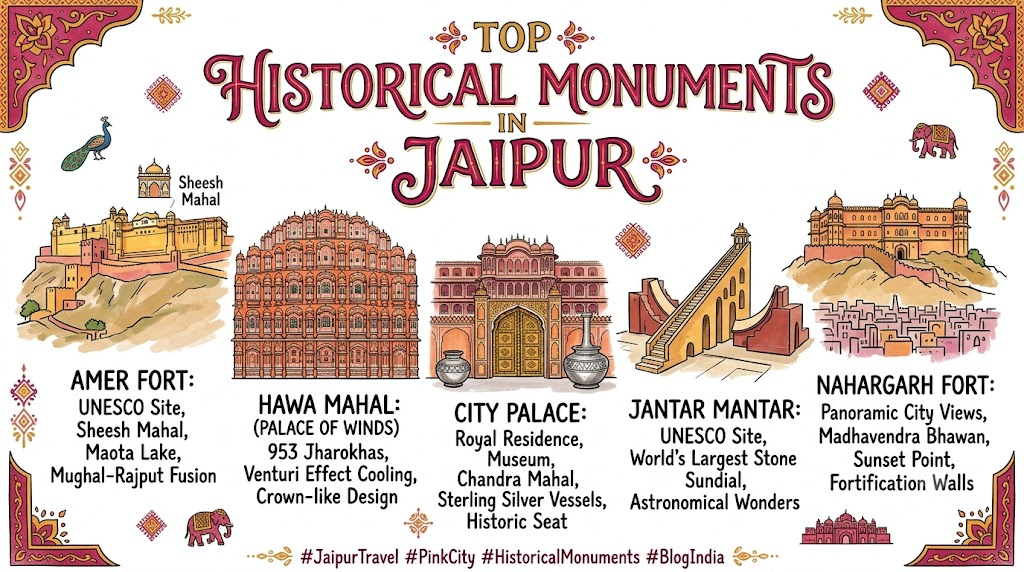
Amer Fort
Amer Fort is an architectural masterpiece that commands the rugged ridges of the Aravalli hills. Constructed out of pale yellow and rose pink sandstone combined with pure white marble, the fortress presents a formidable exterior that conceals an opulent, artistic interior.
Inside, the layout unfolds into majestic ceremonial courtyards, subterranean passages, and grand audience halls. The crowning jewel of the structure is the world-renowned Sheesh Mahal (Mirror Palace). Its walls are embedded with thousands of convex imported Belgian glass mirrors that illuminate an entire hall with the flicker of a single match.
- Location: Amer District, approximately 11 kilometers north of the Jaipur city center.
- Why it is worth visiting: It is a UNESCO World Heritage Site that perfectly fuses Rajput military grit with Mughal artistic refinement.
- Best things to do: Stand inside the shimmering Sheesh Mahal to admire the mirror reflections, walk through the imposing Ganesh Pol gateway, and view the reflection of the fort complex across Maota Lake.
- Best time to visit: Arrive by 8:00 AM to beat the mid-day heat and large crowds, or visit after 6:30 PM for the evening light and sound show.
- Ideal for whom: History buffs, architecture students, and landscape photographers.
- Travel tip: Skip the controversial elephant rides at the base. Instead, take an authorized local jeep or enjoy the brisk 15-minute uphill walk through the historic cobblestone ramparts.
Hawa Mahal
The Hawa Mahal, known as the Palace of Winds, stands as the visual signature of Jaipur. Built in 1799 by Maharaja Sawai Pratap Singh, this striking five-story facade resembles the crown of Lord Krishna.
The structure is famous for its 953 small casements (jharokhas) decorated with intricate latticework. This design created a natural cooling phenomenon known as the Venturi effect, allowing cool air to circulate through the interiors during scorching summers. It also allowed royal women to observe daily street life without being seen by the public.
- Location: Downtown Pink City, right on Hawa Mahal Road, Gangori Bazaar.
- Why it is worth visiting: It is an engineering and architectural wonder featuring a honeycomb facade built without a solid foundation.
- Best things to do: Climb the narrow internal ramps to the top floor for panoramic views of the City Palace, photograph the colored stained-glass windows, and capture the exterior facade from the street-side cafes opposite the monument.
- Best time to visit: Early morning between 9:00 AM and 10:30 AM when the golden sunlight directly hits the front of the palace.
- Ideal for whom: Independent explorers, culture enthusiasts, and avid photographers.
- Travel tip: The famous facade is actually the back of the building. The main entrance is located around the corner to the rear, accessible via the old city alleyways.
City Palace
Positioned at the exact geographic center of the old grid layout, the City Palace is the historic seat of the Maharaja of Jaipur. This sprawling complex is a beautiful blend of Rajput, Mughal, and European design.
Large sections of the palace have been meticulously converted into the Maharaja Sawai Man Singh II Museum. It showcases a rare collection of royal vestments, heavy weaponry, and historic manuscripts. A private wing of the palace, the Chandra Mahal, remains the active private residence of the titular Jaipur royal family.
- Location: Chayan Samiti, Old City, near the Tripolia Gate.
- Why it is worth visiting: It offers an authentic look at the living heritage of a royal family, featuring grand architecture and well-preserved ceremonial spaces.
- Best things to do: Walk through the inner courtyard (Pritam Niwas Chowk) to marvel at the four heavily ornamented gates representing the seasons, and view the massive sterling silver water vessels (Gangajalis) certified by the Guinness Book of World Records.
- Best time to visit: Late afternoon between 3:00 PM and 5:00 PM when the shadows lengthen across the marble courtyards.
- Ideal for whom: Heritage connoisseurs, textile enthusiasts, and families.
- Travel tip: If your budget permits, purchase the premium royal grandeur ticket to access the private upper floors of the Chandra Mahal, including the spectacular blue-and-white Chhavi Niwas.
Jantar Mantar
Jantar Mantar is an open-air astronomical observatory built between 1727 and 1734 by the scholar-king Sawai Jai Singh II. It features 19 monumental architectural instruments constructed from stone and local marble.
These massive structures were built to calculate local time, track the positions of stars, and predict eclipses using only the naked eye. The site houses the Vrihat Samrat Yantra, the world’s largest stone sundial, which stands an impressive 27 meters tall and measures local time with an accuracy of two seconds.
- Location: Directly adjacent to the entry gates of the City Palace complex.
- Why it is worth visiting: A UNESCO World Heritage Site, it is widely considered one of the most innovative and best-preserved historic observatories in the world.
- Best things to do: Watch the shadow move across the face of the Samrat Yantra sundial, explore your astrological sign’s instrument in the Rasivalaya complex, and admire the geometric lines of the stone structures.
- Best time to visit: Mid-day between 11:30 AM and 1:30 PM, when the sun is directly overhead and the shadows on the instruments are sharpest and easiest to read.
- Ideal for whom: Science lovers, math enthusiasts, and travelers who appreciate geometric design.
- Travel tip: These stone structures can look like abstract art without context. Hiring an officially certified local guide is essential to understand how these ancient instruments actually function.
Nahargarh Fort
Perched high on the rugged edge of the Aravalli hills, Nahargarh Fort once formed a fierce defensive ring around Jaipur alongside Amer and Jaigarh. Built in 1734 by Maharaja Sawai Jai Singh II, the fort was primarily designed as a tranquil retreat.
The main attraction here is the Madhavendra Bhawan, a two-story royal pleasure pavilion. It features nine identical, interconnected residential suites built for the king’s nine queens, all designed with beautiful frescoes and private open-air courtyards.
- Location: Atop the Aravalli Hills, a winding 14-kilometer drive up from the main city.
- Why it is worth visiting: It offers unparalleled panoramic views of the entire Jaipur cityscape, framed by historic fortification walls.
- Best things to do: Explore the labyrinthine rooms of Madhavendra Bhawan, walk along the extensive fort ramparts, and visit the deep historic stepwell featured in popular cinema.
- Best time to visit: Late afternoon around 4:00 PM, staying long enough to watch the sunset and see the city light up below.
- Ideal for whom: Couples, groups of friends, and sunset chasers.
- Travel tip: Avoid taking an auto-rickshaw up the steep hill after dark. It is best to hire a round-trip private cab or rent a scooter for a safer return trip down the unlit hill.
Offbeat Exploration: Hidden Gems Tourists Miss
Gaitore Ki Chhatriyan (Royal Gaitor)
Tucked away in a quiet valley at the foothills of Nahargarh, this peaceful complex serves as the historic royal crematorium for the Kachwaha Rajput rulers. While the crowds scramble to the major palaces, this serene site remains blissfully empty. The complex is filled with exquisite white marble cenotaphs (chhatris), each featuring delicate carvings of battle scenes, mythological stories, and geometric patterns that reflect the style of the ruler it honors.
Panna Meena Ka Kund
Located just a few minutes past Amer Fort, this 16th-century historic stepwell is a marvel of ancient water engineering and geometric design. Its symmetrical, criss-crossing yellow stone stairways descend down to a central pool of water. It originally served as a community gathering spot and rainwater harvesting system.
Important Safety Note: To preserve this historic structure, walking down onto the steps is strictly prohibited by local authorities. Security guards monitor the site closely, but you can still capture stunning photographs from the upper viewing platforms.
Detailed Practical Guidance for Travelers
| Destination | Standard Entry Fee | General Timings | Best Local Food Options Nearby | Recommended Nearby Attractions |
| Amer Fort | ₹200 (Indian) / ₹1000 (Foreign) | 8:00 AM – 5:30 PM | 1135 AD (Inside Fort), Jal Mahal Restaurant | Panna Meena Ka Kund, Jaigarh Fort |
| Hawa Mahal | ₹100 (Indian) / ₹600 (Foreign) | 9:00 AM – 5:00 PM | Wind View Cafe, Tattoo Cafe, LMB | City Palace, Johari Bazaar |
| City Palace | ₹300 (Indian) / ₹1000 (Foreign) | 9:30 AM – 6:30 PM | Baradari (In Courtyard), Palace Café | Jantar Mantar, Tripolia Bazaar |
| Jantar Mantar | ₹100 (Indian) / ₹600 (Foreign) | 9:00 AM – 5:00 PM | Rawat Mishtan Bhandar (Short Auto Ride) | City Palace, Hawa Mahal |
| Nahargarh Fort | ₹100 (Indian) / ₹600 (Foreign) | 10:00 AM – 5:30 PM | Padao Restaurant, Once Upon a Time | Jaigarh Fort, Charan Mandir |
Logistics & On-Ground Navigation
Local Transport Options
- E-Rickshaws: These compact electric vehicles are perfect for navigating the tightly packed lanes of the walled Pink City. Always agree on a fare before stepping inside.
- Auto-Rickshaws: Widely available for longer cross-city commutes. It is highly recommended to cross-reference prices on ride-hailing apps to ensure fair pricing.
- App-Based Cabs (Uber/Ola): The safest, most predictable option for traveling to distant hilltop forts like Amer, Jaigarh, and Nahargarh.
- Two-Wheeler Rentals: Renting a scooter or motorbike gives you total freedom to navigate the hill roads at your own pace.
Budget Planning
- Backpacker / Budget Tier (₹1,500 – ₹2,500 per day): Covers a bed in a top-rated social hostel, meals at local street vendors and traditional dhabas, traveling via e-rickshaws, and using a multi-monument composite entry ticket.
- Mid-Range / Comfort Tier (₹5,000 – ₹9,000 per day): Includes a private AC room in a charming heritage haveli, sit-down meals at mid-range restaurants, a private air-conditioned cab rental for the day, and hiring certified local tour guides.
Safety and Inclusivity Tips
- For Families: The large courtyards at Amer Fort and City Palace are stroller-friendly, but the steep steps of Hawa Mahal can be challenging for toddlers and elderly relatives. Keep bottled water handy to stay hydrated.
- For Couples: Enjoy a romantic evening dinner overlooking the lit-up city at Nahargarh Fort, but avoid isolated spots along the city walls after dark.
- General Safety: Beware of aggressive street vendors and unofficial “guides” around the entrances of major monuments. Politely but firmly say no and keep moving.
Strategic Travel Planning Guardrails
Travel Planning Tips for Jaipur
- Buy the Composite Ticket: Instead of paying individual admissions, buy the Rajasthan Tourism composite ticket. This pass gives you access to multiple sites like Amer Fort, Hawa Mahal, Jantar Mantar, and Albert Hall over two consecutive days.
- Keep Cash Handy: While digital payments (UPI) are common in shops, carry physical cash for small purchases, street food vendors, and rickshaw fares.
- Dress Respectfully: Many monuments house active shrines. Keep your shoulders and knees covered, and carry a light scarf to cover your head if needed.
- Stay Hydrated: The dry desert sun can be intense even in the winter. Carry a reusable water bottle during your afternoon walks.
- Hire Certified Guides: Look for guides carrying official identification cards from the Ministry of Tourism to avoid historical misinformation.
Common Mistakes to Avoid
- Overpacking Your Day: Do not try to squeeze more than three major landmarks into a single day. The heat and bustling city traffic can quickly lead to travel fatigue.
- Falling for the “Gem Exhibition” Scam: Be skeptical if an auto driver offers to take you to a “rare, government-approved wholesale jewelry market.” These are often high-pressure commissions traps.
- Visiting Monuments at Mid-day: Wandering open marble courtyards under the midday sun can be exhausting. Plan your outdoor exploration for early mornings or late afternoons.
- Skipping the Local Street Food: Missing out on classic local treats like Pyaaz Kachori at Rawat Mishtan Bhandar or rich lassi served in clay cups at Lassiwala means missing a core part of the city’s soul.
- Forgetting Proper Footwear: You will be doing a lot of walking over uneven stone floors and climbing steep fort pathways. Wear comfortable, broken-in walking shoes or sneakers.
Suggested Itinerary Blueprints
1. One-Day Quick Dash (The Heritage Highlights Route)
Designed for travelers on a tight schedule. Start early at 8:00 AM at Amer Fort before the crowds arrive. Head back into town by 11:30 AM to photograph the front of Hawa Mahal. Enjoy a traditional Rajasthani lunch at a nearby restaurant, then spend your afternoon exploring the City Palace and the stone instruments at Jantar Mantar.
2. Two-Day Deep-Dive (Fortresses & Bazaars Route)
- Day 1: Dedicate your morning to exploring Amer Fort and the nearby Panna Meena Ka Kund stepwell. In the afternoon, dive into the historic markets of Johari Bazaar and Tripolia Bazaar to shop for traditional crafts and textiles.
- Day 2: Start your morning at Hawa Mahal, followed by a detailed tour of the City Palace museum. In the mid-afternoon, take a scenic drive up to Nahargarh Fort to watch the sunset over the city.
3. Complete Weekend Travel Plan (The Royal Legacy Loop)
- Friday Afternoon: Arrive in the city and check into a heritage haveli. Spend a relaxing evening watching a classic Bollywood film at the historic, art-deco Raj Mandir Cinema.
- Saturday: Explore Amer Fort early in the morning, then walk up the connecting ridge to see the massive cannon at Jaigarh Fort. Spend your afternoon browsing the vibrant textile shops in the old city.
- Sunday: Visit Hawa Mahal and Jantar Mantar in the morning. Spend a peaceful afternoon away from the crowds at Gaitore Ki Chhatriyan, and end your trip with an upscale dinner in the inner courtyard of the City Palace.
Common Tourist Mistakes to Avoid
- Geographic Blunders: Do not try to visit the hilltop Amer Fort and the far-off Chokhi Dhani ethnic village on the same afternoon. They are located on opposite sides of the city, and you will spend your vacation stuck in traffic.
- Commercial Traps: Avoid spending your time in modern, air-conditioned shopping malls. The real charm of the city lies in its atmospheric street bazaars, where artisans have practiced block printing and pottery for generations.
- Neglecting Modern/Alternative Zones: Take time to explore beyond the old city walls. Neighborhoods like C-Scheme and Malviya Nagar offer a wonderful mix of quiet tree-lined streets, contemporary indie cafes, and modern art galleries.
- Transport Overpayment: Never accept the first flat rate an auto-rickshaw driver quotes at the train station. Check prices on ride-hailing apps first to know the fair rate, or use a pre-paid transport counter.
- Luxury Dining Bias: While dining in a converted palace is an unforgettable experience, eating only at luxury hotels cuts you off from the city’s authentic food culture. The street vendors in the old city serve incredibly fresh, time-tested local specialties.
Frequently Asked Questions
1. What is the historic composite ticket in Jaipur and how much does it cost?
The composite ticket is an official tourist pass issued by the Department of Archaeology and Museums. It costs approximately ₹450 for Indian nationals and ₹1000 for foreign visitors. The ticket is valid for two consecutive days and grants entry to major attractions including Amer Fort, Hawa Mahal, Jantar Mantar, Albert Hall Museum, Nahargarh Fort, and the royal gardens.
2. Are drones allowed for photography at the historical monuments?
No, flying commercial or recreational drones over historical monuments in Jaipur is strictly prohibited by the Archaeological Survey of India (ASI) for security and preservation reasons. Violating this rule can result in heavy fines and the confiscation of your equipment. Special permits are only granted for approved documentary filmmakers or government projects.
3. Is it possible to explore the interiors of the floating Jal Mahal palace?
No, the interiors of Jal Mahal are completely closed to the general public to protect the delicate ecosystem of Man Sagar Lake and preserve the architectural structure. Visitors cannot take boats to the palace. However, you can stroll along the paved lakeside promenade to photograph the beautiful exterior, especially during sunrise or sunset.
4. What should I do if an auto-rickshaw driver insists on taking me to a shopping market?
Firmly but politely tell the driver, “No shopping, only destination.” This is a common commission trap where drivers receive vouchers or kickbacks simply for bringing tourists into high-priced emporiums. If a driver refuses to go directly to your destination, it is best to step out and book a ride using a ride-hailing app.
5. Which historical monument in Jaipur is best suited for wheelchair users?
The ground-floor courtyards of the City Palace and Jantar Mantar are the most accessible, featuring flat marble pathways and shallow ramps. In contrast, locations like Hawa Mahal and the upper levels of Amer Fort feature steep steps and very narrow corridors that are not suitable for wheelchairs or strollers.
6. Can I visit the historical forts of Jaipur during the night?
Yes, several landmarks offer special evening experiences. Amer Fort opens for “Amer by Night” from 7:00 PM to 10:00 PM, allowing you to see the illuminated courtyards under the stars. Nahargarh Fort also stays open late so visitors can enjoy dinner at its rooftop restaurants while overlooking the lit-up city below.
7. How much time should I plan to spend exploring Amer Fort?
You should budget at least 2.5 to 3 hours to fully explore Amer Fort. The complex is quite large, featuring four distinct courtyards, the expansive Sheesh Mahal, the royal apartments, and hidden subterranean tunnels that are well worth exploring.
8. Is there a strict dress code for entering the historical monuments of Jaipur?
While there is no legal dress code for secular monuments, dressing modestly is highly recommended out of respect for local cultural norms. Loose clothing that covers your shoulders and knees is ideal. If a monument houses an active temple inside—such as the Shila Devi temple at Amer Fort—you will need to remove your shoes and leather items before entering.
9. Are local guides at the entry gates of the monuments reliable?
Only guides carrying an official photo ID card issued by the Ministry of Tourism or Rajasthan Tourism are authorized and reliable. Unlicensed individuals frequently loiter near the entrances offering low rates, but they often share inaccurate history and try to steer tourists toward expensive souvenir shops.
10. What is the best way to get from the Jaipur city center up to Nahargarh Fort?
The most practical option is to hire a round-trip private AC cab or rent a scooter for the day. While auto-rickshaws can drive up the winding hill road, they often struggle with the steep incline and charge high rates for the return trip, especially after dark when the road is unlit.
11. Why are the historical buildings in the old city painted pink?
In 1876, Maharaja Sawai Ram Singh ordered the entire old city to be painted a distinctive terracotta pink—a traditional color symbolizing hospitality—to welcome the visiting Prince of Wales (later King Edward VII). Today, local laws preserve this heritage by requiring shops within the walled old city to maintain this uniform pink color.
12. Is tap water safe to drink while exploring the monuments?
No, tap water is not safe for drinking. Stick to sealed bottled water from reliable local shops, or carry a reusable bottle equipped with a built-in purification filter. Most hotels and fine-dining restaurants provide safe, reverse-osmosis (RO) purified drinking water.
Conclusion
Choosing a thoughtful journey through Jaipur over a generic, hurried vacation is a step toward deeply rewarding travel. Walking the old stone corridors of Amer Fort or watching the evening light soften against the historic walls of Nahargarh connects you to something enduring. This city invites you to slow down, look closely at the details of its ancient stone carvings, and appreciate a vibrant living heritage that continues to thrive well into the modern day.
