Introduction
Beyond the crowded ticket counters and tour-bus convoys of standard urban vacation spots, a remarkably raw countryside unfurls just outside Jaipur’s perimeter. While the walled city dazzles with its painted terracotta gates, the real magic begins where urban noise dissolves into rugged desert hills, crumbling fortress walls, and quiet rural settlements.
Venturing into the surrounding hinterland connects you to centuries of untold folklore, architectural wonders carved from volcanic stone, and expansive salt horizons. This is not passive sightseeing; it is an intimate encounter with ancient trade corridors, forgotten hamlets, and living artisan communities untouched by commercial tourism.
Why Jaipur is a must-visit city
Jaipur stands as the cultural crown of northwestern India, anchoring the legendary Golden Triangle circuit while functioning as the ultimate gateway to Rajasthan’s hinterlands. Geographically positioned against the ancient Aravalli Range, the region balances royal Rajput legacies with pastoral trade routes that linked central India to the Silk Road. Its world-class infrastructure—spanning international air connectivity, high-speed rail corridors, and well-paved national expressways—makes excursions into the countryside seamless for solo backpackers, couples, and traveling families.
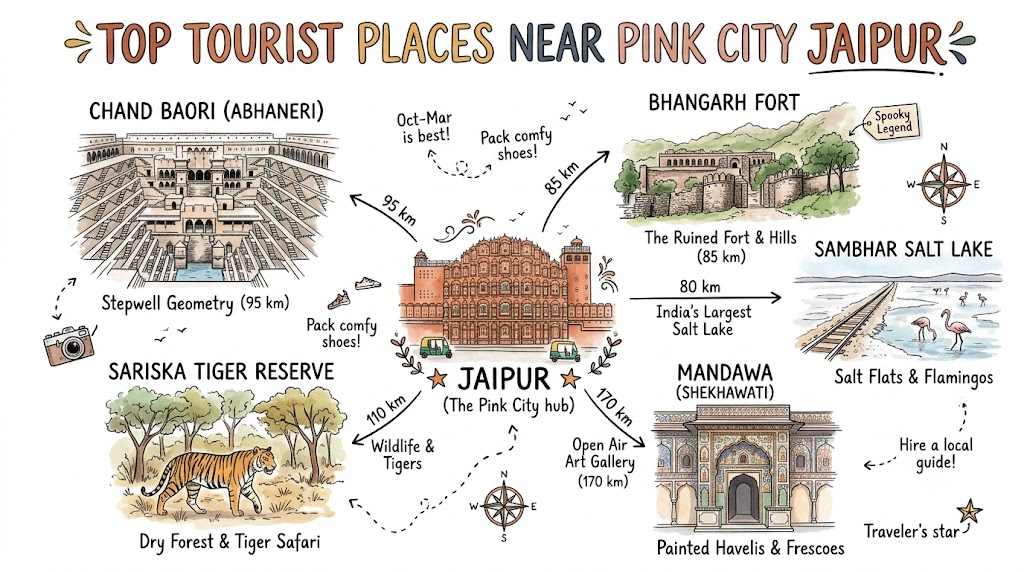
The peripheral travel circuit radiates outwards in three distinct directions: the heritage and stepwell corridor towards Dausa and Alwar to the east, the wildlife and wetland belt towards Sambhar and Ranthambore to the southwest, and the open-air painted havelis of Shekhawati to the north. Travelers can transition effortlessly from five-star heritage palaces to stargazing across white salt flats in under two hours.
| Region / Hub | Key Distance from Jaipur | Primary Appeal | Optimal Travel Window | Recommended Transport |
|---|---|---|---|---|
| Abhaneri (Dausa) | ~95 km East | Ancient Stepwell Architecture & Temples | October to March | Private Cab / Delhi Highway Bus |
| Bhangarh (Alwar) | ~85 km Northeast | Medieval Ruins, Folklore & Forest Scenery | November to February | Rented Vehicle / Day Taxi |
| Sambhar Lake | ~80 km West | Inland Salt Flats, Birdwatching & Camping | October to March | Direct Passenger Train / Private Car |
| Shekhawati (Mandawa) | ~170 km North | Frescoed Merchant Havelis & Open-Air Art | October to March | Express Cab / State Transport Bus |
| Sariska (Alwar) | ~110 km North | Wildlife Safaris, Royal Hunting Lodges | October to April | SUV / Private Hired Cab |
Best Places or Experiences
Chand Baori, Abhaneri
Dating back to the 8th and 9th centuries under the reign of King Chanda of the Nikumbha dynasty, Chand Baori is one of the world’s deepest and most visually mesmerizing stepwells. Carved deep into the earth to capture seasonal monsoon runoffs, this architectural masterstroke consists of 3,500 precisely chiseled stone steps arranged across 13 subterranean tiers. The complex provided a cooling sanctuary for desert travelers, with shaded pavilions, pillared galleries, and intricately carved sculptures of Ganesha and Mahishasuramardini.
Directly adjacent to the stepwell stands the Harshat Mata Temple, a ruined 10th-century shrine dedicated to the goddess of joy and happiness. Walking around the perimeter reveals carved stone fragments depicting classical celestial dancers, geometric pillars, and forgotten sanctums that highlight medieval North Indian temple architecture.
- Location: Abhaneri Village, Dausa District, approximately 95 km east of Jaipur via the Agra Highway (NH 21).
- Why it is worth visiting: It is a marvel of ancient hydraulic engineering featuring mathematical symmetry that changes appearance as the sun shifts.
- Best things to do: Photograph the geometric stair patterns, inspect the carved stone panels inside the subterranean pavilions, and walk through the ruins of Harshat Mata Temple.
- Best time to visit: Early morning between 8:30 AM and 10:30 AM for sharp shadows on the stone steps.
- Ideal for whom: Architecture enthusiasts, photographers, and history buffs.
- Travel tip: Wear sturdy walking footwear with good traction, as the stone perimeter pathways around the surrounding ruins are uneven.
Bhangarh Fort Ruins
Constructed in the late 16th century by Raja Bhagwant Das for his son Madho Singh, Bhangarh Fort sits tucked within a secluded valley flanked by the rugged Aravalli hills. Enclosed within multiple concentric stone walls, the fortified settlement once held bustling market bazaars, grand residential quarters, banyan-shaded courtyards, and remarkably intact stone temples dedicated to Gopinath, Someshwar, and Mangla Devi.
While popular folklore brands it as India’s most haunted site, the true grandeur lies in its preserved medieval town planning and dramatic natural setting. Towering stone bastions and royal palace ruins rise five stories up the hillside, offering panoramic views of the dense forest reserve that now reclaims the valley floor
.
Historic royal ruins inside Bhangarh Fort.
- Location: Rajgarh Tehsil, Alwar District, roughly 85 km northeast of Jaipur via the Dausa-Bhangarh road.
- Why it is worth visiting: A preserved 16th-century fortified township that showcases classical Rajput defensive architecture framed by forested peaks.
- Best things to do: Explore the carved pillars of Gopinath Temple, hike up to the multi-tiered royal palace ruins, and spot langurs playing in the banyan groves.
- Best time to visit: Late afternoon between 3:00 PM and 5:00 PM when the setting sun illuminates the stone ruins in warm amber tones.
- Ideal for whom: Thrill-seekers, folklore enthusiasts, and wilderness lovers.
- Travel tip: The Archaeological Survey of India strictly enforces visitor departure before sunset; ensure you begin exiting by 5:30 PM.
Sambhar Salt Lake
Spanning hundreds of square kilometers across Jaipur and Nagaur districts, Sambhar Salt Lake is India’s largest inland saline lake and a designated Ramsar wetland site. The lakebed stretches into a surreal, blinding-white horizon of salt crusts and evaporating brine pans, punctuated only by century-old narrow-gauge railway tracks used to transport harvested mineral salts.
During the winter months, this quiet saline expanse transforms into a bustling avian refuge, welcoming hundreds of thousands of migratory birds, most notably greater and lesser flamingos. The vast openness, minimal light pollution, and quiet atmosphere make it an exceptional setting for sunset watching and night stargazing
.
Migratory flamingos at Sambhar Salt Lake.
- Location: Sambhar Lake Town, approximately 80 km west of central Jaipur via the Phulera highway corridor.
- Why it is worth visiting: A stark landscape offering blinding white salt flats, historical narrow-gauge salt trains, and thriving flamingo colonies.
- Best things to do: Take a heritage salt train ride through the crystallization pans, spot flamingos near the feeding wetlands, and watch the sun set over the white horizon.
- Best time to visit: November to February for migratory bird sightings and comfortable daytime temperatures.
- Ideal for whom: Nature lovers, astrophotographers, and road-trippers.
- Travel tip: Avoid driving private hatchbacks or standard sedans onto the lakebed, as the soft salt crust can trap standard vehicles.
Painted Havelis of Mandawa (Shekhawati)
Dubbed the world’s largest open-air art gallery, Mandawa was a key trading outpost established in the 18th century along ancient caravan routes. Wealthy Marwari merchants poured their fortunes into constructing sprawling multi-courtyard mansions (havelis), competing to adorn every inch of interior and exterior lime plaster with vibrant, storytelling frescoes.
Wandering the sandy lanes reveals wall murals painted with natural mineral pigments, depicting everything from Hindu mythologies and royal darbars to British steam engines, gramophones, and motor cars. Masterpieces like the Murmuria Haveli, Hanuman Prasad Goenka Haveli, and Chokhani Double Haveli offer a detailed window into the cultural collisions of early 20th-century India
.
Vibrant fresco paintings inside Shekhawati havelis.
- Location: Jhunjhunu District, approximately 170 km north of Jaipur via the Sikar Highway (NH 52).
- Why it is worth visiting: Unmatched concentration of 19th- and 20th-century fresco art covering grand multi-story merchant mansions.
- Best things to do: Tour the frescoed inner courtyards of Murmuria Haveli, take a guided walking tour of Mandawa Bazar, and stay in a converted merchant mansion.
- Best time to visit: October through March during the cool morning and late afternoon hours.
- Ideal for whom: Art lovers, heritage travelers, and cultural researchers.
- Travel tip: Hire a licensed resident guide from the Mandawa town center to gain access to locked privately owned havelis.
Sariska National Park & Alwar Royal Palace
Tucked inside the dry deciduous scrub forests of the northern Aravalli ranges, Sariska National Park is a premier conservation haven renowned for successful tiger relocation programs. The park’s varied terrain includes rocky hills, deep gorges, and dense dhok tree valleys where Royal Bengal tigers share territory with leopards, striped hyenas, sambar deer, and four-horned antelopes.
Deep within the jungle canopy sit historical relics, including the 10th-century Kankwari Fort, where Mughal emperor Aurangzeb imprisoned his elder brother Dara Shikoh. Paired with the nearby Alwar City Palace and the marble Moosi Maharani ki Chhatri, this destination blends wildlife exploration with classical royal architecture.
- Location: Alwar District, roughly 110 km northeast of Jaipur via the Delhi-Jaipur Expressway.
- Why it is worth visiting: Close proximity to Jaipur for tracking big cats in the wild while exploring medieval jungle ruins.
- Best things to do: Book an open-top gypsy safari through Core Zone 1 or 2, explore the cliffside Kankwari Fort, and visit the Moosi Maharani cenotaph.
- Best time to visit: October to April, with peak predator sightings occurring in the warmer months of March and April.
- Ideal for whom: Wildlife photographers, nature lovers, and adventure travelers.
- Travel tip: Reserve official safari vehicle slots well in advance, especially for weekend morning slots.
Offbeat Exploration: Hidden Gems Tourists Miss
Garh Ganesh Temple Trail
Perched on a sharp peak overlooking Jaipur’s northern rim, this 18th-century fortress temple dedicated to Lord Ganesha is reached via a stone staircase. It remains free of tour groups, offering views across the old city ramparts at dawn.
Bagru Hand-Block Printing Workshops
Located 30 km southwest of Jaipur, the village of Bagru is an authentic hub for natural dye textiles. Travelers can walk through community dyeing fields (chhipa mohalla) where artisans use carved wooden blocks and mud-resist (dabu) techniques along the riverbeds.
Sambhar Heritage Salt Train Ride
Few tourists know that you can ride the historic narrow-gauge railway across the salt pans of Sambhar. The small locomotive, originally installed during British rule to pull salt wagons, offers an authentic ride across the vast white flats.
Detailed Practical Guidance for Travelers
| Destination | Standard Entry Fee | General Timings | Best Local Food Options Nearby | Recommended Nearby Attractions |
|---|---|---|---|---|
| Chand Baori (Abhaneri) | ₹25 (Indians) / ₹300 (Foreigners) | Sunrise to Sunset (6:00 AM – 6:00 PM) | Highway dhabas near Sikandra (Pyaaz Pakoda, Masala Chai) | Harshat Mata Temple, Mehandipur Balaji Temple |
| Bhangarh Fort | ₹25 (Indians) / ₹300 (Foreigners) | 6:00 AM – 6:00 PM (Strict closing at dusk) | Local fruit stalls, packaged snacks, dhabas along Dausa bypass | Ajabgarh Fort Ruins, Sariska Southern Edge |
| Sambhar Salt Lake | Free (Train rides carry nominal charges) | Open 24 Hours (Daylight recommended) | Desi Ghee Dal Baati at Phulera town eateries | Shakambhari Devi Temple, Salt Museum |
| Mandawa Havelis | ₹100 – ₹200 per private haveli | 8:00 AM – 6:00 PM | Mandawa Kothi Courtyard Cafe, local Marwari thalis | Castle Mandawa, Nawalgarh Havelis, Fatehpur |
| Sariska National Park | Safari charges vary by gypsy/canter | Morning (6:30 AM – 10:00 AM), Evening (2:00 PM – 5:30 PM) | Sariska Palace Restaurant, highway dhabas on Alwar road | Kankwari Fort, Pandupol Temple, Bhartrihari Temple |
Logistics & On-Ground Navigation
Local Transport Options
- Private Taxi Hire: The most practical and time-efficient method for reaching peripheral sites like Bhangarh, Abhaneri, and Sariska. Booking an 8-hour or 12-hour outstation cab avoids transit delays.
- Self-Drive Car Rentals: Readily available in Jaipur for road trips to Sambhar Lake and Mandawa, where smooth national highways make driving enjoyable.
- Express Trains: Indian Railways operates frequent passenger and express trains from Jaipur Junction to Phulera (for Sambhar Lake) and Alwar Junction (for Sariska and Alwar City).
- State Transport Buses (RSRTC): Budget-friendly express buses leave Sindhi Camp Inter-State Bus Terminal frequently toward Dausa, Alwar, Sikar, and Jhunjhunu.
Budget Planning
- Backpacker Tier (₹1,800 – ₹2,800/day): Travel via state buses or passenger trains, stay in town guest houses or hostels, dine at highway dhabas, and use shared jeeps for last-mile transit.
- Comfort/Mid-Range Tier (₹6,000 – ₹11,000/day): Hire an air-conditioned sedan for the full day, stay in converted heritage properties or countryside resorts, take guided safari drives, and dine at hotel restaurants.
Safety and Inclusivity Tips
- Families: Keep children close around the unprotected edges of ancient stepwells and hilltop fort ruins. Carry plenty of drinking water during daytime excursions.
- Couples: Rural outstation routes are welcoming and scenic, but it is best to wrap up visits to isolated heritage spots like Bhangarh well before twilight.
- General Safety: Watch your belongings around troop-heavy monkey zones near hill temples, and avoid off-roading across untested salt marshes without a four-wheel-drive vehicle.
Strategic Travel Planning Guardrails
Travel Planning Tips for Jaipur
- Book Outstation Taxis Through Verified Agencies: Arrange day-rate drivers via verified local tour desks or established ride apps to guarantee clear mileage billing.
- Carry Physical Currency: Cellular connectivity can drop in deep valleys around Bhangarh and rural Shekhawati; carry sufficient cash for entry tickets and small vendors.
- Dress Modestly for Rural Sites: Village communities surround most historic sites; wearing clothing that covers shoulders and knees respects local cultural norms.
- Pack Sun Protection: Even in winter, direct sunlight across the open salt plains and stone courtyards is strong; bring wide-brim hats, polarized sunglasses, and sunscreen.
- Check Wildlife Booking Schedules Early: Safari allocations for Sariska Tiger Reserve fill up weeks in advance during peak winter weekends.
Common Mistakes to Avoid
- Overpacking Distant Zones: Attempting to combine Sambhar Lake (West) and Abhaneri (East) in a single day wastes hours backtracking through Jaipur city traffic.
- Driving Ordinary Sedans on Salt Flats: Entering the Sambhar lakebed without an all-wheel-drive vehicle frequently results in wheels sinking into deep mud hidden under dry salt.
- Staying Inside Forts After Dark: Respect the Archaeological Survey of India restrictions at Bhangarh Fort; trespassing past sunset carries legal penalties.
- Ignoring Local Street Cuisine: Skipping roadside highway dhabas means missing out on freshly fired tandoori rotis, rustic dal tadka, and steaming clay-cup chai.
- Visiting Heritage Mansions Without a Guide: Walking past the frescoes of Shekhawati without a knowledgeable local narrator means missing the historic context behind the murals.
Suggested Itinerary Blueprints
Day Quick Dash (Eastern Heritage Express)
- Target Audience: Day-trippers seeking maximum architectural impact within 8 to 10 hours.
- Morning (7:30 AM – 11:30 AM): Depart early from Jaipur via the Agra Highway to explore the Chand Baori stepwell and Harshat Mata Temple in Abhaneri.
- Afternoon (12:00 PM – 4:00 PM): Head northwest to Bhangarh Fort, explore the stone ruins, and enjoy a picnic or highway dhaba lunch near Dausa.
- Evening (4:30 PM – 7:00 PM): Return to Jaipur in time for dinner at an open-air rooftop restaurant.
Day Deep-Dive (Wilderness & White Horizons)
- Day 1 (Western Frontier): Depart Jaipur mid-morning for Sambhar Salt Lake. Take the narrow-gauge train ride, photograph migratory flamingos, and witness a white-horizon sunset. Overnight at a heritage camp.
- Day 2 (Northern Forest Trail): Drive northeast through the scenic Aravalli foothills to Sariska National Park. Check into a jungle lodge, embark on an afternoon tiger safari, and return to Jaipur by nightfall.
Complete Weekend Travel Plan (The Grand Royal Loop)
- Friday: Arrive in Jaipur, hire an outstation vehicle, and drive north to Mandawa in Shekhawati. Spend the evening touring Murmuria Haveli and dining in a restored merchant mansion.
- Saturday: Explore the frescoed streets of Nawalgarh and Fatehpur. After lunch, drive south to Sariska Tiger Reserve for an evening campfire and overnight jungle stay.
- Sunday: Take an early morning safari in Sariska, stop by the historical stepwell of Abhaneri on the return leg, and arrive back in Jaipur by Sunday evening.
Common Tourist Mistakes to Avoid
- Geographic Blunders: Grouping destinations located along opposite radial highways on the same day forces you to spend most of your vacation stuck in transit.
- Commercial Traps: Spending precious day hours in souvenir-heavy craft emporiums on the highway rather than visiting authentic artisan villages like Bagru or Abhaneri.
- Neglecting Modern/Alternative Zones: Focusing strictly on walled monuments while ignoring contemporary art galleries, cafe-lined residential pockets, and craft studios in Jaipur’s C-Scheme.
- Transport Overpayment: Agreeing to flat taxi rates without checking standard per-kilometer rates; always confirm whether parking fees, tolls, and driver allowances are included.
- Luxury Dining Bias: Eating only inside upscale international hotels, which deprives you of regional classics like Kadhi Kachori, roasted corn cobs, and local milk sweets.
Frequently Asked Questions
1. What is the most convenient way to travel from Jaipur to Chand Baori in Abhaneri?
The most convenient way to reach Chand Baori is by booking a private outstation taxi via the Jaipur-Agra Highway (NH 21), taking roughly two hours each way. Alternatively, you can take a state transport bus toward Dausa or Sikandra and hire a local auto-rickshaw for the final village stretch.
2. Is Bhangarh Fort actually unsafe to visit during normal daytime hours?
Bhangarh Fort is completely safe to explore throughout standard daylight hours. The area is maintained and monitored by the Archaeological Survey of India. The local safety regulations and warnings apply strictly to the night hours after sunset, when entering the forested ruins is prohibited.
3. What months offer the best flamingo sightings at Sambhar Salt Lake?
The best months to observe migratory greater and lesser flamingos at Sambhar Salt Lake are from November through February. During this winter period, thousands of migratory birds gather across the shallow saline feeding pans, offering prime birdwatching conditions during morning and late afternoon hours.
4. Can tourists drive their personal cars onto the white flats of Sambhar Lake?
Driving private cars directly onto the lakebed is strongly discouraged unless you are operating a dedicated four-wheel-drive vehicle with an experienced local guide. Thin, dry salt crusts often conceal deep, wet mud underneath that can easily trap ordinary passenger cars.
5. How far is the Shekhawati fresco region from central Jaipur?
The main towns of the Shekhawati region, such as Mandawa, Nawalgarh, and Sikar, are located approximately 140 to 170 km north of Jaipur. The drive takes around three to four hours along the well-paved NH 52 expressway, making it an easy weekend excursion.
6. Are entry tickets for Sariska National Park safaris available on the spot?
While limited spot booking counters exist at the Sariska forest gate, tickets for open-top gypsies sell out quickly, particularly on weekends. Booking your safari slots online through the official Rajasthan forest department portal several weeks in advance is the safest approach.
7. Is a day trip to Bhangarh and Abhaneri together feasible from Jaipur?
Yes, pairing Bhangarh Fort and the Abhaneri stepwell into a single day trip is very feasible because both destinations lie in the eastern heritage corridor. Depart Jaipur by 8:00 AM, explore Abhaneri before noon, continue on to Bhangarh by early afternoon, and return comfortably by evening.
8. What should travelers wear when visiting rural temples and stepwells around Jaipur?
Modest, breathable clothing that covers shoulders and knees is recommended when touring rural villages, temples, and stepwells. Sturdy walking shoes with reliable grip are essential for safely navigating uneven flagstones, open ruin trails, and steep stone stairways.
9. Are credit cards and digital payments widely accepted around peripheral sites?
While major ticket counters and highway restaurants accept UPI and debit cards, small village vendors, rural tea stalls, and local rickshaws rely primarily on cash. Travelers should carry sufficient physical cash to cover incidental expenses and rural purchases.
10. What makes the painted havelis of Mandawa architecturally significant?
The havelis of Mandawa are significant because their walls serve as an open-air visual archive of early 20th-century cultural changes. Wealthy merchants commissioned local artists to paint traditional mythological scenes alongside newly introduced European inventions like steam locomotives, airplanes, and gramophones.
11. Can visitors descend the steps inside Chand Baori to touch the water?
Visitors are restricted from walking down the steps to the bottom of the water reservoir for safety and preservation reasons. Viewing galleries, decorated pavilions, and perimeter railings allow clear photographic angles of the steps without compromising the monument’s historical stone framework.
12. What unique regional delicacies should one try while road-tripping around Jaipur?
While traveling along the radial highways, travelers should sample Pyaaz Kachori served with tangy tamarind chutney, steaming Mirchi Vada, freshly churned spiced buttermilk (chaas), and hearty clay-pot Dal Baati Churma prepared with hot clarified butter at local roadside dhabas.
Conclusion
Exploring the historic expanses surrounding Jaipur rewards the traveler with a deeper, more grounded understanding of Rajasthan’s cultural tapestry. Trading predictable, crowded tourist circuits for the geometric depths of ancient stepwells, silent salt flats, and forgotten forest citadels transforms an ordinary vacation into a timeless journey through living history.
