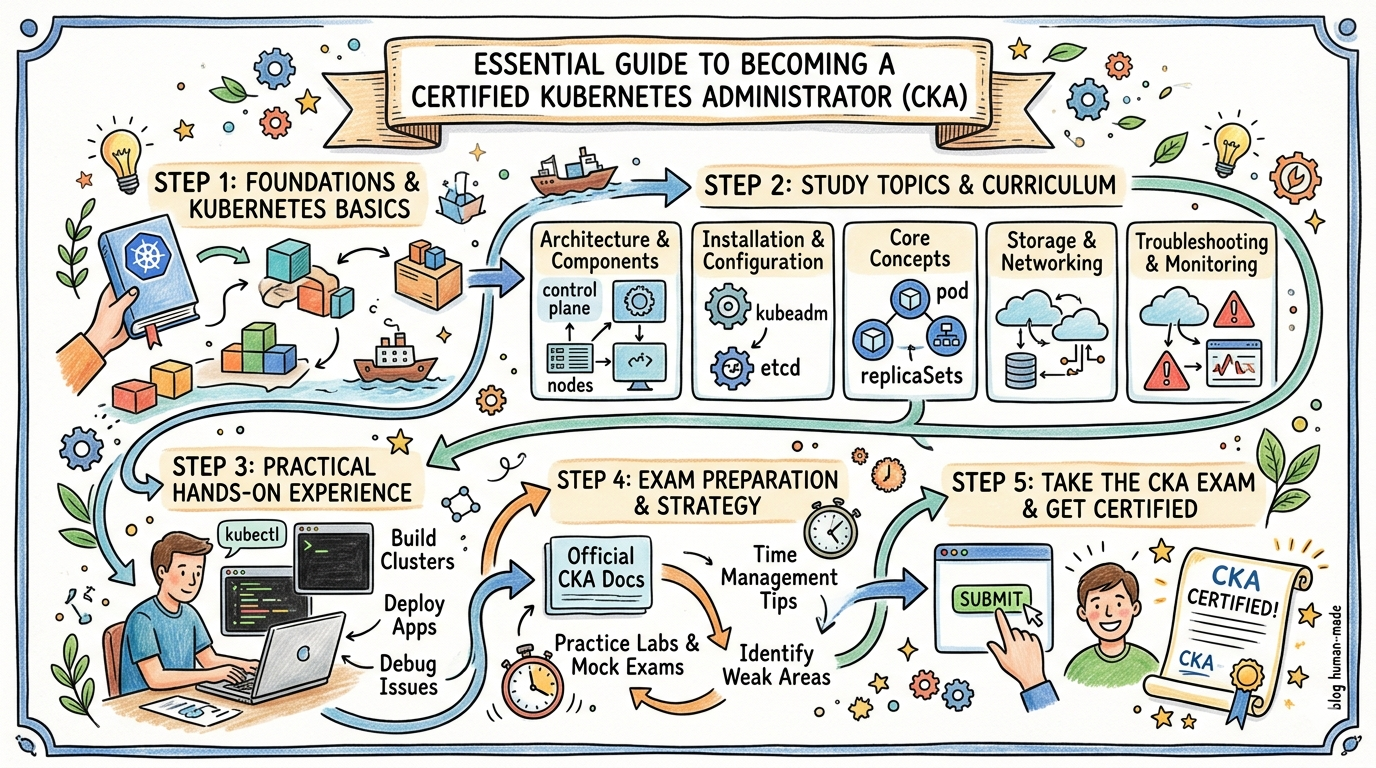
Introduction
The modern enterprise infrastructure landscape has fundamentally shifted toward containerization, making container orchestration an essential engineering discipline. This comprehensive guide to the Certified Kubernetes Administrator (CKA) is designed for cloud professionals, system administrators, and platform engineers aiming to validate their infrastructure management capabilities. As cloud-native architectures become the default standard for global enterprises, understanding how to deploy, manage, and troubleshoot clusters effectively determines operational success. Navigating this landscape requires more than theoretical awareness; it demands proven, hands-on competency to maintain system availability and scale applications efficiently. Whether you are an experienced infrastructure specialist or a software engineer transitioning into platform engineering, this evaluation helps you make informed career choices by mapping technical validation to market demands across the global software ecosystem, including highly specialized tracks like aiopsschool.
What is the Certified Kubernetes Administrator (CKA)?
The Certified Kubernetes Administrator (CKA) is a performance-based certification program designed to evaluate an engineer’s ability to handle the responsibilities of a Kubernetes administrator. Rather than relying on multiple-choice questions, the assessment requires candidates to solve real-world problems directly inside a live command-line environment. This operational focus ensures that individuals who pass the examination can reliably build, configure, expose, and secure enterprise-grade clusters from scratch.
For modern engineering teams, this certification represents a standard of production readiness and technical self-sufficiency. It establishes that a professional understands core cloud-native concepts, networking models, storage provisions, and lifecycle management protocols. Enterprise workflows prioritize minimal downtime and rapid incident response, making the practical troubleshooting skills tested by this program highly valuable for standard corporate environments.
Who Should Pursue Certified Kubernetes Administrator (CKA)?
This program is highly beneficial for DevOps engineers, Site Reliability Engineers (SREs), systems administrators, and platform architects who manage infrastructure pipelines daily. Software developers looking to understand the underlying environment where their applications run will also find immense value in learning these administrative principles. Security compliance officers and data infrastructure engineers can leverage this knowledge to enforce governance and manage stateful distributed systems effectively.
From a career perspective, the program serves professionals across various experience levels, helping system administrators transition into modern cloud engineering roles and assisting senior leaders in designing resilient topologies. The curriculum carries significant global weight, making it highly relevant for engineering markets across North America, Europe, and India’s rapidly growing tech hubs. Organizations managing hybrid cloud operations actively seek these verified validation standards to mitigate deployment risks.
Why Certified Kubernetes Administrator (CKA)
Technology trends move quickly, but core infrastructure patterns such as distributed consensus, declarative state management, and service discovery remain foundational over time. Mastering this orchestration ecosystem provides professionals with an architectural framework that remains relevant even as underlying cloud platforms evolve. The longevity of this knowledge stems from its platform-agnostic design, which functions consistently across various public and private clouds.
Investing time into this curriculum offers a strong return on career progression by qualifying engineers for critical infrastructure roles that command higher organizational influence. It demonstrates a commitment to deep technical mastery rather than superficial tool usage, giving professionals the confidence to handle production outages under pressure. As enterprises scale their microservices, the demand for individuals who can optimize resource utilization and manage cluster costs continues to grow steadily.
Certified Kubernetes Administrator (CKA) Certification Overview
The training programs and assessment preparation modules are delivered through comprehensive learning channels and hosted online to ensure broad accessibility. The certification approach is entirely hands-on, testing practical engineering capabilities through live scenarios where candidates modify system architectures and fix failing components. This performance-based model ensures the credential represents true technical proficiency rather than simple memorization.
The curriculum covers cluster architecture, installation, configuration, workloads, scheduling, services, networking, storage, and comprehensive troubleshooting practices. Managed under rigorous quality standards, the program is updated regularly to align with upstream open-source releases and changing operational methodologies. This structured approach helps engineers develop a systematically organized mental model for administering distributed software at scale.
Certified Kubernetes Administrator (CKA) Certification Tracks & Levels
The cloud-native learning path naturally transitions from initial conceptual understanding to advanced administrative capabilities and specialized security domains. Engineers typically start by learning basic container concepts before moving on to core administration, which focuses on cluster provisioning, networking topologies, and deep troubleshooting. This logical progression ensures that foundational mechanics are thoroughly mastered before tackling more complex design challenges.
As professionals advance, they can explore specialized tracks tailored to specific organizational workflows, such as DevSecOps, advanced site reliability engineering, or performance tuning. Aligning these technical milestones with your career goals helps you systematically move from operational execution to high-level platform architecture. This methodical growth path ensures that engineers remain competent and capable at every stage of their professional journey.
Complete Certified Kubernetes Administrator (CKA) Certification Table
| Track | Level | Who it’s for | Prerequisites | Skills Covered | Recommended Order |
|---|---|---|---|---|---|
| Core Administration | Professional | Systems Administrators, DevOps Engineers, SREs | Basic Linux CLI and Container Fundamentals | Cluster installation, networking configuration, storage provisioning, logging, and troubleshooting | First |
| Security Engineering | Advanced | Cloud Security Engineers, DevSecOps Specialist | Core Administration Competency | Cluster hardening, system auditing, network policies, secrets management, and runtime security | Second |
| Application Delivery | Foundation | Application Developers, Software Engineers | Container usage awareness | Pod design, deployment strategies, state persistence, and basic resource observability | Optional Pre-requisite |
Export to Sheets
Detailed Guide for Each Certified Kubernetes Administrator (CKA) Certification
Certified Kubernetes Administrator (CKA) – Core Administration
What it is
This certification validates an engineer’s competence in managing, configuring, and troubleshooting production-ready clusters, ensuring they can handle day-to-day infrastructure challenges.
Who should take it
Systems administrators, cloud engineers, and DevOps professionals with a working knowledge of container runtimes and Linux command-line operations who want to formalize their infrastructure management skills.
Skills you’ll gain
- Provisioning multi-node control planes and worker nodes from scratch
- Implementing cluster networking models and managing CoreDNS configurations
- Configuring persistent volumes, claims, and storage classes for stateful data
- Diagnosing system component failures, broken nodes, and misconfigured kubelets
- Setting up Role-Based Access Control and managing cluster authentication metrics
Real-world projects you should be able to do
- Build a highly available cluster on bare-metal or cloud infrastructure using kubeadm
- Debug a multi-tier application failing due to network policy restrictions or DNS errors
- Perform a zero-downtime rolling upgrade of a production control plane and runtime nodes
Preparation plan
- 7–14 Days: Focus heavily on mastering imperative commands using the command-line interface and memorizing key documentation paths to locate YAML schemas quickly under time constraints.
- 30 Days: Set up multiple local multi-node environments using virtual machines, practice breaking clusters deliberately, and systematically restore control planes, broken certificates, and failing systemd services.
- 60 Days: Perform timed mock examinations, deeply review complex networking topologies, practice advanced JSONPath filtering for resource inspection, and build custom automation scripts for routine configuration tasks.
Common mistakes
- Spending too much time manually writing complex YAML structures from scratch instead of relying on generator flags
- Neglecting to back up the control plane database prior to executing major upgrade procedures
- Misunderstanding the specific context and namespace requirements when executing commands across different environmental scopes
Best next certification after this
- Same-track option: Advanced Cloud Architecture Specialist
- Cross-track option: Cloud-Native Security Specialist
- Leadership option: Principal Infrastructure Architect
Choose Your Learning Path
DevOps Path
This path focuses on integrating robust orchestration mechanisms directly into continuous deployment pipelines. Engineers learn to automate infrastructure provisioning, orchestrate canary rollouts, and ensure smooth application delivery cycles. The primary objective is to bridge the gap between application development and underlying system resources for faster delivery.
DevSecOps Path
Security must be woven directly into the fabric of the container infrastructure rather than treated as an afterthought. This track teaches professionals how to enforce network isolation policies, implement strict access controls, manage sensitive data safely, and scan images for vulnerabilities. It ensures that automated delivery pipelines maintain compliance without slowing down engineering momentum.
SRE Path
Reliability engineers prioritize cluster stability, automated self-healing capabilities, and clear infrastructure visibility. This path emphasizes configuring detailed logging systems, establishing alert thresholds, managing resource limits, and debugging complex networking anomalies. The ultimate goal is to maintain high availability and minimize incident resolution times in large-scale production environments.
AIOps Path
Modern infrastructure environments generate vast amounts of operational data that require intelligent processing. This path guides engineers on how to deploy machine learning models within clusters to automate anomaly detection, analyze system logs, and predict infrastructure capacity constraints. It helps teams transition from reactive firefighting to proactive, algorithmic system management.
MLOps Path
Deploying machine learning pipelines requires unique infrastructure scaffolding to handle distributed training and heavy compute workloads. This track focuses on orchestrating specialized hardware resources like GPUs, managing large datasets, and running model serving engines efficiently. It bridges the gap between data science workflows and scalable production infrastructure.
DataOps Path
Data pipelines and stateful applications demand specialized storage management and high data throughput configurations. This path teaches engineers how to handle persistent data architectures, manage distributed database deployments, and ensure consistent replication across clusters. It focuses on maintaining data integrity and availability for analytical workloads.
FinOps Path
Operating large-scale cloud infrastructure requires a disciplined approach to resource utilization and cost optimization. This track focuses on identifying underutilized computing blocks, setting up granular resource quotas, and analyzing cluster billing metrics. It helps organizations balance engineering performance with strict budgetary boundaries to maximize cloud investment returns.
Role → Recommended Certified Kubernetes Administrator (CKA) Certifications
| Role | Recommended Certifications |
|---|---|
| DevOps Engineer | Core Administration Certification, GitOps Fundamentals |
| SRE | Core Administration Certification, Advanced Observability Specialist |
| Platform Engineer | Core Administration Certification, Service Mesh Practitioner |
| Cloud Engineer | Core Administration Certification, Multi-Cloud Architecture Suite |
| Security Engineer | Cloud-Native Security Specialist, Compliance Auditor |
| Data Engineer | Core Administration Certification, Distributed Data Systems Manager |
| FinOps Practitioner | Cloud Optimization Specialist, Financial Operations Associate |
| Engineering Manager | Infrastructure Overview Training, Cloud Governance Frameworks |
Export to Sheets
Next Certifications to Take After Certified Kubernetes Administrator (CKA)
Same Track Progression
After securing the core administrative credentials, engineers should pursue deep technical specialization within the cloud-native ecosystem. This includes mastering service mesh architectures, implementing advanced ingress controllers, and designing multi-cluster management strategies across hybrid geographical regions. Focus your learning on advanced automation tooling that scales infrastructure operations without adding significant management overhead.
Cross-Track Expansion
Broadening your skillset requires exploring complementary domains such as Infrastructure as Code (IaC) and comprehensive system monitoring frameworks. Learning tools that automate underlying cloud hardware provisioning allows you to control the entire infrastructure lifecycle from bare hardware to running applications. Combining orchestration skills with advanced data analysis capabilities makes you a versatile asset for modern engineering organizations.
Leadership & Management Track
Transitioning into engineering leadership requires moving away from daily command-line operations toward architectural strategy, governance, and financial responsibility. Aspiring technical leaders should focus on cloud governance structures, enterprise risk management, and team capacity planning frameworks. This ensures you can align complex infrastructure investments with broader corporate goals and business metrics.
Training & Certification Support Providers for Certified Kubernetes Administrator (CKA)
DevOpsSchool provides comprehensive, instructor-led training modules focused heavily on practical execution and live lab environments. Their curriculum is carefully structured to guide professionals systematically through complex administration topics, offering detailed mentorship and real-world troubleshooting scenarios that simulate enterprise production environments.
Cotocus specializes in delivering targeted bootcamps designed for working professionals who need to build operational competency quickly. Their training programs emphasize core architectural mechanics, helping candidates develop the practical skills necessary to manage production infrastructure confidently and efficiently.
Scmgalaxy offers a rich repository of learning resources, documentation breakdowns, and community-driven insights aimed at cloud engineering professionals. Their support materials focus on practical implementation patterns, making it easier for candidates to bridge the gap between theoretical guidelines and day-to-day engineering workflows.
BestDevOps focuses on delivering high-impact, hands-on instructional courses tailored specifically to modern platform engineering practices. Their training tracks prioritize production-grade projects, ensuring that engineers understand the real-world implications of configuration choices and architectural designs.
devsecopsschool integrates critical security paradigms directly into foundational infrastructure administration training tracks. Their specialized modules ensure that engineers learn how to secure container environments, implement access controls, and maintain strict compliance standards throughout the application lifecycle.
sreschool centers its educational framework around system reliability, advanced debugging practices, and performance tuning methodologies. Their courses prepare professionals to handle large-scale system degradation, implement automated self-healing mechanisms, and maintain high operational uptime under heavy workloads.
aiopsschool focuses on the intersection of modern system administration and automated operational intelligence frameworks. Their training pathways help forward-looking engineers implement machine learning models to analyze logs, predict system bottlenecks, and automate routine administrative tasks.
dataopsschool delivers specialized training focused on managing stateful distributed applications and large data processing pipelines within container ecosystems. Their curriculum addresses the unique challenges of data persistence, replication, and storage performance optimization across enterprise infrastructure.
finopsschool addresses the critical need for financial accountability and resource optimization within cloud-native architectures. Their programs teach engineers and financial managers how to monitor cluster expenditures, eliminate resource waste, and design cost-effective deployment patterns.
Frequently Asked Questions (General)
- What is the primary format of performance-based technical examinations?
The evaluation takes place within a live, command-line environment where candidates must solve actual configuration and troubleshooting tasks on real clusters within a designated timeframe. - How long does a typical professional infrastructure validation remain active?
Most technical credentials in the cloud-native space are valid for a period of two to three years, requiring professionals to recertify to stay aligned with current software releases. - Are there any mandatory technical prerequisites required before taking the core examination? There are no formal prerequisite credentials required, but a strong foundational understanding of Linux administration and container concepts is highly recommended for success.
- How much time should a working professional allocate for thorough preparation?
Depending on prior hands-on experience, most professionals require between thirty to sixty days of consistent study and practical lab exercise execution to prepare adequately. - Can the assessment be taken remotely, or does it require an in-person testing center?
The evaluation can be taken online from any private location that meets the specific environment and proctoring security criteria established by the hosting provider. - What happens if a candidate fails the practical evaluation on their initial attempt?
Most registration programs include a retake option within the original purchase, allowing candidates to review their weak areas and attempt the practical examination again. - How does practical validation impact compensation trends for engineering professionals? Verifiable hands-on technical skills consistently correlate with higher salary offers and faster career advancement into senior platform engineering and architecture roles.
- Are documentation resources accessible to candidates during the live assessment?
Candidates are generally permitted to open a limited number of browser tabs to access the official open-source documentation for reference during the performance-based test. - Why do companies prefer performance-based credentials over multiple-choice evaluations? Performance-based assessments prove that an engineer can actually write valid configurations and fix broken systems in real time, rather than just memorizing facts.
- What are the foundational computing skills required to start learning orchestration tools? Professionals should have a solid grasp of basic networking concepts, secure shell operations, command-line text editors, and general operating system mechanics.
- How regularly is the underlying software version updated for the certification track?
The testing environment is typically updated multiple times a year to stay closely aligned with recent stable upstream open-source releases. - Is it beneficial for software developers to obtain infrastructure-focused credentials?
Yes, understanding administrative constraints helps developers write more resilient, cloud-native applications that match production environment behaviors perfectly.
FAQs on Certified Kubernetes Administrator (CKA)
- How difficult is the CKA examination compared to traditional cloud certifications?
The assessment is widely considered challenging because it completely avoids multiple-choice questions in favor of real-world troubleshooting scenarios. Candidates must interact directly with live system components, modify YAML configuration files under time pressure, and fix broken cluster systems. This setup tests actual engineering capabilities rather than simple memorization, meaning you must be fast and comfortable with the command line to finish all tasks within the two-hour limit. - Can I pass the CKA certification by studying theoretical concepts without practical labs?
No, passing this evaluation without extensive hands-on experience is virtually impossible. Because the testing interface requires you to resolve real cluster issues, configure network components, and deploy actual workloads, theoretical knowledge alone will not suffice. Success requires a deep familiarity with imperative command patterns and regular practice in live sandbox environments to build muscle memory for fixing broken control plane components. - What specific version of Kubernetes is used during the practical assessment environment?
The examination environment updates regularly to reflect recent upstream open-source stable releases, usually trailing the current release by a few months. It is important to practice your administration techniques on the specific version listed in the current exam guidelines, as command flags and API groups can change slightly between minor versions. Staying updated ensures your syntax remains fully compatible during the test. - How does the CKA certification differ from the Certified Kubernetes Application Developer (CKAD) program?
While both programs require hands-on command-line work, they target completely different engineering functions. The CKAD focuses on application design, pod deployment strategies, and managing resource constraints from a developer’s point of view. In contrast, the CKA covers core infrastructure administration, cluster installation, networking setups, security management, and deep troubleshooting of the underlying control plane nodes. - What is the significance of mastering JSONPath expressions for the CKA examination? JSONPath filtering is incredibly valuable for querying complex resource outputs quickly under strict exam time limits. You will often need to filter specific data—such as internal IP addresses from a long list of cluster nodes—and output those results into specific files. Master these filtering syntax patterns during your preparation to save valuable time that would otherwise be wasted scanning long outputs manually.
- Is a background in Linux systems administration necessary to succeed in CKA?
A solid understanding of Linux fundamentals is critical because the entire orchestration ecosystem runs on Linux architectures. You must be comfortable managing systemd services, inspecting system logs via journalctl, modifying files with vim or nano, and troubleshooting network interfaces. Lacking these core operating system skills will make navigating the troubleshooting and cluster assembly portions of the test much harder. - How does earning the CKA credential impact my career options in platform engineering? Securing this credential officially validates your ability to manage complex production workloads, making you a strong candidate for senior DevOps, SRE, and platform engineering roles. Enterprises look for this specific validation because it proves an engineer can handle critical infrastructure outages independently. It acts as an objective industry standard that sets your technical profile apart in competitive hiring environments.
- What strategy should I use to manage my time effectively during the CKA test?
Time management is key to passing the exam. Avoid getting stuck on a single high-difficulty troubleshooting question; instead, use the flagging feature to mark complex tasks and move on to simpler configuration prompts. Focus on generating clean YAML files using imperative command flags rather than writing them out manually, and ensure you are working in the correct cluster context and namespace before executing changes.
Final Thoughts: Is Certified Kubernetes Administrator (CKA) Worth It?
Investing the time and effort required to clear the Certified Kubernetes Administrator program is a practical choice for any serious infrastructure professional. The industry has moved decisively past basic virtualization toward containerized architectures, and Kubernetes sits squarely at the center of this shift. This performance-based credential offers lasting career value by verifying that you can handle real-world operational pressure, design resilient clusters, and fix critical system failures.
Rather than chasing superficial technology buzzwords, completing this curriculum builds a deep, practical understanding of distributed systems architecture. It transforms the way you approach system reliability, infrastructure automation, and platform security. For engineers committed to mastering modern cloud-native systems, this path provides a clear, reliable, and highly respected route to long-term professional growth.
