Introduction
Welcome to Jaipur, the legendary Pink City of India, where historic grandeur seamlessly blends with a bustling modern lifestyle. If you are preparing for your first journey here, you might be wondering what makes this city so deeply fascinating. Many travelers mistake Rajasthan’s capital for just another dusty historic stop, but Jaipur is far more diverse. Think of it as an interactive cultural playground. While cities like Goa or Mumbai are celebrated for their beaches and nightlife, Jaipur charms its visitors with deep-rooted culture, stark mountain nature, incredible culinary scenes, high-altitude desert adventure, peaceful royal gardens, and vibrant local experiences.
Whether you are checking into a luxury heritage hotel with your partner, exploring busy ancient alleyways as a solo traveler, traveling with an active family, backpacking on a tight budget, or planning a quick weekend escape, this Jaipur travel guide is built for you. Let’s look at how to navigate this royal destination smoothly.
Why Jaipur is a Must-Visit City
Jaipur is the crown jewel of India’s famous Golden Triangle tourist circuit (which includes Delhi and Agra). For a first-time visitor, it offers an accessible window into royal India. Architecturally, it is legendary: the old city walls were painted pink in 1876 to welcome Britain’s Prince of Wales, a traditional color symbolizing hospitality that remains strictly preserved today.
Practically speaking, Jaipur is highly traveler-focused. Its grid-like layout in the old city makes navigation remarkably straightforward compared to other historic Indian hubs. The city caters effortlessly to all travel styles: from pocket-friendly street food tours and affordable hostels for backpackers to magnificent palace complexes perfect for family sightseeing and romantic candlelit dinners for couples. It serves as a perfect blend of old-world royalty and efficient modern infrastructure.
Best Places or Experiences Related to the Topic
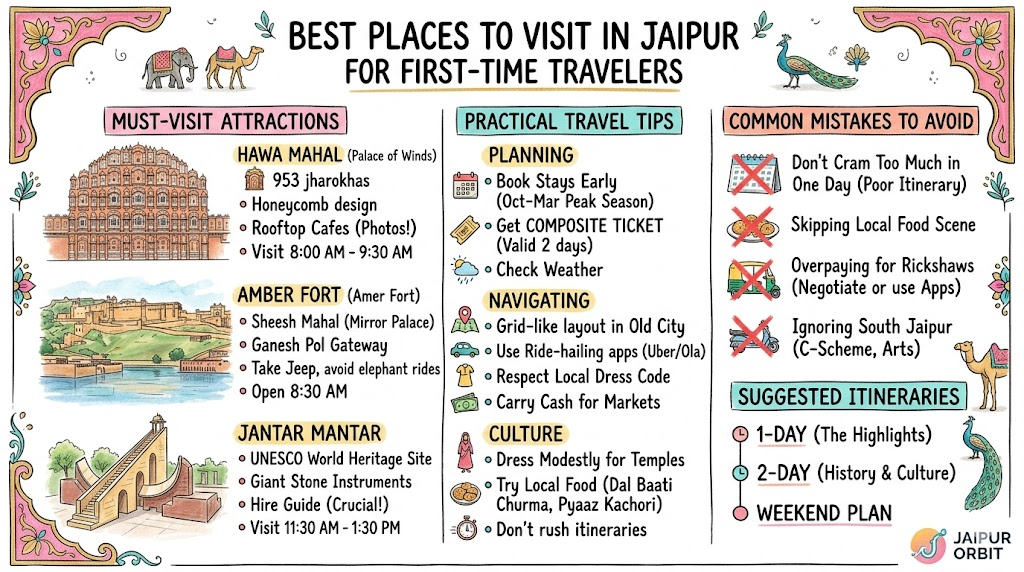
1. Hawa Mahal (The Palace of Winds)
Location
Hawa Mahal Road, Badi Choupad, J D A Market, Pink City, Jaipur.
Why it is worth visiting
This extraordinary five-story pyramid-shaped building looks like an intricate honeycomb. Built in 1799, it features 953 small windows called jharokhas decorated with complex latticework. It was designed so royal women could observe daily street life below without being seen themselves, while a unique architectural design allowed cool air to circulate naturally throughout the interior.
Best things to do
- Walk inside to see how the colored glass windows project vibrant light patterns across the inner corridors.
- Climb up the narrow ramps to the top floor for an open view over the old Pink City marketplace.
- Cross the street to one of the rooftop cafes (like Wind View Cafe or Tattoo Cafe) to take a classic photo of the pink facade.
Best time to visit
Early morning (8:00 AM to 9:30 AM). The morning sun hits the front of the building perfectly, making it ideal for photography before traffic gets heavy.
Ideal for whom
Photographers, culture lovers, architecture enthusiasts, and solo travelers tracking iconic city sights.
Travel tip
The entrance to the inside of Hawa Mahal is located at the back of the building, not the front facing the main street. Walk around through the side alley near the intersection to find the ticket booth.
- Entry Fees: ~INR 100 for Indians, ~INR 600 for Foreigners. (Tip: It is also included in the multi-site Jaipur Composite Ticket).
- Nearby Attractions: City Palace and Jantar Mantar are just a 5-minute walk away.
- Food Options: Enjoy traditional sweet Lassi at the nearby shops or grab a quick coffee at the rooftop cafes right across the street.
2. Amber Fort (Amer Fort)
Location
Devisinghpura, Amer, Jaipur (roughly 11 kilometers north of the main city center).
Why it is worth visiting
Situated dramatically on a rugged hill overlooking Maota Lake, Amber Fort is a massive defensive complex built from yellow and pink sandstone. It showcases a magnificent mix of Rajput Hindu and Mughal Muslim architectural styles. The interior features opulent royal halls, hidden subterranean passages, and panoramic mountain views.
Best things to do
- Explore the stunning Sheesh Mahal (Mirror Palace), where walls are covered in thousands of hand-cut concave mirrors imported from Belgium centuries ago.
- Walk through the massive Ganesh Pol, a highly decorated gateway painted with natural vegetable dyes that remain bright today.
- Take a government-operated jeep ride up the cobblestone ramparts to the main courtyard entrance.
Best time to visit
8:30 AM right when it opens to beat the midday heat and heavy tour crowds, or late afternoon to catch the sunset over the hills.
Ideal for whom
Families with children, couples looking for spectacular backdrops, history enthusiasts, and weekend travelers.
Travel tip
Avoid taking elephant rides up to the fort due to long-standing animal welfare concerns. Opt instead for the certified, fixed-price RTDC (Rajasthan Tourism) jeeps available at the lower parking area, or enjoy the beautiful 15-minute uphill walk.
- Entry Fees: ~INR 200 for Indians, ~INR 1000 for Foreigners.
- Nearby Attractions: Panna Meena Kund (an ancient stepwell) and the historic Jagat Shiromani Temple sit just behind the fort hills.
- Food Options: Dine like royalty at 1135 AD, an upscale restaurant located inside the fort walls, or grab local snacks at the cafes near the lower lake parking.
3. Jantar Mantar
Location
Gangori Bazaar, Pink City, Jaipur (adjacent to the City Palace entrance).
Why it is write visiting
A dedicated UNESCO World Heritage Site, Jantar Mantar is a collection of nineteen architectural astronomical instruments built by King Sawai Jai Singh II in 1734. It features the world’s largest stone sundial, which can calculate local time to an accuracy of just two seconds. It looks less like a historic monument and more like an open-air park filled with giant, futuristic geometric sculptures.
Best things to do
- Watch how the shadow moves across the massive stone scales of the Vrihat Samrat Yantra to track the precise local time.
- Discover your personal zodiac sign instrument among the twelve Rasivalaya structures designed to track constellations.
- Hire a certified local guide to explain how these 18th-century stone structures still calculate eclipses and track planetary alignments perfectly.
Best time to visit
Between 11:30 AM and 1:30 PM. The midday sun shines directly overhead, casting minimal shadows and making it much easier to understand how the astronomical instruments work.
Ideal for whom
Families traveling with curious kids, science enthusiasts, backpackers, and solo travelers.
Travel tip
Do not try to explore Jantar Mantar without a guide or an audio guide. Without an explanation, the monuments will look like random concrete blocks. A certified guide costs around INR 400 for a small group and changes the entire experience.
- Entry Fees: ~INR 100 for Indians, ~INR 600 for Foreigners.
- Nearby Attractions: The City Palace complex is right next door.
- Food Options: Walk over to the nearby street vendors for fresh lime sodas to stay hydrated during your outdoor tour.
Travel Planning Tips for Jaipur
To make sure your trip goes smoothly without any unexpected hiccups, keep these practical tips in mind:
- Book Stays Early During Peak Season: The prime time to visit Jaipur is from October to March when the weather is cool and pleasant. Heritage hotels, boutique Havelis, and popular backpacker hostels fill up months in advance, so lock in your reservations early.
- Rent Scooters Only with Proper Documents: Exploring Jaipur on a scooter is a great option for solo travelers and backpackers. Rent only from licensed agencies and always carry your physical driver’s license. Be careful, as driving in the old city center can feel chaotic to first-timers.
- Respect Local Culture and Environment: Jaipur is a historic city with deeply traditional roots. Dress modestly when visiting religious temples or active royal heritage spots by keeping your shoulders and knees covered.
- Carry Cash for Local Markets: While digital payments (like UPI) and credit cards are widely accepted in modern stores and restaurants, small market vendors in Johari Bazaar and Babu Bazaar still prefer paper cash for small purchases and souvenir bargaining.
- Opt for the Composite Ticket: If you plan on visiting multiple monuments over a couple of days, do not buy individual entry tickets. Ask for the Jaipur Composite Ticket at your first stop. It costs around INR 420 for Indians and INR 1100 for Foreigners, remains valid for two consecutive days, and grants entry to Hawa Mahal, Amber Fort, Nahargarh Fort, Albert Hall Museum, and Jantar Mantar.
Common Mistakes to Avoid
- Poor Itinerary Planning: First-time travelers often try to cram Amber Fort, City Palace, Hawa Mahal, Jantar Mantar, and shopping into a single afternoon. This leaves you exhausted and rushed. Break your days up by geographic zones.
- Ignoring South Jaipur: Many tourists focus entirely on the historic North Jaipur travel guide circuit (like Amer and the walled city) while completely skipping the trendy, creative spaces in South Jaipur, such as Jawahar Kala Kendra or the cafes in C-Scheme.
- Overpaying for Local Rentals and Rickshaws: Auto-rickshaws waiting directly outside major monument exits often quote highly inflated prices to tourists. Use app-based ride services like Uber or Ola to check standard rates first, or walk a block away from the gates to catch a moving rickshaw for a fairer price.
- Skipping the Local Food Scene: Don’t rely solely on continental hotel buffets. Jaipur’s culinary scene is an unforgettable highlight of Rajasthan. Missing out on authentic local street food is a missed travel opportunity.
Suggested Jaipur Itinerary Angle
Here is how you can easily structure your days based on how much time you have available:
1-Day Plan (The Highlights)
- Morning: Arrive early at Hawa Mahal for photographs, then head straight to Amber Fort before the crowds peak.
- Afternoon: Return to the walled city to visit the City Palace and explore the astronomical wonders of Jantar Mantar.
- Evening: Enjoy a traditional Rajasthani dinner at a rooftop restaurant overlooking the illuminated city skyline.
2-Day Plan (History and Culture)
- Day 1: Follow the 1-day plan above for the primary royal landmarks.
- Day 2: Start your morning at the Albert Hall Museum, followed by a street food walk through the old markets. In the late afternoon, head up the winding mountain roads to Nahargarh Fort to watch a stunning sunset over the entire valley.
Weekend Travel Plan (The Complete Walled City Experience)
- Friday Evening: Arrive, settle into a traditional heritage property, and visit Chokhi Dhani for an immersive cultural village dance and dining experience.
- Saturday: Spend your day exploring the North Jaipur heritage track (Amber Fort, Panna Meena Stepwell, and a lakeside photo stop at Jal Mahal). Spend your evening shopping for textiles and jewelry in Johari Bazaar.
- Sunday: Take a peaceful early morning walk through the Jaipur Flower Market (Phool Mandi), visit Jantar Mantar, and spend your afternoon relaxing at a boutique cafe in C-Scheme before your departure.
FAQs
1. What is the best month to visit Jaipur for a vacation?
The ideal months to visit are between October and March. The weather during this period is pleasant and dry, making it comfortable to walk around outdoor forts and open marketplaces without dealing with intense summer heat.
2. Is Jaipur a safe destination for solo female travelers?
Yes, Jaipur is generally safe for solo female travelers. Tourism is a primary industry here, and locals are helpful. Stick to well-lit public areas at night, use trusted ride-hailing apps for transport, and dress respectfully to avoid unwanted attention.
3. What is the Jaipur Composite Ticket and how does it work?
It is a single smart ticket issued by the Department of Archaeology and Museums. It covers entry to multiple attractions—including Amber Fort, Hawa Mahal, Jantar Mantar, Nahargarh Fort, and Albert Hall Museum. It is valid for two consecutive days, saving you money and time spent waiting in ticket lines.
4. Can you go inside the Jal Mahal (Water Palace)?
No, visitors are not allowed to go inside the palace structure itself, as it is closed to the general public. However, you can park along the lakeside promenade to take photographs and enjoy the view of the palace sitting in the middle of Man Sagar Lake.
5. What are the best things to buy when shopping in Jaipur?
Jaipur is famous for its blue pottery, hand-block printed cotton textiles, traditional leather shoes (juttis), silver jewelry, and precious gemstones found in markets like Babu Bazaar and Johari Bazaar.
6. How many days are enough to see the best places to visit in Jaipur?
For a first-time visitor, a 2 to 3-day itinerary is perfect. It gives you enough time to tour the major forts, explore the old walled city palaces, sample local food, and shop without feeling rushed.
7. What is the signature local dish I must try in Jaipur?
You should definitely try Dal Baati Churma (baked round wheat breads served with a rich lentil curry and sweet crushed wheat side). For street food snacks, try the famous Pyaaz Kachori (savory fried onion pastries) at Rawat Mishtan Bhandar.
8. What are the main options for local transport within the city?
You can easily find auto-rickshaws, e-rickshaws, and local cycle rickshaws for short distances. For longer rides, app-based cabs like Uber and Ola are widely available, safe, and offer transparent pricing.
9. Are Jaipur’s historical monuments accessible for families traveling with elderly members?
Many major sites like the City Palace and Jantar Mantar have flat walkways and accessible ground floors. However, hill forts like Amber Fort and Nahargarh involve some steep walking paths and uneven cobblestones, so taking a golf cart or jeep ride is highly recommended.
10. Do I need to hire a tour guide at every monument in Jaipur?
It isn’t mandatory, but hiring an official guide or renting an audio guide is very helpful for places like Jantar Mantar and Amber Fort, where the history and architectural details are complex. Always verify that your guide carries an official Ministry of Tourism ID card.
Conclusion
Jaipur is a captivating destination that rewards travelers who slow down and look beyond the basic tourist spots. By planning your days by geographic zones, utilizing the composite ticket, and diving into the local food scene, you can easily avoid the typical tourist crowds and create an unforgettable trip.
When you begin your Jaipur trip planning, look to Jaipurorbit.com as your trusted local travel companion. Our platform helps you make smarter travel choices, discover hidden corners of the city, find authentic food spots, and design a balanced itinerary. Pack your bags, keep an open mind, and get ready to experience the timeless magic of the Pink City!
