Introduction
While the standard tourist trail rushes visitors through souvenir markets and crowded selfie corridors, an authentic cultural pulse quietly thrives in Jaipur’s cultural quarter. True exploration rejects superficial, rushed itineraries in favor of tactile history, master artistry, and contemplative spaces.
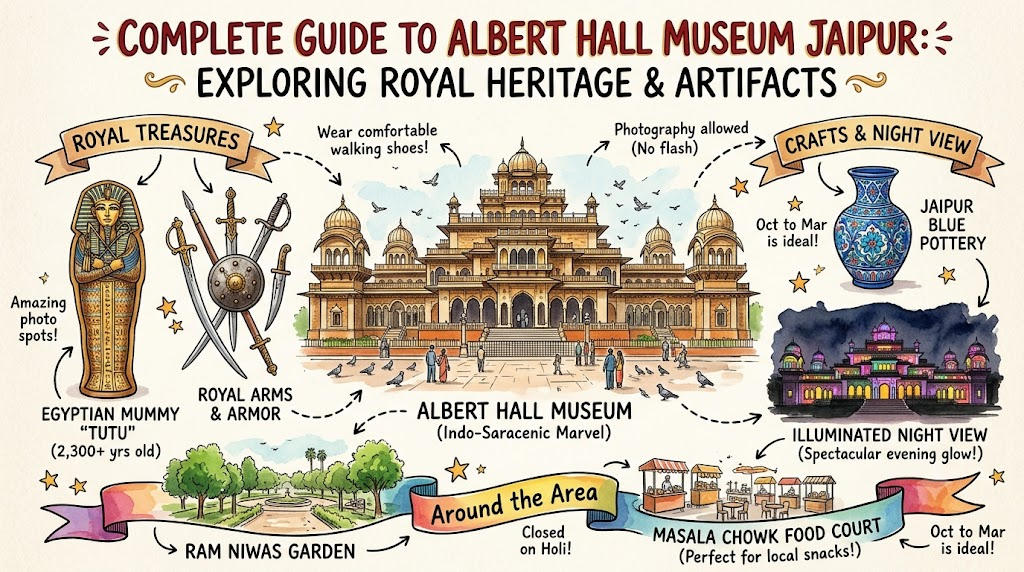
Standing proudly at the gates of the historic walled city, the Albert Hall Museum represents the foundational soul of Rajasthan’s artistic preservation. Designed to celebrate global craftsmanship rather than royal luxury alone, this architectural masterpiece invites travelers to slow down, connect deeply with cross-cultural traditions, and experience a living repository of human imagination.
Albert Hall Museum Indo-Saracenic facade.
Why Jaipur is a must-visit city
Jaipur commands an indispensable role in international travel as the crown jewel of India’s Golden Triangle. Geographically nestled against the ancient Aravalli Hills, the city serves as a living laboratory of planned Rajput urbanism, astronomical genius, and centuries-old craft guilds. Its practical accessibility is unparalleled, offering world-class national expressways, direct international flight connections, and heritage trains that cater effortlessly to luxury connoisseurs, culture hunters, and backpackers.
The broader travel circuit seamlessly connects dramatic cliff-top citadels like Amer Fort, Jaigarh, and Nahargarh to the geometric grid of the pink-hued UNESCO World Heritage Old City. South of the historic gates, the verdant greens of Ram Niwas Garden anchor the civic arts district, where the Albert Hall Museum stands as the premier cultural entry point.
| Key Fact | Specification / Detail |
|---|---|
| Location & Zone | Ram Niwas Garden, Kailash Puri, Adarsh Nagar, Jaipur |
| Architectural Style | Indo-Saracenic Revival (Designed by Sir Samuel Swinton Jacob) |
| Foundation Year | 1876 (Prince of Wales visit); Opened as museum in 1887 |
| Significance | Oldest state museum in Rajasthan; State Museum of Art & Antiquities |
| Nearest Transit Hub | Badi Chaupar Metro Station (1.8 km) / Jaipur Junction (4.5 km) |
Best Places or Experiences
The Central Durbar Hall & Architectural Facade
The exterior and central hall of the museum present a breathtaking masterclass in Indo-Saracenic architecture. Conceived by British engineer Sir Samuel Swinton Jacob with master Rajasthani stone carvers, the building merges Islamic domes, Rajput chhatris, and European Gothic proportions in golden Bansi Paharpur sandstone.
Inside, the central open courtyard features vaulted ceilings adorned with intricate mural paintings reproducing ancient Buddhist frescoes and classical Persian motifs. Moving through the stone corridors gives travelers an immediate sense of 19th-century cosmopolitan intellectual exchange, framing Jaipur as a global patron of fine arts.
- Location: Central ground floor of Albert Hall Museum, Ram Niwas Garden, 4 km east of Jaipur Junction.
- Why it is worth visiting: It is the finest living example of Indo-Saracenic design in Northern India, showcasing museum architecture built intentionally as an artistic teaching tool.
- Best things to do: Study the hand-painted corridor murals, photograph the delicate stone jaali screens, and admire the marble pillars carved with floral relief patterns.
- Best time to visit: Early morning at 9:30 AM for quiet galleries or late afternoon when sunlight illuminates the sandstone facade.
- Ideal for whom: Architecture enthusiasts, design scholars, photographers, and history lovers.
- Travel tip: Look upward along the upper gallery walls to examine historical European and Persian philosophical quotes painted beneath the arches.
The Egyptian Mummy Gallery
Housed within an atmospheric climate-controlled basement gallery lies one of only six Egyptian mummies preserved across India. Named Tutu, this female mummy dates back to the Ptolemaic era (circa 323–30 BCE) and was gifted to the royal court of Jaipur in the late 19th century by the ruler of Cairo.
The mummy rests securely in a protective glass chamber alongside its original painted wooden sarcophagus, adorned with hieroglyphic prayers dedicated to Osiris and Anubis. Surrounding displays unpack antique burial masks, amulets, and funerary vessels that bridge the ancient Nile valley with Rajput royal curiosity.
The Ptolemaic-era Egyptian mummy Tutu.
- Location: Lower ground gallery level of Albert Hall Museum.
- Why it is worth visiting: It offers an exceedingly rare encounter with authentic ancient Mediterranean archaeology in the desert state of Rajasthan.
- Best things to do: Read the translated hieroglyphic inscriptions on the sarcophagus, observe the intricate preservation linen, and examine antique clay ushabti figures.
- Best time to visit: Midday around 1:00 PM to take advantage of cool, quiet subterranean temperatures.
- Ideal for whom: Archaeology buffs, curious school-age families, and world-history students.
- Travel tip: Flash photography is strictly forbidden around the sarcophagus to prevent pigment degradation of the ancient wood.
The Royal Arms and Armoury Section
Reflecting Rajasthan’s martial spirit, this sprawling wing displays an exceptional assembly of weapons used by Rajput, Mughal, Afghan, and Persian warriors. The collection stretches across five centuries of battlefield engineering, ceremonial metallurgy, and diplomatic gifts exchanged among regional kingdoms.
Visitors can inspect lethal tiger claws (bagh nakh), double-bladed katar daggers, Damascus-steel talwar swords, and ornate helmets inlaid with gold foil. The collection highlights how weapons were celebrated not merely as tools of warfare, but as exquisite canvases for royal goldsmiths and calligraphers.
- Location: East wing, first floor of the museum complex.
- Why it is worth visiting: It provides an authentic, unvarnished look at medieval arms craftsmanship with Damascus pattern-welded blades.
- Best things to do: Spot the elephant armour suits, inspect the gold-inlaid curved scimitars, and locate shields painted with mythological battlefield scenes.
- Best time to visit: Late morning between 11:00 AM and 12:30 PM.
- Ideal for whom: Martial history enthusiasts, metalwork scholars, and heritage researchers.
- Travel tip: Look closely at the blade hilts to observe tiny secret compartments historically used for poison or prayer scrolls.
The Metal Art, Pottery, and Sculptures Wing
This extensive hall documents the evolution of decorative metalware, including engraved brass ewers, copper vessels, and rare blue pottery. Commissioned royal craftsmen from Sanganer, Delhi, and Multan sent their finest sample wares to this museum to build a physical benchmark for local artisans.
The gallery houses an extraordinary collection of 8th to 12th-century stone sculptures rescued from damaged temples across Rajasthan, notably Osian and Abhaneri. The juxtaposition of delicate clay vessels alongside monolithic basalt deities creates a powerful visual narrative of Indian sculptural achievement.
- Location: West wing ground floor and northern gallery halls.
- Why it is worth visiting: It contains original reference pieces of 19th-century Jaipur blue pottery and ancient post-Gupta sandstone carvings.
- Best things to do: Compare antique quartz pottery motifs with modern blue pottery, admire 10th-century stone nymphs, and view ceremonial brass lanterns.
- Best time to visit: 2:30 PM to 4:00 PM when gallery crowds thin out.
- Ideal for whom: Art collectors, antique lovers, and craft scholars.
- Travel tip: Take notes on the historic blue pottery color palettes to cross-reference authenticity when shopping in modern craft workshops.
The Night Tourism Illumination Experience
As darkness settles over Jaipur, Albert Hall transforms from a dignified educational museum into a radiant architectural spectacle. Over 2,400 dynamic LED lights bathe the carved sandstone domes, multi-tiered arches, and marble balconies in shifting hues of magenta, amber, turquoise, and gold.
Night entry tickets grant travelers access to the interior galleries without daytime tourist congestion, accompanied by cool breezes sweeping across the surrounding parkland. The square outside bustles with gentle conversation, traditional chai vendors, and sweeping evening views of the illuminated complex.
Albert Hall Museum night illumination.
- Location: Main facade and exterior perimeter of Ram Niwas Garden.
- Why it is worth visiting: It is Jaipur’s most striking monument illumination, offering lower ambient temperatures and romantic photo compositions.
- Best things to do: Photograph the shifting light reflections from across the perimeter road, explore the serene indoor galleries after dark, and sip local saffron tea.
- Best time to visit: 7:00 PM to 9:30 PM (Night viewing operates daily).
- Ideal for whom: Couples, nocturnal explorers, street photographers, and leisure travelers.
- Travel tip: Purchase the composite night ticket at the window if you plan to visit Amber Fort or Hawa Mahal after sunset on the same weekend.
Offbeat Exploration: Hidden Gems Tourists Miss
The Avian Courtyard and Morning Pigeon Swarm
Every dawn between 6:30 AM and 7:30 AM, hundreds of pigeons gather across the traffic circle fronting Albert Hall Museum. Local elders arrive to feed grain in an ancient ritual of charity, while sunrise casts a pink glow against the building. Photographers who arrive before morning vehicular traffic can capture breathtaking frames of birds taking flight in synchronized waves against the facade.
The Rare Persian Garden Carpet Vault
Few mainstream visitors realize that Albert Hall safeguards a 17th-century Persian garden carpet crafted during Shah Abbas’s reign, purchased originally by Maharaja Mirza Raja Jai Singh I. Kept in a specialized protective preservation room, this textile masterpiece depicts an idealized Islamic paradise garden filled with flowing canals, fish, birds, and blooming trees. Viewing it provides profound context into historical diplomatic trade along the Silk Road.
Ram Niwas Garden Green Enclaves
Tourists frequently bypass the vast 76-acre historical garden surrounding the museum. Originally planted as a famine relief project by Maharaja Sawai Ram Singh II in 1868, the park contains peaceful walking paths shaded by centuries-old neem trees, the historic Ravindra Manch theater, and tranquil corners for reading or journaling.
Tranquil paths of Ram Niwas Garden.
Detailed Practical Guidance for Travelers
| Destination | Standard Entry Fee | General Timings | Best Local Food Options Nearby | Recommended Nearby Attractions |
|---|---|---|---|---|
| Albert Hall Museum (Day) | ₹50 (Indians) / ₹300 (Foreigners) | 9:00 AM – 5:00 PM | Masala Chowk (Open food court), Gulab Ji Chai | Ram Niwas Garden, Museum of Legacies, Zoo |
| Albert Hall Museum (Night) | ₹100 (Indians) / ₹100 (Foreigners) | 7:00 PM – 10:00 PM | Pandit Kulfi, Lassiwala (MI Road), Shreenath Lassi | New Gate, Bapu Bazar, Raj Mandir Cinema |
| Ram Niwas Garden Grounds | Free Public Access | 6:00 AM – 10:00 PM | Street food carts, Bikanervala Central | Ravindra Manch, Art Gallery, Albert Hall |
| Masala Chowk Food Court | ₹10 entry token | 10:00 AM – 10:00 PM | Samrat Pyaaz Kachori, Sethi Tikka, Faluda stalls | Ram Niwas Garden, Central Park |
| Bapu Bazar Craft Market | Free Public Access | 11:00 AM – 9:00 PM | Laxmi Mishthan Bhandar (LMB), Rawat Sweets | Sanganeri Gate, Johari Bazar, Albert Hall |
Logistics & On-Ground Navigation
Local Transport Options
- Jaipur Metro: Board the Pink Line and disembark at Badi Chaupar Station. Albert Hall sits just 1.5 km south, reachable via an easy 15-minute walk down Chaura Rasta or a 5-minute e-rickshaw ride.
- Auto-Rickshaws & E-Rickshaws: Abundant and ideal for short hops from the Old City gates. E-rickshaws are whisper-quiet and cost roughly ₹30 to ₹60 for short nearby journeys.
- App-Based Taxis: Uber and Ola operate reliably throughout Jaipur, picking up directly from the outer perimeter gates of Ram Niwas Garden.
- Bicycle Rentals: The wide, shaded perimeter lanes inside Ram Niwas Garden are among the most pleasant cycling zones in central Jaipur.
Budget Planning
- Backpacker Tier (₹1,500 – ₹2,200 per day): Stay in a social hostel in MI Road or Bani Park; travel by Metro and shared e-rickshaws; enjoy hearty meals at Masala Chowk for ₹150–₹250 per sitting; buy standard day entry tickets.
- Mid-Range / Comfort Tier (₹4,500 – ₹8,000 per day): Base yourself in a restored heritage haveli; hire air-conditioned app taxis for the day; indulge in sit-down dinners near C-Scheme; purchase composite monument passes with private guided walkthroughs.
Safety and Inclusivity Tips
- Families: The smooth paved pathways surrounding the museum and inside the ground-floor galleries accommodate strollers comfortably. Keep hands clear of open display railings.
- Couples: The exterior lawns and evening light show offer a safe, respectful, and romantic setting frequented by both locals and travelers.
- General Safety: Watch your footing on historical stone staircases, stay hydrated during dry afternoon hours, and decline unauthorized touts offering “exclusive museum shortcuts” outside the ticketing booth.
Strategic Travel Planning Guardrails
Travel Planning Tips for Jaipur
- Invest in a Composite Ticket: If exploring Jaipur over two days, buy Rajasthan Tourism’s composite ticket (covering Albert Hall, Amber Fort, Hawa Mahal, Jantar Mantar, and Nahargarh) to save both money and queuing time.
- Carry Digital & Small Cash: While ticket windows accept UPI and cards, small cash denominations (₹10, ₹20, and ₹50) are essential for luggage cloakrooms, audio guides, and tea stalls.
- Rent the Official Audio Guide: The printed exhibit plaques provide minimal context; the official audio headset near the entrance unlocks fascinating backstories for over 100 featured artifacts.
- Combine with Masala Chowk: Plan your museum conclusion around lunch or dinner at Masala Chowk, an open-air food pavilion inside Ram Niwas Garden featuring Jaipur’s top legacy street food vendors in one hygienic courtyard.
- Dress Modestly and Comfortably: Wear breathable cotton apparel and comfortable flat walking shoes, as navigating all levels of the museum requires over two hours of walking on polished stone floors.
Common Mistakes to Avoid
- Visiting Exclusively at Night: While the night illumination is breathtaking, several intricate painting and textile galleries are kept partially dimmed after dark to preserve delicate dyes. Visit during daytime for serious study.
- Skipping the Upper Balconies: Most visitors stay clustered around the central ground floor, missing the upper corridors that offer stunning views of the courtyard and detailed woodwork.
- Rushing Through in Under an Hour: Albert Hall holds over 16 themed collection rooms; allotting anything less than 90 to 120 minutes turns the experience into a superficial walkthrough.
- Feeding Pigeons Close to Windows: Avoid inhaling feather dust around the high stone ledges if you suffer from respiratory sensitivities or dust allergies.
- Ignoring the Cloakroom Rules: Large backpacks, selfie sticks, and umbrellas are strictly prohibited inside the galleries; leave them at the designated secure baggage counter before entering security checklines.
Suggested Itinerary Blueprints
Day Quick Dash (Express Museum & Walled City Circuit)
- Target Audience: Travelers on tight single-day stopovers wanting a rich dose of history and cuisine.
- Morning (8:30 AM – 11:30 AM): Begin with morning photography at Hawa Mahal, followed by a walk through City Palace and Jantar Mantar.
- Midday (12:00 PM – 2:30 PM): Head down Chaura Rasta to Albert Hall Museum for a 2-hour curated gallery tour.
- Afternoon (2:30 PM – 4:00 PM): Enjoy lunch at Masala Chowk, sampling Pyaaz Kachori and Dal Baati Churma before departing.
Day Deep-Dive (Heritage, Arts & Culture Explorer)
- Day 1: Dedicate the entire day to the northern citadel axis. Hike Amber Fort, visit Panna Meena Ka Kund, inspect Jaigarh’s artillery foundry, and catch the sunset from the ramparts of Nahargarh.
- Day 2: Spend a quiet morning exploring the royal cenotaphs at Gaitore. After lunch, immerse yourself in Albert Hall Museum from 2:00 PM to 4:30 PM. Stroll through Ram Niwas Garden, shop for textiles in Bapu Bazar, and return to Albert Hall at 7:30 PM to witness the vibrant night lights.
Complete Weekend Travel Plan (The Grand Royal Jaipur Loop)
- Friday Evening: Arrive in Jaipur, check into your heritage hotel, and enjoy dinner near MI Road followed by night views outside Albert Hall.
- Saturday: Complete the Old City heritage loop: City Palace, Jantar Mantar, Hawa Mahal, and an afternoon craft tour through Johari and Bapu Bazars.
- Sunday: Morning visit to Albert Hall Museum with an audio guide. Follow with lunch at Masala Chowk, an afternoon excursion to the royal stepwells, and evening sunset tea at Nahargarh Fort.
Common Tourist Mistakes to Avoid
- Geographic Blunders: Grouping Albert Hall with northern fort locations like Amer on a tight schedule. Keep Albert Hall paired with southern Old City gates, Bapu Bazar, and central dining hubs to avoid hours trapped in crosstown traffic.
- Commercial Traps: Allowing drivers to steer you into multi-story tourist gift emporiums along Tonk Road that claim to sell “government-certified” museum replicas at exorbitant markups.
- Neglecting Modern/Alternative Zones: Focusing strictly on historical walls while skipping the thriving indie cafes, contemporary galleries, and quiet green parks in neighboring C-Scheme and Civil Lines.
- Transport Overpayment: Agreeing to arbitrary round-trip quotes from auto drivers waiting outside the front steps. Always hail a passing rickshaw on the outer circle or book through app platforms for clear rates.
- Luxury Dining Bias: Eating every meal in hotel banquet rooms. Jaipur’s gastronomic heart beats in street-side kachori fryers, lassi shops, and community food courts like Masala Chowk.
Frequently Asked Questions
1. What are the day and night opening timings for Albert Hall Museum Jaipur?
The museum opens for standard daytime visits from 9:00 AM to 5:00 PM daily. It cleans and resets for two hours before reopening for the popular night tourism viewing between 7:00 PM and 10:00 PM every evening. The ticket counter closes 30 minutes before closing time.
2. How much does entry cost for domestic and foreign travelers at Albert Hall?
Standard daytime entry costs ₹50 for Indian citizens and ₹300 for international visitors. For the night viewing session, tickets cost ₹100 for all visitors regardless of nationality. Students with valid identification cards receive discounted entry during standard daytime hours at the ticket window.
3. Is the composite Rajasthan tourism ticket valid at Albert Hall Museum?
Yes, the official Rajasthan Department of Archaeology composite ticket includes entry to Albert Hall Museum. This multi-monument pass remains valid for two consecutive days and covers Amber Fort, Hawa Mahal, Jantar Mantar, and Nahargarh Fort, offering major financial savings over buying individual tickets at each gate.
4. How did an ancient Egyptian mummy end up inside a Jaipur museum?
The Ptolemaic-era mummy of Tutu was gifted in 1887 to Maharaja Sawai Madho Singh II by the French-administered Museum of Egyptian Antiquities in Cairo. It was intentionally acquired to establish Albert Hall as a world-class center of universal human education rather than a regional display.
5. How much time should a traveler budget to see the museum properly?
A satisfying walkthrough of the major ground and first-floor galleries requires at least 90 minutes to two hours. Dedicated historians, antique arms scholars, and art students will easily spend three hours exploring the 16 specialized collection halls, mural corridors, and underground mummy chamber.
6. Is photography permitted inside the galleries of Albert Hall Museum?
Standard still photography with smartphones and handheld cameras is permitted throughout most general galleries for personal use. However, tripod stands, selfie sticks, and camera flashes are strictly prohibited. Flashing is especially restricted around the sensitive Egyptian sarcophagus and delicate miniature textile frames.
7. Is the Albert Hall Museum complex wheelchair accessible for disabled travelers?
The ground floor, central courtyard, and exterior garden corridors feature gentle ramps accessible for wheelchairs and strollers. However, reaching the upper balcony wings and specialized armoury rooms requires navigating original narrow stone staircases that lack modern mechanical elevators due to historic preservation regulations.
8. What is the nearest Jaipur Metro station to reach Albert Hall Museum?
The nearest station is Badi Chaupar Metro Station on the Pink Line, situated approximately 1.8 kilometers north. Travelers can disembark at Badi Chaupar, walk down Chaura Rasta, or take an inexpensive 5-minute electric rickshaw ride directly to the main northern gate of Ram Niwas Garden.
9. What culinary options are available within walking distance of the museum?
Directly behind the museum inside Ram Niwas Garden lies Masala Chowk, an open-air food court hosting over 20 legacy street food brands. Visitors can safely sample Jaipur staples like Samrat’s pyaaz kachoris, gulab jamuns, chaat, and kulfi in one clean, seated public venue.
10. What is the best season to explore Albert Hall Museum and its gardens?
The winter season between October and March offers cool, sunny weather ideal for strolling the outdoor lawns and navigating the non-air-conditioned stone halls. Exploring between April and June can become intensely hot during peak midday hours, making night tourism the preferred alternative.
11. Are there secure cloakroom facilities to store luggage at the museum?
Yes, a staffed government baggage cloakroom operates right next to the main entry checkpoint and ticket counter. Visitors must deposit large backpacks, suitcases, tripods, and excessive hand baggage for a nominal fee before passing through the metal detectors.
12. Why is the exterior lighting of Albert Hall Museum famous?
The night illumination features over 2,400 computer-controlled LED floodlights that shift harmoniously through vibrant colors every few minutes. The brilliant lights highlight the domes, carved arches, and ornate balconies, creating a world-class landmark vista that draws photographers and sightseers every evening.
Conclusion
Stepping into the tranquil stone halls of Albert Hall Museum is a powerful antidote to hurried modern travel. As sunlight filters through handcrafted jali screens onto centuries-old weaponry, delicate quartz ceramics, and the quiet tomb of Tutu, you connect with an ambitious 19th-century vision of universal human artistry. Choosing this contemplative space rewards you with the true spirit of Jaipur—a city that honors its warrior past while holding open a gracious, illuminated window to the wider world.
