Introduction
Most modern holidays have devolved into predictable, homogenized check-ins where travelers shuffle through selfie lines and sterile resort lobbies. True wanderlust, however, demands raw authenticity, sensory immersion, and an unshakeable connection to the living past.
Jaipur shatters the monotony of typical overcrowded vacation hubs by welcoming you into an intact, pulsating civilization. Step beyond the tour bus rush into historic havelis and craft guilds, where royal architecture, Vedic cosmology, and devotional rituals have thrived uninterrupted for three centuries.
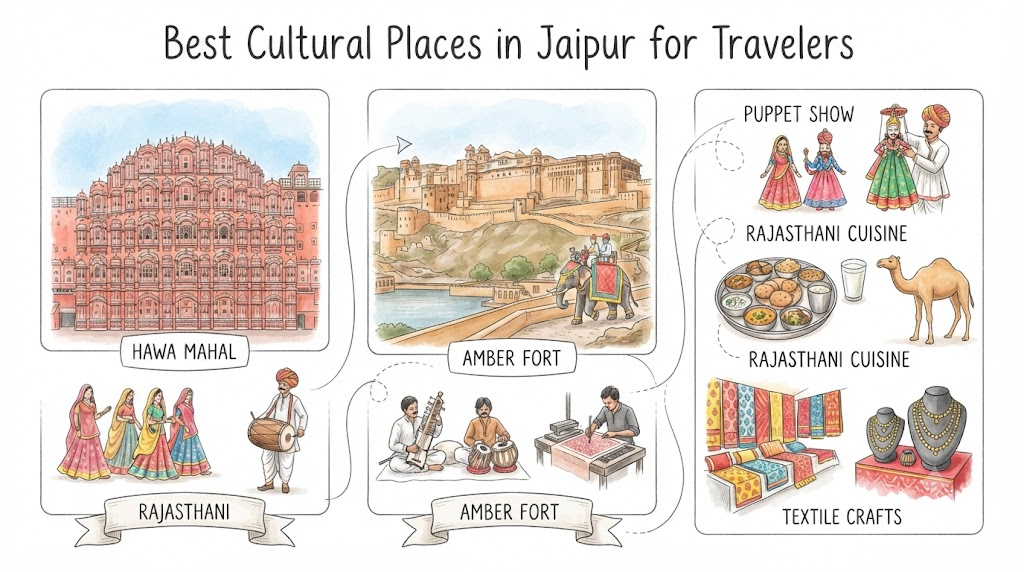
The iconic facade of Hawa Mahal.
Why Jaipur is a must-visit city
Jaipur is not merely an open-air museum; it is India’s first planned city, built in 1727 under the visionary Rajput ruler Maharaja Sawai Jai Singh II and architect Vidyadhar Bhattacharya. Rooted in the ancient architectural principles of Vastu Shastra and Shilpa Shastra, its wide grid layout and terracotta-pink facades represent a masterclass in urban planning. Culturally, the city serves as a thriving sanctuary for classical arts, folk music, gem-cutting guilds, and royal cuisine, ensuring every street corner hums with living history.
Geographically positioned in northern Rajasthan, Jaipur forms the crowning jewel of the world-famous Golden Triangle travel circuit alongside Delhi and Agra. It acts as the gateway to the Thar Desert while remaining exceptionally connected via the modern Delhi-Mumbai Expressway, extensive express rail networks, and Jaipur International Airport. Whether you are a backpacker navigating lively alleyways, a family exploring royal forts, or a luxury traveler residing in restored heritage palaces, Jaipur delivers unmatched hospitality.
| Travel Dimension | Essential Insight |
|---|---|
| Location & Coordinates | Eastern Rajasthan, India (26.9124° N, 75.7873° E) |
| Ideal Travel Season | October to March (Crisp mornings, pleasant afternoon sun) |
| Connectivity | Jaipur International Airport (JAI), Jaipur Junction (JP), NH 48 |
| UNESCO Accolades | Jaipur City (Walled Heritage Core), Jantar Mantar, Amber Fort |
| Recommended Trip Length | 3 to 4 Full Days for deep cultural exploration |
Best Places or Experiences
Amber Fort and Palace
Perched dramatically atop the rugged Aravalli hills, Amber Fort represents the zenith of Rajput-Mughal architectural synergy. Constructed out of pale yellow and pink sandstone paired with pure white marble, the fortress overlooks the shimmering waters of Maota Lake, which once served as a natural moat.
Inside its high-walled courtyards, you will encounter the legendary Sheesh Mahal (Mirror Palace), where ceilings and walls are adorned with convex imported Belgian glass mirrors that illuminate an entire hall with a single candle flame. Passing through the grand Ganesh Pol into royal residential courtyards reveals delicate Mughal-style gardens and sophisticated medieval air-cooling water channels.
Royal courtyards inside Amber Fort.
- Location: Amer Zone, roughly 11 km north of Jaipur’s Old City center.
- Why it is worth visiting: Unrivaled blend of defensive military architecture and breathtaking mirror-inlaid royal chambers.
- Best things to do: Walk the perimeter of the Sun Gate (Suraj Pol), marvel at the micro-mosaic reflections in the Sheesh Mahal, and view the submerged garden of Kesar Kyari from the ramparts.
- Best time to visit: Arrive at 8:00 AM sharp to explore before tourist crowds arrive, or visit at 6:30 PM for the sound and light show.
- Ideal for whom: History buffs, architecture lovers, and heritage photographers.
- Travel tip: Skip the elephant rides to avoid animal welfare concerns and walk up the stone-paved ramp or take an authorized electric jeep.
City Palace Complex
Situated at the direct epicenter of the historic walled city, the City Palace is a sprawling fusion of Rajasthani, Mughal, and European design that continues to house the titular Jaipur royal family. Enclosed within high security walls, the complex encompasses sprawling ceremonial courtyards, royal stables, and regal audience halls.
The inner courtyard of Pritam Niwas Chowk features four legendary painted gates dedicated to the Hindu seasons and deities, including the iconic Peacock Gate symbolizing autumn. Within the Mubarak Mahal and Diwan-i-Khas, travelers can inspect royal garments, ancient armaments, and two colossal sterling silver vessels (Gangajalis) that hold the Guinness World Record as the largest silver objects ever forged.
- Location: J.D.A. Market, Pink City, 4 km from Jaipur Railway Station.
- Why it is worth visiting: An active royal residence offering direct glimpses into royal court living, regalia, and high ceremonial art.
- Best things to do: Photograph the vibrant feather mosaics of the Peacock Gate, inspect the world-record Gangajali silver urns, and upgrade to the Chandra Mahal private tour for access to the royal family’s private chambers.
- Best time to visit: Midday between 11:30 AM and 2:00 PM when outdoor fort walking is hot, as the palace exhibits are sheltered and shaded.
- Ideal for whom: Cultural researchers, luxury travelers, and multi-generational families.
- Travel tip: Purchase a combined composite ticket or invest in the Royal Grandeur Pass to skip main ticketing lines.
Jantar Mantar Astronomical Observatory
Conceived between 1728 and 1734 by the astronomer-king Maharaja Sawai Jai Singh II, Jantar Mantar is the world’s largest stone astronomical observatory. Featuring 19 monumental masonry instruments, this UNESCO World Heritage Site stands as physical proof of ancient India’s mathematical and astronomical brilliance.
The site is dominated by the Vrihat Samrat Yantra, a colossal 27-meter-tall gnomon sundial capable of calculating local solar time to an astonishing accuracy of two seconds. Walking among these geometric stone sculptures feels like wandering through a surrealist modernist art gallery designed solely to track constellations, predict eclipses, and map celestial coordinates.
Vrihat Samrat Yantra at Jantar Mantar.
- Location: Adjacent to City Palace, Gangori Bazar, Pink City.
- Why it is worth visiting: The world’s most significant, fully operational collection of pre-modern stone astronomical instruments.
- Best things to do: Watch the shadow shift across the Samrat Yantra curve in real time, view the circular Jai Prakash Yantra bowl used for celestial mapping, and hire a certified astronomer-guide.
- Best time to visit: Exactly at solar noon (12:00 PM to 1:00 PM) when the sun reaches its zenith and sundials reveal dramatic readings.
- Ideal for whom: Science enthusiasts, mathematicians, curious intellectuals, and older children.
- Travel tip: Never enter without an authorized guide or audio guide; the instruments look like simple abstract statues without technical explanation.
Hawa Mahal (Palace of Winds)
Erected in 1799 by Maharaja Sawai Pratap Singh and masterfully designed by Lal Chand Ustad, Hawa Mahal is a five-story architectural marvel shaped like the crown of Lord Krishna. Built of chiselled red and pink sandstone, the structure surprisingly has no formal foundation and stands as the world’s tallest building constructed without a base footing.
Its honeycombed outer facade incorporates 953 exquisitely carved casements (jharokhas) fitted with tiny lattices. This intricate screen allowed purdah-observing royal women to watch street festivals, royal processions, and daily market life completely unseen, while the Venturi air currents kept the inner chambers remarkably cool during desert heatwaves.
- Location: Badi Chaupar, Hawa Mahal Road, Walled City.
- Why it is worth visiting: World-famous pink honeycomb sandstone architecture engineered for natural air circulation.
- Best things to do: Climb the narrow, sloping internal ramps to the top floor, peer through the stained-glass windows, and enjoy an elevated view of Jantar Mantar and the city rooftops.
- Best time to visit: Early morning at 7:30 AM to catch the golden sunrise striking the eastern facade.
- Ideal for whom: Solo travelers, architecture lovers, and street photographers.
- Travel tip: The best photos of the complete exterior facade are taken from the rooftop cafes directly across the road.
Albert Hall Museum (Central Museum)
Set amidst the sprawling Ram Niwas Garden, Albert Hall Museum is the oldest museum in Rajasthan, with its foundation stone laid during the 1876 tour of the Prince of Wales. Designed by Sir Samuel Swinton Jacob, it stands as the premier example of Indo-Saracenic architecture, featuring elegant domes, stone lanterns, and carved pillared corridors.
Inside, the museum houses a vast historical archive of metal sculptures, traditional Rajasthani miniature paintings, Persian carpets, ivory carvings, and royal musical instruments. Its most famous exhibit is a remarkably preserved Ptolemaic Egyptian mummy named Tutu, which was gifted to the royal court in the late 19th century.
- Location: Ram Niwas Garden, southern fringe of the Old City.
- Why it is worth visiting: The pinnacle of Indo-Saracenic civic architecture paired with deep ethnographic and antique collections.
- Best things to do: Inspect the 17th-century Persian Garden carpet, visit the Egyptian mummy display, and view the stunning exterior night illumination.
- Best time to visit: Evening from 7:00 PM to 9:00 PM when the entire facade is washed in vibrant colored lights.
- Ideal for whom: Museum lovers, students, art historians, and evening strollers.
- Travel tip: A combined ticket purchased at Amber Fort or City Palace includes access to Albert Hall within a two-day window.
Offbeat Exploration: Hidden Gems Tourists Miss
Gaitore Ki Chhatriyan (Royal Cenotaphs)
Tucked away in a tranquil limestone valley beneath the cliffs of Nahargarh Fort, Gaitore houses the royal memorial tombs of the Kachwaha Rajput rulers. Each open-air pavilion (chhatri) is carved from pristine white marble and sandstone, featuring detailed carvings of royal court life, elephant battles, and Hindu mythos.
Peaceful royal cenotaphs of Gaitore.
Panna Meena Ka Kund Stepwell
Located near the foot of Amber Fort, this 16th-century architectural stepwell is an engineering gem built for rainwater harvesting. Its crisscross geometric stairs create hypnotic visual rhythms, yet it is often missed by tour groups rushing to the fort ramparts above.
Govind Dev Ji Temple Aarti Ritual
Situated between the City Palace and royal gardens, this temple houses the sacred idol brought from Vrindavan by the royal dynasty. Attending the morning or sunset devotional gathering (aarti) alongside thousands of locals singing folk hymns provides an authentic cultural experience untouched by tourism commercialism.
Detailed Practical Guidance for Travelers
| Destination | Standard Entry Fee | General Timings | Best Local Food Options Nearby | Recommended Nearby Attractions |
|---|---|---|---|---|
| Amber Fort and Palace | ₹100 (Domestic) / ₹500 (Foreigner) | 8:00 AM – 5:30 PM, 6:30 PM – 9:00 PM | 1135 AD (Fine Dining), Jagat Shiromani Tea Stalls | Jaigarh Fort, Panna Meena Stepwell |
| City Palace Complex | ₹300 (Domestic) / ₹700 (Foreigner) | 9:30 AM – 5:00 PM, 7:00 PM – 10:00 PM | The Palace Cafe, Jharokha Heritage Restaurant | Jantar Mantar, Hawa Mahal |
| Jantar Mantar | ₹50 (Domestic) / ₹200 (Foreigner) | 9:00 AM – 5:00 PM | LMB Sweets (Johari Bazar), Samrat Kachori | City Palace, Badi Chaupar Market |
| Hawa Mahal | ₹50 (Domestic) / ₹200 (Foreigner) | 9:00 AM – 5:00 PM | Wind View Cafe, Tattoo Cafe (Rooftops) | Johari Bazar, Sireh Deori Bazar |
| Albert Hall Museum | ₹40 (Domestic) / ₹300 (Foreigner) | 9:00 AM – 5:00 PM, 7:00 PM – 10:00 PM | Masala Chowk (Open Street Food Court) | Ram Niwas Garden, Zoo |
Logistics & On-Ground Navigation
Local Transport Options
- Jaipur Metro: A modern, clean, air-conditioned metro system that runs east-to-west directly into Badi Chaupar, right at the doorstep of Hawa Mahal.
- Auto-Rickshaws and E-Rickshaws: Ideal for traversing narrow Old City bazaars where cars get stuck. Always agree on a fare before boarding or insist on the meter.
- Ride-Hailing Apps (Uber / Ola): Reliable, transparently priced options for longer hops across town or journeys between central hotels and the railway station.
- Chauffeur-Driven Car Rentals: Hiring a car for an 8-hour / 80-km package is the most comfortable way to tackle hilly northern outposts like Amber, Jaigarh, and Nahargarh.
Budget Planning
- Budget / Backpacker Tier (₹1,500 – ₹2,500 per day): Stay in boutique heritage hostels in Bani Park, travel via metro and shared e-rickshaws, eat traditional meals at street food corners, and purchase composite monument passes.
- Comfort / Mid-Range Tier (₹6,000 – ₹12,000 per day): Stay in restored Rajput havelis, hire private air-conditioned vehicles for sightseeing, dine at heritage courtyard restaurants, and book guided walking tours.
Safety and Inclusivity Tips
- For Families: The vast fort courtyards offer ample walking space, but be careful around low rampart walls and stepwells with young children.
- For Couples: Jaipur is welcoming and safe for traveling couples; private garden cafes and evening fort overlooks provide relaxed, romantic settings.
- General Safety: Keep cash secure in crowded bazaars, avoid street hawkers claiming to sell genuine gemstones, and drink only sealed bottled or purified water.
Strategic Travel Planning Guardrails
Travel Planning Tips for Jaipur
- Acquire the Composite Monument Ticket: Buy a multi-attraction pass at your first state monument stop to save money and bypass ticket queues.
- Keep Cash on Hand: While digital UPI payments are widespread, street food vendors and auto drivers often require physical cash.
- Dress Conservatively: Cover your shoulders and knees when visiting active pilgrimage sites such as Govind Dev Ji and Galta Ji.
- Carry Good Footwear: Exploring marble palace terraces and stone fort inclines involves miles of walking; choose comfortable slip-on walking shoes.
- Secure Peak-Season Bookings: Reserve boutique havelis and train tickets at least two months in advance if visiting between November and February.
Common Mistakes to Avoid
- Rushing All Forts in One Day: Visiting Amber, Jaigarh, and Nahargarh back-to-back causes sensory overload and physical exhaustion.
- Trusting Unsolicited “Guides”: Decline touts who claim historic monuments are closed or push you toward private textile “factories.”
- Skipping Street Culinary Classics: Sticking solely to hotel buffets means missing out on legendary local treats like hot pyaaz kachoris and rich lassi.
- Assuming Summer Travel is Feasible: Visiting between April and June brings scorching temperatures above 42°C, which restricts outdoor sightseeing to early mornings.
- Forgetting Sun Protection: Rajasthan’s desert sun is intense even in winter; carry polarized sunglasses, broad-spectrum sunscreen, and a scarf.
Suggested Itinerary Blueprints
Day Quick Dash (Express Heritage Circuit)
- Target Audience: Business travelers and weekend travelers on a quick stopover.
- 08:00 AM – 11:30 AM: Early morning exploration of Amber Fort before tour crowds peak.
- 12:00 PM – 01:30 PM: Quick photo stop at Jal Mahal followed by traditional Rajasthani lunch on MI Road.
- 02:00 PM – 05:00 PM: Visit the City Palace and adjacent Jantar Mantar, ending with an exterior photo stop at Hawa Mahal.
Day Deep-Dive (Palaces, Forts & Guilds)
- Day 1 (The Walled City Core): Morning exploration of Hawa Mahal, Jantar Mantar, and City Palace. Enjoy an afternoon heritage walk through Johari Bazar and attend evening aarti at Govind Dev Ji Temple.
- Day 2 (Fortresses & Craft Quarters): Morning visit to Amber Fort and Panna Meena Stepwell. Spend the afternoon shopping for authentic blue pottery in Civil Lines, then catch the golden sunset from Nahargarh Fort ramparts.
Complete Weekend Travel Plan (The Ultimate Jaipur Loop)
- Friday Evening: Arrive, settle into a Bani Park haveli, and head to Albert Hall Museum to see the illuminated facade followed by dinner at Masala Chowk.
- Saturday (Imperial Heights): Spend the morning at Amber Fort and Jaigarh Fort. Head to Gaitore Royal Cenotaphs in the afternoon, followed by dinner in an Old City rooftop cafe overlooking the illuminated Hawa Mahal.
- Sunday (Culture, Crafts & Farewell): Visit City Palace and Jantar Mantar in the morning. Dedicate the afternoon to authentic block-printing workshops and spice shopping in Bapu Bazar before heading to the airport.
Common Tourist Mistakes to Avoid
- Geographic Blunders: Don’t attempt to visit Amber Fort in the far north and Chokhi Dhani in the far south on the same afternoon; traffic across the urban core will cost you hours.
- Commercial Traps: Avoid spending your travel budget in modern air-conditioned souvenir malls; explore the state-run Rajasthali emporium or generational artisan studios instead.
- Neglecting Modern/Alternative Zones: Do not spend your entire trip within the historic walls; modern residential enclaves like C-Scheme and Civil Lines offer tranquil leaf-lined avenues and chic indie art cafes.
- Transport Overpayment: Always verify auto-rickshaw fares on apps like Uber or Ola before agreeing to street prices, especially when exiting major transit terminals.
- Luxury Dining Bias: High-end hotel kitchens rarely capture the authentic fiery depth of traditional Laal Maas or the crisp crunch of local samosas found at heritage city eateries.
Frequently Asked Questions
1. What is the single best time of year to visit Jaipur?
The best time to visit Jaipur is between October and March when daytime temperatures stay between a pleasant 18°C and 25°C. Winters provide crisp, dry weather that is perfect for walking through open-air forts, enjoying rooftop dining, and exploring colorful street markets without the oppressive desert heat that arrives from April onward.
2. How many days are realistically needed to experience Jaipur?
A realistic itinerary requires three full days to take in the major sights without exhaustion. This window allows you to spend one dedicated day touring northern forts like Amber and Nahargarh, another day within the Old Walled City exploring palaces and observatories, and a third day discovering artisan workshops, heritage stepwells, and local culinary traditions.
3. Is the composite monument ticket worth buying in Jaipur?
Yes, the Rajasthan Tourism composite ticket offers exceptional value for travelers planning to visit key sights. It grants entry to Amber Fort, Albert Hall Museum, Hawa Mahal, Jantar Mantar, and Nahargarh Fort over two consecutive days. Purchasing this pass saves both money and time by allowing you to bypass individual ticket queues at each site.
4. What is the most practical way to travel from Delhi to Jaipur?
The most practical option is the Vande Bharat Express or Shatabdi Express train, which departs from New Delhi and arrives at Jaipur Junction in under four hours. Alternatively, driving via the Delhi-Mumbai Expressway takes around three and a half hours, making it a reliable and stress-free alternative to flights.
5. How should visitors dress when exploring temples and cultural sites in Jaipur?
Travelers should dress modestly to respect local customs, particularly when visiting active temples and rural areas. Both men and women should wear lightweight cotton clothing that covers shoulders and knees. Slip-on shoes are ideal, as you will need to take off your footwear before entering holy shrines and private palace rooms.
6. Is Jaipur safe for solo female travelers?
Jaipur is generally welcoming and safe for solo female travelers who follow basic precautions. Stick to well-lit areas, arrange evening transport through verified ride-hailing apps, and ignore overly pushy street touts. Staying in reputable heritage havelis or boutique homestays in quiet neighborhoods like Bani Park or C-Scheme adds an extra layer of comfort.
7. Can travelers visit the private residential quarters of the City Palace?
Yes, travelers can view the private residential quarters within the Chandra Mahal by booking the specialized Royal Grandeur or Scenic Tour. These higher-tier tickets grant exclusive access to the royal family’s private chambers, including the blue-walled Chhavi Niwas and the mirror-inlaid Sukh Niwas, accompanied by an authorized palace guide.
8. What authentic local souvenirs should travelers look for in Jaipur?
Jaipur is famous for genuine quartz-based blue pottery, hand-block-printed textiles from Sanganer and Bagru, untreated precious gemstones from Johari Bazar, and traditional leather footwear (mojris). To ensure authenticity and fair prices, shop at certified artisan collectives or the government-run Rajasthali emporium on MI Road instead of unregulated tourist shops.
9. What are the essential Rajasthani dishes to try in the city?
You should try the classic Rajasthani thali featuring Dal Baati Churma, which combines crisp wheat balls, spiced lentil curry, and sweet powdered grain. Non-vegetarians should seek out authentic Laal Maas, a fiery slow-cooked mutton curry flavored with Mathania chillies, followed by a sweet glass of thick churned lassi from MI Road.
10. Do I need an authorized guide when visiting Jantar Mantar?
Hiring an authorized monument guide or renting the official audio guide is essential when visiting Jantar Mantar. The stone structures are precise astronomical calculation tools designed to measure solar time, track constellations, and predict eclipses. Without an expert explanation, they appear merely as abstract sculptures, and you miss the mathematical genius behind their design.
11. Is it safe to drink tap water in Jaipur hotels and restaurants?
Tap water is not potable in Jaipur and should be avoided by travelers. Always drink sealed bottled water from reliable brands or consume filtered water provided by reputable hotels. Use bottled or purified water for brushing your teeth, and skip iced beverages at casual roadside stalls to prevent stomach upsets during your journey.
12. What is the difference between Amber Fort, Jaigarh Fort, and Nahargarh Fort?
Amber Fort was the opulent royal palace residence featuring ornate mirror-inlaid halls and sprawling residential courtyards. Jaigarh Fort was the military stronghold that protected Amber, housing the world’s largest cannon on wheels. Nahargarh Fort served as a scenic retreat along the ridge, offering defensive walls and sweeping panoramic views over the Jaipur skyline.
Conclusion
Choosing a cultural pilgrimage through Jaipur over an ordinary, sanitized holiday rewards you with the rare magic of living history. From the quiet morning light washing over Amber’s sandstone battlements to the sacred evening hymns echoing through Govind Dev Ji, the Pink City does not merely entertain its visitors—it captivates the soul and leaves an indelible mark of royal heritage on every traveler who walks its streets.
