Introduction
Mainstream vacation itineraries too often shuffle travelers between generic souvenir gift shops and overcrowded monument selfie zones. In Jaipur, the true spirit of discovery bypasses commercial department stores entirely, pulling you straight into centuries-old alleyways scented with drying indigo, crushed marigolds, and warm lacquer resin.
Behind the pink terracotta facades of the old city lies a living artisan ecosystem that has functioned continuously since the 18th century. Stepping across these historic thresholds connects you directly with multigenerational guild masters who mold quartz pottery, hammer brass sheets, and carve teak blocks entirely by hand.
Vibrant lanes of Bapu Bazar.
Why Jaipur is a must-visit city
Jaipur stands as India’s definitive epicenter of living heritage arts, preserving an urban layout planned around specific craft guilds. Founded in 1727 by Maharaja Sawai Jai Singh II, the city was deliberately engineered to shelter India’s finest jewelers, block-printers, and ceramic masters.
Geographically positioned along Rajasthan’s vibrant tourism corridor, the capital offers world-class accessibility via Jaipur International Airport (JAI), superfast Vande Bharat express trains, and smooth expressways. Modern infrastructure seamlessly blends with royal heritage, catering equally to solo backpackers, cultural researchers, and luxury collectors seeking direct access to artisanal lineages.
| Key Fact | Specification |
|---|---|
| Administrative State | Rajasthan, Western India |
| Prime Travel Season | October to March (Comfortable, crisp winter temperatures) |
| Principal Transit Hub | Jaipur Junction Railway Station & JAI Airport |
| Core Handicraft Guilds | Hand-Block Printing, Blue Pottery, Lac Bangles, Kundan Jewelry |
| Recommended Trip Length | 3 to 4 Days for deep heritage exploration |
Best Places or Experiences
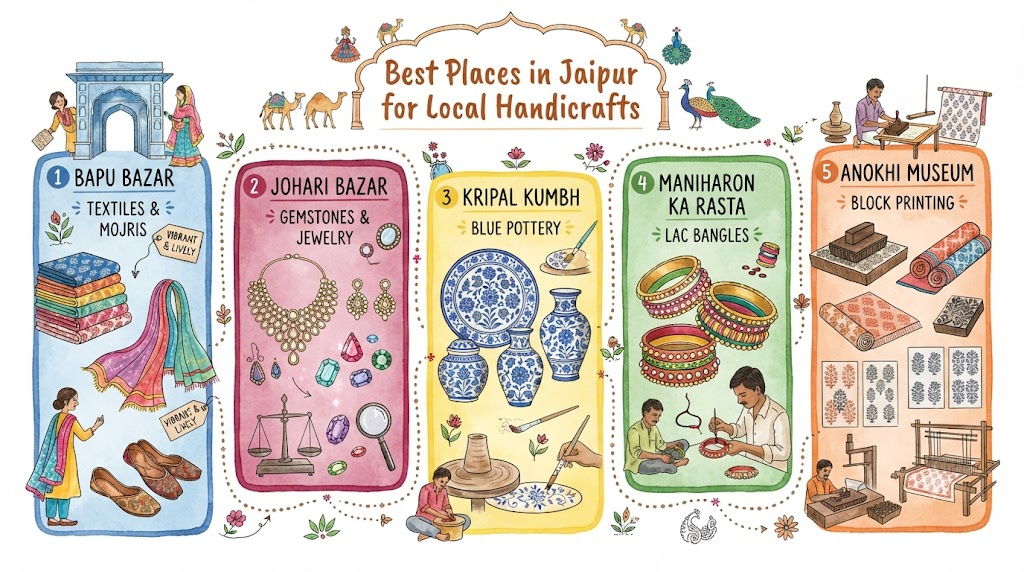
Bapu Bazar
Bapu Bazar remains the undisputed vibrant corridor for authentic Rajasthani textiles, camel leather footwear, and hand-embroidered homeware. Running between the Sanganeri Gate and New Gate, its uniform pink verandas house hundreds of compact, family-owned trading counters.
The market buzzes with sensory energy as merchants unfold kaleidoscopic bandhani and leheriya tie-dye dupattas before discerning buyers. Wandering through these rhythmic stalls lets you trace how traditional rural stitching evolved into functional, globally celebrated everyday wear.
- Location: Old City, between Sanganeri Gate and New Gate, approximately 4 km east of Jaipur Junction.
- Why it is worth visiting: Unmatched epicenter for authentic camel-leather mojris, chanderi textiles, and cotton bedspreads at street-level prices.
- Best things to do: Try on hand-stitched leather jutis, bargain for pure cotton Jaipuri rajais (quilts), and purchase vivid tie-dye fabrics.
- Best time to visit: Late afternoon between 3:30 PM and 6:30 PM when shops are fully open and daylight illuminates fabric dyes.
- Ideal for whom: Bargain shoppers, textile collectors, and families hunting for home furnishings.
- Travel tip: Smell leather footwear before buying; genuine vegetable-tanned camel leather carries a distinct earthy aroma without chemical residue.
Johari Bazar & Gopalji Ka Rasta
Constructed as the premier gemstone and bridal quarter of the royal capital, Johari Bazar is a dazzling maze of traditional jewelry boutiques and narrow artisan lanes. Inside the deep side-artery of Gopalji Ka Rasta, master lapidaries still hand-cut raw emeralds, rubies, and tourmalines on ancient lap wheels.
This legendary market is also world-renowned for pioneering Meenakari (intricate metal enameling) and Kundan-Jadau (refined 24-karat gold-foil stone setting). Walking through these glittering colonnades gives visitors a profound appreciation for royal luxury jewelry created entirely without modern computer-aided machinery.
Artisans and traders in Johari Bazar.
- Location: Pink City center, directly south of Badi Chaupar, roughly 4.5 km from the main city railway terminal.
- Why it is worth visiting: The historical headquarters of Asia’s gemstone trade and India’s finest ancestral enamel-work jewelers.
- Best things to do: Watch gemstone polishers in Gopalji Ka Rasta, browse authentic silver tribal jewelry, and admire traditional bridal gota-patti lehengas.
- Best time to visit: Mid-day from 12:00 PM to 4:00 PM when gem dealers inspect stones under clear natural overhead sunlight.
- Ideal for whom: Fine jewelry connoisseurs, bridal shoppers, and gemology enthusiasts.
- Travel tip: Always insist on a government-recognized gemological certificate (such as GIA or IGI) when purchasing precious stones.
Kripal Kumbh
Nestled in a peaceful residential pocket of Bani Park, Kripal Kumbh is the consecrated workshop of the late Padma Shri Kripal Singh Shekhawat. It was here in the mid-20th century that the master artist single-handedly revived the dying craft of Jaipur blue pottery, inventing unique multi-hued glazes.
Unlike conventional clay pottery, the delicate vessels crafted here use zero soil, relying instead on a secret dough of crushed quartz stone, raw glass, gum, and natural minerals. Stepping into this quiet garden studio feels like entering an art museum, where every turquoise urn, hand-painted tile, and glazed plate represents preserved cultural genius.
Glazed handiwork at Kripal Kumbh.
- Location: B-18, Shiv Marg, Bani Park, located just 2 km northwest of Jaipur Junction Railway Station.
- Why it is worth visiting: Authentic origin studio of modern blue pottery with museum-grade preservation standards.
- Best things to do: Examine classical Persian-inspired cobalt vases, commission custom decorative wall tiles, and observe live glazing techniques.
- Best time to visit: 11:00 AM to 2:00 PM on weekdays for uninterrupted conversation with resident craft historians.
- Ideal for whom: Art collectors, interior designers, and solo cultural explorers.
- Travel tip: Blue pottery is brittle; ask the team to ship heavy pieces via their specialized wooden-crate courier service.
Maniharon Ka Rasta
Deep within the labyrinthine heart of Tripolia Bazar lies Maniharon Ka Rasta, the ancestral quarter of the Muslim lac-worker community known as the Maniharis. For nearly three centuries, these skilled artisans have melted, shaped, and embellished natural resin over open charcoal fires to produce sacred Rajasthani bangles.
The lane glows with the metallic warmth of brass plates, studded mirror flakes, and fiery red pigments. Visitors can sit on raised stone stoops just inches away from craftsmen as they roll molten lac rods around wooden mandrels with rhythmic precision.
- Location: Off Tripolia Bazar, Old City, roughly 4 km northeast of the railway station.
- Why it is worth visiting: The only heritage street in India dedicated exclusively to the centuries-old alchemy of handmade lac bangles.
- Best things to do: Watch artisans melt raw lac over coal braziers, measure custom wrist dimensions, and buy personalized bridal chudas.
- Best time to visit: Late morning around 11:30 AM when artisans begin fresh morning firings before peak crowd congestion.
- Ideal for whom: Couples, cultural documentarians, and ethical craft shoppers.
- Travel tip: Lac bangles expand under heat; gently warm tight bangles in your hands before sliding them onto your wrist.
Anokhi Museum of Hand Printing
Housed inside the meticulously restored 16th-century Chanwar Palkiwalon Ki Haveli in the shadow of Amer Fort, this UNESCO-honored museum celebrates the heritage of woodblock textile printing. The limestone building itself is an architectural treasure featuring cool arched colonnades and historic stone balconies.
Inside, educational exhibits document natural color extractions, complex carved block patterns, and the historic preservation of traditional Bagru and Sanganer prints. The top floor features working master block-carvers and printers who demonstrate the precision required to align multi-color pigment blocks by eye.
Anokhi Museum in historic Amer.
- Location: Kheri Gate, Amer, approximately 12 km north of Jaipur city center.
- Why it is worth visiting: India’s premier specialized museum dedicated to the preservation, evolution, and technique of hand-block printing.
- Best things to do: Try hand-printing your own scarf on the artisan demonstration floor, study antique natural-dye garments, and visit the curated gift boutique.
- Best time to visit: 10:30 AM to 1:00 PM, avoiding the heat and pairing perfectly with an early morning Amer Fort visit.
- Ideal for whom: Textile designers, history scholars, and slow-travel enthusiasts.
- Travel tip: The museum remains strictly closed on Mondays and during the month of May for annual conservation.
Offbeat Exploration: Hidden Gems Tourists Miss
Thikana Mandir Govind Dev Ji Morning Aarti
While most tourists view handicrafts purely as retail commodities, attending the 4:45 AM or 7:30 AM Mangala Aarti at Govind Dev Ji Temple inside the City Palace complex reveals their sacred, everyday context. Here, thousands of locals gather beneath an immense column-free pavilion, wearing hand-blocked angrakhas and devotional cotton stoles, demonstrating living heritage woven directly into spiritual daily life.
Sanganer Paper-Making Wards (Kagzi Mohalla)
A short 13-km drive south brings you to Kagzi Mohalla, home to the Kagzi community, who have manufactured handmade paper since the Mughal era. Rather than using wood pulp, these artisans recycle cotton fabric scraps, soaking and pressing them on large screens to create acid-free, sun-dried parchment favored by bookbinders worldwide.
Nahargarh Artisan Stepwells at Sunset
Skip the crowded front viewpoint of Nahargarh Fort and walk along the quiet stepped stone water reservoirs built into the northern ridge. The raw, geometric masonry provides an atmospheric vantage point to observe how ancient Rajput builders turned stone excavation and rainwater harvesting into a monumental sculptural art.
Detailed Practical Guidance for Travelers
| Destination | Standard Entry Fee | General Timings | Best Local Food Options Nearby | Recommended Nearby Attractions |
|---|---|---|---|---|
| Bapu Bazar | Free entry | 11:00 AM – 9:00 PM | Pandit Kulfi (Saffron Kulfi), Faluda stalls | Albert Hall Museum, New Gate |
| Johari Bazar | Free entry | 11:00 AM – 8:30 PM | Laxmi Mishthan Bhandar (LMB) for Ghewar & Kachoris | Hawa Mahal, Jantar Mantar |
| Kripal Kumbh | Free entry | 10:00 AM – 8:00 PM | Rawat Mishthan Bhandar (Crispy Pyaaz Kachori) | Collectorate Circle, Station Road |
| Maniharon Ka Rasta | Free entry | 11:30 AM – 8:00 PM | Samrat Restaurant (Samosa & Doodh Jalebi) | Tripolia Gate, Isarlat Minaret |
| Anokhi Museum | ₹80 for adults | 10:30 AM – 5:00 PM (Closed Mondays) | 1135 AD (Royal Rajasthani Dining inside Amber) | Amer Fort, Panna Meena Ka Kund |
Logistics & On-Ground Navigation
Local Transport Options
- Jaipur Metro: Highly efficient and clean, running from Mansarovar straight into Badi Chaupar in the heart of the walled market districts.
- Auto-Rickshaws & E-Rickshaws: The most practical option for navigating tight artisan lanes inside Tripolia and Johari bazars where cars cannot fit.
- App-Based Taxis: Uber and Ola operate reliably across the metropolitan area, ideal for longer journeys out to Amer Fort or Sanganer.
- Chauffeur Car Rentals: Booking a verified full-day taxi via your hotel offers stress-free transit when visiting multiple craft destinations across town.
Budget Planning
- Budget / Backpacker Tier (₹1,500 – ₹2,500 per day): Stay in boutique heritage dorms, dine on legendary street snacks, ride the Metro or e-rickshaws, and shop for small handmade items like lac bangles, wooden printing blocks, and block-printed cotton bandanas.
- Mid-Range / Comfort Tier (₹5,500 – ₹10,000 per day): Stay in historic haveli hotels, book private air-conditioned cabs, dine at atmospheric heritage courtyard cafes, and purchase authentic blue pottery vases, silver filigree pendants, or fine camel-leather weekender bags.
Safety and Inclusivity Tips
- For Families: The busy old market lanes can be sensory-heavy; keep small children close by the hand, especially around passing two-wheelers in narrow alleys.
- For Couples: Early mornings in the walled city offer peaceful, romantic walks before the market gates roar to life at midday.
- General Safety: Keep your wallet and phone in secure front pockets in crowded bazars, stay well-hydrated during warm afternoons, and decline unsolicited roadside shopping escorts.
Strategic Travel Planning Guardrails
Travel Planning Tips for Jaipur
- Focus on Peak Winter: Schedule your itinerary between November and February to comfortably explore open-air markets on foot.
- Equip Yourself with Cash: While established showrooms accept credit cards and UPI, street-level craftsmen in Maniharon Ka Rasta require small paper bills.
- Pack Sturdy Slip-On Shoes: You will frequently enter traditional floor-seated shops (gaddis) where removing your shoes is customary etiquette.
- Allow Packing Space: Handcrafted goods like brassware, quilts, and fragile ceramics require substantial room in your luggage.
- Respect Artisan Studio Etiquette: Always ask polite permission before snapping close-up photographs of craftsmen working over their tools.
Common Mistakes to Avoid
- Relying on Hotel Drivers for Shopping: Never let taxi drivers steer you to their “exclusive government emporiums,” where heavy commissions inflate prices.
- Confusing Commercial Prints with Hand-Blocks: Avoid cheap screen-printed industrial textiles masquerading as natural hand-block art.
- Rushing Your Schedule: Packing five large markets into a single afternoon causes decision fatigue and impulse buying.
- Ignoring the Lunch Siesta: Arriving in old city bazars before 11:00 AM will leave you standing outside locked wooden shutters.
- Skipping Bill Invoices: Failing to request itemized tax receipts when purchasing high-ticket silver or gemstone jewelry.
Suggested Itinerary Blueprints
Day Quick Dash (Express Artisan Trail)
- Target Audience: Fast-moving travelers wanting essential handicraft highlights in under 12 hours.
- Morning (9:30 AM – 1:00 PM): Begin with an early tour of the Anokhi Museum in Amer, watching live hand-block printing demonstrations.
- Afternoon (2:00 PM – 5:00 PM): Head into Bani Park for an authentic blue pottery collection at Kripal Kumbh, followed by lunch at Rawat.
- Evening (5:30 PM – 8:30 PM): Dive into Bapu Bazar to pick up handcrafted leather jutis and vibrant tie-dye fabrics before dinner.
Day Deep-Dive (Two-Day Cultural Immersion)
- Day 1 (Royal Metal, Gems & Textiles): Spend your morning at City Palace, followed by an afternoon exploring gemstone cutting in Gopalji Ka Rasta and silver boutiques along Johari Bazar. Complete your evening browsing cotton home textiles in Bapu Bazar.
- Day 2 (Fire, Glaze & Sustainable Paper): Dedicate the morning to live lacquer bangle making in Maniharon Ka Rasta. After lunch, visit Kripal Kumbh in Bani Park, concluding your day with a sunset excursion to Kagzi Mohalla in Sanganer.
Complete Weekend Travel Plan (Three-Day Master Route)
- Friday: Check into your heritage haveli, enjoy an afternoon meal on MI Road, and spend the evening browsing curated collections at Kripal Kumbh.
- Saturday: Early morning tour of Amer Fort, stepwell exploration at Panna Meena Ka Kund, and a deep-dive visit to the Anokhi Museum. Return to the city for evening shopping across Bapu Bazar and Tripolia Bazar.
- Sunday: Attend morning prayers at Govind Dev Ji Temple, visit master craftsmen in Maniharon Ka Rasta, sample street food at LMB, and conclude with custom gemstone browsing in Johari Bazar.
Common Tourist Mistakes to Avoid
- Geographic Blunders: Attempting to combine the northern hills of Amer with the southern paper workshops of Sanganer on the same morning leads to hours stuck in city traffic.
- Commercial Traps: Spending precious travel hours in generic air-conditioned tourist malls along the highway rather than stepping inside genuine heritage guild markets.
- Neglecting Modern Zones: Forgetting to explore artistic modern neighborhoods like C-Scheme, which house independent designer studios and artisanal cafes.
- Transport Overpayment: Accepting the first arbitrary price quoted by roadside rickshaws; always insist on meter rates or compare with ride-hailing apps.
- Luxury Dining Bias: Eating exclusively in international hotel buffets, missing historic street stalwarts like LMB, Rawat, and Lassiwala on MI Road.
Frequently Asked Questions
1. How can I verify that a piece of Jaipur blue pottery is completely authentic?
Genuine Jaipur blue pottery is crafted entirely without clay, using a mixture of quartz powder, powdered glass, and natural gums. It feels remarkably lightweight, features an off-white unglazed base, and displays slight, natural brushstroke irregularities under its clear glaze.
2. Are the prices in Jaipur’s traditional handicraft bazars open to bargaining?
Bargaining is standard practice across street stalls in Bapu Bazar and Tripolia Bazar, where polite counter-offers around 20% to 30% below the opening price are normal. However, boutique workshops like Kripal Kumbh, Anokhi, and high-end jewelry houses maintain strict fixed-price policies.
3. What is the practical difference between Sanganeri and Bagru hand-block printing?
Sanganeri printing typically features delicate floral patterns, curvilinear motifs, and vibrant color palettes stamped against clean white backgrounds. In contrast, Bagru printing relies heavily on geometric grids, earthy mud-resist techniques (Dabu), and rich dark indigo, red, and harda-yellow plant dyes.
4. Where can I find genuine camel leather shoes that will last?
Head directly to the specialized footwear arcades inside Bapu Bazar. High-quality mojris feature thick, neat double stitching along the sole edges, a clean vegetable-tanned scent without acrid petrochemical odors, and soft inner leather lining that conforms easily to your foot shape.
5. How are handmade lac bangles made, and can they be customized on the spot?
Artisans melt organic resin secreted by insects over hot charcoal troughs, blending it with powdered pigments and rolling it onto wooden dowels. In Maniharon Ka Rasta, craftsmen will measure your wrist and set custom glass beads directly into warm, pliable bangles right before your eyes.
6. Which market is the most dependable for purchasing genuine silver jewelry?
Johari Bazar and its specialized side alley, Haldiyon Ka Rasta, house Jaipur’s most established silver silversmiths. Always verify the official 925 BIS hallmark stamp engraved on the reverse side of pendants, earrings, and rings to ensure verified purity standards.
7. Can delicate blue pottery and heavy home decor items be safely shipped overseas?
Established craft studios and export houses regularly ship fragile ceramic orders worldwide using custom-built wooden crates and dense bubble packaging. Always inspect pieces thoroughly before packing, take clear photos of your items, and verify full marine transit insurance on international shipping manifests.
8. Is it easy to find authentic vegetarian cuisine near the major handicraft markets?
The historic walled city is a paradise for vegetarian food lovers. Johari Bazar is home to the legendary Laxmi Mishthan Bhandar (LMB), famous for royal Rajasthani thalis and fresh ghewar, while nearby Tripolia Bazar features decades-old sweetshops serving hot samosas and saffron-infused jalebis.
9. What should I pack when planning a full day of handicraft shopping in Jaipur?
Pack an eco-friendly cloth tote bag for small purchases, comfortable slip-on walking shoes for entering shops, a refillable water flask, and ample small-denomination cash bills. A compact magnifying loupe is also helpful if you plan to inspect fine gemstones or intricate block prints closely.
10. Are the handicraft markets in the Old City open on Sundays?
Most independent street vendors in Bapu Bazar remain open every day of the week, but several heritage jewelry showrooms in Johari Bazar close on Sundays. For the best selection and full artisan workshop access, plan your shopping excursions between Tuesday and Saturday.
11. How can I avoid shopping scams and driver commission traps in Jaipur?
Politely refuse unsolicited invitations from auto-rickshaw drivers or self-appointed city guides who promise private visits to “secret artisan factories.” These stops are usually commission-driven retail showrooms that inflate prices by up to 40% to cover driver kickbacks.
12. Why is hand-block printed clothing priced higher than machine-printed textiles?
Authentic hand-block printing requires incredible human skill, with a master artisan stamping hand-carved teak blocks thousands of times across a single fabric bolt. Natural plant-based dyes require labor-intensive washing, sun-curing, and mordanting, yielding a soft, breathable cloth that industrial screen-printing cannot replicate.
Conclusion
Shopping for handicrafts across Jaipur is far more than a simple souvenir run; it is a meaningful journey into the living heritage of a royal desert capital. When you run your fingers along the cobalt glaze of a quartz bowl or watch an artisan roll warm resin into an intricate bangle, you are supporting a lineage of masters who have guarded their traditions across generations.
